

Ali RA Ka Zikr Aur Ali RA Kay Chehre Ko Takna Ibadat
TAG: Ali
Role Model For Modesty ( Fatima bint Muhammad)
One day in the early days of Islam, the Prophet (SAWS) was praying in front of the Ka’aba. Abu Jahal, ‘Ukbah bin Abi Mu’eet, and Shayba, the enemies of the Prophet (SAWS) were sitting around and they said to each other, Abu Jahal made the suggestion and he said, “Who would take the guts of a camel and all of the filth and dump it on his back while he is praying to humiliate him?” Abu Jahal is someone who stepped on the neck of the Prophet (SAWS) while he was praying, he’s someone who used to throw dirt at the Prophet (SAWS) while he was praying but he wanted to degrade him even further. And ‘Ukban volunteered himself and he went and grabbed all of the filth of a camel, all of its guts and all of its najaasa (excretions) and he went and he dumped it on the back of the Prophet (SAWS) while he was in sujood/prostration. That weight down the back of the Prophet (SAWS) heavily. Imagine this young girl, not even a teenager yet, Fatimah radiyaAllahu ta’ala ‘anha, the daughter of the Prophet (SAWS) seeing her father in this state, seeing the people laugh at him and mock him and curse him. And she comes and she starts to scrape all of that filth off of the back of her father. Imagine the humiliation and the hurt and the pain and she sees that. She starts to cry Radi Allahu ta’ala ‘anha and the Prophet (SAWS) says “لا تبكي إن الله ناصرٌ أباك” [laa tabki inn Allah naasirun ‘abaaki]- Do not cry oh my daughter, Allah (SWT) will help and give victory to your father. And it is at that time that the Prophet (SAWS) raised his hands to the skies and made du’aa saying,
“اللهم عليك بأبي جهل، اللهم عليك بعقبة، اللهم عليك بشيبة”.
And those 3 men that the Prophet (SAWS) made du’aa against were the first 3 people to go down in Badr.
Now the moral of this story more than anything else is the young girl. Don’t you think that would traumatize her and make her an individual who would not have the same love for her father’s cause but would rather blame it? Absolutely not! And we look at this young girl Fatima Radi Allahu ta’ala ‘anha, the 5th child of the Prophet (SAWS). The Prophet (SAWS) had other daughters and you might wonder, why Fatima? Why is she the one that perfected her faith? What about her older sisters? And there are a couple of reasons that the scholars mention. One of them is that she spent the most time with her mother Khadija Radi Allahu ta’ala ‘anha, another woman who had perfected her faith. And so she adopted her morals and her characters more than anything else. Another reason is that she was with the Prophet (SAWS) at times when no one else was with him. When Khadija Radi Allahu ta’ala ‘anha passed away, it was only the Prophet (SAWS) and Fatima Radi Allahu ta’ala ‘anha alone in that household. Subhan Allah, you can imagine what role she had to play. She was only 5 years old when Rasool Allah received revelation. She was born and grew up in Islam unlike any of the other children. She grew up in Islam. But Subhan Allah she was with the Prophet (SAWS) when no one else was with him. And you can imagine those moments. Imagine the times the Prophet (SAWS) would come home when he was feeling devastated after losing Khadija and AbuTalib and having no one else she was the one that would cook for him, she was the one that would come to his aid, she was the one that started to comfort him and took her mother’s place Radi Allahu ta’ala ‘anha. And in fact, they used to call Fatima Radi Allahu ta’ala ‘anha ‘أم أبيها’ [umm abeeha]- the mother of her father. Subhan Allah. She cared for the Prophet (SAWS) that much.
She also adopted so much from the Prophet (SAWS) in terms of her character. One of her nicknames being ‘الزهراء’ [al-Zahraa’] – the splendid one was because of her radiant face, she had that beautiful radiant face and she was the daughter of the Prophet (SAWS) whose face was as bright as the full moon. And we find that ‘Aisha Radi Allahu ta’ala ‘anha says something very special about her. ‘Aisha says, “I have never seen anyone who resembled the Prophet (SAWS) from Allah’s creation more in speech and character and conversation than Fatima Radi Allahu ta’ala ‘anha.” And listen to what ‘Aisha says, she says that any time Fatima entered a room where the Prophet (SAWS) was she said the Prophet (SAWS) would get up. He would greet her, he would kiss her, he would hold her hand and then he would take Fatima and sit her down in the same place that he was sitting, ‘alayhi al salat wassalam, Honoring her and holding her in that high esteem. And you might think to yourself, Subhan Allah this woman is that daughter of Khadija Radi Allahu anha but the Prophet (SAWS) said that Fatima is ‘سيدة نساء الجنة’ [sayyidat nisaa’ al-jannah]- she is the queen, the leader of the women of Paradise. Not only has she perfected her faith but she is the leader of the women of Paradise. And the Prophet (SAWS) treated her like royalty. But royalty in a different sense. You know we think of royalty nowadays that he got her married to a really rich man and probably gave her a palace and spoiled her rotten and gave her gifts all the time. The Prophet (SAWS) rejected many proposals from great sahaba who had wealth and were very well off in dunya and aakhirah but the Prophet (SAWS) chose ‘Ali radiya Allahu ta’ala ‘anhu, the one who the Prophet (SAWS) called his brother after Hijra. And Rasool Allah (SAWS) used to always call ‘Ali his brother after hijra to the point that Umm Ayman Radi Allahu ta’ala ‘anha she said, “How come you call him your brother? Who is your brother?” He said, “This is the one who I made my brother. We were paired after hijra.”
The Prophet (SAWS) chose ‘Ali for Fatima. And the Prophet (SAWS) whenever ‘Ali Radi Allahu ‘anhu came to propose to Fatima, the Prophet (SAWS) sat infront of ‘Ali Radi Allahu ta’ala ‘anhu and ‘Ali was nervous. So the Prophet (SAWS) offered it to ‘Ali Radi Allahu ta’ala ‘anhu and said, “Maybe you came so that you could get engaged to Fatima?” ‘Ali Radi Allahu ta’ala ‘anhu said “Yes”. So the Prophet (SAWS) said, “Well what do you have as a dowry? What do you have as a mahr?” He had nothing. All he had was a shield and that’s the only thing he owned. And the Prophet (SAWS) said, “Well why don’t you sell that shield and use that as mahr?” And that is the only thing she had as her dowry. ‘Ali Radi Allahu ta’ala ‘anhu sold his shield to ‘Uthman Radi Allahu ta’ala ‘anhu and that was the only thing that would be used for dowry.
Subhan Allah think about how much the Prophet (SAWS) loved her but even with that, the Prophet (SAWS) was so involved with the life of Fatima and ‘Ali that sometimes Fatima Radi Allahu ta’ala ‘anha thought that maybe the Prophet (SAWS) loved ‘Ali more than her because the Prophet (SAWS) was always caring for that household. He would come and wake them up for qiyam-ul-layl. Subhan Allah he was always involved with that household, always taking care of them and checking up on them. So Fatima Radi Allahu ta’ala ‘anha wondered one time that maybe the Prophet (SAWS) loves my husband more than me. And the Prophet (SAWS) who has ‘خلقٍ عظيم’ [khuluqin ‘atheem]- the most perfected exalted character says to ‘Ali and Fatima when they’re together, he points to ‘Ali and says, ‘فاطمة أحب إلي منك’ [Fatima ‘ahabbu illayya mink]- Fatima is more beloved to me. And then he looks to Fatima and says, ‘وعلي أعز إلي منك’ [‘Ali a’azzu illayya minki]- and ‘Ali Radi Allahu ta’ala ‘anhu has more honor with me than you. Subhan Allah satisfying and pleasing both parties.
The Prophet (SAWS) while he was checking up on them, for example, one time he saw Fatima Radi Allahu ta’ala ‘anha and think about this: the only thing that they owned in their household was a sheepskin to sleep on. That was all they had in their possession and the Prophet (SAWS) he sees this situation and he comes home one day Fatima said to the Prophet (SAWS) that ‘Ali is upset that they had some kind of difference like any other married couple and ‘Ali Radi Allahu ta’ala ‘anhu went to sleep in the masjid. The Prophet (SAWS) goes to the masjid and he sees ‘Ali Radi Allahu ta’ala ‘anhu laying down he wakes ‘Ali up and starts to dust off ‘Ali Radi Allahu ta’ala ‘anhu and says, ‘قم يا أبا تراب’ [qum ya abaa turaab] -stand up oh father of dust. And ‘Ali said that was the most beloved nickname to me after that. Rasool Allah (SAWS) was diffusing the situation. He always wanted them to be happy and together and was checking up on his daughter.
Again, this is the Queen of the Women of Jannah, right? So what would her status be like in dunya? ‘Ali Radi Allahu ta’ala ‘anhu sees Fatima Radi Allahu ‘anha one day and her hands are covered in blisters because of how much she has to work because of all the hardship that she goes through in this life. This is the Queen of the women of jannah. And he says to Fatima Radi Allahu ‘anha, and this was after a Battle, he says, “Why don’t you go to the Prophet (SAWS) and ask him for a servant?” Ask the Prophet (SAWS) for a servant. And the Prophet (SAWS) did not want that for her. The Prophet (SAWS) comes to their home and sits ‘Ali and Fatima on the bed and Rasool Allah (SAWS) sits between them and he says, “Shall I give you something even better than that?” He says, “Say Subhan Allah 33 times, Aalhamdulellah 33 times, and Allahu Akbar 34 times before you sleep.” This is the Prophet (SAWS) caring for his daughter. This is what he considered providing for his daughter.
Now the Prophet (SAWS) of course took care of them but you have to understand that this did not make Fatima Radi Allahu ‘anha a bitter woman. She didn’t think to herself “I’m entitled I should be living a really good life”, because she saw the way that her father was suffering and she suffered with him and she was like him (SAWS). And Subhan Allah we find that when the Prophet (SAWS) was dying, Fatima Radi Allahu ta’ala ‘anha, she saw the Prophet (SAWS) in his battered state and his clothes and his illness and she started to cry. And Rasulullah (SAWS) calls her over compassionately, and the Prophet (SAWS) says come let me tell you something. And Rasulullah (SAWS) whispers something to her and she starts to cry further. And then Rasulullah (SAWS) says come back down let me tell you something else. And he whispers to her again and she starts to laugh and the people were amazed. ‘Aishah Radi Allahu ta’ala ‘anha demanded she said, “Tell me what it was that the Prophet (SAWS) told you!” At first, she refused, but eventually, she gave in and said ‘Aisha Radi Allahu ‘anha. She said, “My father told me the first time (SAWS) that he would not survive this illness. And then he called me back and told me you will be the first one to join me.” She laughed at death. The Prophet (SAWS) was telling her you’re going to be the first one to die from my companions and Subhan Allah 4-6 months afterward Fatima Radi Allahu ta’ala ‘anha became ill and she was ill from the time of the death of the Prophet (SAWS) out of her pain from her father dying. And this is a mother of young children. This is a mother who is married to a wonderful husband but Subhan Allah she just wants to be with her father (SAWS) in jannat-ul-firdaous.
She goes one day and she lies down and she smiles looking to the heavens and she calls for Asmaa bint Abi ‘Umays, the wife of Abu Bakr Al-Siddeeq may Allah (SWT) be pleased with them both. And Asmaa was going to be the one that was going to wash the body of Fatima . And look at how this royal woman speaks, she says to Asmaa “Whenever you do my ghusl (wash my body after I pass) and whenever you do my janaazah (funeral) do it at night so that the people will not see my figure.” Subhan Allah! This was a woman who was full of modesty and was known for her modesty. She is the daughter of the most modest and most bashful (SAWS). She said, “Whenever you bury me, bury me in the evening so that no one would see my figure.” Subhan Allah! And that is how she was buried at night. But Allah (SWT) joined her with her father (SAWS) and she took her rightful position as the Queen, the leader, of the women of Paradise.
Now I just want you to think about this for a moment. Who was a greater woman than Fatima Radi Allahu ta’ala ‘anha? Who is more deserving of a lavish wedding and of a high mahr and of living a life of joy and luxury than Fatima Radi Allahu ta’ala ‘anha? But that is not what true royalty is. Because a kingdom that will be taken away at any moment is not a real kingdom at all. But rather that which is eternal and everlasting ‘والآخرة خيرٌ وأبقى’ [wal aakhiratu khayrun wa abqa]- that which is everlasting is what truly matters. And she is a Queen in that regard and she is Royal in Jannah.
And we ask Allah (SWT) to grant us that high and royal company in the highest of levels jannat-ul-Firdaus. Allahumma ameen.
Please note this transcript has been edited for readability purposes. If any of this information is good and true, know that it comes from Allah subhanahu wa ta’ala. If there are mistakes we ask for Allah’s Forgiveness and Mercy.
By: Brother Omar Suleiman.
Sayyiduna Ali (RA) The Fourth Caliph Of Islam
Election
After Sayyiduna ‘Uthman (radi Allahu anhu) passed away, Sayyiduna Ali (radi Allahu anhu) was elected as the fourth Caliph by the Muslims. During the period of the first three Caliphs, Madinatul Munawwarah continued to be the capital of the Muslim world, but Sayyiduna Ali (radi Allahu anhu) transferred the Islamic capital to Kufah in Iraq.
Early Life
Sayyiduna Ali (radi Allahu anhu) was the son of Abu Taalib, an uncle of Sayyiduna Rasulullah (sallal laahu alaihi wasallam). Sayyiduna Ali (radi Allahu anhu) was married to Sayyadah Bibi Fathima (radi Allahu anha), the daughter of Sayyiduna Rasulullah (sallal laahu alaihi wasallam). They had 3 sons, Sayyiduna Hassan, Sayyiduna Hussain and Sayyiduna Mohsin (radi Allahu anhumul ajma’in).
Sayyiduna Ali (radi Allahu anhu) took part in the battle of Badr, Khandaq and Khaibar. At Khaibar, it was Sayyiduna Ali (radi Allahu anhu) who subdued the Jews with his furious assault. He also held many important positions during the time of Sayyiduna Rasulullah (sallal laahu alaihi wasallam) and the first 3 Caliphs before him.
He had a love for learning and was a great and learned person himself. He had been given the title of “Baabul I’lm” or “Gate of Learning” by Sayyiduna Rasulullah (sallal laahu alaihi wasallam). He was also called “Asaadullah” or “Lion of Allah.”
Opposition
The situation in Madinatul Munawwarah after the murder (Shahaadah) of Sayyiduna ‘Uthman (radi Allahu anhu) was serious. Sayyiduna Ali (radi Allahu anhu’s) first task was to rid Madinatul Munawwarah of the rebels and to return the situation to normal.
Sayyiduna Ali (radi Allahu anhu) was able to force the rebels to withdraw from Madinatul Munawwarah and to establish peace and order in the city. The powerful governor of Syria, Sayyiduna Mu’awiyah (radi Allahu anhu), challenged Sayyiduna Ali (radi Allahu anhu) and refused to pay homage to him. Sayyiduna Mu’awiyah (radi Allahu anhu) insisted that Sayyiduna Ali (radi Allahu anhu) arrest the murderers of Sayyiduna ‘Uthman (radi Allahu anhu) and hand them over to him.
Sayyiduna Ali (radi Allahu anhu) was a man with a deep sense of justice and did not want to accuse the wrong people. He needed a peaceful period to trace the culprits. But, Sayyiduna Mu’awiyah (radi Allahu anhu) began accusing him of protecting the murderers, and in this way, the old enmity between the two families were revived.
Hashimites And Umayyads
Abd Munaf
Abd Shams Hashim
Ummayah Abdul Muttalib
Abu Al Asi Harb Abdullah Abu Taalib
Affan Abu Sufyan Rasoolullah Ali
‘Uthman Mu’awiyah
Assassination
On the 17th of July 659 A.C., Sayyiduna Ali (radi Allahu anhu) overcame the Khaarijees in a battle near Nahrawan, in which, it is said, that 40 000 lives were lost.
In the early morning of the 24th of January 661 A.C., Abdul Rahman bin Muljim, a Khaariji fanatic lay in ambush in the Masjid of Kufah and stabbed Sayyiduna Ali (radi Allahu anhu) when he entered the musjid. He passed away from the wound. He was 63 years old.
Personal Life
Sayyiduna Ali (radi allahu anhu) lived a simple life. He refused any luxury food and wore simple clothes thinking of the poor. He should sleep on the ground and even sit on the floor. He repaired his own clothes and shoes and even did manual labor. He spent nights in Salah and should fast for three days in a row. Honesty, piety, justice, and love of truth were the main marks of his character.
Uhad ki Larai Mein Hazrat Ali (RA) Ki Buhadari
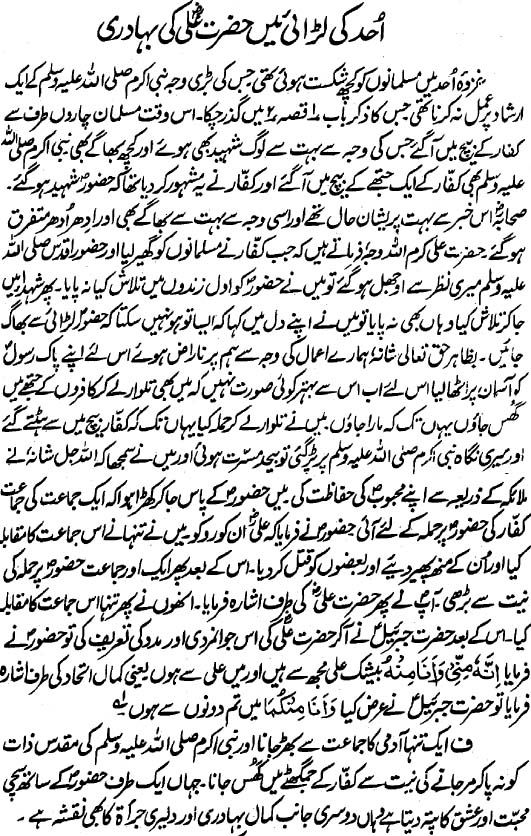
Uhad ki Larai Mein Hazrat Ali (RA) Ki Buhadari
Ibn Abbas’s Debate With Extremists
Abdullah Ibn Abbas narrates his debate when he approached the Khawaarij:
“I have come to you from the companions of the Messenger of Allah (peace be upon him), from the Muhajireen and the Ansar, so that I may inform you of what they say.
The Qur’an was sent down upon them. And they are more knowledgeable concerning the revelation than you, and it was revealed amongst them. And none of them are amongst you.”
So some of them said, “Let us speak with him and let us see what he says.” I said, “Inform me of that which you harbor against the son of the uncle of the Messenger of Allah (peace be upon him) and his son-in-law (Ali), the Muhajireen and the Ansar.”
They said, “Three issues.” I asked, “What are they?” They said, “As for the first of them, then he (Ali) has allowed men to judge in the affair of Allah, yet Allah said,
“…The judgement is for none but Allah…” (Qur’an, 12:40)
So it is not for men and it is not for judges.”
So I asked, “This is only one issue.”
They said, ‘As for the other issues, then he fought his enemies, yet he did not take any prisoners or war booty. So if those whom he fought were disbelievers, then their imprisonment and war booty has been made lawful. And if they were believers, then fighting them is not permissible.”
I said, “These are only two issues, so what is the third?”
They said, “Indeed, he erased the title, ‘Leader of the Believers’ from himself, so therefore he is the leader of the disbelievers.” I said, “Do you have anything besides this?” They said, “This is sufficient for us.”
So I said to them, “Do you hold that if I recite to you from the Book of Allah and the Sunnah of His Messenger (peace be upon him), that which refutes your statement, that you will obey?”
They said, “Yes!” So I said, “As for your statement that he has allowed men to judge concerning from the affair of Allah, then I shall recite to you that which shows that Allah relegated His judgment to men.
Allah the Mighty and Majestic has said concerning the woman and her husband,
” If you fear a breach between them twain (the man and his wife), appoint (two) arbitrators, one from his family and the other from her’s; if they both wish for peace, Allâh will cause their reconciliation. Indeed Allâh is Ever All-Knower, Well-Acquainted with all things.” (Qur’an, 4:35)
So Allah made the judgement of the men a tradition to be believed in. So do you leave this (issue)?” They said, “Yes!”
Ibn Abbas continued, “As for your statement that he fought and he did not take prisoners, nor did he take war booty, then do you revile your mother, Ayesha? Then you must declare her lawful in that which you have declared lawful with regards to other than her! So if you were to do that, then you would become disbelievers, as she is your mother. And if you were to say that she is not our mother, then you have disbelieved. Since, Allah says,
“The Prophet is closer to the Believers than their ownselves, and his wives are their mothers…” (Qur’an, 33:6]
So you are revolving around two positions of misguidance. Regardless of which of them you adopt, you have adopted misguidance.”
So they began to look at each other. I said, “Have you left from this?” They said, “Yes!”
“And as for your statement, that he erased the title of ‘Leader of the Believers’ from his name, then I shall come to you with one whom you are pleased with and I shall see you. Indeed, you have heard that on the day of Al-Hudaybiyyah, the Prophet (peace be upon him) made a treaty with Suhayl Ibn ‘Amr and Abaa Sufyaan Ibn Harb.
So the Messenger of Allah (peace be upon him) said to the Leader of the Believers (Ali), “Write O Ali: These are the terms of peace agreed upon by Muhammad the Messenger of Allah.” So the pagans said, “No, by Allah! Had we known that you were the Messenger of Allah, we would not have fought you.”
So the Messenger of Allah (peace be upon him) said, “O Allah! You know that I am the Messenger of Allah.
Write O Ali: These are the terms of peace agreed upon by Muhammad Ibn Abdullah.”(Bukhari and Muslim)
So by Allah, the Messenger of Allah was better than Ali, yet he was not removed from Prophethood when he erased the title from his name.”
Abdullah Ibn Abbas then said, “So two thousand of those people repented, and the rest were killed upon misguidance.”
– This incident has been related in Musnad Ahmad (1/342), An-Nisaa’ee in Khasaa’is Ali (no. 190), Al-Bayhaqee in as-Sunanul-Kubraa (8/179) and many others.
Umar Ibn Al Khattab Radiallahu Taala Anhu Loves The Ahle Bayt
Hazrat Umar E Farooq is regarded Highly in the Ummah after Syaddina Abu Bakr Siddique Radi Allahu taala anhu
The Holy Prophet said If there were a prophet after me it would be Hazrat Umar E Farooq Radi Allahu taala anhu.
Following is how Hazrat Umar E Farooq regarded the Ahle Bayt
Sayaddina Umar E Farooq radiallahu taala anhu narrates how the Holy Prophet used to regard his beloved daughter
Umar bin Khattab (radiallahu taala anhu ) (also) narrates that the Holy Prophet Sallalaahu Alaihi wasallam used to say to Fatimah (radiallahu taala anhu), “(Oh Fatimah!) My mother and father be sacrificed for you.”
Shawkani said in Darr-us-sahabah fi manaqib al – qarabah was-sahabah (p. 279)
Hakim narrated it in al -Mustadrak
Umar (raadiallahu taala anhu) narrates, “I heard the Holy Prophet Sallallahu Alaihi Wa Sallam say, ‘The family tree of the children of every woman is attributed to their father except for Fatimah’s(radiallahu tala anhu) children. I am their family and I am their father. ‘”
1. Tabarani, al -Mujam-ul-kabir (3:44#2631)
2. Ahmad bin Hambal, Fadai l-us-sahabah (2:626#1070)
3. Haythami, Majma-uz-zawaid (4:224)
4. Haythami, Majma-uz-zawaid (6:301
Sayadina Umar E Farooq Radi Allahu taala anhu narrates the relationship of the five to the Holy Prophet Muhammed Sallallahu Alaihi Wa Sallam
Umar bin Khattab (radiallahu taala anhu) states, “I heard the Messenger of Allah say, ‘Except for my family and my relationship, every family and relationship will be broken on the Day of Judgement.’”
1. Hakim, al-Mustadrak (3:153#4684)
2. Ahmad bin Hambal, Fadail -us-sahabah (2:625, 626#1069, 1070)
3. Ahmad bin Hambal narrat ed it i n Fadail -us-sahabah
(2:758#1333) through Miswar bin Makhramah as well.
4. Bazzar, al-Musnad (1:397#274)
5. Tabarani, al -Mujam-ul-kabir (3:44,45#2633, 2634)
6. Tabarani, al -Mujam-ul-awsat (5:376#5606)
7. Tabarani, al -Mujam-ul-awsat (6:357#6609)
8. Daylami, al -Fi rdaus bi mathur al -khitab (3:255#4755)
9. Maqdasi, al -Ahadith-ul -mukhtarah (1:198#102)
10. Haythami said i n Majma-uz-zawaid (9:173) Tabarani
narrated it in al-Awsat and al -Kabir and its chain of
transmitters is thiqah (trustworthy).
Once Sayiddina Umar E Farooq Radi Allahu taala anhu was said about the purified five on the Day of Judgement. and the following is what he said
Umar bin Khattab (Radhi Allahu taala anhu) narrates that the Holy Prophet(Sallallahu Alaihi Wa Sallam) said, “Indeed, Fatima, Ali, Hasan, and Husain(may Allah be pleased with them all) will live in a white dome in Paradise. The Throne of Rahman will be its roof .”
1. Ibn Asakir, Tari kh Dimi shq al -kabi r (14:61)
2. Hindi, Kanz-ul -ummal (12:98#34167)
Sayadina Umar E Farooq Radi Allahu taala anhu Congratulated Ali Al Murtuza (radiallahu taala anhu on the Great event of Ghadeer Ul Khulm) when the Holy Prophet Sallallahu Alaihi Wa Sallam declared the beginning of Wilayat
“It is narrated by Bara’ bin ‘Azib(radiallahu taala anhu): We were on a journey with Allah’s Messenger. (On the way) we stayed at Ghadir Khum. There it was announced that the prayer was about to be offered. The space under two trees was cleaned for Allah’s Messenger. Then he offered the zuhr (noon) prayer, and, holding ‘Ali’s(radiallahu taala anhu) hand, he said: Don’t you know that I am even nearer than the lives of the believers? They said: Why not! He said: Don’t you know that I am even nearer than the life of every believer? They said: Why not! The narrator says that he said while holding ‘Ali’ s hand: One who has me as his master has ‘Ali as his master. O, Allah! Befriend the one who befriends him (‘Ali) and be the enemy of one who is his enemy. The narrator says that after this ‘Umar ( bin al-Khattab(radiallahu taala anhu) met ‘Ali(radiallahu taala anhu) and said to him: O Ibn Abi Talib! Congratulations, you have become the master of every male and female believer, morning and evening (forever).”
Ahmad bin Hambal related it from Bara’ bin ‘Azib through two different chains of transmission in al-Musnad (4:281);
Ibn Abi Shaybah, al-Musannaf (12:78 # 12167);
Muhib Tabari, Dhakha’irul-‘uqba fi manaqib dhawi al-qurba (p.125),
ar-Riyad-un-nadrah fi manaqib-il-‘ashrah (3:126, 127);
Hindi, Kanz-ul-‘ummal (13:133, 134 # 36420);
Ibn ‘Asakir, Tarikh Dimashq al-kabir (5:167, 168);
Ibn Athir, Asad-ul-ghabah (4:103);
and Ibn Kathir in al-Bidayah wan-nihayah (4:169; 5:464).
Note the phrase in the following hadith where Hazrat Umar E Farooq(radiallahu taala anhu) Congratulated Ali Al Murtuza (radiallahu taala anhu)
‘Umar ( bin al-Khattab(radiallahu taala anhu) met ‘Ali(radiallahu taala anhu) and said to him: O Ibn Abi Talib! Congratulations, you have become the master of every male and female believer, morning and evening (forever).”
Ahmad bin Hambal in his book Fada’il-us-sahabah (2:610 # 1042)
has added the following words in the tradition related to ‘Umar bin al-Khattab.
The Prophet said: (O Allah!) Be the enemy of one who is his (‘Ali’s) enemy, and help him who helps him, and love him who loves him. Shu‘bah says that the Prophet said in its place, “Bear malice towards him who bears malice towards (‘Ali).”
Manawi has written that when Abu Bakr and ‘Umar had heard the Prophet’s saying — One who has me as his master has ‘Ali as his master — they said to ‘Ali: O son of Abu Talib! You have become the master of every male and female believer, morning and evening (forever).”
Manawi has written in Fayd-ul-Qadir (6:217)
Dhahabi has said in Siyar a‘lam-in-nubala’ that ‘Umar uttered the words:
O ‘Ali! Congratulations
Dhahabi has said in Siyar a‘lam-in-nubala’ (2:623, 624)
“AbuHurayrah has narrated that one who fasted on 18 Dhul-hijjah will receive a reward equal to 60 months of fasting. This was the day of Ghadir Khum when the Prophet, holding ‘Ali bin Abi Talib’s hand, said: Am I not the guardian of the believers? They said: why not, O Messenger of Allah! He said: One who has me as his master has ‘Ali as his master. At this, ‘Umar bin al-Khattab said: congratulations! O Ibn Abi Talib! You are my master and (the master of ) every Muslim. (On this occasion) Allah revealed this verse: Today, I have perfected your religion for you.”
1. Qur’an (al-Ma’idah, the Table spread) 5:3.
2. Khatib Baghdadi related it in Tarikh Baghdad (8:290);
3 Wahidi,Asbab-un-nuzul (p.108); Razi, at-Tafsir-ul-kabir (11:139);
4. Ibn ‘Asakir, Tarikh Dimashq al-kabir (45:176,177); Ibn Kathir, al
Umar E Farooq Radi Allahu taala anhu Respected Hazrat Fathima radiallahu taala anhu highly
Umar bin Khattab says that he went to the house of Fatimah the daughter of the Messenger of Allah and said, “Oh Fatimah! I swear by Allah that I have not seen anyone who is dearer to the Messenger of Allah than you. I swear by Allah that nobody is dearer to me than you after your father”
1. Hakim, al-Mustadrak (3:168#4736)
2. Ibn Abi Shaybah, al -Musannaf (7:432#37045)
3. Shaybani, al -Aahad wal -mathani (5:360#2952)
4. Ahmad bin Hambal, Fadai l-us-sahabah (1:364#532)
5. Khat ib Baghdadi, Tarikh Baghdad (4:401)
Hazrat Umar E Farooq Radi Allahu taala anhu regarded Hazrat Ali radiallahu taala anhu as his Maula after the Ghadeer declaration
“It is narrated by ‘Umar that once a person had an argument with him. He said: the man sitting here will decide between you and me, and he pointed towards ‘Ali. That man said: this pot-bellied person (will decide between us)! ‘Umar rose from his seat, caught him by the collar, and lifted him from the ground. Then he said: Do you know that the person you consider worthless is my master as well as the master of every Muslim.”
1. Muhib Tabari has said in ar-Riyad-un-nadrah fi manaqib-il-‘ashrah (3:128) that Ibn Samman has documented this narration
“It is narrated by ‘Umar that two Bedouins came to him disputing with each other. He said to ‘Ali: O Abu Hasan: decide between these two. So he decided between them (and settled their dispute). One of them said: Is he the only one left to decide between us? (At this) ‘Umar moved towards him and caught him by his collar and said: May you be dead! Do you know who he is? He is my master and the master of every believer ( and) one who does not acknowledge him as his master is not a believer.”
1. Muhib Tabari has narrated this tradition in Dhakha’ir-ul-‘uqba fi manaqib dhaw-il-qurba (p.126), and says that Ibn Samman mentioned it in his book al-Muwafaqah. He also narrated it in ar-Riyad-un-nadrah fi manaqib-il-‘ashrah (3:128).
Umar said: that one who has Allah’s Messenger as his master has ‘Ali as his master.
“ Salim narrates: ‘Umar was asked why he always treated ‘Ali differently from other Companions. (At this) ‘Umar replied: Indeed that ( ‘Ali) is my master .”
1. Related by Muhib Tabari in ar-Riyad-un-nadrah fi manaqib-il-‘ashrah (3:128).
Ibn ‘Asakir narrated it in Tarikh Dimashq al-Kabir (45:178).
Few people particularly the Shia have fabricated stories about Hazrat Umar radiallahu taala anhu Slapping bibi fathimatuz zuhra radiallahu taala anhu, and other stories about him burning their houses, etc, All these are fake as you can see from these References how he regarded the Ahle Bayt, the people from the Wilayat began, The Ahle Bayt.
People should understand that there are two legacies of the Holy Prophet Muhammed Sallallahu Alaihi Wa Sallam , one is the Spiritual Legacy and saintism which continued from the Progeny of the Holy Prophet Muhammed Sallallahu Alaihi Wa Sallam, and then to Awliya.
And the other legacy is outwardly, The Legacy of Dominion which continued through the Rightly Guided Khalifas beginning from Syedina Abu Bakr Siddique Radi Allahu taala anhu
Both the legatees gave support to each other wholeheartedly
Tanveer Pasha
Martyrdom Of Imam Ali Ibn Abu Talib
`Ali Ibn Abu Talib was the Prophet’s nephew; his father was Abu Talib Ibn Abdul Muttalib, and his mother was Fatimah bint Asad. He embraced Islam when he was just seven. He married Fatimah, the Prophet’s daughter and apple of his eye and the mistress of believing women in Paradise. Fatimah bore him Al-Hasan, Al-Husain, Zainab and Umm Kulthum.
On the Day of Khaibar, the Prophet, peace be upon him, said: “Tomorrow, I will give the banner to a man whom Allah will make victorious. That man loves Allah and His Messenger, and Allah and His Messenger love him.” On the next day, the Prophet, peace be upon him, summoned Ali and gave him the banner. Also, on the day of Tabuk, Ali was sad that the Prophet, peace be upon him, would leave him at home to take care of the household. Hence the Prophet said to him: “Aren’t you happy that you are for me exactly as Harun (Aaron) was for Musa (Moses), save that there is no Prophet after me?”
`Ali was one of the greatest heroes of Islam; he never refrained from fighting nor feared death in the cause of Allah. On the Battle of Badr, he fought along with Hamzah and `Ubaidah Ibn El-Harith against three of the enemies and the Muslim group won. On the Battle of Al-Khandaq, he fought `Amr Ibn Wudd, one of the strongest men in Quraish, and killed him. `Ali was assassinated by `Abdur-Rahman Ibn Muljam, may Allah curse him, on 17th Ramadam, 40 A.H. at the age of 58.
His Quotable Remarks:
Once he said: “The true scholar is the one who does not make the people despair of Allah’s Mercy, or make them heedless of His punishment, or gives them permission to disobey Him; or (he himself) discards the Qur’an for the sake of anything else, and there is no good in worship that is void of knowledge, and knowledge that is void of understanding and reading that is void of contemplation.”
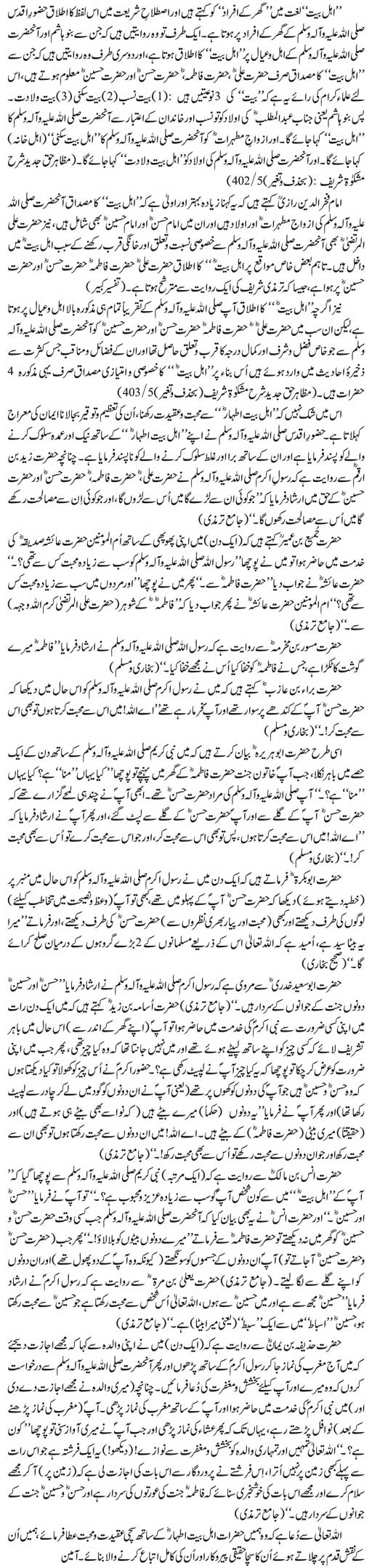
Ahl-al-Bayt Say Mohabbat Iman Ki Miraaj
10 Ways Of Honoring Servants
Most Muslims in Eastern countries employ domestic staff as a norm. For some, domestic helpers are a priceless resource who significantly ease our day-to-day chores. Conversely, for others, they can be a source of distress and chagrin.
Many women complain to each other about the trouble they face from the incompetence, treachery, and intentional misdemeanor of their servants. However, we need to remind ourselves that it is in managing our helpers according to Islamic injunctions that the secret lies to get the best out of them.
- Think of their pay as Sadaqah
We need to change the way we view our servants’ wages. By considering it an “expense,” we tend to extract the “full value” of the money. For instance, even if a maid is sick, her employer might say, “I pay her to work, so she must work.” But if we consider the salary a “Sadaqah” that helps fill their bellies, we will In Sha Allah be more tolerant of their shortcomings as human beings.
- Counsel them when they need it
You might notice that your domestic helpers are disturbed on some days. They are human beings who have problems and worries just like us. Ask them what is troubling them; then advise them to have patience and hope in Allah’s mercy. Keep the counsel short, but show them that you care.
- Forgive and forget their mistakes
Just like other human relationships, it is not pleasant to have your past mistakes and wrongs thrown in your face repeatedly. Forgive them for the sake of Allah if they wrong you, and do not be harsh when scolding them.
- Do not accuse them of stealing, cheating, or lying on mere suspicion
Many employers are guilty of this unfair action – as soon as something in the house is missing due to their own absentmindedness, the domestic helper is squarely accused of theft or negligence.
“O you who believe! Avoid suspicion as much (as possible): for suspicion in some cases is a sin.” (Qur’an, 49:12)
Ask them normally if they have seen the missing object, but do not accuse them of theft or misplacement. In most cases, the object is eventually found after the maid has been fired, causing guilt and embarrassment to the employer for life.
- Informally teach them Islamic manners and knowledge
One of the rights of our domestic helpers upon us is that they are taught about Islam, or given its message if they are non-Muslims. Without being overtly ‘preachy’, give them small doses of the truth. The best way is to act upon Islam yourself. This will eventually make them love and respect you for the sake of Allah – which results in a sincere relationship devoid of mistrust and treachery.
- Eat with them occasionally without separating utensils
Domestic helpers are not animals. Some people treat them as if they are unhygienic beings from another planet. Allow them to use the utensils from which you and your family eat. If they have dirty habits, teach them hygiene. But do not separate their utensils as if they are untouchables. This will make them feel insulted. They will never return an insult with loyalty or obedience.