TAG: Allah
Disobedience Removes Allah’s Blessings From Our Lives
Disobedience removes the blessings of one’s life, sustenance, knowledge, deeds and obedience. In short, it eradicates the blessings of religion and the material world. You will not find the least blessing in the life, religion or world of one who disobeys Allah. It is none other than the disobedience of creation that effaces blessings from the Earth. Allah says:
And if the people of the towns had believed and had Taqwa (piety), certainly, We would have opened for them blessings from the Heaven and the Earth. (Qur’an, 7:96)
The expanse of sustenance and deeds is not calculated by its quantity and nor is the length of one’s age determined by the number of months and years, but the expanse of sustenance is measured by the blessing within it. It has already been said that the age of the believer is the span of his life and that there is no life for the one who turns away from Allah and preoccupies himself with objects other than Him; the lives of beasts are better than his life.
The life of a person is determined by the life of his heart and soul, and his heart will have no life unless it knows its Maker; loves Him; worships Him alone; turns to Him in repentance; finds tranquillity in His remembrance and endearment by being near to Him. Whoever is denied this life has lost out on all good even if he compensates it with something of the world. In fact, the world in its entirety cannot compensate for such a life.
Everything the believer loses out on has a substitute but if he loses out on Allah, nothing at all can ever substitute Him. How can something that is inherently in need compensate for the One who is inherently self-sufficient; that is inherently incapable compensate for the One who is inherently able? How can one who does not own even the weight of an atom compensate for the One who possesses the dominions of the Heavens and the Earth?
The reason that disobedience of Allah eradicates the blessing of one’s sustenance and age lies in the charge of Satan with disobedience and its perpetrators. His authority is over them and he refers back to this office, its people and associates. The blessing of anything that connects and joins with Satan becomes obliterated; the mentioning of Allah’s Name was prescribed at times of eating, drinking, dressing, mounting and sexual relations because of the blessing associated to the Name of Allah. The mention of His Name expels Satan and cause blessings to materialize; nothing can challenge the name of Allah.
Anything that is not for Allah will have its blessing removed as it is the Lord alone who blesses and all blessings emanate from Him. Everything that is attributed to Him is blessed: His speech is blessed; His Messenger is blessed; His believing servant who benefits creation is blessed; and His Sacred House is blessed.
So none but He alone can bless and nothing besides what is attributed to Him is blessed, i.e., attributed to His servitude, love and pleasure since the whole universe is otherwise ascribed to His lordship and is His creation.
The direct opposite of being blessed is being cursed. The land, the person or action that Allah has cursed will be the most removed from any good or blessing. Anything that is associated and linked to it or is a route to it will contain no blessing whatsoever. Allah cursed His enemy, Iblis, and made him the furthest creation from Himself; everything that emanates from his side will bear the curse of Allah in proportion to its proximity and attachment to him. It is from this perspective that disobedience has the severest effect on removing the blessings of one’s age, sustenance, knowledge and actions. Any period of time in which Allah is disobeyed, any wealth, body, status, knowledge and action Allah is disobeyed with, will count against the doer and not for him. The only life, wealth, strength, status, knowledge and action he really possesses is that with which Allah is obeyed.
Likewise, one may own a tremendous amount of gold and silver but his actual wealth does not extend to a thousand dirhams or so. The case is the same for knowledge and status. It is related in At-Tirmidhi from the Prophet, “The world is cursed; everything in it is cursed except the remembrance of Allah and whatever ensues from it or a scholar and a student.” In another narration, “The world is cursed; everything in it is cursed except that which is for Allah.” This is what contains blessing specifically and Allah is the One Who is sought for help and upon Him we rely.”
– Excerpt from Al-Da’ wa Al-Dawa’/Islam21c
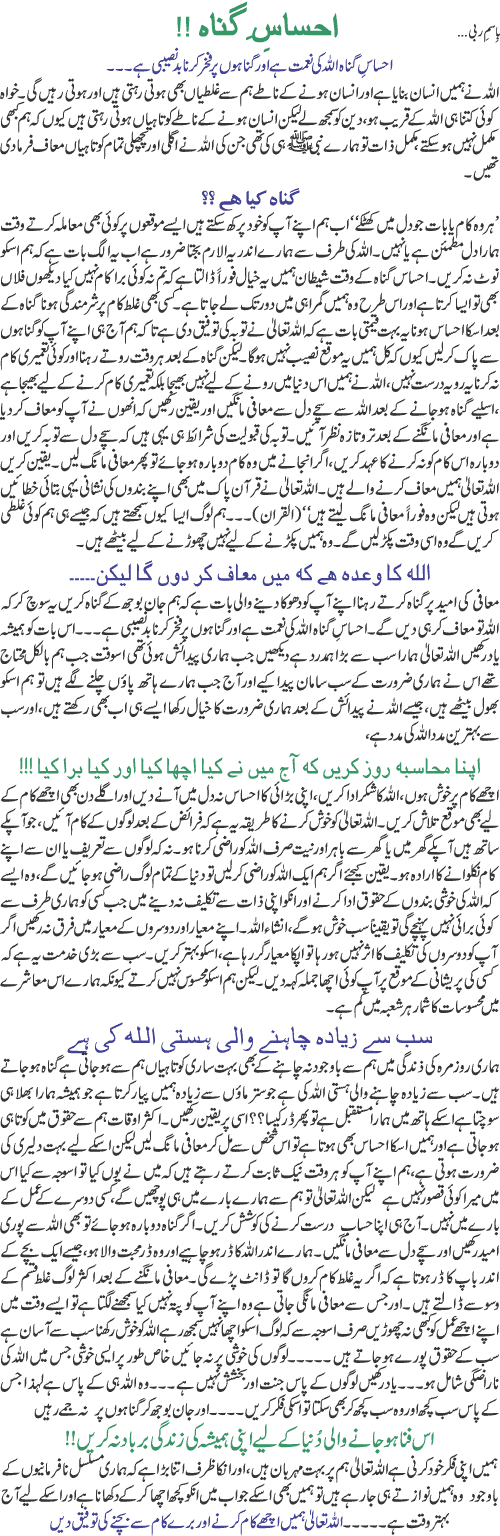
Ehsas e Gunah

Our Goal In Life
All Praise is for Allah, and peace and blessings of Allah be upon His beloved Messenger Muhammad sallallahu alayhi wa sallam.
We are grateful to Allah subhana wa ta’ala for giving us the opportunity to sit in His remembrance. For truly it is a great favor indeed that despite all worldly distractions He has brought us to His House (mosque). Then sat us in His dhikr. And by sitting in His dhikr Allah subhana wa ta’ala helps us to get closer to Him and for every Muslim the true goal in life is to attain the pleasure of Allah subhana wa ta’ala.
Apart from that we all have a common interest, that we would all like to love Allah subhana wa ta’ala and we ourselves would like to be loved by our Lord Most High.
Now is it not strange that a person has a certain desire or goal in life but doesn’t make any effort to achieve it?
Surely it is a basic rule in this world that when a person has a particular interest or hobby, he does not waste any time. He spends most of his time in an activity that will help him achieve his goal. For example if a person wants to be good at a particular sport, he would play that sport very regularly and often spend a lot of money and time on trying to achieve his objective.
So truly if our objective in life is to be loved by Allah, and we also know that this can happen through doing His dhikr in abundance, then why is it that we not make ourselves busy in His remembrance?
The formula for achieving this is straightforward, Allah subhana wa ta’ala has stated in the Qur’an ‘Fadhkurooni adhkurkum’ (Remember Me and I will remember you). It is stated in a Hadeeth that Allah remembers His servant as soon as he remembers Allah.
Subhan Allah, can you imagine the Lord Most High, The creator of the Heavens and the Earth remembering you? Indeed that is great thing. And this method for achieving our objective is so easy that it almost defies belief.
In a Hadeeth transmitted by Bukhari it is stated that Abu Hurayrah radhiallah anhu narrated that Allah’s Messenger sallallahu alayhi wa sallam said “Allah Almighty says, ‘I am towards My servant as he is towards Me. I am with him when he remembers Me. If he remembers Me alone, I remember him alone. If he remembers Me in a gathering, I remember him in a gathering better than it.”
Why Do Muslims Fast in Ramadan?
Fasting in the month of Ramadan is one of the pillars of Islam. Muslims observe the fast happily in obedience to Allah and to seek His reward. Ramadan is a great chance for Muslims to be united and maintain their faith. It teaches Muslims spiritual discipline, self-control, patience, and perseverance.
Muslims fast in order to obey the order of Allah, their Creator. Being All-Wise and All-Knowing, He alone knows what ails humans and what benefits them. As Muslims we believe that God Who created us has provided for our spiritual welfare even as He has provided for our physical needs. He did so by sending prophets and messengers who guided us unto the straight path, and by adhering to it, humans can realize their full humanity and attain ultimate felicity in this world and the next. Fasting in Ramadan, together with prayer, Zakah and pilgrimage to Makkah, is part of a comprehensive program whose purpose is to inculcate in humans true consciousness of their mission in life as God’s servants and develop the right attitude.
Among the many benefits of fasting are the following:
1) It deepens our spiritual awareness by inculcating God-consciousness.
2) It helps our bodies to recuperate and renew; it is comparable to the state of hibernation that all creatures in nature go through.
3) It helps us train in patience.
4) It creates empathy for the poor who are starving.
5) The month of Ramadan gives us a month-long training course to enable us to break free of our bad habits and develop new positive habits.
6) Through fasting we discover true spiritual identity, for too often our entanglements in the physical cares and concerns make us forget our true destiny: We proceed from God and we are ever journeying unto Him.
Muhammad’s (pbuh) Simple Life Proves His Prophethood
If we compare the life of Prophet Muhammad (peace be upon him) before and after his mission as a Prophet, we will conclude that it is unreasonable to think that Muhammad was a false prophet who claimed Prophethood to attain material gains, greatness, glory, or power. Before his mission as a Prophet, Muhammad (peace be upon him) had no financial worries.
As a successful and reputed merchant, he earned a satisfactory and comfortable income. After his mission as a Prophet and because of it, he became worse-off materially. To clarify this, let us look at the following sayings on his life:
Muhammad’s wife `A’ishah (may Allah be pleased with her) once said to her nephew, `Urwah ibn az-Zubayr, “O my nephew, we would sight three new moons in two months without lighting a fire (to cook a meal) in the Prophet’s houses.” Her nephew asked, “O aunt, what sustained you?” She said, “The two black things, dates and water, but the Prophet (peace be upon him) had some neighbors of the Ansar who had milch camels and they used to send the Prophet some of the milk.” Anas (may Allah be pleased with him) , a Companion of Prophet Muhammad (peace be upon him), said, “The Prophet (peace be upon him) did not eat at a table till he died, and he did not eat a thin nicely baked wheat bread till he died.”
Prophet Muhammad’s wife `A’ishah said , “The Prophet’s (peace be upon him) mattress on which he slept was made of leather stuffed with the fiber of the date-palm tree.”
`Amr ibn Al-Harith (may Allah be pleased with him), one of Prophet’s Companions, said that when the Prophet died, he left neither money nor anything else except his white riding mule, his arms, and a piece of land that he left to charity.
Prophet Muhammad lived this hard life till he died although the Muslim treasury was at his disposal, the greater part of the Arabian Peninsula was Muslim before he died, and the Muslims became victorious after 18 years of his Mission. Is it possible that Muhammad might have claimed Prophet hood in order to attain status, greatness, and power?
- May, 24
- 4693
- Prophet Character
- More
Islam Not A Religion Of Equality, But Of Justice
There are some people who speak of equality instead of justice, and this is a mistake. We should not say equality, because equality implies no differentiation between the two.
Because of this unjust call for equality, they ask, “What is the difference between male and female?” So they have made men similar to women. The communists said, “What difference is there between the ruler and the subject? No one has any authority over anyone else.” Not even the father over his son?! So they said the father has no authority over his son and so on.
Instead, if we say justice, which means giving each one what he or she is entitled, this misunderstanding no longer applies, and the word used is correct. Allah does not say in the Qur’an that He enjoins equality. He said (interpretation of the meaning):
“Verily, Allah enjoins Al‘Adl (i.e. justice)” (Qur’an, 16:90)
“And that when you judge between men, you judge with justice.” (Qur’an, 4:58)
Those who say that Islam is the religion of equality are lying against Islam. Rather Islam is the religion of justice, which means treating equally those who are equal and differentiating between those who are different.
No one who knows the religion of Islam would say that it is the religion of equality. Rather what shows you that this principle is false is the fact that most of what is mentioned in the Qur’an denies equality, as in the following verses:
“Say: Are those who know equal to those who know not?” (Qur’an, 39:9)
“Say: Is the blind equal to the one who sees? Or darkness equal to light?” (Qur’an, 13:16)
“Not equal among you are those who spent and fought before the conquering (of Makkah, with those among you who did so later.” (Qur’an, 57:10)
“Not equal are those of the believers who sit (at home), except those who are disabled (by injury or are blind or lame), and those who strive hard and fight in the Cause of Allah with their wealth and their lives.” (Qur’an, 4:95)
Not one single letter in the Qur’an enjoins equality, rather it enjoins justice.
You will also find that the word justice is acceptable to people, for I feel that if I am better than this man in terms of knowledge, or wealth, or piety, or in doing good, I would not like for him to be equal to me.
Everyone knows that it is unacceptable if we say that the male is equal to the female.
– By Sheikh Muhammad Bin Saleh Al-Uthaymeen
– Sharh Al-Aqeedah Al-Wasitah, 1/180-181
Paradise Is Not The Equivalent Of Deeds
Paradise is something of immense value; a person cannot earn it by virtue of his deeds alone – Muslim reported from Abu Hurayrah (ra) that the Prophet (saw) said,
“No one of you will enter Paradise by his deeds alone.” They asked, “Not even you, O Messenger of Allah?” He said, “Not even me, unless Allah covers me with His Grace and Mercy” [Saheeh Muslim, 4/2170, no. 2816]
The fact that some texts indicate that Paradise is the equivalent reward for deeds could be problematic, for example:
“No person knows what is kept hidden for them of joy as reward for they used to do.” [32:17].
However, there is no conflict between these aayaat and the meaning of the hadith. The aayaat indicates that good deeds will be a reason, not the price, for admission to Paradise. The hadith says that good deeds are not the price.
Two groups were misled in this matter: The Jabaariyyah, who took the hadith to mean that the reward is not connected to deeds, because man has nothing to do with deeds [i.e. everything is foreordained]; and the Qaadariyyah who took the hadith to mean that Paradise was the equivalent of good deeds, and man has the right to enter by virtue of his good deeds.
The commentator on at-Tahhaawiyyah said, “As for the idea that recompense results directly from one’s deeds, the Jabaariyyah and the Qaadariyyah are misled, and Allah has guided Ahl as-Sunnah. The ba’ of negation [nafyi] is not like the ba’ used for affirmation. The negation in the hadith “No one will enter Paradise by virtue of his deeds” [bi’ amaalihi] is the ba’ of substitution or exchange, as if good deeds were not the price of a man’s admission to Paradise. This is like the [false] Mu’tazili claim that good deeds will give a person the right to enter Paradise, whereas the truth is that admission to Paradise is by the Grace and Mercy of Allah. The bi’ in the ayah “a reward for what they used to do [jazaa’an bi maa kanoo ya’maloon]” [32:17] is known in Arabic grammar as the bi’ of causation, i.e. because of their deeds. But Allah is the Creator of Cause and Effect, so everything is referred back to His Grace and Mercy” [Sharh at-Tahhaawiyyah, 495]
- May, 15
- 4192
- Info, Paradise-Hell
- More
Jannah – Have You Ever Tasted, Seen It Or Felt It?
In Sahih Muslim, Abdullah Ibn Mas’ood narrates from Allah’s Messenger (peace be upon him) the warming story of the last man to escape Hellfire:
HIS crawl away from Hellfire is filled with his face slipping into the dirt, a tremoring walk, and a fire that licks him until he finally escapes.
When he is past it, he looks back, horrified, and announces with the loudest voice, “All praise is due to Allah Who saved me from you.” Then he says, most proud, “Verily I have been rewarded with something that no one from the beginning to the end of creation has been blessed with.”
At that moment, a tree catches his eye – a tree that was commanded to be raised for him. He quickly raises his hands, “O Allah! Allow me to draw near to that tree so that I can cool off under its shade and drink from its water.”
Then Allah calls him, “O son of Adam! If I grant you what you ask, you shall ask for more.”
“Nay, O Allah!” pleads the man and he testifies that he shall ask no more.
As the man basks in the glory of the tree, another tree is raised, one more bounteous and lush than the first. The man pleads, “O Allah! Allow me to draw near to that tree so that I can cool off under its shade and drink from its water.
- May, 1
- 3691
- Paradise-Hell
- More
Five Ways To Disobey Allah!
Ibn Qudamah Al-Maqdisi mentions a conversation between a young lad and the great scholar Ibrahim Bin Adham in his book Kitab At-Tawwabeen, page 285.
The young boy: O Abu Ishaq, I am wronging my soul, advise me with something that’ll hold me back from disobeying Allah and breathe new life into my heart.
Ibrahim Bin Adham: Alright. If you take five things from me and fulfill them, you can disobey Allah the Almighty all you want, and no harm will come to you.
Young boy: (Interested) Ok, tell me.
Ibrahim Bin Adham: One, if you want to do other than what Allah wants you to do, then do not eat the food that He provides you.
Young boy: Then where am I supposed to eat from when all the food on earth is from Allah?
Ibrahim Bin Adham: Dear lad, is it right that you eat the food Allah the Almighty has given you and then go off and disobey Him?
Young boy: No it is not right. What is the second?
Ibrahim Bin Adham: Two, if you want to live life to the fullest in disobedience of Allah, then don’t live on His land.
Young boy: That’s harder than the first. Where shall I live when all that is in the east and west belongs to Him?
Ibrahim Bin Adham: Dear boy, is it right that you eat His food and live in His land, yet still insist on turning your back when He calls you?
Young boy: No it’s not right. What’s the third?
Ibrahim Bin Adham: If you want to disobey Allah, yet still eat the food He gave you and still live in His land, then find a place where He can’t see you.
Young boy: O Abu Ishaq, how can that be so when Allah is the All-Seeing and All-Knowing of all that happens, even what the heart whispers?
Ibrahim Bin Adham: Dear boy, is it right that you eat His food and live in His land and disobey Him while He watches you and what you are exposing?
Young boy: No it’s not right. What’s the fourth?
Ibrahim Bin Adham: When the angel of death comes to snatch your soul, tell him to grant you a day so that you can sincerely ask Allah for forgiveness and change your life.
Young boy: He won’t grant me that.
Ibrahim Bin Adham: Dear boy, if you find yourself helpless to put off death for just one day and you know that it cannot be delayed by your wishes, how do you expect to win?
Young boy: (With a sigh) What is the fifth?
Ibrahim Bin Adham: When the gatekeepers of Hell will come to drag you away on your face to Hellfire refuse to go with them.
Young boy: Nothing will stop them.
Ibrahim Bin Adham: How do you expect to be saved then?
Young boy: Enough, Abu Ishaq. (And he lowers his head crying). O Allah, forgive me for my transgression.
Epilogue: Young boy went on to become a student of Ibrahim Bin Adham. He repented to Allah sincerely and lived an upright life with his teacher until death parted the two.
Imam Ibrahim Bin Adham died over a thousand years ago in the year 778 CE.