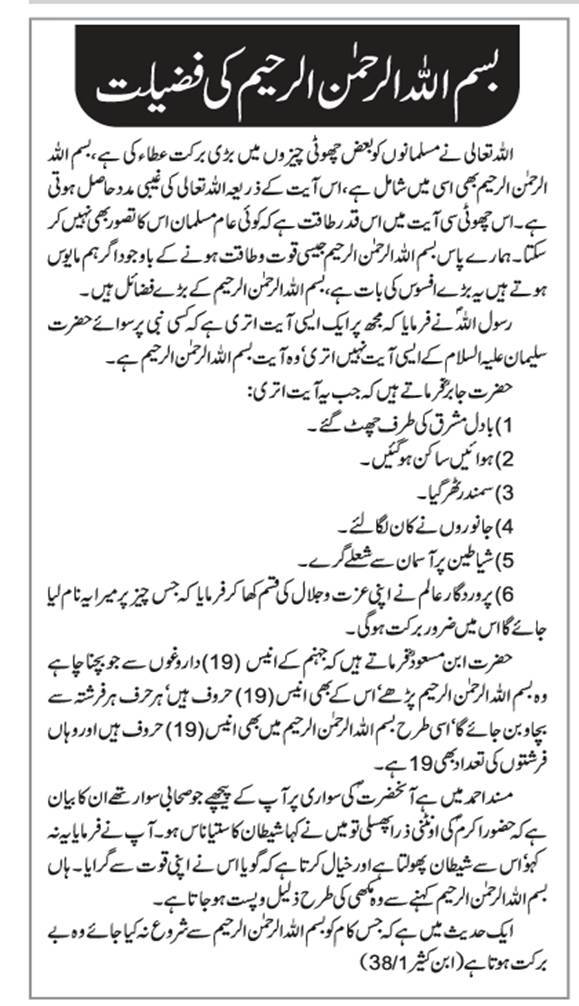
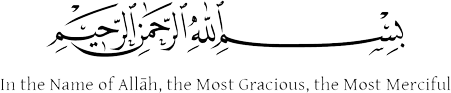
bismillah ki fazeelat

bismillah ki fazeelat
Khadija (radhiAllaahu anha – may Allah be please with her) was the first wife of Nabi [the Prophet] (sallallahu alaihi wasallam – may the peace and blessings of Allah be upon him) and she was the mother of Faatima (radhiAllaahu anha) and she was the maternal grandmother of Hassan and Hussein (radhiAllaahu anhuma – may Allah be pleased with them both). Her father’s name was Khuwailid, her paternal grandfather’s name was Asad, her mother’s name was Fatima, and her maternal grandmother’s name was Zaahida. She was a Quraishi. She married Nabi (sallallahu alaihi wasallam), when she was 40 years of age. At that time Nabi (sallallahu alaihi wasallam) was 25 years old.
Prior to her coming into Nabi (sallallahu alaihi wasallam)’s Nikah, she was married to two other persons, one after the after. She bore children for both of them. One of her previous husband’s name was Abu Haala, and the other was Ateeq bin Aa`id. There is a difference of opinion between the historians, regarding which husband was the first and which was the second. The author of “Isti`aab”, has preferred the opinion that Abu Haala was the first and Ateeq bin Aa`id was the second.
After Khadija (radhiAllaahu anha)’s two husbands passed away, one after the other, many noble persons were hopeful of marrying her owing to her honour, respect and wealth. However, what had happened was the desire of the Greatest, Allaah. Allaah Ta`ala (the All-mighty) had decreed that Khadija (radhiAllaahu anha) be honoured with marriage to the best of mankind (sallallahu alaihi wasallam). And that she be blessed with the title of “Ummul Mu`mineen” (Mother of the Believers).
When Nabi (sallallahu alaihi wasallam) reached the age of 25 years, his uncle Abu Talib, regretfully told him that he will not be able to financially assist him, and that times were tough. He suggested that Nabi (sallallahu alaihi wasallam) do as many other persons were doing, in that they were taking the merchandise of Khadija (radhiAllaahu anha), to Shaam (Syria), and selling it for a profit.
When Khadija (radhiAllaahu anha) heard that Muhammed Bin Abdullah Al-Ameen (sallallahu alaihi wasallam)’s uncle had advised him to take her goods to sell, she took the opportunity to send a message to the trustworthy, honest and veracious Nabi (sallallahu alaihi wasallam), and invited him to be an agent for her. She promised him twice the profit she usually paid her other agents. Rasulullah [the messenger of Allah] (sallallahu alaihi wasallam) accepted her offer and he took her goods to Shaam. Khadija (radhiAllaahu anha) sent her slave “Maisara” with him. Nabi (sallallahu alaihi wasallam) sold the merchandise very wisely, and Khadija (radhiAllaahu anha) reaped more profit that year , than she had in any of the previous years.
On the journey, Maisara, saw many unique things about Nabi (sallallahu alaihi wasallam) that he had never seen before. Whilst they were stationed under a tree, a Raahib (priest) asked Maisara, regarding the identity of Nabi (sallallahu alaihi wasallam). Maisara replied that he is a resident of Mecca and a Quraishi. The Raahib, said that he (Nabi (sallallahu alaihi wasallam)) will become a Prophet. He said this because he saw in Nabi (sallallahu alaihi wasallam) two signs of the Seal of Prophethood, which were recorded in the scriptures of old.
As the caravan reached Mecca, it was in the afternoon, and Khadija (radhiAllaahu anha) was sitting on the upper storey of her house, she saw two Angels shading Nabi (sallallahu alaihi wasallam). Besides this, she heard from her slave Maisara, other similar and very strange incidences which occurred during the journey. He also mentioned the incident regarding the Raahib, where he said Nabi (sallallahu alaihi wasallam) was to be the final Prophet. Thereafter Khadija (radhiAllaahu anha), sent a proposal of Marriage to Nabi (sallallahu alaihi wasallam).
The sister of Ya`la bin Umayya, Nafeesa, took the proposal. Nabi (sallallahu alaihi wasallam) accepted and his uncles, Hamza (radhiAllaahu anhu – may Allah be pleased with him), and Abu Taalib were pleased with this.
Hamza (radhiAllaahu anhu), Abu Taalib and other members of Nabi (sallallahu alaihi wasallam) came to Khadija (radhiAllaahu anha)’s house for the occasion of the Nikah (marriage). By that time, the mother of Khadija (radhiAllaahu anha) had passed away, and her uncle, Amar bin Asad, participated in the occasion. Besides him, there were other members of Khadija (radhiAllaahu anha)’s family also present at the Nikah.
The Mahr (dowry) was set at 500 Dirhams, on the Mashwera of Amar bin Asad, and Khadija (radhiAllaahu anha) was honoured with the title of Ummul Mu`mineen.
Ibn Abbaas (radhiAllaahu anhu – may Allah be pleased with him) reports that during the time of ignorance, the women of Mecca used to gather at joyous occasions. On one such occasionKhadija (radhiAllaahu anha) was also present. Suddenly a man appeared and said in loud voice: “Oh women of Mecca! There will be a Prophet from this city of yours, whose name will be Ahmed. If any of you get the opportunity to marry him then certainly do so.” The women, upon hearing this, set up a labyrinth (maze) – [in order to compete and see who the fortunate one will be]. Hadhrat Khadija (radhiAllaahu anha) tied a knot (as a guide), and she succeeded over all the others.
Khadija (radhiAllaahu anha) had the great honour of having been the first person to accept the message of Nabi (sallallahu alaihi wasallam). Prior to her acceptance, no man or woman, young or old, and no child had accepted the message.
“The first person to accept Imaan, from amongst the men and women was Khadija binti Khuwailid (radhiAllaahu anha)”.
Haafiz Ibn Katheer (rahmatullahi alaihi – may the mercy of Allah be upon him) writes in “Bidaya”, from Muhammed bin Ka`ab (radhiAllaahu anhu – may Allah be pleased with him): “The first person to accept Imaan (faith) from this Ummah (nation)was Khadija (radhiAllaahu anha). The first man (to accept Islaam) was Abu Bakr and Ali (radhiAllaahu anhuma – may Allah be pleased with them both).
Once Nabi (sallallahu alaihi wasallam) said the following in reply to a question of Aisha (radhiAllaahu anha – may Allah be pleased with her): “She (Khadija radhiAllaahu anha) was the first person to believe in me when others disbelieved. She attested to my message, when others falsified me. She assisted me financially when others deprived me. Allah Ta`ala blessed me with children from her, and not from any of my other wives.”
Khadija (radhiAllaahu anha) has great claim to Islaam’s rise to glory. Prior to Nabuwwat (Prophethood), Nabi (sallallahu alaihi wasallam), used to seclude himself in the cave of Hira. Khadija (radhiAllaahu anha) used to prepare provisions for Nabi (sallallahu alaihi wasallam), during these expeditions. Rasulullah (sallallahu alaihi wasallam) used to spend many consecutive nights in the cave. He used to return when his provisions were depleted, and go back again. On one such occasion when Nabi (sallallahu alaihi wasallam) was in the cave, occupied in Ibaadat (worship), an Angel appeared and ordered him to read (“Iqra!”). Nabi (sallallahu alaihi wasallam) said: “I am illiterate”. The Angel took hold of Nabi (sallallahu alaihi wasallam) and squeezed him against himself and let him loose. The Angel again said: “Iqra!”. Nabi (sallallahu alaihi wasallam) again gave the same reply. For the second time, the Angel squeezed Nabi (sallallahu alaihi wasallam), let him go and said: “Iqra!”. Nabi (sallallahu alaihi wasallam) again gave the same reply. The Angel squeezed Nabi (sallallahu alaihi wasallam), for the third time and thereafter, the Angel began reciting. He read the first five Aayaat (verses) of Surah (chapter) Qalam. After hearing these Aayaat, Nabi (sallallahu alaihi wasallam) memorised them and went home in fear. He told Khadija (radhiAllaahu anha): “Cover me with a blanket, cover me with a blanket!” She did as she was told and after a while, this fear gradually subsided in Nabi (sallallahu alaihi wasallam). Thereafter, Rasulullah (sallallahu alaihi wasallam) narrated the entire incident to Khadija (radhiAllaahu anha), and he said: “I feared for my life.”
Women are usually more feeble natured , and when they see men in a state of fear, they usually get more frantic. However, Khadija (radhiAllaahu anha), was not in the least bit fazed. She gave Nabi (sallallahu alaihi wasallam) courage and consoled him, saying: “Never, I take an oath in Allaah, Allaah Ta`ala will never place you in difficulty or disgrace you. (You have such great qualities and traits, that) You strengthen family ties, you take the burden of others, help the poor, serve the guests, and you assist the truth at times of difficulty.”
Khadija (radhiAllaahu anha), then took Nabi (sallallahu alaihi wasallam) to her cousin, Waraqa bin Nawfil. She told him: “Oh brother, listen to what he (sallallahu alaihi wasallam) has to say.” Waraqa, was an old man, whose eyesight was failing him. He was a devout and true Christian. He asked Nabi (sallallahu alaihi wasallam): “What did you see?” Nabi (sallallahu alaihi wasallam) narrated the entire incident to him. Thereafter, Waraqa said: “This is Namoos (the great Angel, Jibraeel – Gabriel(alaihi salaam – peace be upon him), who was sent to Moosa – Moses (alaihi salaam – peace be upon him). I wish that I was young and that I am alive when your nation will expel you.”
Haafiz Ibn Katheer (rahmatullahi alaihi – may Allah have mercy upon him) quotes in “Bidaya”, from Baihaqi, that during the initial stages of Nabuwwat, Khadija (radhiAllaahu anha) said to Nabi (sallallahu alaihi wasallam): “When Jibraeel (alaihi salaam) comes to you can you inform me thereof?” Nabi (sallallahu alaihi wasallam) replied in the affirmative. When Jibraeel (alaihi salaam) came, Nabi (sallallahu alaihi wasallam) told her: “Oh Khadija, here is Jibraeel.” Khadija (radhiAllaahu anha) asked Nabi (sallallahu alaihi wasallam): “Can you see him at this moment?” Nabi (sallallahu alaihi wasallam) replied: “Yes!” Khadija (radhiAllaahu anha) told Nabi (sallallahu alaihi wasallam) to stand up and sit on her right hand side. Nabi (sallallahu alaihi wasallam) accepted her request and did as she requested. Then, Khadija (radhiAllaahu anha) asked: “Can you still see Jibraeel (alaihi salaam)?” Nabi (sallallahu alaihi wasallam) replied in the affirmative. She then told him(sallallahu alaihi wasallam), to sit on her lap. Nabi (sallallahu alaihi wasallam) did this and she again asked: “Can you still see Jibraeel (alaihi salaam)?” Again Nabi (sallallahu alaihi wasallam) replied in the affirmative. Thereafter, Hadhrat Khadija (radhiAllaahu anha) removed her scarf and her hair was revealed. Then she asked: “Can you still see Jibraeel (alaihi salaam)?” Now, Nabi (sallallahu alaihi wasallam) said: “No, I cannot see him.” Upon hearing this, Hadhrat Khadija (radhiAllaahu anha) said; “Know, now for sure, that this is an Angel. You should remain steadfast, and accept the glad-tidings of Prophethood (because had it been shaitaan (the devil), that came to you, then when I revealed my hair, he would not have disappeared. (Angels are modest).” This incident displayed the intelligence and wisdom of Hadhrat Khadija (radhiAllaahu anha).
After Nabi (sallallahu alaihi wasallam) received Nabuwwat, he began preaching Islaam, and the Mushrikeen (idolaters) became his enemies, and they harassed Nabi (sallallahu alaihi wasallam) in various ways. The entire nation became his enemies, including (some) his close friends. During these extremely trying times, the only helpers he had was his uncle Abu Taalib, and his beloved wife, Khadija (radhiAllaahu anha).
Haafiz Ibn Katheer (rahmatullahi alaihi) writes in “Bidaya”:
“Hadhrat Khadija (radhiAllaahu anha) was the first to bring faith in Allaah Ta`ala and His Nabi (sallallahu alaihi wasallam). She testified to the message that he brought. Allaah Ta`ala alleviated the burden and tribulations from Nabi (sallallahu alaihi wasallam), owing to her acceptance. When Nabi (sallallahu alaihi wasallam) began preaching and the people turned his speech upside down, and they falsified him, then Allaah Ta`ala used Khadija (radhiAllaahu anha), to alleviate and lighten his grief and sorrow. When he returned home, then she would encourage him and give him fortitude. She used to testify his message.”
The following is written in the “Seerat of Ibn Hishaam”, regarding Khadija (radhiAllaahu anha): “Khadija (radhiAllaahu anha) was Nabi (sallallahu alaihi wasallam)’s, veritable Wazir (minister / right-hand), in so far as Islaam (history) is concerned.” Whatever affliction and difficulty came upon Nabi (sallallahu alaihi wasallam), his grief and sorrow were shared by Hadhrat Khadija (radhiAllaahu anha). She also bore many of the difficulties, together with Nabi (sallallahu alaihi wasallam). She gave excellent support, encouragement and motivation to Rasulullah (sallallahu alaihi wasallam).
by Iman Badawi
In the name of Allah, the source of Mercy, the Mercy-giving.
Reaping the opportunities in Ramadan:
The Prophet’s (may Allah send His blessing and peace upon him) companions used to say, “Let not the day that you fast and the day that you do not fast be equal.” It is important that one’s behavior, attitude, and outlook should not be the same on the day that one is fasting and when one is not fasting. There should be a change, as one is trying to worship Allah more, so one’s fasting should have an effect.
Lesson 1:
Gaining taqwa (fear of Allah)
Allah legislated fasting for gaining taqwa,
“O you who believe fasting has been prescribed upon you as it has been prescribed upon those before you, so that you may attain taqwa.” (meaning of Sooratul Baqarah (2):138)
Taqwa in this case means, to make a shield between oneself and Allah’s anger and hellfire. So we should ask ourselves when we break our fasts, ‘Has this fasting day made us fear Allah more? Has it resulted that we want to protect ourselves from the hellfire ?’
Lesson 2:
Drawing us closer to Allah
This is achieved by reciting and reflecting on Al-Qur’an during the night and the day, attending the Taraweeh prayers, remembering Allah, sitting in circles of knowledge, and for those who can, making umrah.
The Prophet (may Allah send His blessing and peace upon him) said, “An umrah in the month of Ramadan is equal (in reward) to performing a hajj.” (Ahmad & Ibn Majah).
Also for those who can make i’tikaf (seclusion) in the last ten days of Ramadan, so to leave all worldly pursuits and seclude oneself in a masjid just thinking of Allah, brings us closer to Allah.
When one sins, one feels distant from Allah. That is why one might find it hard to read and reflect on the Qur’an and come to the masjid. However, the obedient worshipper feels closer to Allah and wants to worship Allah more, because Allah forgives and is merciful.
Lesson 3:
Acquiring patience and strong will
Allah has mentioned patience more than seventy times in the Qur’an and has commanded patience in more than sixteen ways in His Book. So when one fasts, and gives up one’s food and drink, and one’s marital sexual relations for those hours, one learns restraint and patience. This ummah needs men and women that are strong-willed, who can stand upon the Sunnah and the Book of Allah and not waver in front of the enemies of Allah. We do not need emotional people, who raise slogans and shout, but when the time comes to stand upon something firm, they cannot do so, they waver.
Lesson 4:
Striving for Ihsan (righteousness & sincerity)
and staying away from Riya (showing off
Ihsan means to worship Allah as if one sees Him, for if one does not see Him, He sees all. Hasan al-basri said, “By Allah in the last twenty years, I have not said a word or taken something with my hand or refrained to take something with my hand or stepped forward or stepped back, except that I have thought before I have done any action,’ Does Allah love this action? Is Allah pleased with this action ?’ ” So when one is fasting, one should gain this quality of watching oneself and also staying away from riyah (showing off).
That is why Allah said in a Qudsi hadith, “..Fasting is for Me and I will reward it..” (Bukhari) Allah singles out fasting from all other types of worship saying, “..Fasting is for Me..”, because no one knows whether you are fasting or not, except Allah. For example, when one is praying or giving charity, or making tawaf, one can be seen by the people, so one might do the action by seeking the praise of the people.
Sufian at-thawri used to spend the nights and the days crying and the people used to ask him, “Why do you cry, is it due to the fear of Allah ?”, he said,’ No.’, they said, “Is it due to the fear of the hell-fire ?”, he said, ‘No. It is not the fear of Allah that makes me cry, what makes me cry is that I have been worshiping Allah all these years and doing scholarly teaching, but I am not certain that my intentions are purely for Allah.’
Lesson 5:
Refinement of manners, especially those related to truthfulness and discharging trusts.
The Prophet (may Allah send His blessing and peace upon him) said,”Whoever does not abandon falsehood in word and action, then Allah, the Mighty and the Majestic has no need that he should leave his food and drink.” (Bukhari)
And the Prophet (may Allah send His blessing and peace upon him) said, “It may be that a fasting person attains nothing but hunger and thirst from his fast.” (Ibn Majah)
What we learn from this, is that we must pay attention to the purification of our manners. The Prophet (may Allah send His blessing and peace upon him) said, “I was sent to perfect good manners.” (Muwatta) So we must check ourselves, are following the behavior of the Prophet (may Allah send His blessing and peace upon him). For example, Do we give salam to those we don’t know and those we do know? Do we follow the manners of Islam, by telling the truth and only telling the truth? Are we merciful to the creation?
Lesson 6:
Recognizing that one can change for the better
The Prophet (may Allah send His blessing and peace upon him) said, “Every son of Adam sins, and the best of the sinners are those who repent.” (Ibn Majah) Allah provides many opportunities to repent to Him and seek His forgiveness. If one was disobedient they can become obedient.
Lesson 7:
Being more charitable
Ibn Abbas said, “The Prophet (may Allah send His blessing and peace upon him) was the most charitable amongst the people, and he used to be more so in the month of Ramadan when Gibreel used to meet him every night of Ramadan till the end of the month. The Prophet (may Allah send His blessing and peace upon him) used to recite the Holy Qur’an to Gibreel.” (Bukhari)
The Prophet (may Allah send His blessing and peace upon him) said, “He who gives food for a fasting person to break his fast, he will receive the same reward as him, without nothing being reduced from the fasting person’s reward.” (Tirmidhi )
Lesson 8:
Sensing the unity of the Muslims
The Prophet (may Allah send His blessing and peace upon him) said, “…Those of you who will live after me, will see many differences. Then you must cling on to my Sunnah and the Sunnah of the rightly guided Khalifah. Hold fast to it and stick to it..” (Abu Dawud)
It is possible for Muslims to be a single body, but this will only be achieved when obedience is only to Allah and His Messenger. One senses unity because the Muslims pray and fast together.
Lesson 9:
Learning discipline
The Prophet (may Allah send His blessing and peace upon him) said, “Bilal makes the adhan, while it is still night; therefore, eat and drink until Ibn Umm Maktum makes the adhan.” (Bukhari)
The Prophet (may Allah send His blessing and peace upon him) made us adhere to this strictness. Similarly one cannot knowingly break the fast before the sunset, as this will not be accepted by Allah. Muslims should learn to be very strict in their lives because they are people of an important message, which they mold their lives around.
Lesson 10:
Teaching the young to worship Allah
It was the practice of the people of Madinah, that during the fast of Ashura (which is now a recommended fast of one day) to get their children to fast with them. When the children would cry from hunger and thirst, their parents would distract their attention by giving them some sort of toy to play with. The children would break their fast with their parents. (mentioned in Bukhari) So the young should be brought to the masjid and they should pray with their parents so that they are able to get into the habit of becoming worshippers of Allah.
If one does not encourage children to fast when they are young, they will find it very difficult to fast for thirty days at the age of puberty. This is why the Prophet (may Allah send His blessing and peace upon him) said, “Command your children to pray at the age of seven and beat them at the age of ten (if they do not pray)” (Hakim)
Lesson 11:
Caring for one’s health
Fasting teaches Muslims to take care of their health and to build strong bodies. The Prophet (may Allah send his blessing and peace upon him) said,”A strong believer is better and is more beloved to Allah than a weak believer, and it is good in everyone.” (Muslim)
O, Allah!
For us let this month of Ramadan be a period of peace,
faith safety and total submission to Thy will;
make us walk apace swiftly to that
which Thou likes and approves.
O, Allah!
Pour out many blessings on us in this month, make available for us its generous good and assistance, and keep us safe from the harm, evil, misfortune, and mischief that may try to trap us in this month.
(Aameen)
May Allah Subhanuhu Wa Ta’ala keep all of us guided on Siraat-al-Mustaqeem, and grant us the taufeeq to utilize this most blessed month of Ramadan. May Allah accept our fasts, sujood o qayam, and Tauba for indeed His mercy prevails over His wrath, and indeed we are sinners in dire need of Allah’s mercy.
(Aameen Ya Rabb-ul-Aalaameen)
Wassalamu Alaykum Wa Rahmatullah!
Let there arise out of you a group of people inviting to all that is good (Islam), enjoining Al-Ma’ruf (i.e. Islamic Monotheism and all that Islam orders one to do) and forbidding Al-Munkar (polytheism and disbelief and all that Islam has forbidden). And it is they who are successful. (3:104)
O you who believe! Eat not Riba (usury) doubled and multiplied, but fear Allah that you may be successful.(3:130)
And obey Allah and the Messenger (Muhammad PBUH) that you may obtain mercy. (3:132)
And march forth in the way (which leads to) forgiveness from your Lord, and for Paradise as wide as the heavens and the earth, prepared for Al-Muttaqun. (3:133)
Those who spend (in Allah’s Cause) in prosperity and in adversity, who repress anger, and who pardon men; verily, Allah loves Al-Muhsinun (the good-doers). (3:134)
Dont’s
Surely, We have sent down to you (O Muhammad PBUH) the Book (this Qur’an) in truth that you might judge between men by that which Allah has shown you (i.e. has taught you through Divine Revelation), so be not a pleader for the treacherous. (4:105)
sisterhood in Islam is something very special that a sister who has come from a life as a non-Muslim and embraced this beautiful religion of Islam notices immediately. Her sisters in Islam treat her in a manner that no one has ever done before, not even her family.
So what makes this relationship so special?
She Loves Them as Sisters For the Sake of Allah
It doesn’t matter what your skin color is, the language you speak, or the status of your family, or whether you are rich or poor, in Islam we are all united like a single family. Our belief in Allah united us: “The Believers are but a single brotherhood…” [Noble Quran 49:10]
Prophet Muhammad (peace be upon him) said: “There are three things that whoever attains them will find the sweetness of faith: if Allah and His Messenger are dearer to him than anyone or anything else; if he loves a person solely for the sake of Allah; and if he would hate to return to Kufr after Allah has rescued him from it, as much as he would hate to be thrown into the Fire.” [Bukhari and Muslim]
The Status of Two Who Love One Another For the Sake of Allah
There is great reward in loving one another for the sake of Allah: “Where are those who loved one another for My glory? Today I will shade them in My shade on the Day when there is no shade but Mine.” [Muslim]
Prophet (peace be upon him) said: “A man went to visit a brother of his in another village. Allah sent an angel to wait for him on the road. When the man came along, the angel asked him, ‘Where are you headed?’ He said, ‘I am going to visit a brother of mine who lives in this village.’ The angel asked, ‘Have you done him any favor (for which you are now seeking repayment)?’ He said, ‘No, I just love him for the sake of Allah.’ The angel told him, ‘I am a messenger to you from Allah, sent to tell you that He loves you as you love your brother for His sake.'” [Muslim]
And we are encouraged to tell one another, to promote a loving bond between each other: Anas said that a man was with the Prophet (peace be upon him) when another man passed by. The first man said, “O Messenger of Allah, indeed I truly love this man.” The Prophet (peace be upon him) asked him, “Have you let him know that?” He said, “No.” The Prophet (peace be upon him) said, “Tell him.” He caught up with him and told him, “Truly I love you for the sake of Allah,” and the man said, “May Allah love you who loves me for His sake.” [Abu Dawud]
Effect of Love for the Sake of Allah on the Life of a Muslim Woman
It is important that we greet one another in the proper Islamic manner:
The Prophet (peace be upon him) said: “By the One in Whose hand in my soul, you will not enter Paradise until you believe, and you will not believe until you love one another. Shall I not tell you of something that if you do it, you will love one another? Spread Salam amongst yourselves.” [Muslim]
And when one of us is hurting, oppressed or suffering in some way, we all feel it:
“The believers, in their mutual friendship, mercy, and affection, are like one body: if any part of it complains, the rest of the body will also stay awake in pain.”