

Badr Ka Muqabla Bara ibn Azib (radi Allahu anhu) Ka Shoaq
TAG: Badr
No Time Like Ramadan Time: “Golden Hours On Angel Wings”
Soon, once again, the blessed month of Ramadan will be with us; once again, like “golden hours on angel wings”, will descend upon us in its blessed moments. Like every other year since Hijrah, it will summon Muslims, as individuals and as a corporate body, to an intense and sustained life of Fasting and Prayer, of worship and obedience, of devotion and discipline all centered on the Quran which, too, was sent down in these very moments in the custody of ‘noble and trustworthy’ angels. The call will go forth to every believer to take to prolonged companionship with the Book of God. To a life of redoubled endeavor to become what God desires Muslims to be. Ramadan bids our hearts and minds, our society and polity, to come to.
Joyfully and dutifully the Muslims will respond. Every day will be spent in Fasting: from dawn to sunset, for one whole month, not a morsel of food, nor a drop of water, indeed nothing shall pass down the throat; nor will sex be indulged in. Each night. hours will be devoted to standing in Prayers before Allah, reciting and reading His words as sent down in the Quran. During the day, too, reading the holy text will be a cherished business.
Fasting, in one form or another, has always been an important and often necessary part of religious life, discipline, and experience in every faith. As a means par excellence to come nearer to God, to discipline the self, to develop the strength to overcome the temptations of the flesh, it needs no emphasis. Yet Islam turns Fasting, as it does every other act of worship and devotion, into something different and unique, the life-giving center of life.
How does it impart new meaning and force to Fasting?
Put simply: by prescribing for it the time of Ramadan. This may sound like making things too simplistic or trivializing the important. But Ramadan is no trivial event. For it is the month “in which was sent down the Quran: the Guidance for mankind, with manifest truths of guidance and the Criterion [by which to judge the true and the false” (Al-Baqarah 2:185). It was on a night in Ramadan that the last Divine message began to come down: “Read in the name of your Lord…” (Al-Alaq 96:1). That is why you must fast in Ramadan, says the Quran.
Ramadan, therefore, centers the entire discipline of Fasting on the Quran. The sole purpose is to prepare us for receiving the Divine guidance, for living the Quran, for witnessing the Truth and Justice that it perfects, for striving to make the word of God supreme.
How is this purpose achieved?
The fruit of Fasting ought to be that rich inner and moral quality that the Quran calls taqwa. “Ordained for you is Fasting . . . so that you might develop taqwa” (2:183). The most basic condition for being guided by God, too, is taqwa. The significance is plain to see. Fasting, linked to Ramadan in which Allah’s guidance came down, generates taqwa which becomes directed on the supreme goal of entering the world of the Quran and of living therein, instead of being a spiritual ecstasy to be frittered away in the delights of the soul. It becomes the key with which can be unlocked all the doors leading to the blessings which the Quran has to offer; honor, prosperity, and freedom from fear and anxiety in this world; success, Paradise and God’s good pleasure in the life-to-come. No time for Fasting other than Ramadan could have made taqwa such a potent force.
More importantly, the fulfillment of being guided by the Quran comes about when we strive to discharge the mission it entrusts to us. For, having the Book of God ‘a weighty word’ places on our shoulders a heavy responsibility: to hear is to make it heard, to know is to act, to have is to share, to say shahadah is to do shahadah. This means an unflinching pursuit to create a new self within us, and to create a new world of Quranic ideals outside us.
This is the sole purpose for which a new Ummah was created and charged with the mission of bringing man to God by witnessing to His guidance, ‘so that you be witnesses unto mankind, and the Messenger be witness unto you’ (Al-Baqarah 2: 143). Otherwise, when the Quran came, the world was not devoid of godly men who fasted, and stood in prayers before God and wept.
Discharging that mission requires immense inner and moral resources like knowledge of and devotion to the Quran, strong faith (Iman), resolve, and steadfastness (sabr). For it is no light task. Few have a full and clear understanding of what it means. Let us pause here and reflect on why otherwise we shall never grasp what the Ramadan Fasting is for and what it achieves.
When in Ramadan the first ray of Divine revelation reached the Prophet, blessings and peace be on him, in Hira, its message of Iqra was impregnated with world-shaking forces; he, therefore. trembled. The second revelation made things clear: ‘arise and warn; make the greatness of your Lord the greatest’ (Al-Muddaththir 74:2-3); he, then, took up his task with a single-minded dedication, and encountered stiff opposition. For, the call to ‘let God be the Greatest’ (fakabbir) implied that all false claiments ‘ and every claimant is false ‘ to greatness, to unlimited power, authority and lordship over men and things, to obedience, loyalty, and servitude from God’s creatures be challenged, and dethroned.
This, it is not difficult to see, requires supreme sacrifices in ‘giving up’ (Hijrah) everything one loves and fighting with all that one possesses for the sake of that love of Allah which must be greater than all else (Al-Baqarah 2:165). A life of Jihad therefore necessarily requires important qualities: knowledge of and devotion to the Quran, deep and strong faith (Iman), resolve and steadfastness (sabr), total trust (tawakkul), and, of course, taqwa. Read the Quran and you will find every promise of success here and in the Hereafter conditional upon these qualities.
Fasting, combined with the Quran recital in night prayers, generates these rich resources which Ramadan harnesses to the fulfillment of the Quranic mission.
First, look at taqwa. What is it? Literally, it means saving ourselves from harm. In the moral life, therefore, taqwa must primarily mean. firstly, accepting that some actions and beliefs are harmful, that is to say, right and wrong do exist, and secondly, having the resolve and will to avoid the wrong and do the right. As a consequence, thirdly, his conduct should reflect this consciousness and resolve, if he is not a hypocrite.
To have the Quranic taqwa, which will entitle us to its guidance, we must know that there are realities and values beyond matter, beyond what we are incapable of perceiving by our physical senses, beyond this world, that man needs to be guided to what is right and what is wrong, (yu’minuna bil- ghayb). We should also be prepared to submit, willingly, all that we possess ‘mind, body, wealth’ to the truth that we know and believe (yuqimunas salata wa mimma razaqnahum yunfiqun).
Every moment in Ramadan engraves these lessons on our hearts. Integrates them in our practice. The most elementary physical needs ‘food and water and sleep’ are readily and joyfully sacrificed. Hunger and thirst are no more harmful; God’s displeasure is. Physical pleasures no more hold any lure; God’s rewards do. The scale of values is turned upside down. The measure of comfort and pain, success and failure are radically changed. Without this change, none is entitled to take up Allah’s cause.
To the uninitiated, or an outsider, the devotional regimen of Ramadan may appear harsh and austere, but, in fact, it is eagerly awaited by believers. The sighting of the new moon, the crescent that signals the beginning of Ramadan is met with celebrations and jubilation. Even children ‘ who are not required to fast’ look forward to their first experience of Ramadan fasting. The sick, too, remain restless for having been deprived of this blessing. Such jubilation and eagerness, to sacrifice time, wealth, and life in submitting to whatever God asks of us, and regret and sorrow if prevented from doing so for reasons beyond our control, is highly desirable in the way of Allah.
These qualities spring from genuine faith in the heart. For a Muslim, the fast is primarily a commandment to his person, though its collective aspect is no less important. Little wonder, then, that individuals gladly take on the tribulations of Ramadan as an expression of their faith. Just as Fast is something special between man and his God which only He can reward, so should we take Jihad to be.
Whatever the physical discomfort, the mortification of the flesh is certainly not the desired object in Islam. The gifts of God are there to be enjoyed, but the limits by Him must also be strictly observed ? that is another lesson of taqwa in Ramadan. As the sun sets, the fast must be broken, and sooner the better. All that became forbidden at His command, becomes permissible, again at His command.
Similarly eating before dawn is strongly urged, even though the hour is unearthly. For it provides the necessary strength for the rigors of the day ahead. Fasting and praying are obvious acts of worship but eating, drinking, and sleeping, too, constitute forms of worship. So in the way of Allah: what matters is His command, the whole life must witness to Him.
The month-long regimen of dawn-to-sunset abstinence from food, drink, and sex, for the sake of Allah alone, internalizes the lesson that one must never touch, acquire or enter that which does not belong to one under the law of God. A man can no more remain a slave to his own self-indulgence as he prepares for the arduous journey on the road to his Lord.
For many, it is difficult to see the value of long hours of hunger, thirst, and sleeplessness. Productivity losses are difficult to accept in an age that has tried to make gods of gross national product and economic growth. According to Islam, however, man is created to live a life of total submission to the One and Only God, and this purpose must be paramount in all scales of values. Ramadan fasting is crucial to this understanding. It shows that its purpose, like God’s guidance through His Prophets and Books and all other rituals of worship, is to train the believer in how he must live totally and unreservedly, at all costs, in submission to God.
Obedience, let there be no misunderstanding. is not limited to mere outward conformity with the letter of law. The law must be observed, but evil, in all its forms, must be eschewed. lbn Maja the great Hadith scholar, reports that the Prophet said: When the month of Ramadan arrives, the gates of Paradise are flung open while those of Hell are closed. All the shayatin (satans) are put in chains and a herald cries out. ‘O you who seek good come here and those who desire evil desist’.
Imam Bukhari, the most renowned Hadith scholar narrates: Eyes should refrain from seeing evil, ears from hearing evil, heart from reflecting evil, tongue from speaking evil. The Prophet said: “One who does not give up speaking false words and acting by them is not required by God that he give up only his food and drink.” On another occasion, he said: “Many are the observers of fast who gain nothing from their fast but hunger and thirst” (Darimi).
As a collective experience Ramadan suffuses the entire life of communities with the spirit of taqwa; even the air, it seems, is changed with a new fervor. In Ramadan, we can see a beautiful example of how Islam unites the individual and the society under the sovereignty of One Lord alone.
In Ramadan, therefore, the demands of Allah take precedence over all other demands; no part of the personality, no aspect of our life remains outside His writ, even aspects as mundane as timings for eating and going to bed. Thus, a will is strengthened, a determination is reinforced, the spirit of sacrifice is intensified, self-control is heightened.
But, above all, the life in Ramadan revolves, as it must, around the Quran which, as the Word of God, must become the core of all devotional activities. At least one reading of the Quran is a required duty during nightly Prayers, after the ‘Isha.’ But it ought to be extensively recited both within and without ritual prayers. Ramadan is not only the annual celebration of the coming down of the Quran by disciplining every moment of life into the surrender of God, it is also the occasion for heart and mind to get absorbed in its words and teachings.
Closely linked to fasting is the nightly prayer. Sleep is deliberately avoided to enter into communion with God’s words, to prostrate before Him, and thus to move nearer to Him. It is during the quiet and calm of the night that we can dwell upon God’s words, and the truths which might otherwise elude us can be grasped.
No time is like Ramadan time. For in it lies that night which is ‘better than a thousand months, the ‘Night of Destiny … in it the angels and the Spirit descend’ (AlQadr 97:1-4). It is ‘that blessed night in which was made distinct everything wise’ and ‘a warning’ and a ‘mercy’ was sent down which God has always sent for mankind (AlDukhan 44: 3-6).
That is why Fasting is placed in Ramadan. In this technological age, when the clock has become the only measure of time and every concept of the sacredness of time has been erased from human memory, some may find it difficult to visualize how every moment of Ramadan encompasses centuries in it, how it allows us to draw nearer to God at a much faster pace. Acts of virtue during the month are especially rewarded; an obligatory act (fard) increases seventy times; a voluntary one (nafl) is rewarded like the obligatory. Each of its moments offers the immense possibility of great spiritual journeys. As the poet Iqbal said:
Far though the valley of love may be,
a long and terrible way,
The path of a hundred years maybe
traveled at times in a sigh.
If Ramadan is blessed because the Quran began to come down in this month; it is blessed, too, because the Quran triumphed in this month. The Quran is the al-Furqan (criterion by which to judge the truth and the falsehood); in Ramadan falls that day which the Quran calls the Yawmul Furqan, Day of Criterion, on which the truth and the falsehood were judged, and the Truth triumphed. That was the Day of Badr when the Prophet, blessings, and peace be on him, beseeched God for help and victory thus: O God if this group perishes today, You will not be worshipped anymore’ (Ibn Ishaq). This was both a petition and a pledge; an expression of the final goal of all of his strivings, and of what our lives ought to be devoted to. Only an inattentive mind can ignore the significant link between al-Furqan descending in Ramadan. and Yaum al-Furqan falling in Ramadan.
Thus, to come back to the center: Ramadan reminds us of our mission, the only purpose of our existence as Muslims. It prepares us to discharge that mission; it deepens our consciousness, brings us closer to Quran and the Prophet, blessings and peace be on him, strengthens our resolve, schools us to taqwa and patience.
The end of Ramadan brings Eid-al-Fitr. the feast of the breaking of the fast, which celebrates the revelation of the Quran. The Quran makes it clear: ?that you complete the number, and proclaim the greatness of God for His having guided you, and that you render your thanks’ (2:185). Man’s response to the Divine initiative of guidance must be gratitude and extolling Him as the Greatest. That is why constantly on lip is the tasbih: Allahuakbar. . . walillahil-Hamd.
Even so, the heart still remembers wistfully the trying days and the silent, busy nights when the soul was engulfed in the dawn of light and cries out:
Stand still, you ever-moving
sphere of heaven,
That time may cease, and
midnight never come.
Martyrdom Of Imam Ali Ibn Abu Talib
`Ali Ibn Abu Talib was the Prophet’s nephew; his father was Abu Talib Ibn Abdul Muttalib, and his mother was Fatimah bint Asad. He embraced Islam when he was just seven. He married Fatimah, the Prophet’s daughter and apple of his eye and the mistress of believing women in Paradise. Fatimah bore him Al-Hasan, Al-Husain, Zainab and Umm Kulthum.
On the Day of Khaibar, the Prophet, peace be upon him, said: “Tomorrow, I will give the banner to a man whom Allah will make victorious. That man loves Allah and His Messenger, and Allah and His Messenger love him.” On the next day, the Prophet, peace be upon him, summoned Ali and gave him the banner. Also, on the day of Tabuk, Ali was sad that the Prophet, peace be upon him, would leave him at home to take care of the household. Hence the Prophet said to him: “Aren’t you happy that you are for me exactly as Harun (Aaron) was for Musa (Moses), save that there is no Prophet after me?”
`Ali was one of the greatest heroes of Islam; he never refrained from fighting nor feared death in the cause of Allah. On the Battle of Badr, he fought along with Hamzah and `Ubaidah Ibn El-Harith against three of the enemies and the Muslim group won. On the Battle of Al-Khandaq, he fought `Amr Ibn Wudd, one of the strongest men in Quraish, and killed him. `Ali was assassinated by `Abdur-Rahman Ibn Muljam, may Allah curse him, on 17th Ramadam, 40 A.H. at the age of 58.
His Quotable Remarks:
Once he said: “The true scholar is the one who does not make the people despair of Allah’s Mercy, or make them heedless of His punishment, or gives them permission to disobey Him; or (he himself) discards the Qur’an for the sake of anything else, and there is no good in worship that is void of knowledge, and knowledge that is void of understanding and reading that is void of contemplation.”
Saat Mujahido Ki Maa
Momin Hai To Be Taigh Bhi Larta Hai Sipahi
Hazrat Abu Bakr Siddique(Radi Allah Unho)
Early Life
Sayyiduna Abu Bakr (radi Allahu anhu’s) real name was Abdullah, and he was given the title of “As Siddique” or”Testifier to the Truth.” His father, ‘Uthman, was known as Abu Quhafah and his mother, Salma, was known as Ummul Khair. He was two and a half years younger than Sayyiduna Rasulullah (sallal laahu alaihi wasallam).
He was the first among the Sahaba to accept Islam. He accompanied Sayyiduna Rasulullah (sallal laahu alaihi wasallam) during the Hijrah to Madinatul Munawwarah. Sayyiduna Abu Bakr (radi Allahu anhu) was a merchant. He freed many slaves, including Sayyiduna Bilal (radi Allahu anhu) and Sayyiduna Umayyah bin Qahaf (radi Allahu anhu). He participated in all the battles in which Sayyiduna Rasulullah (sallal laahu alaihi wasallam) had to fight the Kuffar.
Sayyiduna Abu Bakr (radi Allahu anhu) loved his faith more than anything else. At the Battle of Badr, his son, Sayyiduna Abdur Rahman (radi Allahu anhu), was fighting on the side of the Kuffar. After accepting Islam, Sayyiduna Abdur Rahman (radi Allahu anhu) said to his father, “O Father, at Badr, you were twice under my sword, but my love for you held my hand back.” To this, Sayyiduna Abu Bakr (radi Allahu anhu) replied, “Son, if I had you only once under my sword, you would have been no more.” He was so uncompromising in his faith.
At the time of the Battle of Tabuk, he donated all his wealth to the war effort, and when Sayyiduna Rasulullah (sallal laahu alaihi wasallam) asked him, “What have you left for your family,?” he replied, “Allah and His Rasool (sallal laahu alaihi wasallam).”
As A Caliph
After his election as the Caliph, Sayyiduna Abu Bakr (radi Allahu anhu) addressed the Muslims with these words:
“O People! I have been chosen by you as your leader, although I am no better than any of you. If I do any wrong, set me right. Listen, truth is honesty and untruth is dishonesty. The weak among you are the powerful in my eyes, as long as I do not give them their dues. The powerful among you are weak in my eyes, as long as I do not take away from them what is due to others.
“Listen carefully, if people give up striving for the Cause of Almighty Allah, He will send down disgrace upon them. If people become evil-doers, Almighty Allah will send down calamities upon them.
“Obey me as long as I obey Allah and His Rasul (sallal laahu alaihi wasallam). If I disobey Allah and His Rasul (sallal laahu alaihi wasallam), you are free to disobey me.”
Such was the first Caliph of Islam. Indeed, the world would be a better place to live in, if we had leaders like Sayyiduna Abu Bakr (radi Allahu anhu).
Sayyiduna Abu Bakr (radi Allahu anhu) now sent Sayyiduna Usamah (radi Allahu anhu) on the expedition to Syria to fight the Romans, even though he had to attend to all the internal problems of the Islamic State.
The news that Sayyiduna Rasulullah (sallal laahu alaihi wasallam) had passed away, made some new Muslims think that the Islamic State would crumble and they refused to pay the Zakaah. These new Muslims could not yet get used to their faith and its requirements until then. Sayyiduna Abu Bakr (radi Allahu anhu) declared, “By Allah! Even if a single thread is due from a man, he must give it. If he refuses, I will declare war against him.”
Passes Away
Sayyiduna Abu Bakr (radi Allahu anhu) fell ill at this time and passed away on the 21st of Jamadi-ul-Aakhir 13 A.H. (22 August 634). His rule lasted 2 years and 3 months. He was 63 years old.
One of the many contributions of Sayyiduna Abu Bakr (radi Allahu anhu) was the collection and compilation of the Holy Quran.
Personal Life
He lived a very simple, pious and upright life. He was a true servant of Almighty Allah and a meticulous follower of Sayyiduna Rasulullah (sallal laahu alaihi wasallam).
He wore ordinary clothes and his meals were very simple. He attended to house-hold work and would go out at night and seek the poor and destitute. Humility and modesty were the keynotes of his character. He felt embarrassed when people showered praises on him or showed him immense respect. He often fasted during the day and spent the whole night in Salaah and meditation. He was a great orator and a master of genealogy (one who can trace a person’s family line). In personal life, he was a Saint. He used all his powers to promote the interest of Islam and the good of people.
Ramadan In History – The Battle Of Badr
In these blessed days, the month of Ramadan, we remember the battle of Badr, which took place in the seventeenth of Ramadan, the second year of Hijrah. The battle plays a great role in the Islamic history as it was to determine the destiny of worshiping Allah on earth, and it was the first of a series of battles later. Muslims were not ready for such a war, they were only three hundreds and thirteen fighters, armed with a few weapons, seventy camels and two horses whereas the disbelievers were nine hundreds and fifty, armed with many weapons, seven hundreds camels, and hundred horses. Yet, Muslims decided to go for the battle with great persistence.
One could wonder how did those Muslims were encouraged to battle in such a critical situation and without hesitation?
It is sincere faith, relying on Allah and entrusting matters to Him. They turned to Allah for aid, implored Him with deep trust that He would never disappoint them. Allah who never break His promise, sent them angels to fight alongside them and it was a great victory.
Achieving victory in war needs preparation, well training and providing weapons, such causes of victory have to be well regarded by Muslims with complete reliance on Allah ,Lord of the Universe. Yet there are other causes that man can not interfere in, but are only caused by the Divine Decree, like weather conditions, rain, snow wind, and cloud; all this has great effect on the warfare Besides, men’s hearts are in the hands of their Creator; that’s faith is an essential key to victory, but it is controlled by Allah [swt]. Faith is the only factor lacked by the West. Muslims have to fill their hearts with faith, turn back to the path of Allah Almighty, and apply His law on earth.
Virtue Of The People Of Badr
People came to the door of Umar Bin Al-Khattab (may Allah be pleased with him). Among them were Suhail Bin ‘Amr, Abu Sufyan Bin Harb and other chiefs of Quraish.
Umar went to let the people in and he began by giving permission to the people of Badr first (i.e. those who participated in the Battle of Badr), to the likes of Suhaib, Bilal and others from Ahl Al-Badr.
By Allah, Umar himself was a Badri, and he loved them and advised others regarding them. So Abu Sufyan said, “I have never seen the like of today before! He gives permission to slaves like these while we sit here and he does not even look at us?!”
So, Suhail Bin Amr (who himself was a notable among Quraish) said, “O people, by Allah, I can see what has come over your faces. If you are angry, then only be angry over your own selves.
The people were called (to Islam) and you were also called, they hastened to respond but you were slow. By Allah, what they have preceded you in of virtue, in matters that you don’t know, is more of a loss than your competition here in front of this door.”
Then he said, “O people, these people have succeeded you in what you can see, and so by Allah, there is no way for you to attain what they have succeeded you in.
Look to this matter of Jihad and adhere to it so that perhaps you may be granted martyrdom.” Then (Suhail) took hold of his garment and went off to Al-Sham (Greater Syria).
Al-Hasan said, “By Allah he was truthful. Allah will never allow a slave who hastens to Him, to be equal to a slave who is slow.” (Abdullah Bin Mubarak, Kitab Al-Jihad, no. 100, pg. 32)
Paradise (Jaanah) According to Quran and Ahadith
Hadith – Sahih Bukhari 4:51, Narrated Abu Huraira
The Prophet said, “A place in Paradise as small as the bow or lash of one of you is better than all the world and whatever is in it”
The Noble Qur’an – Al-Mu’minun 23:8-11
Those who are faithfully true to their trusts and to their covenants; And those who strictly guard their (five compulsory congregational) prayers (at their fixed stated hours). These are indeed the inheritors. Who shall inherit the Firdaus (Paradise). They shall dwell therein forever.
Hadith – Sahih Bukhari 4:569, Narrated Abu Huraira
Then Allah [swt] will say (to him): ‘I have forbidden Paradise for the disbelievers.’
Hadith – Sahih Bukhari 6:373, Narrated Abu Huraira
The Prophet said, “Paradise and the Fire (Hell) argued, and the Fire (Hell) said, ‘I have been given the privilege of receiving the arrogant and the tyrants.’ Paradise said, ‘What is the matter with me? Why do only the weak and the humble among the people enter me?’ On that, Allah said to Paradise, ‘You are My Mercy which I bestow on whoever I wish of my servants.’ Then Allah said to the (Hell) Fire, ‘You are my (means of) punishment by which I punish whoever I wish of my slaves. And each of you will have its fill.’ As for the Fire (Hell), it will not be filled till Allah puts His Foot over it whereupon it will say, ‘Qati! Qati!’ At that time it will be filled, and its different parts will come closer to each other; and Allah will not wrong any of His created beings. As regards Paradise, Allah will create a new creation to fill it with.”
Descriptions of Paradise
Hadith – Sahih Bukhari 4:474, Narrated Anas bin Malik , see also Bukhari 6:403, Quran 56:30
The Prophet said, “There is a tree in Paradise (which is so big and huge that) if a rider travels in its shade for one hundred years, he would not be able to cross it.”
Hadith – Mishkat, Narrator AbuHurayrah , transmitted by Tirmidhi and Darimi
Allah’s Messenger said, “The inhabitants of Paradise are hairless, beardless and have black eyes, their youth does not pass away and their garments do not wear out.”
Hadith – Sahih Bukhari 4:479, Narrated Sahl bin Sad
The Prophet said, “Paradise has eight gates, and one of them is called Ar-Raiyan through which none will enter but those who observe fasting.” The Prophet also said, “If a person spends two different kinds of something (for Allah’s cause), he will be called from the gates of Paradise.”
5 Hazar Farishtay Maidan-e-Jang Mae
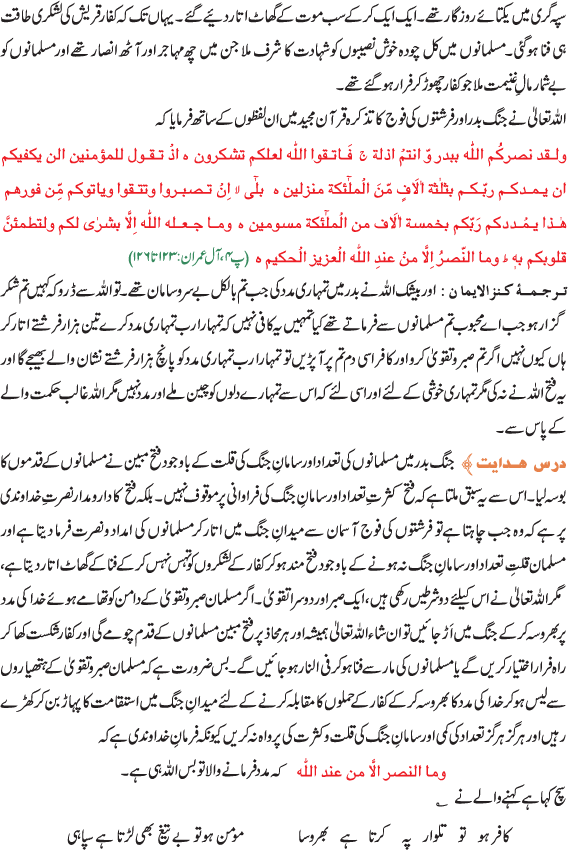
5 Hazar Farishtay Maidan-e-Jang Mae