
Nasihat
TAG: Dua
Do Not Get Frustrated When There Is Delay In Accepting Your Supplications
Abu Hurairah (May Allah be pleased with him) reported: The Messenger of Allah (PBUH), “The supplication of every one of you will be granted if he does not get impatient and say (for example): `I supplicated my Rubb but my prayer has not been granted’.” [Al-Bukhari and Muslim].
The narration of Muslims is: “The supplication of a slave continues to be granted as long as he does not supplicate for a sinful thing or for something that would cut off the ties of kinship and he does not grow impatient.” It was said: “O Messenger of Allah! What does growing impatient mean?” He (PBUH) said, “It is one’s saying: `I supplicated again and again but I do not think that my prayer will be answered.’ Then he becomes frustrated (in such circumstances) and gives up supplication altogether.”
Abu Umamah (May Allah be pleased with him) reported: The Messenger of Allah (PBUH) was asked: “At what time does the supplication find the greatest response?” He (PBUH) replied, “A supplication made during the middle of the last part of the night and after the conclusion of the obligatory prayers.” [At-Tirmidhi].
`Ubadah bin As-Samit (May Allah be pleased with him) said: The Messenger of Allah (PBUH) said, “Whenever a Muslim supplicates Allah, He accepts his supplication or averts any similar kind of trouble from him until he prays for something sinful or something that may break the ties of kinship.” Upon this, someone of the Companions said: “Then we shall supplicate plenty.” The Messenger of Allah (PBUH) said, “Allah is more plentiful (in responding).”
[At-Tirmidhi].
Commentary: We learn from this Hadith that prayer (supplication) is beneficial to us in any case, because Almighty Allah either grants the prayer we make, or if the supplication is not being accepted, He removes some future trouble that was destined for us, or He grants us in full in the Hereafter.
A Muslim should never feel shy of praying to Allah. In fact, he should persistently pray because there is no end to His Treasures.
Ibn `Abbas (May Allah be pleased with them) said: The Messenger of Allah (PBUH) used to say when he was in distress: “La ilaha illallahul-Azimul-Halim. La ilaha illallahu Rabbul-`Arshil-`Azim. La ilaha illallahu Rabbus-samawati, wa Rabbul-ardi, wa Rabbul-`Arshil-Karim. (None has the right to be worshiped but Allah the Incomparably Great, the Compassionate. None has the right to be worshiped but Allah the Rubb of the Mighty Throne. None has the right to be worshiped but Allah the Rubb of the heavens, the Rubb of the earth, and the Rubb of the Honorable Throne).”
[Al-Bukhari and Muslim].
Commentary: The only medicine in a time of distress is the remembrance of Allah Whose Help alone should be sought. This Du`a contains words that glorify Allah and exalt Him far above all else. It is desirable to recite these words when one is in distress as this is exactly what the Prophet (PBUH) used to recite in such situations
Hope Until The Very End
Once when Ali Bin Abu Talib and Al-Hussain Bin Ali (may Allah be pleased with them) were walking together they heard a man making dua to Allah. The man was begging Allah to forgive him for his evil deeds. His sincere tone and eloquent words aroused his interest in Ali. He told his son, “Do you not hear the man who is so very penitent because of his sins? Go catch up with him and call him.”
When Al-Hussain caught up with the man, he saw that he was clean-looking, clean-smelling, with nice clothes, and altogether handsome, except that he seemed to be paralyzed on the right side of his body. Al-Hussain said, “Answer the summon of Amir Al-Mu’mineen, Ali Bin Abu Talib.”
Dragging his right side, the man followed Al-Hussain back to where Ali was waiting for them.
“Who are you!” asked Ali.
“A man who did not fulfill the rights of others and is now being punished for that,” replied the man.
“And what is your name?” asked Ali. “Munaazil Bin Laahiq,” said the man.
“What is your story?” asked Ali.
The man said, “I was famous among the Arabs for my frivolous and sinful exploits. Merciful and kind, my father would constantly admonish me and advise me to mend my ways. He would remind me of Allah’s punishment, saying, ‘My son, do not go against He who punishes with the Hell-fire!’ When he would persist in advising me, I felt his voice grating on my nerves. I would get so frustrated that I would beat him with harsh blows. In response to my blows, he one day said, ‘By Allah, I will fast without breaking my fast and I will pray without stopping to sleep.’
“He fasted for an entire week, but seeing no change in my behavior, he climbed a camel and set off to perform Haj. His parting words were, ‘I am going to the House of Allah, and there I will seek help from Allah against you.’ When he reached Makkah, he grasped the curtain of the Ka’ba and made du’a against me, asking Allah to make me paralyzed on one side of my body. By the One who raised the sky and sends down the rain, no sooner did my father finish his du’a that I became paralyzed on my right side, which became like a piece of wood. Anyone who would then pass by me would point to me and say, ‘Allah answered his father’s supplication against him.’”
“What did your father do then?” asked Ali.
“O Amir Al-Mu’mineen, after he became pleased with me, I asked him to go back and invoke Allah on my behalf. He agreed to do so. I walked alongside him as he rode on his camel until we reached a place called the Valley of Arak. When we reached there, a group of birds flew away from a tree, their sudden movement frightened the camel. As the camel raced off in a state of fright, my father fell off it and died.”
It was certainly late for the man, but not too late, and so Ali advised him to continue to make du’a and to repent for his past misdeeds. Ali then parted from the man, but before leaving him, he taught him the du’a that a person in distress should say. (The narration does not specifically mention which du’a Ali taught the man.)
– an excerpt from the Stories of Repentance
How To Strengthen Our Faith
Recite and ponder on the meanings of the Qur’an. Tranquility then descends and our hearts become soft. To get optimum benefit, remind yourself that Allah is addressing you. People are described in different categories in the Qur’an; think of which one you find yourself in.
Realize the greatness of Allah. There are signs in everything we see that points us to His greatness. Everything happens according to His permission. Allah keeps track and looks after everything, even a black ant on a black rock on a black moonless night.
Make an effort to gain Islamic knowledge. Learn at least the basic things we need to know in daily life, e.g. how to make Wudhu properly. Know the meanings of Allah’s names and attributes. Only those who have knowledge truly fear Allah (Refer Qur’an, 35:28).
Attend gatherings where Allah is remembered and His religion is taught.
Do more good deeds. One good deed leads to another good deed. Good deeds must be done continuously, not in spurts.
Remember death, the destroyer of pleasures, frequently.
Ponder over the different stages of the Hereafter. From graves to being raised on the Day of Judgment to one’s final destination in paradise or hell-fire.
Make Du’a. Realize that we need Allah. Be humble. Don’t covet material things in this life.
Every night, before going to sleep, think about the good deeds and the sins we did during that day.
Realize the effects of sins and disobedience. Eemaan (faith) increases with good deeds and decreases with sins.
Why Our Dua’s Are Not Answered
IBRAHEEM IBN Adham (may Allah have mercy on him), a teacher and a companion of Sufyaan Ath-Thawree (d. 161H), was asked, “We supplicate, and we are not answered.”
So he replied:
- You know Allah, yet you do not obey Him.
- You recite the Qur’an, yet you do not act according to it.
- You know Satan, yet you have agreed with him.
- You proclaim that you love Muhammad (peace be upon him), yet you abandon his Sunnah.
- You proclaim your love for Paradise, yet you do not act to gain it.
- You proclaim your fear of the Fire, yet you do not prevent yourselves from sins.
- You say “Indeed death is true”, yet you have not prepared for it.
- You point out the faults with others, yet you do not look at your faults.
- You eat of what Allah has provided for you, yet you do not thank Him.
- You bury your dead, yet you do not take a lesson from it.
Secret For Du’a To Be Answered
I often find that people supplicate with certain prayers and have their prayers answered, and they couple their supplication with their neediness and turn towards Allah, or a good deed they carried out that caused Allah to respond to this supplication out of appreciation for this good deed, or they happened to supplicate at a time in which it is more likely to be accepted, etc. So, his supplication was answered because of this.
One might think that the secret was in the specific wording of his supplication, and might therefore approach it simply from this angle while ignoring all of these other things that were coupled with it by the person supplicating. This is like someone who uses beneficial medicine at its proper time and in the proper manner and it benefits him as a result, and someone else thinks that simply using this medicine regardless of these other factors will bring about the same benefit. This person is wrong, and this is where many people fall into error.
And supplications and prayers of refuge are like weapons, and a weapon is only as effective as the person using it, not just based on how sharp it is. So, as perfect and flawless a weapon is, as strong as the arm that is using it, as much as there is nothing to nullify its effectiveness – the more damaging it will be against the enemy. And whenever one of these three elements is absent, the effect will be held back.
So, if the supplication itself is not good, or the one supplicating does not have both his heart and tongue present when making it, or there is some element present to prevent it from being answered, it will have no effect.
– By Ibn Qayyim Al-Jawziyyah
– Ad-Da’ wad-Dawa’; p. 40-41
Hajj Sharait, Ahmeat Aur Fazeelat

Hajj Sharait, Ahmeat Aur Fazeelat
Behtreen Dua
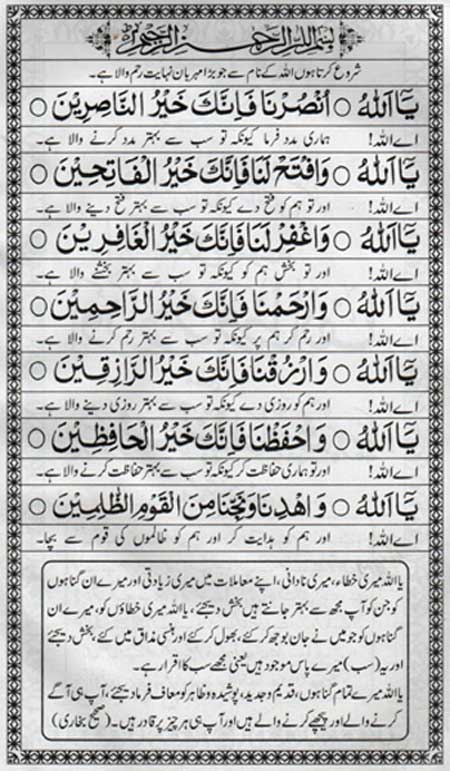
Behtreen Dua
Chand Naikiyan Aur Esaal-e-Sawab
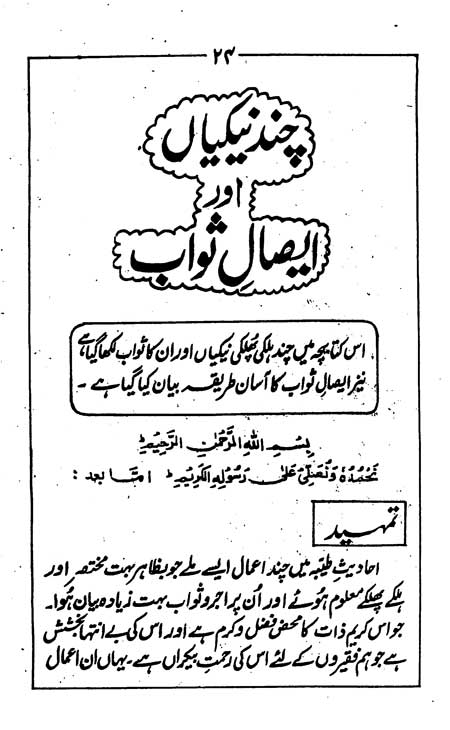
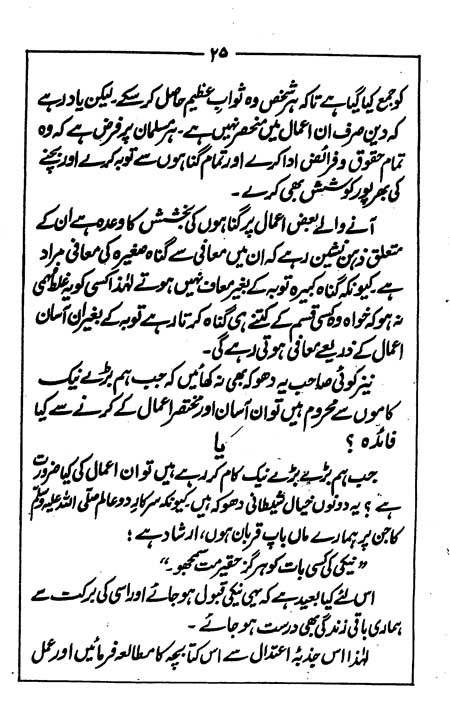
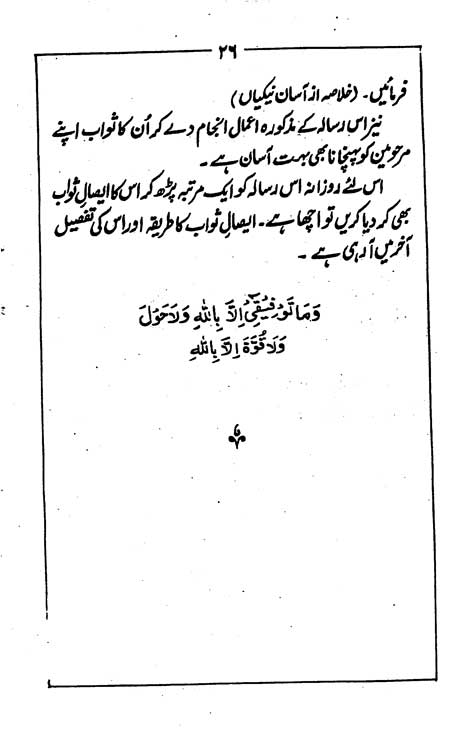
Amal Mukhtasar Sawab Zyada