

TAG: Dua
Maa Ki Dua

Maa Ki Dua
Subhan Allah, Alhamdulillah And Allahu Akbar
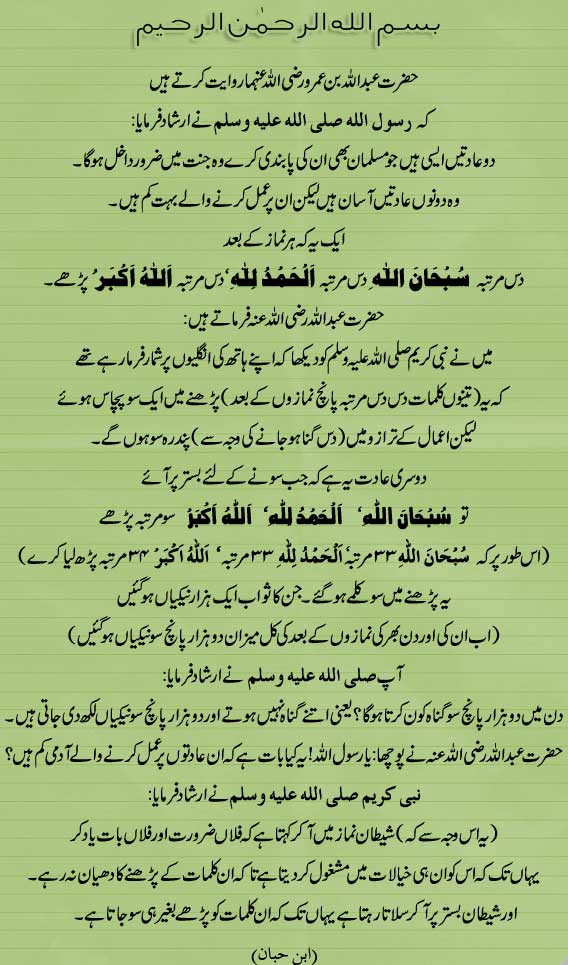
Subhan Allah, Alhamdulillah And Allahu Akbar
Aaj Ki Dua
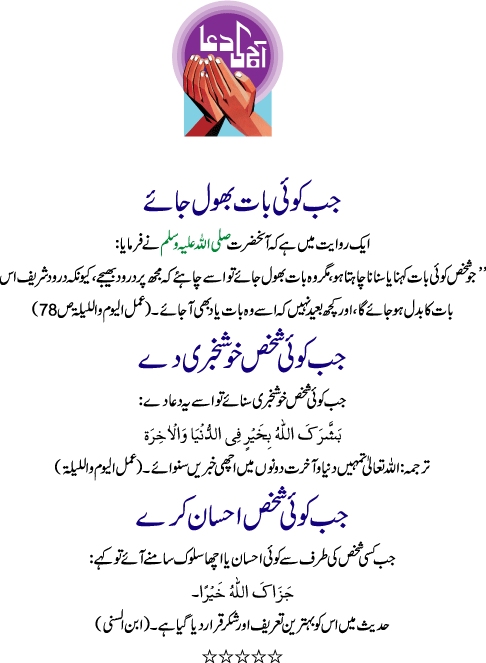
Aaj Ki Dua
Benefits Of Duaa
Numan bin Basheer narrates from Rasool-Allah, “Duaa is ibadat.” Then He read this ayat. (Tirmizi, Abu Dawod, and Ibn-e-Majah)
Abu Hurairah narrates from Rasool-Allah, “In the court of Allah, there is no greater thing than duaa” (Ibn-e-Majah)
Abdullah bin Umar narrates from Rasool-Allah,” Among whatever has been descended and whatever has not been descended Duaa is beneficial of all. Oh people of Allah! Assume Duaa a must for yourselves. (Tirmizi)
Abdullah bin Umar from Rasool-Allah, “For whoever the door of dua opened, for him the doors of mercy are opened. Whatever dua is asked from Allah the best dua is for well-being and safety among them.” (Tirmizi)
Abu Hurairah narrates from Rasool-Allah, “Allah is extremely displeased with the person who doesn’t do daa to Allah“. (Tirmizi)
Salman narrates from Rasool-Allah, “Your Rab is modest and kind. A person raise his hands in HIS court and HE leaves them empty, Allah shies from it.” (Tirmizi and Abu Dawood)
Jabir narrates from Rasool-Allah, “Whoever does dua to Allah, Allah fulfills his seeking or in exchange averts misfortune until the dua is not related to sin or breaking some relation.” (Tirmizi)
Abu Hurairah narrates from Rasool-Allah, “Do dua to Allah with this confidence that HE will accept it and know this well that Allah doesn’t accept the dua done with a negligent and careless heart. (Tirmizi)
Salman Farsi narrates from Rasool-Allah, “Duaa turns away destiny and good deeds lengthen age. (Tirmizi)
Umar narrates that, “Whenever Rasool-Allah raised his hands for dua He did not put down them down until HE took both hands over his face.” (Tirmizi)
Aisha (Radi Allahu Anha) narrates that, “Rasool-Allah liked duas that were inclusive and he left the rest.” (Abu Dawood)
Abdullah bin Umar narrates from Rasool-Allah, “Duaa for a person not present is accepted quickly by Allah.” (Tirmizi and Abu Dawood)
Simple Words That Protect From Every Harm
Khawlah Bint Hakim narrated that Allah’s Messenger (peace be upon him) said: “Whoever arrives somewhere and says: ‘I seek refuge with Allah’s complete Words from the evil He has Created (A’oodhu bi-Kalimaathillaahi- Ath-Thaammaathi min-Sharri maa Khalaq),’ nothing will harm until he leaves that place.” (Sahih Muslim, no. 2708)
In Taysir Al-Aziz Al-Hamid (p. 146), Sulayman Bin Abdullah relates that Al-Qurtubi commented on this by saying:
“And this is true and real, and I believe in it due to the textual proof as well as my own experience. Since I heard this narration, I would constantly act upon it and nothing was able to harm me until I left it.
One night, I was stung by a scorpion in Al-Mahdiyyah (a province in Tunisia). So, I thought to myself until I realized that I had forgotten to seek refuge using these words.”
In Al-Qawl Al-Mufid (1/155), Al-Uthaymeen commented on this Hadith:
“This protection is from all human and jinn devils – whether they are visible or invisible – until the person leaves that place. And there is no way that what is described in this narration will not take place, as these are the words of the truthful one who is believed (i.e. the Messenger of Allah)!
However, if what is mentioned in this narration does not take place, it is because of a preventative factor and not because of a deficiency in the method itself or the narration.
This also applies to anything that the Prophet (peace be upon him) mentioned as a Shar’ee method in which the desired outcome is not achieved. So, this is not because of a fault in the method and is rather because of the presence of an obstacle that is blocking the desired outcome.
For example, reciting ‘Al-Fatihah’ for a sick person is a form of healing. Some people recite it and find that the sick person is not healed.
This is not because of a deficiency in this method and is instead because there is something present that is preventing this method from bringing about its desired effect.
Another example is mentioning Allah before having sexual intercourse in order to prevent Satan from harming the future child.
Some people will mention Allah and find that Satan still ends up harming the child due to something that is preventing this effect from being achieved.
So, you should check yourself to figure out what the obstacle is so that you can remove it and experience the effect of the method.”
Making Du’a While Reciting Qur’an
Hudhayfah (may Allah be pleased with him) narrated, “Whenever the Prophet (peace be upon him) read a verse about Allah’s punishment, he would seek refuge in Allah. And whenever He read a verse mentioning Allah’s mercy, he would ask Allah for His mercy.” (Ahmad, 6/24, Abu Dawood, no. 873, and others; graded Hasan by Al-Albani)
Sheikh Abdul Aziz Bin Baz said: It’s Sunnah for every Muslim who reads the Qur’an – during prayer or elsewhere – to ask Allah for His bounty at the verses of mercy; and to seek refuge from the Hell-fire when he reads about Allah’s punishment. Furthermore, when a Muslim reads a verse that deems Allah above something, he declares it by saying, “Subhanahu wa Ta’ala.”
It’s recommended for every Muslim who reads “Is not Allah the Best of judges?” (Qur’an, 95:8) to say, “Indeed! I believe that to be true.” When one reads, “Is not He (Allah Who does that) Able to give life to the dead?” (Qur’an, 75:40), he should say, “Indeed! I bear witness to this.”
When one reads, “Then in what statement after this (the Qur’an) will they believe?” (Qur’an, ), he should say, “I believe in Allah.” (Qur’an, 77:50)
After the slave recites the verse, “Then which of the Blessings of your Lord will you both (jinns and men) deny? (Qur’an, 55:13), he should say, “We don’t deny any verses from our Lord.” And after reading, “Glorify the Name of your Lord, the Most High,” (Qur’an, 87:1), he says, “Subhana Rabbiyal A’la.”
All these acts are recommended for the Imam, followers, or a person reciting the Qur’an. These words are dua. They resemble saying “Ameen” after Fatihah, and Ameen should be said in the prayer and elsewhere after reciting Fatihah.
(Majmoo Fatawa Bin Baz, vol. 26, p. 62-63)
– Translated by Abdullah Bin Dwight Battle
Istighfar
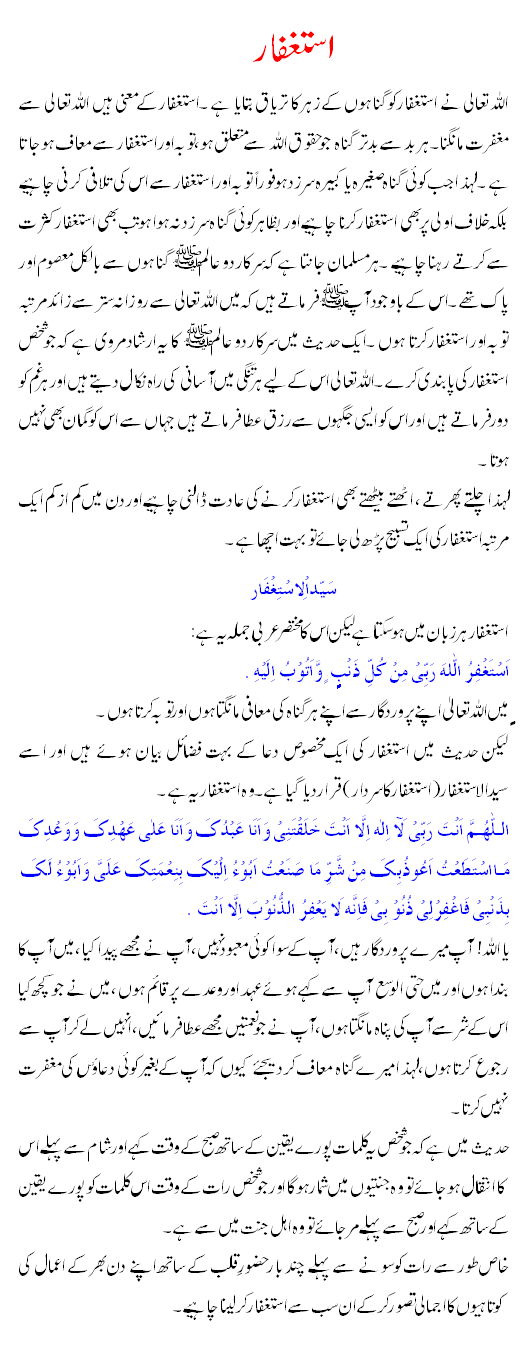
Istighfar
5 Logoon Ki Dua
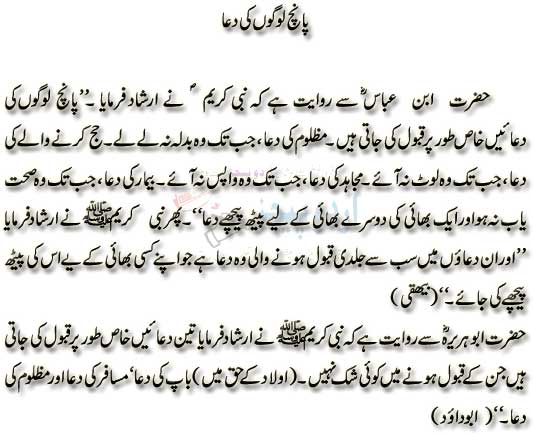
5 Logoon Ki Dua
Nasihat
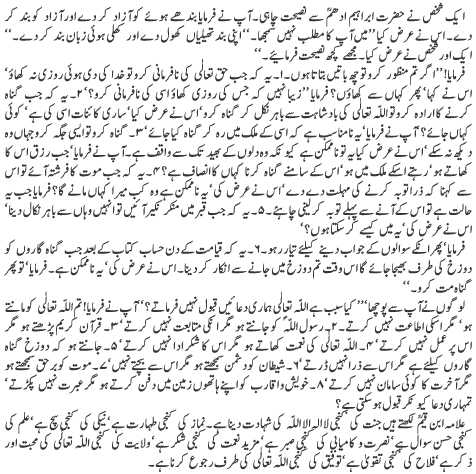
Nasihat