

TAG: Duaa
Maqbool Duaia Kalmat
Khaney Sey Pehle Aur Baad Ki Dua
Aafiyat Ki Mujarab Dua

Hidayat Aur Aafiyat Ki Dua


Dushman Kay Shar Sey Bachne Ki Dua

Durood Shareef Ki Fazeelat
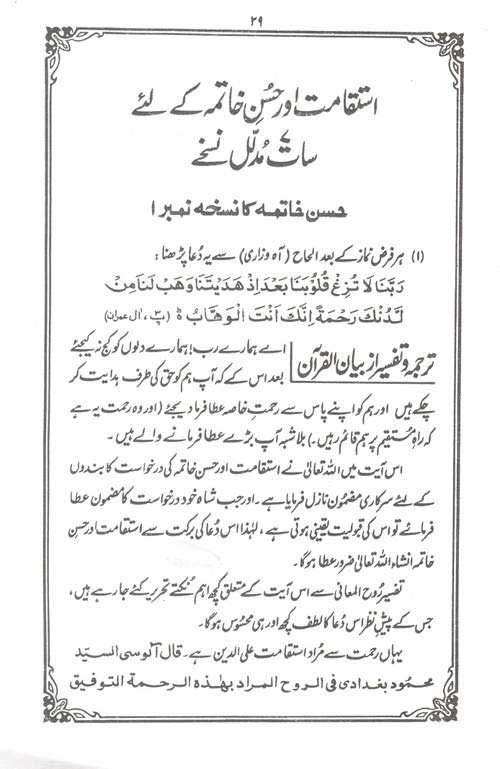
Istiqamat Aur Husn-e-Khatima
Turning To Him In Du’a
EVERY one of us has some problem or the other to deal with in our lives. But who amongst us stands before Allah, cries to Him and asks Him for help? We are so ready to cry out our problems to other people, who can do nothing for us except lend a sympathetic ear.
Why should we seek comfort with people when the Best of helpers is ready to listen to us? Allah said in the Qur’an: “And call upon Me, for I will answer your prayers.” (Qur’an, 40:60).
Several verses of the Qur’an and narrations of the Prophet (peace be upon him) encourage us, in fact command us, to make du’a to Allah, and to Him alone.
“And when my servants ask you (O Muhammad, peace be upon him) concerning Me, then (answer them), I am indeed near. I respond to the innovations of the supplicant when he calls on Me…” (Qur’an, 2:186)
Allah is close to His worshippers by His knowledge, aid and protection. The Prophet (peace be upon him) said: “Indeed your Lord is shy and generous. He is shy, when a man raises his hands to Him, to return them empty and rejected.” (Ahmad, 5/438, Abu Dawood, no. 1488, authenticated by Sheikh Al-Albani)
So, let’s not think twice before asking Allah. Let’s raise our hands, praise Him, send blessings upon the Prophet (peace be upon him), acknowledge our sins, cry with humility and fear, complain only to Allah, be determined in our request and expect the best from Him because He is the All-Hearing, Wise.
Let us also utilize the certain times (proved from the Sunnah) during which du’a is more likely to be answered like the third part of the night, the time when the Adhan is called, during Sajdah while praying Salah, on Fridays, while fasting and while visiting the sick. Apart from the recommended times, du’a is a great act of worship that can be done at all times.
Ask Allah in times of hardship and ease. Encourage your children to seek His help and put complete trust (tawakkul) on Him alone.
“And whosoever fears Allah and keeps his duty to Him, He will make a way for him to get out (from every difficulty). And He will provide him from (sources) he never could imagine. And whosoever puts his trust in Allah, then He will suffice him…” (Qur’an, 65:2-3)
Maa Ki Dua

Maa Ki Dua