

TAG: Haram
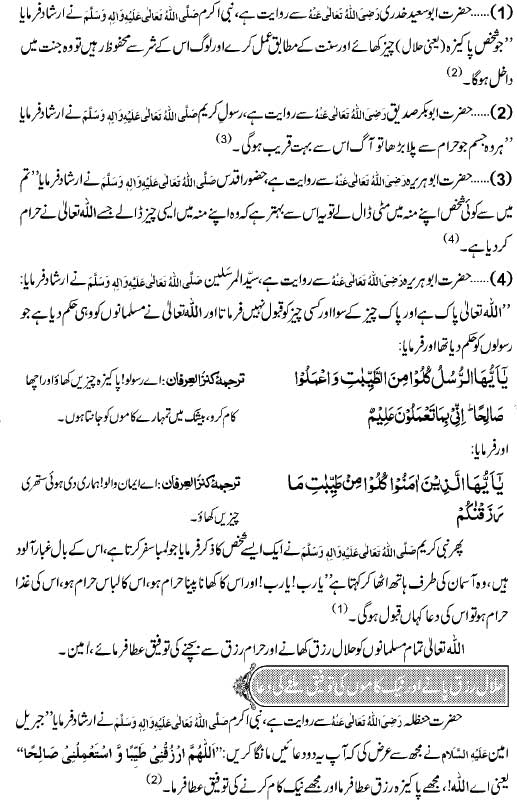
Halal Ki Targheeb Aur Haram Ki Muzammat
حلال کی ترغیب اور حرام کی مذمت
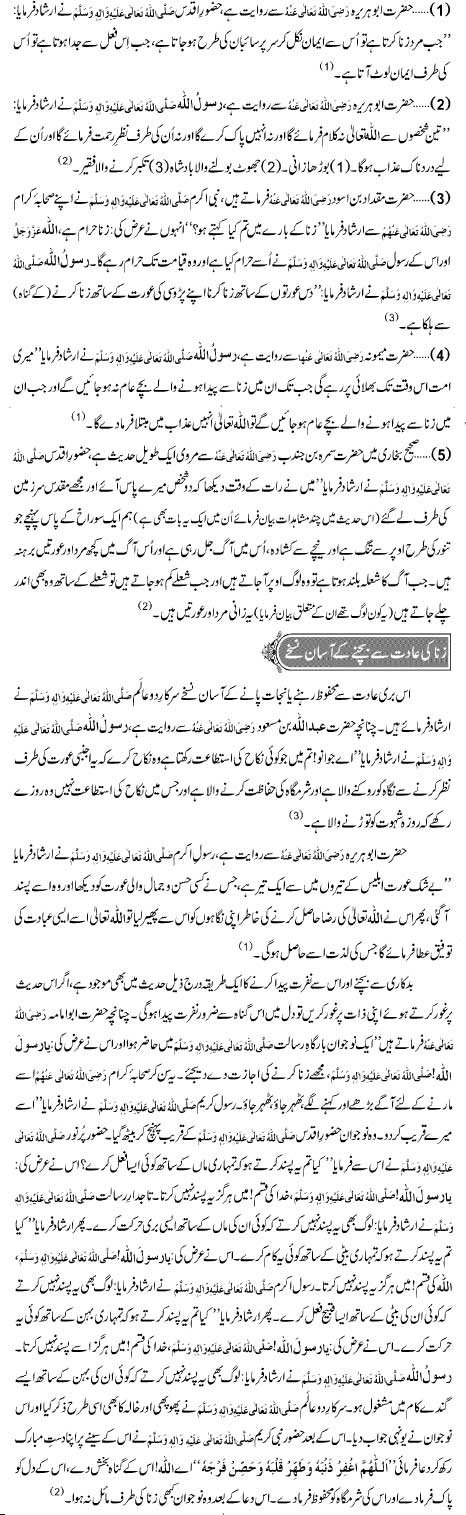
Zina Ki Muzammat Aur Bachnay Kay Tareeqay
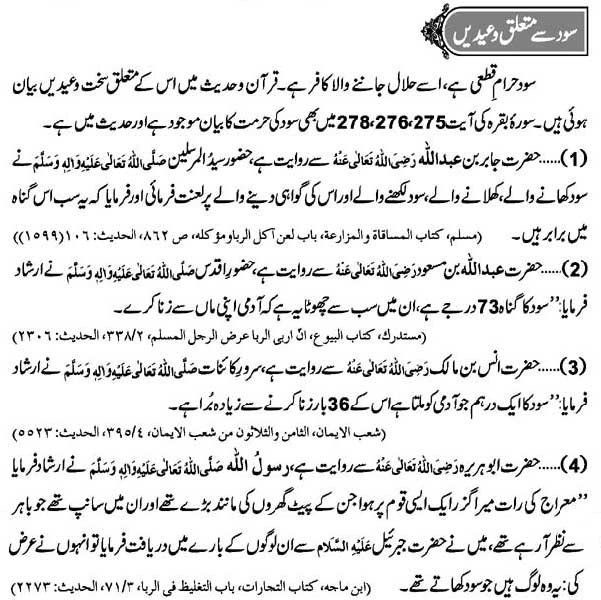
Sood Kay Mutaliq Waeed
Wearing Gold Is Haram For Men
`Abdullah ibn `Abbaas reported that the Prophet (sallallahu alayhi wa sallam) saw a gold ring on a man’s hand. He took it off and threw it aside, saying, “Would any of you take a burning coal and hold it in his hand?” When the Messenger of Allah (salla llahu alayhi wa sallam) had gone away, someone said to the man, “Take your ring and benefit from it (i.e., sell it).” He said, “No, by Allah, I will not take it after the Messenger of Allah (salla llahu alayhi wa sallam) has thrown it away.” (reported by Muslim, no. 2090).
`Abdullah ibn `Amr ibn al’Aas reported that the Messenger of Allah (sallallahu alayhi wa sallam) said: “Whoever of my ummah wears gold and dies wearing it, Allah will deny him the gold of Paradise. Whoever of my ummah wears silk and dies wearing it, Allah will deny him the silk of Paradise.” (Reported by Imaam Ahmad).
This prohibition applies to men only, not to women, as `Ali, radiyallahu anhu, reported that the Prophet of Allah(sallallahu alayhi wa sallam) took a piece of silk in his right hand and a piece of gold in his left, and said: “These are forbidden for the males of my ummah.” (reported by al-Nisaa’i and Abu Dawud).
The Prophet (salla llahua alayhi wa sallam) also said: “Wearing silk and gold is permitted for the women of my ummah and prohibited for the males.” (Reported by Imaam Ahmad)
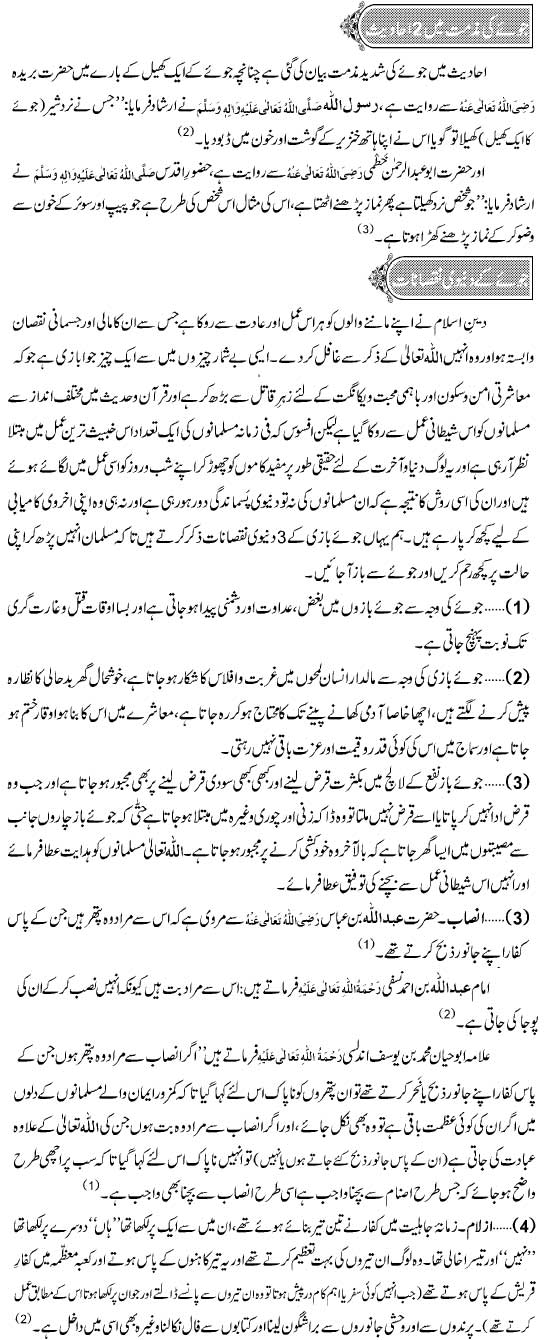
Juaay Ki Mazammat
Seeking Halal Earning
According to Abdullah ibn Masud (Allah be pleased with him), the Prophet Muhammad (peace be upon him), said: ‘Seeking halal earning is a duty after the duty.’ In other words working to earn a halal living is itself a religious obligation second in importance after the primary religious obligations like prayers, fasting and Hajj.
This brief Hadith contains three very important messages. First, it points to the Islamic way out of the apparent dichotomy between the material and the spiritual worlds. We often see them working in opposite directions. Indulgence in the material world does lead one away from the spiritual world. Spiritual uplifting seems to accompany a tendency to distance oneself from the material pleasures. There is a conflict, but is there a contradiction also? Is it possible to resolve the conflict in a way that one can take care of both? Or are they mutually exclusive? This has been a central question for all religions and many in the past suggested the second answer, making hermits as the ideal for the humanity. Unfortunately not much humanity is left when one moves too far in this direction. One can read today the horror stories of monks, among others, who tried to seek spiritual purification this way.
As a reaction, others took the other course, making material pleasures the goal of this life. The Western civilization today is the prime example of that. Its toll on human spirit and morality is well known and is a constant reminder that something is wrong here as well.
In between the two extremes Islam points out the Straight Path. Man is both a material and a spiritual being. The solution does not lie in denying the material needs and desires but in denying their claim to primacy. They are part of being but not the reason or goal of being. As long as they are kept in place, they are an important part of our life. The problem is not money but the love of it. Wealth itself is not bad. In fact Qur’an refers to it as ‘ … your property which Allah has made for you a means of support for you . ..’ [Al-Nisa, 4:5]. And another Hadith praises the merits of ‘the halal wealth of a pious person.’ The effort to earn a living is not only not against spirituality, it is a religious obligation!
But this earning must be through halal means. This is the second message of this Hadith. Our obligation is not just to make money but to make halal money. This is a broad statement that is the basis for Islamization of a society’s economic life. Not every business idea or possible business enterprise is good for the society. And the decision regarding right and wrong here cannot be left to the so-called market forces. Right and wrong in the economic life, as in all life, must be determined by a higher source. Shariah guides us as to the halal and haram business enterprises and practices, and at both individual and collective levels we must follow that guidance.
Five Pillars Of Islam
What Are the Five Pillars of Islam?
1) The Testimony of Faith
2) Prayer
3) Giving Zakat (Support of the Needy)
4) Fasting during the Month of Ramadan
5) The Pilgrimage to Makkah
The Five Pillars of Islam are the framework of Muslim life. They are the testimony of faith, prayer, giving zakat (support of the needy), fasting during the month of Ramadan, and the pilgrimage to Makkah once in a lifetime for those who are able.
1) The Testimony of Faith:
The testimony of faith is saying with conviction, “La ilaha illa Allah, Muhammadur rasoolu Allah.” This saying means “There is no true god (deity) but ALLAH, and Muhammad is the Messenger (Prophet) of ALLAH.” The first part, “There is no true god but ALLAH,” means that none has the right to be worshiped but ALLAH alone and that ALLAH has neither partner nor son. This testimony of faith is called the Shahada, a simple formula that should be said with conviction in order to convert to Islam. The testimony of faith is the most important pillar of Islam.
2) Prayer:
Muslims perform five prayers a day. Each prayer does not take more than a few minutes to perform. Prayer in Islam is a direct link between the worshiper and ALLAH. There are no intermediaries between ALLAH and the worshiper.
In prayer, a person feels inner happiness, peace, and comfort, and that ALLAH is pleased with him or her. The Prophet Muhammad (S.A.W.W) said: {Bilal, call (the people) to prayer, let us be comforted by it.} Bilal was one of Muhammad’s (S.A.W.W) companions who was charged to call the people to prayers.
Prayers are performed at dawn, noon, mid-afternoon, sunset, and night. A Muslim may pray almost anywhere, such as in fields, offices, factories, or universities.
3) Giving Zakat (Support of the Needy):
All things belong to ALLAH, and wealth is therefore held by human beings in trust. The original meaning of the word zakat is both ‘purification’ and ‘growth.’ Giving zakat means ‘giving a specified percentage on certain properties to certain classes of needy people.’ The percentage which is due on gold, silver, and cash funds that have reached the amount of about 85 grams of gold and held in possession for one lunar year is two and a half percent. Our possessions are purified by setting aside a small portion for those in need, and, like the pruning of plants, this cutting back balances and encourages new growth.
A person may also give as much as he or she pleases as voluntary alms or charity.
4) Fasting the Month of Ramadan:
Every year in the month of Ramadan, all Muslims fast from dawn until sundown, abstaining from food, drink, and sexual relations.
Although the fast is beneficial to health, it is regarded principally as a method of spiritual self-purification. By cutting oneself off from worldly comforts, even for a short time, a fasting person gains true sympathy with those who go hungry, as well as growth in his or her spiritual life.
5) The Pilgrimage to Makkah:
The annual pilgrimage (Hajj) to Makkah is an obligation once in a lifetime for those who are physically and financially able to perform it. About two million people go to Makkah each year from every corner of the globe. Although Makkah is always filled with visitors, the annual Hajj is performed in the twelfth month of the Islamic calendar. Male pilgrims wear special simple clothes which strip away distinctions of class and culture so that all stand equal before ALLAH.
Pilgrims praying at the Haram mosque in Makkah
Pilgrims praying at the Haram mosque in Makkah. In this mosque is the Kaaba (the black building in the picture) which Muslims turn toward when praying. The Kaaba is the place of worship that ALLAH commanded the Prophets Abraham and his son, Ishmael, to build.
Important Islamic Jurisprudence Terminology
Fard – Obligatory:
An act commanded by Allah in the Holy Qur’an is known as Fard. The following explains a Fard in detail:
a. An act that is obligatory to be executed
b. It has been proven by rigorously authenticated texts
c. The denial of any Fard renders one to come out of the folds of Islam.
d. If one omits to perform any Fard without any valid shari’i reason, then such a person becomes a fasiq (transgressor) and the person is regarded as a major sinner. [Fatawa Ridawiyyah – Vol. 2, Page 194]
Wajib – Necessary:
An act that is almost as compulsory as a Fard. The Messenger of Allah SallAllaho Alaihi wa Aalihi wa Sallam never omitted it. It is a graded second, below a Fard in its necessity.
a. An act that is compulsory to do.
b. It is proven by religious arguments through ijtihad.
c. One who denies a Wajib is misguided.
d. If one omits a Wajib without any valid shari’i reason, then he is a transgressor and liable for the punishment of Hell.
e. To miss a Wajib once (deliberately, without any valid reason) is a minor sin (Gunah-e-Saghira). However, persistently omitting a Wajib shall turn it into a major sin (Gunah-e-Kabira).
Sunnat-e-Mu’akkadah:
“Sunnat” generally means: an act done or liked by the Messenger of Allah SallAllaho Alaihi wa Aalihi wa Sallam in relation to worship. One shall gain a reward for performing a Sunnah, but there is no sin if one omits it. However, to continually omit it is a sin, and if one shows dissatisfaction with a Sunnah, then this is kufr (disbelief).
a. Sunnat-e-Mu’akkada is an act necessary to perform.
b. An act that was always performed by the Messenger of Allah SallAllaho Alaihi wa Aalihi wa Sallam, but occasionally omitted so as to differentiate from something that is Wajib.
c. One gains the displeasure of Allah Most High and His Beloved Prophet SallAllaho Alaihi wa Aalihi wa Sallam if a Sunnat-e-Mu’akkadah is omitted even if it is occasionally. Thus, making it a habit to omit a Sunnat-e-Mu’akkadah is an act of earning even more displeasure of Allah and His Beloved and inevitably, one becomes liable for punishment.
d. The status of a Sunnat-e-Mu’akkadah is near a Wajib.
e. Sunnat-e-Mu’akkadah is sometimes known as Sunnat-e-Huda.
Sood Haram Ha

