
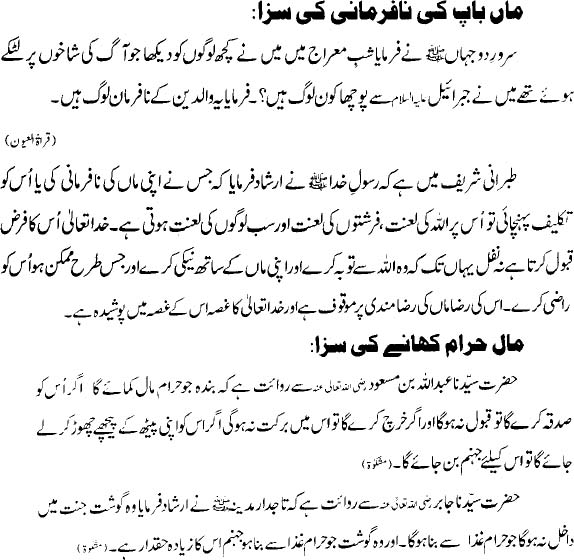
Maa Baap Ki Nafarmani Aur Haram Maal Khane Ki Saza
TAG: Haram
Rizq-e-Halal Ki Ahmiyat Aur Fazeelat

Rizq-e-Halal Ki Ahmiyat Aur Fazeelat
Gambling And Games Of Chance Are Totally Haram
The words “Qimaar” and “Maysar” are synonymous in meaning and are translated as “Gambling or Wagering” in English. The Aayaat in the Qur’an that prohibit gambling are as follows:
“People ask you about liquor and gambling, say to them there are great evils in both these things, along with some benefit, but the harms far exceed the benefit. (Surah Baqarah 219)
“O you who believe! Without doubt liquor, gambling, idols, and gambling with arrows are all filthy, the actions of Shaytaan. Therefore, totally abstain from them so that you may be successful.” (Surah Maaidah 90)
In both these verses, the word “Maysir” has been used for gambling, which is synonymous with the word “Qimar”. As such, Hadhrat Abdullaah bin Umar y says: “Maysir refers to Qimar.”
Apart from this, Muhammad bin Sireen, Mujaahid, Saeed bin Musayyib, Saeeb bin Jabeer, Qatadah, Hasan Basri, Taoos, Ata bin Abi Rabah, Siddi, and Dhahhaak have also agreed that “Maysir” and Qimar” have the same meaning.(Tafseer Ibn Jareer Tabari v-2 pg. 358)
Nabi-e-Kareem (Sallallahu alaihi wasallam) emphasized so much on abstaining from gambling that he not only established gambling to be Haraam but also established the fact that merely expressing an intention to gamble is also a sin. If anyone invites another person to gamble, he is commanded to give Sadaqah as Kaffarah for his sin. As such, this narration of Nabi-e-Kareem (S.A.W) is mentioned in Sahih Bukhaari:
“A person who says to someone, ‘Come, let me gamble with you,’ should give something as Sadaqah.”
Be Hisab Rizq
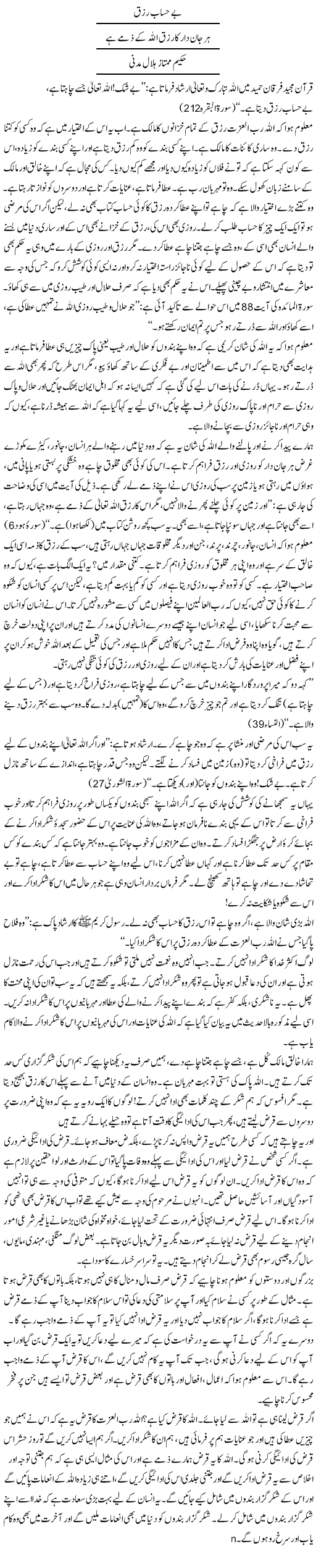
Be Hisab Rizq
People Are Upon 4 Levels Regarding The Circumstances Of Affliction
Knowledge is not measured by how much is memorized, but rather by how much it is acted on.
The First Level: Being Angry
This is in various ways:
The first type: That the anger is in the heart, as if he is angry at his Lord. So he becomes angry with what Allah has decreed for him, and this (level) is Haram. And it is possible that this could lead to Kufr (disbelief). Allah said:
“And among mankind is he who worships Allah as it were, upon the very edge (i.e. in doubt); if good befalls him, he is content therewith; but if a trial befalls him, he turns back on his face (i.e., reverts to disbelief after embracing Islam). He loses both this world and the Hereafter.” [Noble Quran 22:11]
The second type: That the anger is by the tongue, like making Du’a for destruction or ruin, and what is similar to that, and this is Haram.
The third type: That the anger is by the limbs like slapping the cheeks, ripping the clothes, pulling out hair, and similar to that, and all of this is Haram in contradiction to patience, which is Wajib (obligatory).
The Second Level: Being Patient
Just as the poet said: “Patience is like its name – bitter in taste, yet its outcomes are sweeter than honey.”
So the person sees this thing (the affliction) weighs very heavy upon him, yet he bears it although he dislikes that it happened. Rather, his Iman bears it and restrains him from being angry.
So the time of affliction and the time of no affliction are not the same to him, and this (level) is Wajib, because Allah
commanded the people to be patient, saying: “…and be patient. Surely, Allah is with those who are As-Sabirin (the patient ones).” [Noble Quran 8:46]
The Third Level: Being Pleased With The Affliction
Is when the person is pleased with the affliction, and whether it happened or not, it is the same to him, so it is not
difficult for him. He does not bear it as if it is something weighing heavily on him, and this (level) is Mustahabb (preferred – between Haram and Wajib), and it is not Wajib according to the most correct opinion. The difference between this level and the one before it is apparent because the affliction, happening or not happening, is the same due to the pleasure of the one on this level. As for the level before it, the affliction is hard upon him, yet he remains patient over it.
The Fourth Level: Thanking – Being Grateful
This is the highest level. This is that the person thanks Allah for the affliction, which has struck him, in that he knows that this affliction is an expiation for his sins and perhaps a cause for an increase in his good deeds. The Prophet
(Peace and blessings be upon him) said: “There is no affliction which strikes the Muslim except that Allah expiates with it (sins), even with a thorn that may poke him.” [Bukhari & Muslim]
By Sheikh Muhammad Ibn Salih Al-Uthaymeen
Taken from: Fatawa Arkan
Al-Islam
Why Halal And Haram?
In the name of Allah, the Most-Merciful, the All-Compassionate
“May the Peace and Blessings of Allah be Upon You”
Praise be to Allah, we seek His help and His forgiveness. We seek refuge with Allah from the evil of our own souls and from our bad deeds. Whomsoever Allah guides will never be led astray, and whomsoever Allah leaves astray, no one can guide. I bear witness that there is no god but Allah, and I bear witness that Muhammad is His slave and Messenger.
ALLAH SWT, the Almighty, created this magnificent and immaculate universe to favor HIS crowned creation, human beings. ALLAH SWT mentions in the holy Quran, “And HE has subjected to you whatever is in the heavens and whatever is in the earth – all from him. Indeed, in that are signs for a people who give thought” [Al-Jathiyah 45:13].
By virtue of HIS wisdom, ALLAH SWT has proclaimed many things comprised within this world as Halal (lawful) and few others Haram (unlawful) in order to assess our obedience towards HIM.
One of the objectives of this earthly life is to be constantly examined. Quran quotes, “(HE) who created death and life to test you (as to) which of you is best in deed” [Al Mulk 67:2].
Hence, the one who complies with Halal and abstains from Haram in all his matters will succeed. Imam Bukhari narrated that Jundab (RA) said, “The first thing of the human body to purify is the abdomen, so he who can eat nothing but good food (Halal and lawful) should do so”.
Islamic rulings clearly emphasize Halal and Haram, albeit some matters have not been categorized as legal or illegal. What is the way out then?
Narrated by An-Numan bin Bashir (RA): I heard Allah’s Apostle PBUH saying, Both legal and illegal things are evident but in between them, there are doubtful (suspicious) things, and most of the people have no knowledge about them. So whoever saves himself from these suspicious things saves his religion and his honour. And whoever
indulges in these suspicious things is like a shepherd who grazes (his animals) near the private pasture (hima) of someone else and at any moment he is liable to get in it. (O people!) Beware! Every king has a hima, and the hima of ALLAH on the earth is HIS illegal (forbidden) things. Beware! There is a piece of flesh in the body if it becomes good (reformed) the whole body becomes good but if it gets spoil the whole body gets spoils and that is the heart.” (Bukhari).
This hadith enlightens us to refrain from doubtful matters. It also elucidates that the one who consumes unlawful, pollutes his blood that circulates to his heart resulting in the heart being rendered corrupt, and ultimately the whole body is ruined. There could be times when a person may not know the lawfulness of a particular thing, as mentioned in the hadith: “and most of the people have no knowledge about them”. He should then seek advice from a pious scholar. ALLAH the Merciful says, “So ask the people of the message if you do not know” [Al-Anbiya 21:7].
We Muslims have a common tendency to be cautious about food and are casual about other matters concerning Halal and Haram. Sharia (Islamic law) has outlined rules about Halal and Haram in all religious and worldly affairs regarding food, drinks, clothes, marriage, business transactions, behavior towards others, private issues, or issues related to public, hunting, medication, festivals, living habits, and so forth.
In fact, one can say that Islamic rulings are mostly encompassing Halal and Haram, thus making it complicated to elaborate what is lawful and what is not. Rather, the following verses enlighten us …
ALLAH says, “Say, Who has forbidden the adornment of (i.e., from) ALLAH which HE has produced for HIS servants and the good (lawful) things of provision?. Say, They are for those who believe during worldly life (but) exclusively for them on the Day of resurrection. Thus do We detail the verses for a people who know. Say My Lord has only forbidden immoralities – what is apparent if them and what is concealed – and sin, and oppression without right, and that you associate with ALLAH that for which HE has not sent down authority, and that you say about ALLAH that which you do not know.” [Al Araf 7:32-33]
Furthermore, ALLAH the greatest instructs, “Say: Come, I will recite what your Lord has prohibited to you. (He commands) that you not associate anything with HIM, and to parents, good treatment, and do not kill your children out of poverty; WE will provide for you and them. And do not approach immoralities – what is apparent of them and what is concealed. And do not kill the soul which ALLAH has forbidden (to be killed) except by (legal) right. This has HE instructed you that you may use reason. And do not approach the orphan’s property except in a way that is best (i.e, intending improvement) until he reaches maturity. And give full measure and weight in justice.
We do not charge any soul except (with that within) its capacity. And when you speak (i.e., testify), be just (do justice), even if (it concerns) a near relative.
And fulfill the covenant (message) of ALLAH. This has HE instructed you that you may remember. And (moreover), this is MY path which is straight, so follow it; and do not follow (other) ways, for you will be separated from HIS way. This has HE instructed you that you may become righteous” [Al Anam 6:151-153]
Rah e Khuda Mein Maal Kharch Kerne, Haram Kamoon Say Bachne Aur Deen e Islam Ko Sacha Maan-ney Kay Fazail

Rah e Khuda Mein Maal Kharch Kerne, Haram Kamoon Say Bachne Aur Deen e Islam Ko Sacha Maan-ney Kay Fazail
Fahashi Zulm Hai

Fahashi Zulm Hai
Khabardar Khudkushi Haram Hai
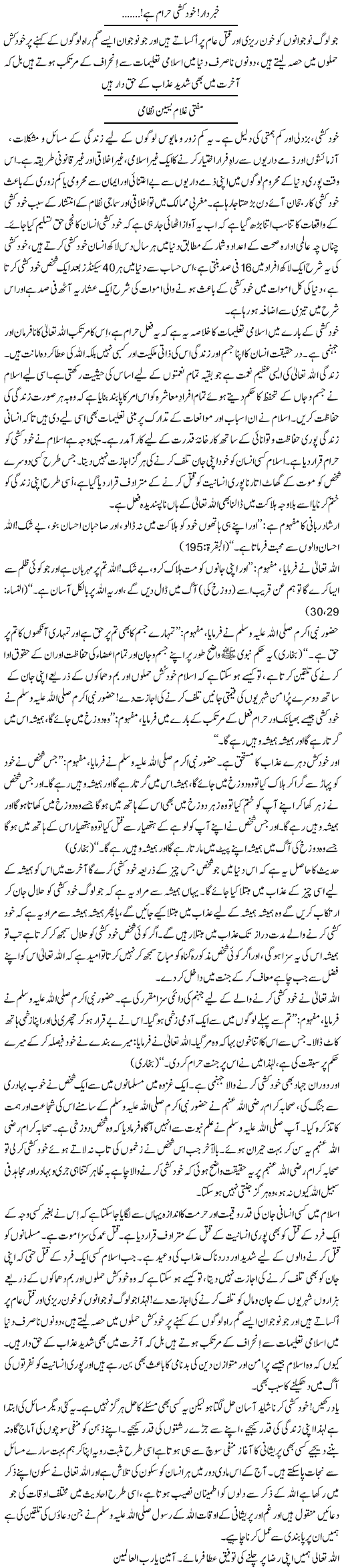
Khabardar Khudkushi Haram Hai
The Importance Of Halal In Islam
Allah (SWT) says in Qur’an: “O you who believe! Eat of the lawful things that we have provided you with, and be grateful to Allah (SWT) If it is He whom you worship” (S2,v172)
“O Messengers! Eat of the Tayiyyibat (Halal foods) which Allah has made lawful (meat of eatable animals, milk products, fats, vegetables, fruits, etc.) and do righteous deeds” (S23,v51)
In both the ayats Allah (SWT) orders the Messengers and all Muslims to abstain from eating Haram food, in the same way, Halal food and pure things are emphasized for consumption while showing thanks (shukr) for this blessing. By eating Haram food bad characteristics are borne in an individual, the desire to perform good deeds disappears and du’aas are not accepted. By eating Halal food, nur (spiritual light) is created. This results in good characteristics and an attraction to do good deeds. A person starts to hate evil deeds. His du’aas are accepted.
- Abu Hurairah (RA) states: ‘For one of you to fill his mouth with the dirt of the earth is better for you than to put a morsel of Haram food in your mouth.’ (Al Kabair, Ahmed)
- Ibn Ka’b bin Ujra (ra) states that Rasulullah (saw) said: ‘That body will not enter Jannah which was nurtured by Haram substances.’ (Tirmidhi)
- Abu Hurairah (RA) states that Rasulullah (SAW) said: ‘A time will come upon the people that they will not care for that which is being taken/earned if it is from Halal or Haram sources.’ (Bukhari)
- Ibn Umar (RA) states that Rasulullah () ) said: ’Four characteristics are such that, if they are within a person, they are enough for him, (1) the care of trust in your possession, (2) to speak the truth, (3) good characteristics, (4) to care for Halal and Haram in eating and drinking. ‘ (Al Targib wal Tarhib)
Many people are such that in matters of eating and drinking they do not think about whether there is a Haram ingredient in the food, or whether the meat has been slaughtered according to Shari’ah or not, i.e. Halal. There are also people who take care of the food being Halal but do not care about the income they use to buy the food. Whether it is Haram or not, in both instances, it is not permissible and the food will be regarded as Haram. Some individuals open bank accounts to use the interest to assist the poor, but after a while, they forget the needy and use the interest for personal gain and enjoyment.
A trustworthy trader’s status in Islam
- Abu Said Al Khudri (ra) states that Rasulullah (SAW) said: ‘The merchant/trader who is completely honest & truthful in his trade will be with the Prophets, the Truthful and Martyrs on the Day of Qiyamah.’ (Tirmidhi)
- Ibn Masood (RA) states that Rasulullah (SAW) said: ‘The worry and striving to earn Halal is Compulsory (Fardh) after the major Fardh acts (salaat, saum, etc.) (Baihaqi)
- Umar (RA) said: ‘Do not give up earning from Halal sources, and do not say that Allah (SWT) provides an earning, for Allah (SWT) does not send gold and silver from the skies, he has the ability to do that, but Allah (SWT) has the habit of using different means to sustain his creation.’(Aksir hidayat)
- Abdullah bin Mubarak (rah) said: ‘ I prefer to return one dirham (silver coin) due to suspicion more than giving 100,000 dirhams in Sadaqah.’ (Al Kabair)
My dearest friends! Everyone has to die and will be placed in their own grave. We should be ashamed that we say ‘The time is such that we can’t differentiate between Halal/Haram’. May Allah (SWT) save us from that. Eating Haram food will cause immodesty, shamelessness, and disregard for the laws of Allah (SWT). If children are nurtured with Haram food, they will be rebellious and have the worst of characteristics. It is plainly evident that from purity comes good and from dirt comes evil.
My Brothers and Sisters! Let us think about whether our earnings are Halal or Haram, and let us ensure that we eat only Halal food. May Allah (SWT) grant us the means to live according to His orders and attain His pleasure. Aameen.
Mufti Yusuf Danka