
- Do Taubah, be it salah, dhikr, read Quran, etc.
- After Fajr, sit in your spot and don’t talk to anyone, and just do dhikr/read Quran. Then after sunrise, do salatul Ishraaq. Outside of Ramadan, the reward is as much as an accepted hajj and umrah (and more). So in Ramadan, that is quantified even more.
- Do Salatul Tahajud etc. as much as possible.
- Throughout Ramadan (especially the last 10 nights because they are about protection from hellfire) make as much dua as you humanly can. Especially ‘Allah Huma Ajirni Min An-naar.
- Before the iftar, spend a couple of minutes making dua. Specifically for forgiveness, your family, mankind, the environment, the world condition, closeness to Allah, etc.
- Read Quran. Keep reading until you get tired. Rest then do fresh wudu and read some more. And then more (if you can)
- Try to go to Taraweeh and even if you don’t pray all the rakahs, listen to the recitation of the Quran
- When you wake up for Suhoor, do two rakahs so it counts as ibadah in the last 1/3 of the night.
- Try to make or help make iftar. You will get the barakah of the people who fasted when they eat your food.
- Make prayer on Rasulullah (saw) as much as possible. People often underrate this and need to understand that he is one of our connections to Allah SWT.
- Say Ayatul Qursi right after every fard prayer.
- Smile at people.
- Brush your teeth (with a miswak) before going to Taraweeh and after you eat Suhur. And before going to the masjid. It is sunnah.
- Make spiritual goals to improve yourself as a human being. Ramadan isn’t about being a good Muslim for a month. It is a time to improve ourselves even more for the rest of our lives.
- Don’t fight. Just don’t. Even if everyone is an idiot or someone in the masjid is insulting you. Suck it up. isn’t worth wasting your valuable Ramadan time.
- Get up for Suhoor and get the barakah for doing so. Even by drinking water during suhoor, we receive barakah.
- Help your mom with the dishes and household work.
- Don’t get angry.
- Be courteous. Be kind. Don’t backbite. Smile. Hold the door open for someone behind you coming into the masjid, Help pick up trash in the masjid. These simple deeds often feel unmarked, but they get you closer to Allah SWT.
- Call on Allah for anything and everything. That’s all I have for this list, may Allah SWT help us to apply these during the month of Ramadaan and during our everyday life inshallah.
TAG: Islam
Hadith: Food & Eating
Give food to the hungry
Narrated by Abu Musa Al Ashari(Radhiallaho anho):
Allah’s Messenger (sallallaahu ‘alaihi wasallam) said, “Give food to the hungry, pay a visit to the sick, and release (set free) the one in captivity (by paying his ransom).”
Sahih Al-Bukhari Vol. 7 : No. 286
Mentioning Allah’s Name on starting to eat
Narrated by Umar bin Abi Salama(Radhiallaho anho):
I was a boy under the care of Allah Messenger (sallallaahu ‘alaihi wasallam) and my hand used to go around the dish while I was eating. So Allah’s Apostle said to me, “O boy! Mention the Name of Allah and eat with your right hand, and eat of the dish what is nearer to you.” Since then I have applied those instructions when eating.
Sahih Al-Bukhari Vol. 7 : No. 288
Eating with the right hand
Narrated by Aisha(Radhiallaho anha):
Allah’s Messenger (sallallaahu ‘alaihi wasallam) used to love to start doing things from the right side whenever possible, in performing ablution, putting on his shoes, and combing his hair. (Al-Ash’ath said: The Prophet used to do so in all his affairs.)
Sahih Al-Bukhari Vol. 7 : No. 292
A believer is satisfied with a little food
Narrated by Abu Huraira(Radhiallaho anho):
A man used to eat much, but when he embraced Islam, he started eating less. That was mentioned to Allah’s Messenger (sallallaahu ‘alaihi wasallam), who then said, “A believer eats in one intestine (is satisfied with a little food) and a Kafir eats in seven intestines (eats much).”
Sahih Al-Bukhari Vol. 7 : No. 309
The Prophet (PBUH) said “Pass on knowledge from me even if it is only one verse”
The Virtues of Ramadan
Bismillah Walhamdulillah Was Salaatu Was Salaam ‘ala Rasulillah
As-Salaam Alaikum Wa-Rahmatullahi Wa-Barakatuhu
Ramadan – Nawafil Prayers
Narrated by Abu Huraira (Radhiallaho anho):
Allah’s Messenger (sallallaahu ‘alaihi wasallam)said, “Whoever fasted the month of Ramadan out of sincere Faith (i.e. belief) and hoping for a reward from Allah, then all his past sins will be forgiven, and whoever stood for the prayers in the night of Qadr out of sincere Faith and hoping for a reward from Allah, then all his previous sins will be forgiven .”
Sahih Al-Bukhari Vol. 3 : No. 231
Ramadan – Umra in Ramadan equivalent to Hajj
Narrated by Ibn Abbas (Radhiallaho anho):
When Allah’s Messenger (sallallaahu ‘alaihi wasallam) returned after performing his Hajj, he asked Um Sinan Al-Ansari, “What did forbid you to perform Hajj?” She replied, “Father of so-and-so (i.e. her husband) had two camels and he performed Hajj on one of them, and the second is used for the irrigation of our land.” The Prophet said (to her), “Perform ‘Umra in the month of Ramadan, (as it is equivalent to Hajj or Hajj with me (in reward).”
Sahih Al-Bukhari Vol. 3 : No. 86
Ramadan – Fasting on one’s behalf
Narrated by Aisha (Radhiallaho anha):
Allah’s Messenger (sallallaahu ‘alaihi wasallam)said, “Whoever died and he ought to have fasted (the missed days of Ramadan) then his guardians must fast on his behalf.”
Sahih Al-Bukhari Vol. 3 : No. 173
Ramadan – Suhur
Narrated by Anas bin Malik (Radhiallaho anho):
Allah’s Messenger (sallallaahu ‘alaihi wasallam)said, “Take Suhur as there is a blessing in it.”
Sahih Al-Bukhari Vol. 3 : No. 146
Important Dua’s – Part 2
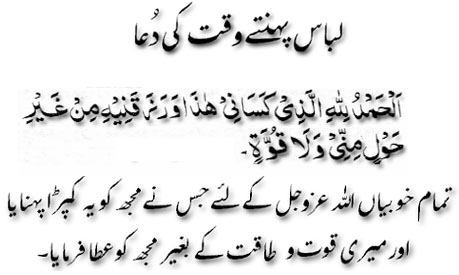
dua at the time of wearing dress
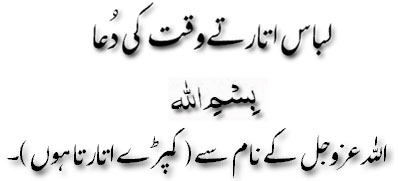
dua at the time of taking off clothes
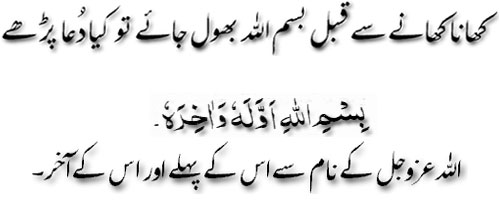
Khana dua
Israa And Miraaj
Israa and Miraaj – Dr. Bilal Philips
Masjid Al-Aqsa and The Dome of the Rock
Israa literally means a journey by night and Miraaj literally means an elevator, i.e., an instrument which lifts something up.
But, in Islaam, Israa refers to a miraculous night journey made by the last Prophet (sallallaahu alayhi wa sallam) from Makkah to Jerusalem, and Miraaj refers to the vehicle which took the Prophet (sallallaahu alayhi wa sallam) from Jerusalem, up and out of the universe, through the seven heavens, and into the direct presence of Allaah.
Towards the end of a calm night, one year before the Hijrah, the roof of Prophet Muhammad’s (sallallaahu alayhi wa sallam) house split open and angel Jibreel (Gabriel) descended into the Prophets (sallallaahu alayhi wa sallam) room. He went over to the Prophet (sallallaahu alayhi wa sallam), opened his shirt, and cut open his chest.
He then removed his heart and washed it inside with Zam Zam water. After he had completed washing it, he then brought a gold dish filled with Eemaan (faith) and Hikmah (wisdom), emptied it into the Prophets (sallallaahu alayhi wa sallam) chest, and then closed it all up.[1]
Jibreel then nudged the Prophet (sallallaahu alayhi wa sallam) until he awoke. When the Prophet (sallallaahu alayhi wa sallam) got up, Jibreel took a hold of his hand and lead him outside of his house to the gate of Kabah.
There the Prophet (sallallaahu alayhi wa sallam) found a strange unearthly animal. It was smaller than a mule but larger than a donkey, white in color and having a wing on either of its hind legs. He was informed that its name was Buraaq, a name taken from the Arabic word Barq which means a flash of lightning.
Jibreel helped the Prophet (sallallaahu alayhi wa sallam) mount it and they set off to the north. Each stride of the Buraaq took it to the horizon, and, in no time they reached Jerusalem. There the Prophet (sallallaahu alayhi wa sallam) dismounted and tied the animal to the same ring on the door of al-Masjid al-Aqsa used by the prophets.
The Prophet (sallallaahu alayhi wa sallam) entered the Masjid and prayed two Rakahs. When he finished he noticed a group of other prophets also making Salaah there. He saw among them Prophet Moosaa, Prophet Eesaa, and Prophet Ibraaheem.
Prophet Muhammad (sallallaahu alayhi wa sallam) was then told to lead them all in Salaah. When the Prophet (sallallaahu alayhi wa sallam) finished this Salaah, someone said to him, This is Maalik, the guardian of the Hellfire, so give him Salaams. When he turned around to greet him, the angel gave him Salaams before he had time to do so.[2] Jibreel then brought two vessels and presented them to the Prophet (sallallaahu alayhi wa sallam). One was filled with wine and the other was filled with milk. The Prophet (sallallaahu alayhi wa sallam) chose the vessel filled with milk and drank from it.
Jibreel then said You have been guided to the Fitrah.[3]
Seeking Forgiveness
The Prophet Muhammad (peace be upon him) reported that the devil said to God: “I shall continue to lead Thy servants astray as long as their spirits are in their bodies.”
And God replied: “(Then) I shall continue to pardon them as long as they ask My forgiveness.” – Al-Tirmidhi, Hadith 742
Why Is A Man Allowed To Have More Than One Wife Islam?
Question: Why is a man allowed to have more than one wife in Islam? i.e. why is polygamy allowed in Islam?
Answer:
1. Definition of Polygamy
Polygamy means a system of marriage whereby one person has more than one spouse. Polygamy can be of two types. One is polygyny where a man marries more than one woman, and the other is polyandry, where a woman marries more than one man. In Islam, limited polygyny is permitted; whereas polyandry is completely prohibited.
Now coming to the original question, why is a man allowed to have more than one wife?
2. The Qur’an is the only religious scripture in the world that says,”marry only one”.
The Qur’an is the only religious book, on the face of this earth, that contains the phrase `marry only one. There is no other religious book that instructs men to have only one wife. In none of the other religious scriptures, whether it be the Vedas, the
Ramayan, the Mahabharat, the Geeta, the Talmud, or the Bible does one find a restriction on the number of wives. According to these scriptures, one can marry as many as one wishes. It was only later,
that the Hindu priests and the Christian Church restricted the number of wives to one.
Many Hindu religious personalities, according to their scriptures, had multiple wives. King Dashrat, the father of Rama, had more than one wife. Krishna had several wives.
Safeguarding Our Kids
The Messenger of Allah[peace be upon him] has mentioned, “When the night approaches then prevent your children (from venturing outdoors) because verily Shaitaan spreads out at this time, …..” (Hadith-Sahih Bukhari).
In another narration, Rasulullah[pbuh] has stated,
” Don’t let your animals and children out from the time the sun sets until the first portion of darkness passes (i.e. Esha time sets in), for indeed Shaitaan sets out from the time the sun sets until the first portion of darkness passes by.” (Hadith-Sahih Muslim)
Safeguarding our children from the evil elements that lurk in our environment is an incumbent duty of the parents, just as it is incumbent to safeguard them from all other evils.
The tendency today is to allow children the freedom to roam out of the house during this time when the Shayateen and their evil influences are at their strongest.
From the above narrations, we learn that parents are duty-bound to ensure that children are given the necessary protection during this time in an Islamic environment.
May Allah Ta’ala protect our innocent children from all forms of evil. Aameen
The Excellence Of The JUMMAH
Allah (SWT), the Exalted, says:
“Then when the (Jumu`ah) Salaah is ended, you may disperse through the land, and seek the Bounty of Allah (by working) and remember Allah (SWT) much: so that you may be successful.” (62:10)
1147. Abu Hurairah (RA) reported: The Messenger of Allah (SWT) Nabi Muhammad (saw) said,
“The best day on which the sun has risen is Friday. On that day Adam (AS) was created, he was admitted to Jannah, and he was expelled therefrom.” [Muslim].
Commentary: This Hadith tells us of the excellence of Jumu`ah. Many achievements were made on this day which also goes to prove its excellent position in Islam.
1156. Abu Hurairah (RA) reported: The Messenger of Allah (SWT) Nabi Muhammad (saw) said while talking about the merits of Friday,
“There is a time on Friday at which a Muslim, while he (or she) is performing Salat and is supplicating, will be granted whatever he (or she) is supplicating for.” And Nabi Muhammad (saw) pointed with his hand to indicate that this period of time is very short. [Al-Bukhari and Muslim].
Commentary: This Hadith mentions another distinction of Jumu`ah, namely a moment in which every prayer that a person then makes is granted with the condition that what one is asking for is good and lawful. It is a very short moment and its time has also not been revealed. For this reason, one should remember Allah (SWT) frequently and pray to Him on Jumu`ah so that one attains that moment when prayers are answered. Prayers can also be answered outside Salaah if one happens to be supplicating at the specified moment.
1158. Aus bin Aus (RA) reported: Nabi Muhammad (saw) said,
“Among the best of your days is Friday. On that day pray to Allah (SWT) to exalt my name and mention frequently, for your such supplications are presented to me.” [Abu Dawud].
Give Your Fellow Muslims Their Rights
Abu Hurayrah (radhiyallaahu ‘anhu – may Allah be pleased with him) narrated that the Messenger of Allaah (sallallaahu ‘alayhi wa sallam – may the peace and blessings of Allah be upon him) said,
“The rights of a Muslim upon their fellow Muslim are six.” It was said, “And what are they Oh Messenger of Allah?” He replied, “When you meet them, give them the greeting of peace, when they invite you, respond to their invitation, when they seek your advice, advise them sincerely, when they sneeze and praise Allah, supplicate for mercy upon them, when they fall ill, visit them, and when they die follow them (i.e. his funeral).” Muslim
The First Right:
“When you meet them, give them the greeting of peace.” For verily the greeting of peace is a cause of loving one another, which results in producing faith (Al-Eemaan), which results in the person entering Paradise. This is as Prophet (sallallaahu ‘alayhi wa sallam) said,
“By the one in Whose Hand is my soul, you all will not enter into the Paradise until you believe, and you will not believe until you love each other. Shall I not direct you to something that if you do it, you will love each other? Spread the greeting of peace amongst yourselves.”
The greeting of peace is from the virtuous characteristics of Islam. For verily each of the two people who meet each other supplicates for the other for safety from evils, and mercy, and blessing that brings about every good. And what follows this is a cheerful face and appropriate words of greeting which result in unity and love, and it removes feelings of estrangement and cold disassociation. Thus, giving the greeting of peace is the right of the Muslim, and it is obligatory for the person who is greeted to return the greeting with a similar greeting or one that is better than it. And the best of the people are those who start the greeting of peace first.
The Second Right:
“When they invite you, respond to their invitation.” This means that when he invites you with an invitation to some food and drink, then fulfill the request of your brother who has drawn near to you and honored you with the invitation. Respond to his invitation (i.e. accept it), unless you have an excuse.