

TAG: Istighfar
Tauba Ki Haqeeqat (hisa do)

Tauba Ki Haqeeqat (hisa awal)

Allah’s Promises of Rizq
I was talking to a brother about Allah’s promise for the Rizq for the maklook( creations), but on the other hand, Allah’s promise for the Jannah for one if we are obedient to Allah. Yet people are running after the Duniya for their Rizq which has already been promised by Allah. We should be trying for the Jannah, which has been promised only with our effort. Arriving home I thought to share a few thoughts on this with you.
First, off all let’s agree on the meaning of Rizq mentioned below:
Rizq is earnings, profit, or wealth
The definition of rizq includes everything whether its wealth, spouse, CHILDREN, provisions, sustenance, which of course includes food, clothing, shelter, etc
“All aspects of a person’s subsistence and livelihood fall under the definition of rizq, including but not restricted to wealth, status, business, and children.”
We see in this capitalist society, everyone will do anything that is possible to gain their Rizq. People think they are expanding their rizq by doing haram, opening liquor shops, but they aren’t. Islam tells us the rizq is assigned at our birth and on top of that Allah Subhanahu Wa Ta’ala made five promises of Rizq.
1. Taqwa
“And whoever fears Allah, for him Allah brings forth a way out, and gives him provision (rizq) from where he does not even imagine…” (Surah At-Talaq: 2/3)
In reference to this Ayaat-i- Karima:
“The word taqwa primarily and literally means ‘to guard’ or ‘to refrain’. In Islamic terminology, it signifies ‘to guard against sins’. When the word is related to Allah, it is translated as ‘to fear Allah’ and implies ‘to avoid disobedience of Allah and guard against sins’.”
Once, Saiyyidina Umar ibn al-Khattab (radhiall ahu anho) asked Saiyyidina Ka’ab Ahbaar (radhiallahu anho): “What is the reality of Taqwa?”
Ka’ab (radhiallahu anho) said: “Have you ever passed a thorny tree?”
Umar (radhiallahu anho) answered: “Yes.”
Ka’ab (radhiallahu anho) asked: “How did you pass?”
Umar (radhiallahu anho) answered: “I passed with such care that I ensured that no thorn got caught into my hem.”
Ka’ab (radhiallahu anho) then elaborated: “In the very same way, the reality of Taqwa is for one to save himself from the thorns of sins and negligence.”
So, this is the first thing with which Allah Ta’ala promised the righteous believers, that He will ease every difficulty of theirs and provide for them all their needs from resources they never expected or thought about.
2. Daily Five Prayers
Everyone who ever spends time in Jama’at should know that through the daily five prayers Allah Ta’ala makes the rizq easy – if you don’t then you should definitely spend time in the way of Allah. Anyone for 4 months? Anyway…
A hadith states: “Salaah is the cause of Allah’s pleasure: It is a beloved act of the Malaikah (angels), a sunnah of the Ambiyaa (alayhimus salam), the nur (light) of ma’rifah is achieved by it, du’aas are accepted, and barakah in rizq is attained.”
Once a Sahabi (radhiallahu anho) said: “When the household of Sayyidina Rasulullah (Sallallahu Alayhi Wasallam) experienced difficulty in their expenses he commanded the performing of salaah, and recited this aayah:
“And enjoin upon thy people worship, and be constant therein. We ask not of thee a provision: We provide for thee. And the sequel is for righteousness.” (Surah Ta Ha: 132)”
3. Istighfar
Sayyidina Rasulullah (Sallallahu Alayhi Wasallam) has said in another Hadith: “The one who seeks forgiveness for Muslim males and females from Allah Ta’aala twenty-six or twenty-five times every day, Allah Ta’ala will count that person among those whose Du’a is accepted, and through the barakah of whom those on earth gain rizq (sustenance) .”
Rasulullah (Sallallahu Alayhi Wasallam) not only made himself 70 till 100 times a day Istighfar and Taubah, but as well enjoined the Muslims to ask Allah Ta’ala frequently for forgiveness. One of the many virtues of Istighfar, that can be found in Ahadith, is that Allah Subhanahu wa Ta’ala deals with the person engaging much in Istighfar in a similar way like with the servant attaining Taqwa.
Sayyidina Abdullah bin Abbas (radhiallahu anho) narrates that Sayyidina Rasulullah (Sallallahu Alayhi Wasallam) said: “The one who (regularly) says Istighfaar, that is, frequently repent to Allah Ta’aala for sins committed, Allah ‘Azza Wa-Jalla will open a path from poverty and difficulties. All sorrow and hardship will be removed, and in its place prosperity and contentment granted. One will receive sustenance from unimagined and unexpected sources.”
4. Tawakul On Allah
Tawakkul on Allah could be translated as sincere reliance on Allah Subhanahu wa Ta’ala. In our context right now it means to be 100% convinced that Allah will definitely give me the rizq, that He has fixed for me. If all creations of Allah Subhanahu wa Ta’ala (malaikah, jinns, humans, animals etc.) come together to change something about that, they simply can not.
Sayyidina Rasulullah (Sallallahu Alayhi Wasallam) has said: “If you have proper and sincere tawakkul (reliance) on Allah Ta’ala. He will grant you rizq like the birds are given rizq, who come out of their nests in the morning with empty stomachs and return to their nests in the evening with a full stomach. Allah Ta’aala says:
“And whoever places his trust in Allah, He is sufficient for him.” (Surah At-Talaq: 3)”
That’s how the Ayaat quoted above continues. Subhan’Allah, what an amazingly illustrious example our beloved Prophet Muhammad Mustafa (Sallallahu Alayhi Wasallam) has given, may Allah shower His blessings upon him and his family.
Sayyidina Imraan bin Husayn (radhiallahu anho) narrates from Sayyidina Rasulullah (Sallallahu Alayhi Wasallam) that: “The person who (sincerely) relies on Allah Ta’aala, Allah Ta’aala will suffice for all the responsibilities of that person. Rizq will be received from such sources, whence it cannot be imagined. The one who relies on the (material) world, Allah Ta’aala hands that person over to the world.”
“One who wishes to become the strongest should make tawakkul on Allah Ta’aala. One who wishes to become the most respectful should adopt taqwa (piety). The one who wishes to become the wealthiest should rely more on the qudrah (power) of Allah than that which is in ones possession.”
5. Infaaq Fisabilillah
It’s no secret that when spending or giving charity in the path of Allah, Allah Ta’ala according to His boundless mercy gives back much times more. There are many Ahadith regarding this, but to spare you time I’ll just type the incident of Hadhrat Sayyidina Ali (karamallahu wajuhu) and a beggar which will make you understand this concept very easily.
Oh yeah, and I almost forgot Asbab. There are no promises of Allah attached to Asbab, but our Yaqeen nowadays is made on them. May Allah forgive us and bring all these attributes into our life. Ameen!
10 Causes That Remove Punishment For A Sin
The punishment for a sin committed by a believer is removed in ten ways:
1. He repents to Allah (taubah), so Allah accepts his repentance, for the one who repents from sin is like the one who has no sin.
2. He seeks forgiveness from Allah (istighfar), so Allah forgives him.
3. He does good deeds that erase his sin for good deeds erase bad ones.
4. His believing brethren pray for him or seek forgiveness for his sins during his life or death.
5. Or they [ask Allah] to bestow on him as gift from the reward for their deeds, with which Allah benefits him.
6. His Prophet Muhammad, sallallahu `alayhi wa sallam, intercedes for him.
7. Allah tests him with trials in this world which expiate his sin.
8. Allah tests him in al-Barzakh (the intermediate life in the grave, between the death and the Day of Judgment) which expiates his sin.
9. Allah tests him in the various stages of the Day of Judgment which expiates his sins.
10. Or the Most Merciful of those who have mercy has mercy on him.
Whoever, then, is missed by these ten cannot blame anyone but himself.
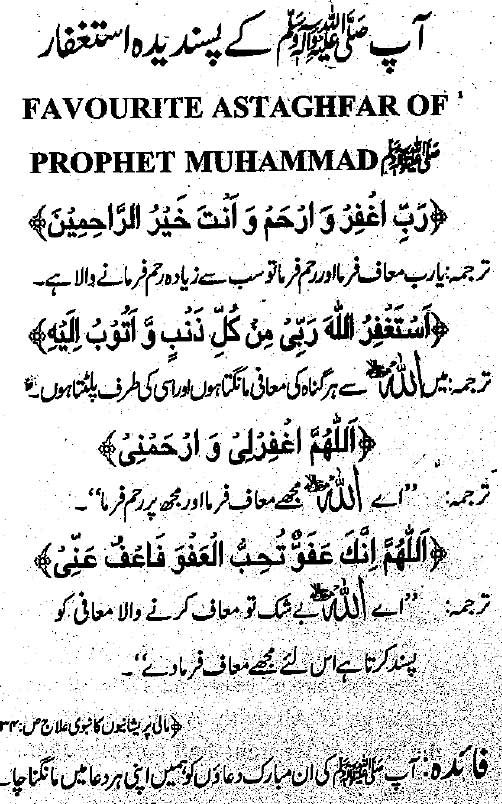
Nabi e Akram (Salallahu Alayhi Wa Sallam) Ka Pasandida Istighfar
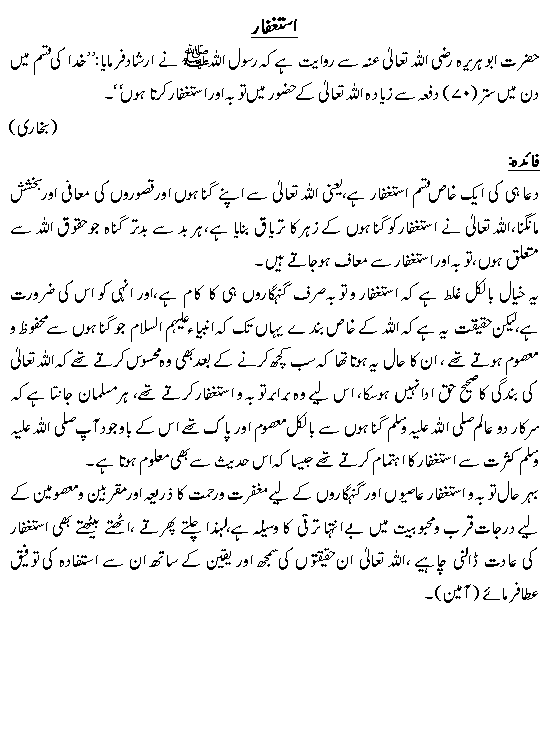
Istighfar
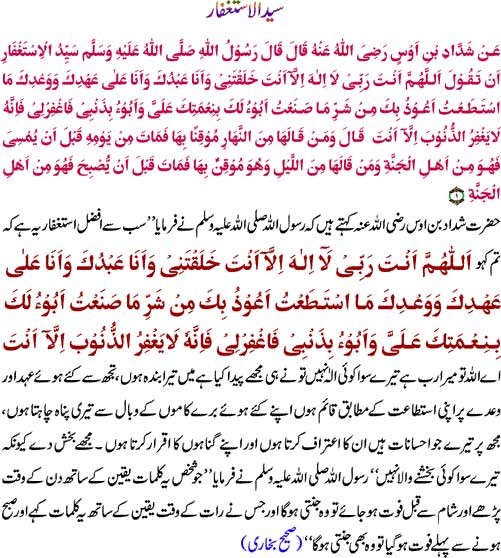
Syed-ul-Istighfar
Hasool e Rizq-e-Halal, Magar Kaise
حصول رزق حلال، مگر کیسے
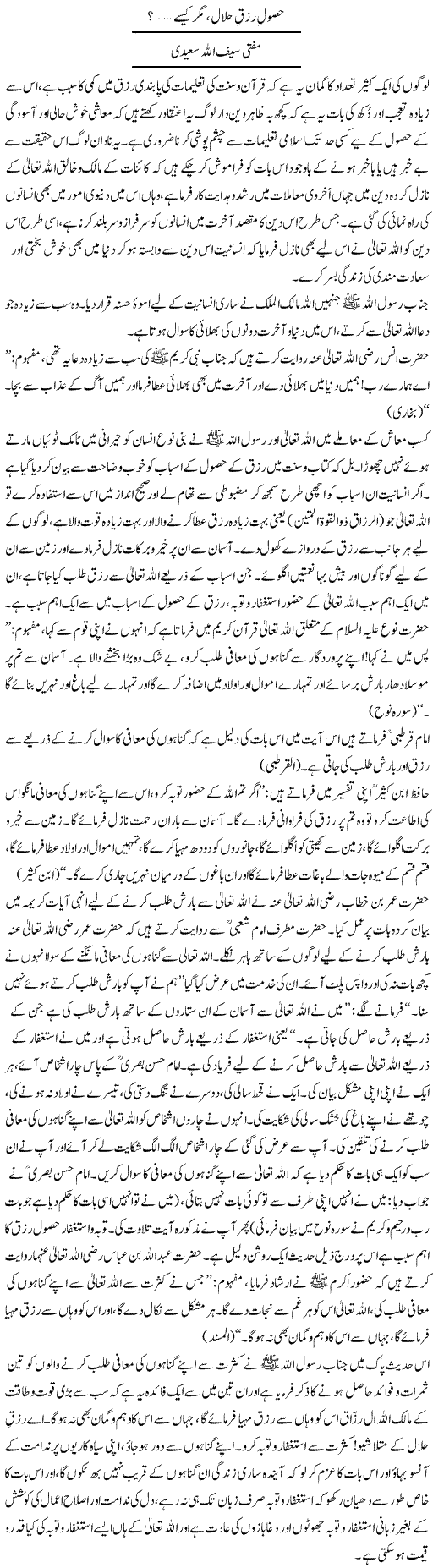
Glossary Of Islamic Terms
There are a number of different collections of Islamic terms and common expressions. Here is a collection that I have found to be most useful to explain common expressions and terminology used by Muslims.
ALAYHIS SALAM-
‘Peace be upon him’, a formula used after the name of a prophet
ALLAHU AKBAR-
The Arabic expression meaning ‘Allah is greater.’ Also called the takbir
ALLAHU ALAM-
An Arabic expression meaning ‘Allah knows best’
AMMA BAAD-
An expression used for separating an introductory from the main topics in a speech; the introductory being usually concerned with Allah’s praises and glorification. Literally it means ‘whatever comes after’
ASTAGFURALLAH-
The Arabic expression meaning ‘I ask forgiveness of Allah’
AUDHU BILLAHI MIN ASH SHAYTAN AR RAJIM-
The Arabic expression meaning ‘I seek protection in Allah from the accursed satan.’
AZZA WA JAL-
A formula used after the mentioning the name of Allah meaning ‘Mighty and Majestic is He’
BARAKALLAH FIK-
An expression which means ‘May the blessings of Allah be upon you.’ When a Muslims wants to thank another person, he uses different statements to express his thanks, appreciation and gratitude. One of them is BarakAllah
BISMILLAH AR RAHMAN AR RAHIM-
‘In the name of Allah, the all Merciful the all Compassionate.’
FI AMANALLAH-
Valedictory phrase meaning ‘In Allah’s protection’
FI SABILILLAH-
The Arabic expression meaning ‘In the way of Allah’, ‘For the cause of Allah’ [also used to mean ‘for the love of Allah’]
AL HAMDU LILAH WA SHUKRU LILLAH-
The Arabic expression meaning which means ‘Praise belongs to Allah and all thanks to Allah’
HASBALA-
The Arabic expression, ‘Hasbunallah wa nimalwakil’ meaning ‘Allah is enough for us and an excellent guardian’
HAWQALA-
The Arabic expression, ‘la hawla wa la quwwata illa billah’ which means ‘There is no power nor strength save (expect) by Allah’
INNA LILLAHI WA INNA ILAYHI RAJIUN-
This is something which a Muslim expresses when he is afflicted by a misfortune, the meaning of which is ‘We are from Allah and to Him are we returning.’ It is taken from an ayat (verse) from the Quran (ch 2 vs 156).
[this is usually said upon hearing of the death of an individual]
INSHALLAH-
The Arabic expression meaning ‘If Allah wills’
[this is usually said when referring to a situation in the future e.g. inshAllah I will go to the grocery shop tomorrow etc]
ISTIGHFAR-
To ask the forgiveness of Allah, especially by saying, Astagfuralah, ‘I seek the forgiveness of Allah’
ISTITHNA-
Exception, saying ‘InshAllah’, ‘If Allah wills’
JALLA JALALUH-
The formula said after the name of Allah meaning ‘Great is His Majesty’
JAZAKALLAHU KHAIRAN-
This is a statement of thanks and appreciation to be said to a person who does a favor. Instead of saying ‘shukran’ (thanks), this phrase is used. It means ‘May Allah reward you with good.
KARAM ALLAHU WAJHAHU-
‘May Allah honor him’, a formula used when Ali ibn Abi Talib (RadiAllahu Ta’ala anhu) is mentioned
LABBAYK-
‘At your service’, the talbiya or call of the pilgrim to his Lord in the hajj.
[the full talbiya is ‘LabbaykAllah huma Labbayk, LabbaykAllah sharee kalala Labbayk, innal hamda, wa naimata lakawulmulk la shareekala’ which means “Here I am O Lord, here I am, Oh Allah, here I am. Here I am. You have no partner. Here I am. Surely all praise, grace and dominion is yours, and you have no partner.”]
LA HAWLA WALA QUWWATA ILLA BILLAH-
The meaning of this expression is ‘There is no power nor strength save in Allah’. This is said by a Muslim when he is struck with calamity, or is taken over by a situation beyond his control.
LI WAJHILLAH-
Literally, ‘For the face of Allah’, meaning in order to obtain the pleasure of Allah, purely for Allah himself.
MA SALAMA-
‘With peace’, a formula for ending letters
MASHALLAH-
A phrase literally meaning ‘What Allah wishes’, and it indicates a good omen
[example of usage, I get an A in a test, my mother would say MashAllah]
MALWANA
‘Our master’, a term of respect
[usually used in the context of referring to the Prophet SAW, also however used in the context of referring to a learned individual e.g. scholar or imam, a concept I am not too keen on supporting and Allah knows best]
RABBANA WA LAKAL_HAMD-
‘Our Lord, Praise if yours’, said after rising from ruku after saying ‘sami Allahuliman hamidah’
[which means ‘Allah listens to the one who praises him’]
RADIYALLAHU ANHA-
The formula ‘May Allah be pleased with her’ used after a female companion
[usually abbreviated as RA or RAA]
RADIYALLAHU ANHU-
This is an expression to be used by Muslims whenever a name of a companion of the Prophet Muhammad is mentioned or used in writing. IT means ‘May Allah be pleased with him’
[usually abbreviated as RA or RAA]
RADIYALLAHU ANHUM-
The formula, ‘May Allah be pleased with them’, used after a group of companions
[usually abbreviated as RA or RAA]
RAHIMAHULLAH-
The formula, ‘May Allah have mercy on him’
ASSALAMU ALAYKUM
‘Peace be upon you’ the greeting of the Muslim
[the reply is ‘wa alaikumus salam’ which means ‘and peace be upon you. The fuller version reads, ‘assalam u alaikum wa rahmatulahi wa baakatuhu’ which means ‘peace be upon you and the blessings and mercy of Alllah’ the reply is ‘wa alaikumus salam wa rahmatulahi wa baakatuhu’]
SALLAHU ALAYHI WA SALLAM-
‘May Allah bless him and grant him peace’, the formula spoken after the mentioning of the Prophet Muhammad
[usually the following two sets of abbreviations are used for this phrase (pbuh) which means ‘peace be upon him’ and is the technical reply for all Prophets or (saws) the correct suffix when referring to the Prophet Muhammad ]
SAMI ALLAHU LIMAN HAMIDAH-
‘Allah heard him who send praise to Him’, said by someone praying when he rises from ruku (unless he is following an imam in prayer)
[if he is following an imam in prayer he says ‘Rabana wala kalhamd’ only]
SAYYIDUNA-
‘Our Master’, a term of respect
[usually used to refer to the Prophet Muhammad SAW , however many people use it to refer to learned man / scholar]
SUBHANALLAH-
‘Glorified is Allah.’ To honor Allah and make Him free from all (unsuitable evil things) that are ascribed to Him, (or ‘Glorified be Allah’)
SUBHANAHU WA TA’ALA-
‘Glorified is He and exalted,’ an expression that Muslims use when the name of Allah is pronounced or written
[this us usually abbreviated as (swt)]
TA’ALA-
‘Exalted is He’, an expression used after the name of Allah is mentioned
[i.e. Allah Ta’ala meaning, Allah, exalted be He]
TAAWWUDH-
Saying, ‘I seek refuge in Allah…’ (audhu billahi minash shaitan nirajeem)
TABARAKALLAH-
The formula ‘Blessed is Allah’
TAHMID-
Saying the expression ‘alhamdulillah’, which means ‘Praise belongs to Allah’
TAKBIR-
Saying ‘Allahu akbar’, which means ‘Allah is Great’
TALBIYA-
Saying ‘Labbayk’, which means ‘At your service’ during the hajj
TAMJID-
Glorifying Allah
TARDIYA-
Saying one of the expressions which begin with ‘radiyallahu….’
TASBIH-
Glorification, saying ‘SubhanAllah’, which means ‘Glory be to Allah’
TASHMIT –
Uttering a prayer for the sneezer which thes the form, ‘yarhamuk Allah’ which means ‘may Allah have mercy on you’
[when a person sneezes he says, Ahamdulillah (Praise be to Allah), a person who hears the sneeze says ‘yarhamuk Allah’ and the sneezer replies ‘Yahdikumul-lah wa Yuslih balakum’ which means ‘May Allah give you guidance and improve your condition.’]
WAJHULLAH –
‘The face of Allah’, meaning for the sake of Allah, irrespective of any reward in this life, purely for Allah’
also however used in the context of referring to a learned individual e.g. scholar or imam
By Aisha Bewley