

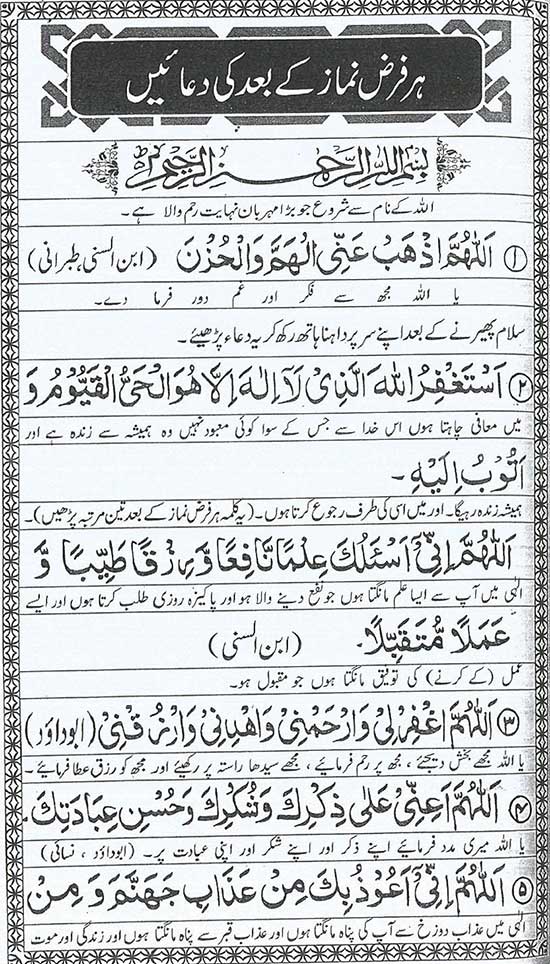
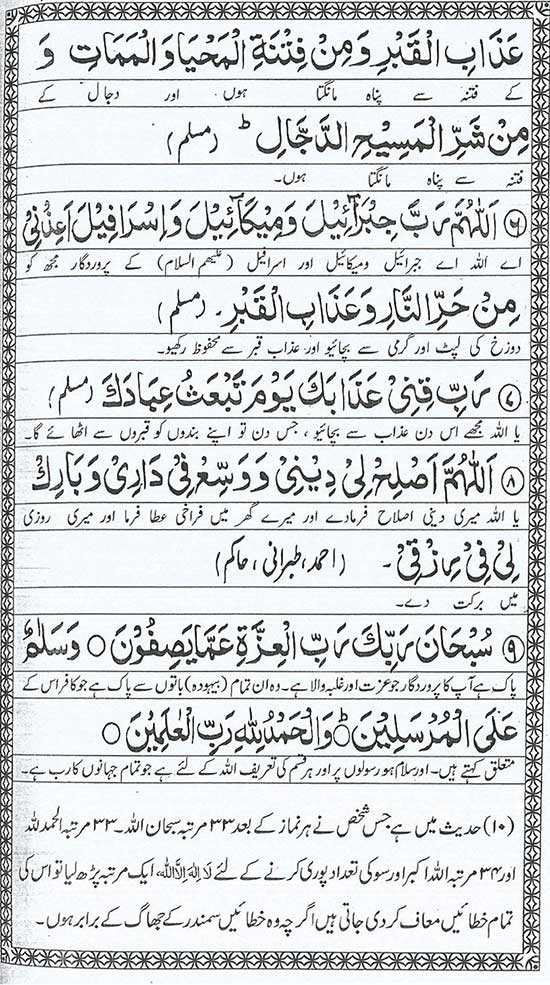
TAG: Istighfar
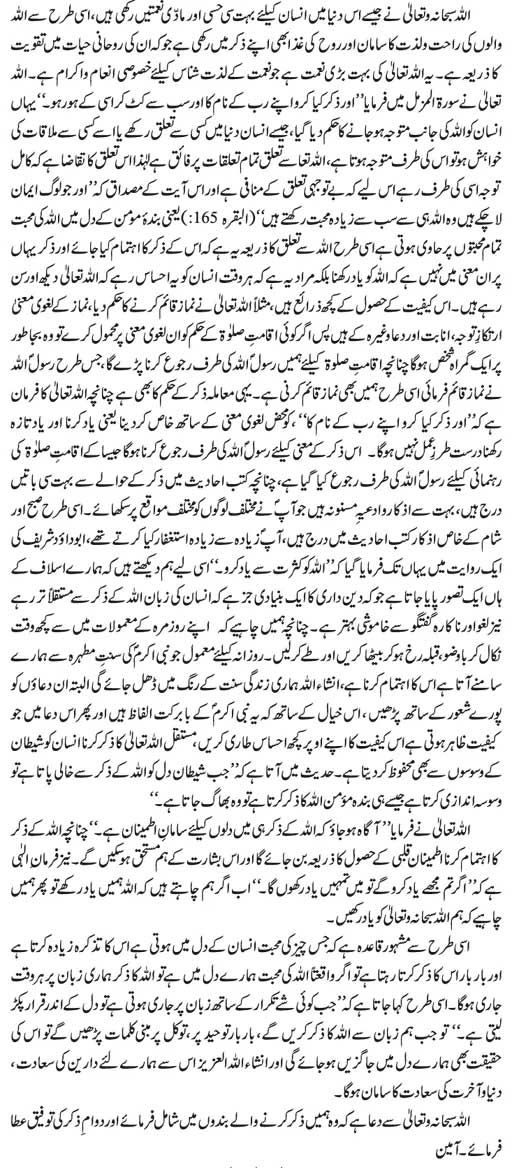
Fazeelat-e-Zikr-e-Elahi
Lessons For Us In Haya
• The two women strove to prevent their sheep from mingling with those of the other shepherds. They were ready to wait, adding to their already difficult task of herding the sheep (a job usually performed by men), so that they would have more privacy and ease whilst watering their sheep. This shows to us modern-day Muslim women that places in which crowds of men are found thronging to get to something should be avoided till there’s a lull, in which we can achieve our objective without fear of being touched/shoved/pushed by the crowd of men.
• The women had the confidence of speaking to a non-Mehram man when he asked them a question about their situation. This shows us that when the need arises, women should possess the self-confidence to speak to a non-Mehram in a business-like, dignified manner.
• Neither of the women endeavored to stick around to chat with Musa after he did them a favor that saved them a lot of trouble and time. Rather, just as he shied away from them, and returned to the tree’s shade without asking for any compensation, they also likewise hurried back home to their father, after the errand for which he had sent them was done. This is a vital point to be noted, especially for the single youth of today. Even in situations when you need to interact with members of the opposite gender to get help with something, you should not hang around chit-chatting or flirting after the favor has been done.
• As the shyness of both the old man’s daughters and Prophet Musa (peace be upon him) (all three of whom were single) shows, Haya entails that we minimize any unnecessary communication with the opposite gender, even in situations when we are thrown together out of necessity and are unsupervised by elders or Mehrams.
• For Muslim women, this incident shows that returning home after outdoor errands have been done is something they should hurry in doing. Loitering around in public places without necessity goes against another Qur’anic command that was sent down by Allah, when addressing the wives of the Prophet Muhammad (peace be upon him): “And stay quietly in your homes…” (Qur’an, 33:33)
• When Prophet Musa (peace be upon him) was to be summoned, the daughter came walking with shyness. The word “Istihya” implies that her gait and demeanor was one “seeking Haya.” In Arabic grammar, words based on the structure of “Istif’al” imply the action of “seeking” in their meaning. (For e.g. “Istighfar” means seeking forgiveness). So her manner of approaching Musa was such that she sought Haya. This proves that when the need arises a woman can become an intermediary between men, especially for a noble/good cause, but she should seek the maximum possible Haya when she appears before a man who is not her Mehram.
• This daughter also advised her father after Prophet Musa finished telling his story. Furthermore, her father took her counsel and accepted her testimony. Women should not feel shy in sharing knowledge to their Mehrams, in consultation and decision-making, or when negotiating the terms of a contract. Haya should, by no means, negate self-confidence and elocution.
– Muslim Matters
Sunnah Acts On The Day Of Eid
EID AL-FITR is the day of benefits and blessings for all fasting Muslims, as they are promised great reward by Almighty Allah for their good observance of fasting. At the end of Ramadan, Muslims express their gratitude to Allah, Who has enabled them to observe fasting and, at the same time, granted them abundant provision during this blessed month. Eid Al-Fitr, therefore, is a day of joy, acts of worship, thanksgiving to Allah, cooperation, solidarity, brotherhood, unity, and spiritual provision.
On the day of Eid, there are some Sunnah acts that we should do, among which are the following:
1. Engage in takbir (saying “Allahu akbar”) from fajr until the imam comes out for salah. Takbir is recommended for males, females, young and old.
2. It is also important to make sure to pay Zakat Al-Fitr before the salah. Ideally, it should be given in advance so that the poor can enjoy their Eid.
3. Appear in the best clean dress that you can afford to, that are reasonable and modest.
4. It is recommended to go early to the prayer place.
5. And most importantly, to wish every one the joy of Eid and show true signs of Islamic brotherhood by shaking hands and embracing and supplicating: “Taqabbal Allahu Minna wa Minkum” (May Allah accept it from us and you).
6. It is also considered a good Islamic practice to visit one another and exchange gifts. The Prophet (peace be upon him) said: “Exchange gifts in order to foster love.”
7. Remember the true spirit of Eid is reflected in our extreme generosity to the poor and the needy. So, be charitable as best as you can.
8. Make lots of istighfar (asking Allah for forgiveness) and pray that Allah accept our fast, prayers and devotion, and may He grant the Ummah glory and success.
Etiquette Of Jumu’ah
1 . Every Muslim should make preparations for jumu’ah from Thursday. After the asr salaat of Thursday, he should make a lot of istighfaar. He should clean his clothes and keep them ready. If he does not have any perfume in his house, then if it is possible he should try and obtain some and keep it ready so that he will not get distracted with these things on jumu’ah. The pious people of the past have stated that the person to receive the most benefit on Friday will be that person who waits for it and who makes preparations for it from Thursday. The most unfortunate person will be he who does not even know as to when Friday will fall, so much so that he will ask the people in the morning as to which day this is. Some pious people used to go and stay in the jaame musjid from the night of jumu’ah in order to make full preparations for the following day. (Ihya aul-Uloom, vol. 1, page 161)
2 . On the day of jumu’ah, ghusl should be made and the hair of the head and the rest of the body should be thoroughly washed. It is also very virtuous to use the miswaak on this day.
3 . After making ghusl, a person should wear the best clothing that he possesses, and if possible he should also apply some perfume. He should also clip his nails.
4 . He should try and go very early to the jaame musjid. The earlier a person goes, the more reward he will receive. Rasulullah (Allah bless him & give him peace) said: “On the day of jumu’ah, the angels stand at the entrance of that musjid in which jumu’ah salaat is to be offered. They write down the name of the person who enters the musjid first, and thereafter the name of the person who follows, and they continue doing this . The person who entered first will receive the reward of sacrificing a camel in the path of Allah, the one who followed him will get the reward of sacrificing a cow, thereafter a chicken, thereafter the reward of giving an egg as charity in the path of Allah. Once the khutbahcommences, the angels close the register and begin listening to the khutbah. ” (Bukhari and Muslim)
In olden times, the roads and alleys used to be extremely busy in the mornings and at fajr time . All the people used to go so early to the jaame musjid and there used to be such a large crowd that it used to look like the days of Eid . Later, when this habit was given up, people began saying that this is the first innovation in Islam. After writing this, Imam Ghazali rahmatullahialayh says: “Aren’t the Muslims ashamed of themselves that the Jews and Christians go so early in the morning to their synagogues and churches on Saturdays and Sundays. Those who are businessmen go so early to the bazaars in order to do their buying and selling . Why don’t the Muslims do the same?” The reality of the situation is that the Muslims have totally reduced the value of this blessed day. They do not even know what day this is, and what a high status it has. How sad it is that the day which was more valuable than eid in the eyes of Muslims of the past, which Rasulullah (Allah bless him & give him peace) was proud of and the day which was not granted to the previous nations has become so dishonoured at the hands of Muslims today and it is such a great ingratitude to the favor of Allah Ta’ala that the consequence of all this can be seen with our very eyes.
5 . By going walking for the jumu’ah salaat, one gets the reward of fasting for one year for every step that he takes. (Tirmidhi)
6 . On Fridays, Rasulullah (Allah bless him & give him peace) used to recite Surah Alif Laam Meem Sajdah and Surah Hal Ataa, in the fajr salaat . These Surahs should therefore be occasionally recited in the fajr salaat on Fridays . Occasionally they should be left out so that people do not regard their recitation as wajib.
Ehsas e Gunah
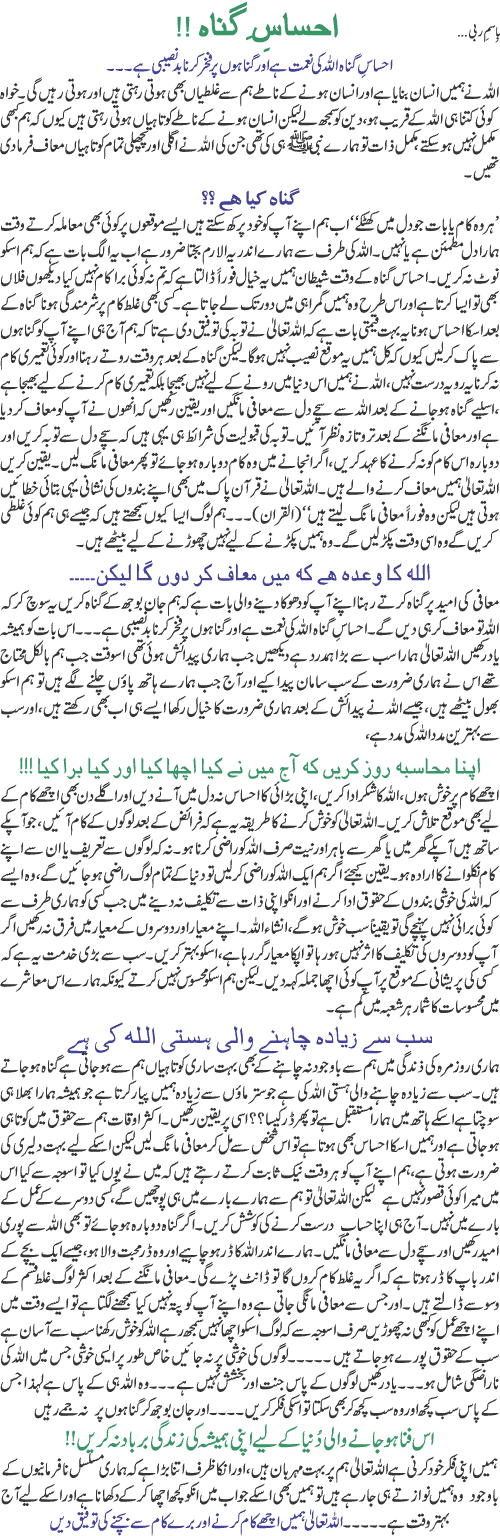
Gunahon Pey Nidamat

Gunahon Pey Nidamat
Istighfar
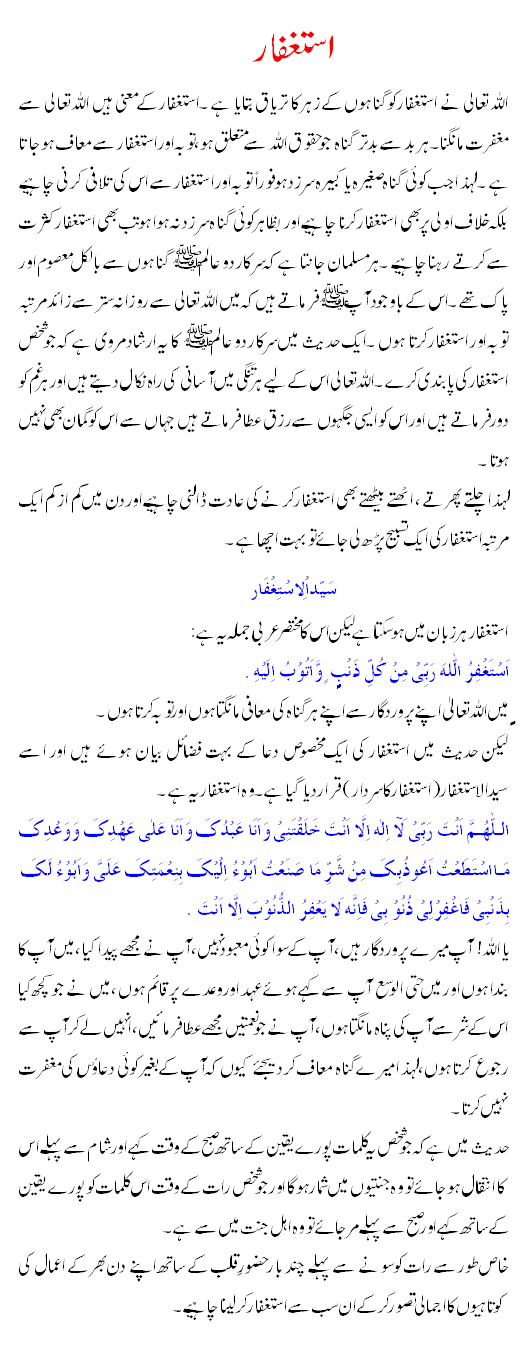
Istighfar
Behtreen Dua
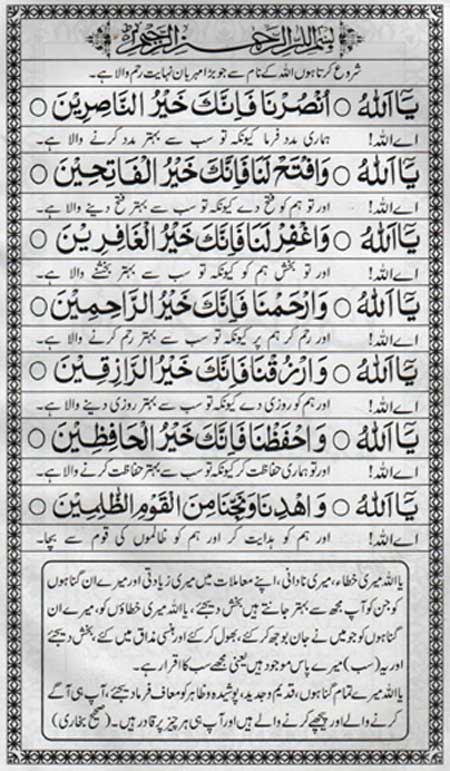
Behtreen Dua
Istighfar Ke Fazail


Istighfar Ke Fazail