
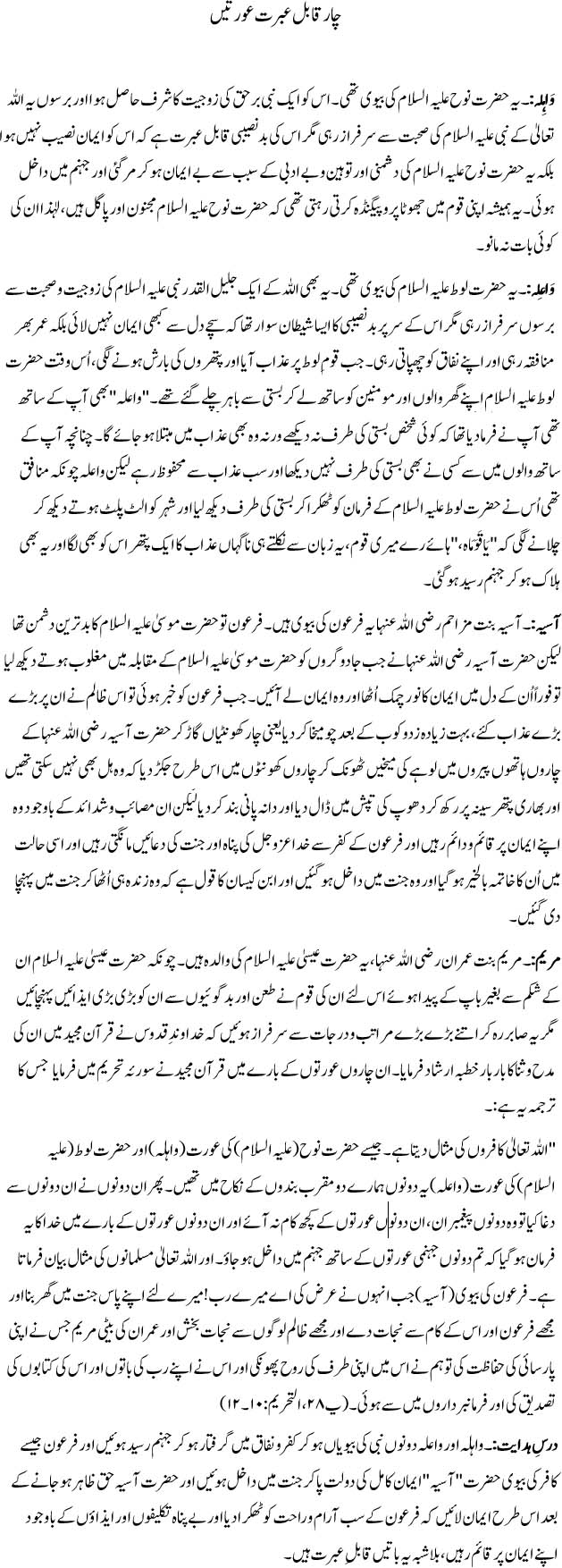
Char Qabil Ibrat Auratain
TAG: Maryam
The Leaders Of The People Of Paradise
(i) The Leaders of the Men
A number of the Sahabah, including ‘Ali ibn Abi Taalib, Anas ibn Maalik, Abu Hudhayfah, Jaabir ibn ‘Abdullaah, and Abu Sa’eed al-Khudri reported that the Messenger (saw) said, “Abu Bakr and ‘Umar will be the leaders of men of Paradise from the earlier and later generations.” [Silsilat al-Hadith as-Saheehah, 12/487, no. 824]
(ii) The Leaders of the Youth
at-Tirmidhi, al-Haakim, at-Tabaraani, Ahmad, and others reported that Abu Sa’eed al-Khudri said, that the Messenger of Allah (saw) said, “Hasan and Husayn are the leaders of the youth of Paradise”. This is proven by so many reports that reach the level of tawatur. [see also the narration from Hudhayfah and from ‘Abdullaah ibn ‘Umar in Ibn ‘Asaakir – Silsilat al-Hadith as-Saheehah, no. 797]
(iii) The Leaders of the Women
The true female leader is the one with whom her Rabb is pleased and whose deeds He accepts. The best women are those who attain the Paradise of delights. The women of Paradise are of different levels, and the Messenger (saw) told us about their leaders:
“The Messenger of Allah (saw) drew four lines and said, “Do you know what these are?” They said, “Allah and His Messenger know best.” He said, “The best women of Paradise are Khadeejah bint Khuwaylid, Faatimah bint Muhammad, Maryam bint ‘Imraan and Aasiyah bin Muzahim, the wife of Fir’awn” [Silsilat al-Hadith as-Saheehah, 4/13, no. 1508, from Ahmad at-Tahhaawi, al-Haakim from Ibn ‘Abbaas, saheeh]
Maryam and Khadeejah are the best of the four – “The best of its women is Maryam and the best of its women is Khadeejah” [from ‘Ali in al-Bukhaari, Kitaab Manaaqib al-Ansaar, Fath al-Baari, 7/133] – and Maryam is the “First Lady” – “The leaders of the women of Paradise, AFTER Maryam bint ‘Imraan will be..” [Silsilat al-Hadith as-Saheehah, 3/410, no. 1424, from Jaabir in at-Tabaraani, saheeh]. The reason why Maryam is considered the best of all women is clearly stated in the Qur’an:
“Behold! the angels said, “O Maryam! Allah has chosen you and purified you, chosen you above the women of all nations.” [3:42]
How could she not be the best of women when Allah has clearly stated that,
“..her Rabb accepted her with a goodly acceptance. He made her to grow in a good manner”. [3:37]
These four women are beautiful examples of perfect, righteous women. Maryam, the daughter of ‘Imran, is praised by Allah in the Qur’an:
“And Maryam, daughter of Imran, who guarded her chastity; and We breather into [the sleeve of her shirt/garment] through Our Ruh [i.e. Jibreel] and she testified to the truth of the Words of her Rabb, and [also believed in] His Scriptures and she was one of the Qaaniteen [obedient to Allah]” [66:12]
Khadeejah as-Siddeeqah believed in the Messenger (saw) without hesitation; she consoled and supported him in every way. Her Rabb gave her the good news, during her lifetime, of a place in Paradise in which there would be no noise or exhaustion [al-Bukhaari, Kitaab al-Manaaqib, Fath al-Baari, 7/133]
Aasiyah the wife of Fir’awn, despised the power and luxuries of this world and rejected Pharaoh and his false claims of divinity. Hence, her husband tortured her until her soul departed to her Creator:
“And Allah sets forth an example for those who believe, the wife of Pharaoh, when she said, “My Rabb! Build for me a home with You in Paradise, and save me from Pharaoh and his works, and save me from the Dhaalimoon [those that do wrong]” [66:11].
Faatimah az-Zahraa, the daughter of the Prophet (saw), was patient, forbearing, and feared Allah. She was a branch from the pure tree, brought up by the educator of humanity.
- December, 13
- 5141
- Paradise-Hell
- More
What Do Muslims Believe About Jesus?
Muslims respect Jesus (peace be upon him) and await his second coming. They consider him one of the greatest of God’s messengers to mankind…
A Muslim never refers to him simply as ‘Jesus’, but always adds the phrase “peace be upon him.” The Qur’an confirms his virgin birth (a chapter of the Qur’an is entitled ‘Mary’) in her time, and Mary is considered the purest woman in all creation. The Qur’an describes the creation of Jesus as follows:
“Behold! the angels said, `God has chosen you, and purified you, and chosen you above the women of all nations. O Mary, God gives you glad tidings of a word from Him, whose name shall be the Messiah, Jesus son of Mary, honored in this world and the Hereafter, and one that shall speak to the people from his cradle and in maturity, and shall be of the righteous.’ She said: ‘O my Lord! How shall I have a son when no man has touched me?’ He said: `Even so; God creates what He wills. When He decrees a thing, He but says to it, “Be!” and it is.” (Qur’an 3:42-47)
Jesus (peace be upon him) was born miraculously through the same power which had brought Adam (peace be upon him) into being without a father:
“Truly, the likeness of Jesus unto Allah is as the likeness of Adam. He created him of dust, and then said to him, ‘Be!’ and he was.” (Qur’an 3:59)
During his prophetic mission, Jesus (peace be upon him) was granted and performed many miracles. The Qur’an tells us that he said:
“I have come to you with a sign from your Lord: I make for you out of the clay, as it were, the figure of a bird, and breathe into it and it becomes a bird by Allah’s leave. And I heal the blind and the lepers, and I raise the dead by Allah’s leave.” [Qur’an 3:49]
Other miracles include speaking soon after birth in defense of his mother’s piety. God’s other gifts to him included healing the ones born blind and the sick, reviving the dead, and, most importantly, the message he was carrying. These miracles were granted to him by God to establish him as a prophet. According to the Qur’an, he was not crucified, but only appeared so; instead, Allah took him up to Himself; (Qur’an, Chapter Al-Nisa)
Neither Muhammad (peace be upon him), nor Jesus (peace be upon him), came to change the basic doctrine of the belief in one God, brought by earlier prophets, but to confirm and renew it. In the Quran Jesus (peace be upon him), is reported as saying: that he came
“To attest the law which was before me.
And to make lawful to you part of what was forbidden you; I have come to you with a sign form your Lord, so fear God and obey me.” (Qur’an 3:50)
Motherhood In The Quran
The cases of the Mothers in the Qur’an are always accompanied by a sense of testing, challenge, anguish and for each one of these cases and there must be a reason for that.
Mother of Musa (a.s.w.s.):
Allah told the Mother of Musa ( through inspiration to do this unbelievable, challenging, trying, and testing act that is to place her newborn son in the chest and throw it into the river to be picked up by one who is an enemy of Allah and an enemy of Musa (Qur’an 20:38-39). How much faith and comfort a mother would have to respond to this call from Allah to throw her son and some people say that after all, she did not have a choice because Pharaoh is killing the sons.
Nonetheless, it is quite difficult to convince a mother to throw her son to the unknown like that. Allah did not say that her son will be taken to safety and instead He said the baby will be picked up by one who is an enemy of Allah and an enemy of Musa (a.s.w.s.). It must have been a very strong and faithful mother.
In the Arabic language, the word ‘fa’ means ‘immediately’ i.e. to place him immediately in the chest and without much delay throw the chest into the river. This shows the sensitivity in the Qur’an that one cannot prolong the agony because the mother could change her mind.
Musa’s (a.s.w.s.) sister goes around and finds that Pharaoh’s wife picked up the chest and seemed to love the child, the sister came forward like a stranger and said: shall I search out a good wet-nurse for the child so that she may rear the child. She agreed and the sister brought the mother and she openly fed the child. (Qur’an 20:40)
There is an attitude in the story that Allah interferes deliberately just for one purpose that this faithful mother needs to be comforted. This step was not needed but somehow Allah showed the sensitivity and empathy to the mother that his son will return to her at least under her direct supervision.
Mother of Yahya (a.s.w.s.):
Yahya’s (a.s.w.s.) father Zakariya (a.s.w.s.) was an old man and there was a need for an heir to carry the legacy of the message. Zakariya’s (a.s.w.s.) wife was also old. Allah wanted him to have a very special child (Qur’an 19:7-11). We know that Yahya (a.s.w.s.) played an important role in the chain of messengers because he was the one who conveyed the message and also who took care of Isa (a.s.w.s.).
The trial is not to Zakariya (a.s.w.s.) but to his wife, the old woman who has to go through the tribulations to having that child. Nonetheless, the father was skeptical of having a child in the old age but on the contrary, the mother was joyful and cheerful about that situation and she came laughing aloud. (Qur’an 51:29)
She just had a positive attitude about the whole thing and cheerfulness that she could not hide even though it was a strange situation to be at.
Mother of Isa(a.s.w.s.):
Maryam’s (a.s.w.s.) trial was also very strange. Maryam, (a.s.w.s.) a chaste and a respectful person of the society find all of a sudden that she will have a baby. She seeks refuge in Allah to protect her. She was wondering how she can have a child affirming her chastity. Qur’an explains the miraculous conception. In the pain of labor, Maryam (a.s.w.s.) wishes that she would rather die than go through this. Allah comforts and guides her. (Qur’an 19:16-25)
She delivers the baby and goes back to her people. Her people immediately remind her about her pious and respectful family. And Allah made the newborn defend her mother. Baby Isa (a.s.w.s.) said he is NOT the son of Allah but the servant of Allah. And Isa said he will be kind to his mother. (Quran 19:26-35)
We can see the gratitude he had towards his mother who went through all these trials.
Foster Mother:
Pharaoh’s (Firaun)wife prays to Allah that she needs a house in heaven and she wants Allah to save her from Pharaoh (Firaun) and his doings and from those who do wrong. (Qur’an 66:11)
One can appreciate her good attitude when she finds the baby [Musa (a.s.w.s.)] inside the chest. She says that the baby is a pleasure to her eyes and her mother’s instinct starts taking over. She says to Pharaoh (Firaun) not to kill the baby and says the baby might be of benefit to them. Here is the mother’s instinct that is saying that they will adopt him as a son. (Qur’an 28:9)
Kindness to Mother:
Qur’an ordains to be kind to one’s parents and especially to the mother (Qur’an 31:14, 46:15). All the family and relationships mentioned in the Qur’an refers to the womb (rahim). Allah instructs not to break the ties of the womb when put in authority (Qur’an 47:22).
Motherhood in Modern times:
For the first time in history, motherhood has become a matter of question. Throughout the history, from Adam (a.s.w.s.) and Hawa (a.s.w.s.) and up until now the motherhood was never questioned. The mother gets pregnant, delivers a baby and she is the mother of the child but with the advent of modern science, people can tamper with that. One can commercially contract motherhood and what is known as Surrogacy, which creates horrendous problems that are both moral and practical and has become an issue of debate.
The surrogate mother may have been quite willing to surrender the child upon birth, but she may have become unwilling to do so after birth. This behavioral change is often termed as “maternal instinct,” in the pregnant woman. The result is that they go to the court and usually the courts rule based on the breach of the contract.
Like any pregnancy, it is impossible to predict the outcome. If the surrogate mother delivers a baby with serious disabilities, would the commissioning couple accept an abnormal child?
I have attended many conferences where many Muslim jurists and doctors participated to address the issue of surrogate motherhood and here are the conclusions.
1. Islam does not accept the practice of surrogacy because it is demeaning.
2. It creates problem
3. If it happens, the (surrogate) woman who delivers the baby is considered as the Mother (Qur’an 58:2).
On the positive side, we have Stem cells that are the blue-print cells in the embryo that have not gone through the process of cell differentiation and therefore have the potential to give rise to many different kinds of specialized cells. For instance, a stem cell could be used to produce liver cells, brain cells, heart muscle cells, blood cells, etc.
Dr. Omar Alfi, a scientist in Genetics explains, “During pregnancy, the fetus leaks the stem cells that goes to the mother and becomes part of her.”
So each mother is carrying in her the parts of the original material that made her child. Hence with the advent of modern science, the mother-child relationship is much more than what we had ever known before. This probably explains the hadith of the Prophet Muhammad (s.a.w.s.) when a man came to him and he was asked, ‘O Messenger of God! Who among the people is the most worthy of my good companionship? The Prophet (s.a.w.s.) said: Your mother. The man said, ‘Then who?’ The Prophet (s.a.w.s.) said: Then your mother. The man further asked, ‘Then who?’ The Prophet (s.a.w.s.) said: Then your mother. The man asked again, ‘Then who?’ The Prophet (s.a.w.s.) said: Then your father (Bukhari).
- September, 7
- 4174
- Human Rights
- More
Insights Into The Story Of Maryam, Mother Of Prophet Isa
The Holy Qur’an is full of insights for those who would like to get a true and comprehensive vision of this life and the Hereafter. The Qur’an offers clues to all the mysteries and ambiguities that human life abounds with. The story of Maryam (Mary) in the Holy Qur’an is told at more than one place. In this article, I would like to shed some light on some of the aspects of this story.
When Maryam was young, Prophet Zakariyya (Zachariah), peace be upon him, found that she had with her the fruits typical of summer in winter and the opposite. When asked about that, she answered, “Every time he entered Al-Mihrab to (visit) her, he found her supplied with sustenance. He said: “O Maryam (Mary)! From where have you got this?” She said, “This is from Allah.” Verily, Allah provides sustenance to whom He wills, without limit.” (Qur’an, 3:37).
In a different context in surah Maryam, Allah says when Mariam is about to deliver her babe Isa (Jesus), “And shake the trunk of date-palm towards you, it will let fall fresh ripe-dates upon you.” “So eat and drink and be glad. And if you see any human being, say: “Verily! I have vowed a fast unto the Most Gracious (Allah) so I shall not speak to any human being this day.'” (Qur’an, 19:25-26)
The question that can be raised here is that when Maryam was young and free of motherly responsibilities, Allah gave her things (fruit) without her exerting any effort. Whereas when she is frail and in throes of childbirth, He orders her to shake the trunk of the date-palm toward her, that it will let fall fresh ripe-dates upon her.
The mystery can be resolved because Allah wants Maryam to depend on herself from now on as she will face the wrath of her people while carrying her own new-born baby, although she is not married. She has to face their shock and consternation depending on nobody but Allah, “Then she brought him (the baby) to her people, carrying him. They said: “O Mary! Indeed you have brought a thing Fariyy (a mighty thing). [Tafsir At-Tabari]” “O sister (i.e. the like) of Harun (Aaron)! Your father was not a man who used to commit adultery, nor your mother was an unchaste woman.” (Qur’an, 19:27-28)
Allah, praise be to Him, supported her with another miracle when the baby, Jesus Christ, peace be upon him, talks to the people, “He Isa (Jesus) said: “Verily I am a slave of Allah, He has given me the Scripture and made me a Prophet,” “And dutiful to my mother, and made me not arrogant, unblest.” (Qur’an, 19:30-32)
At the end, I believe that one of the moral lessons that we can deduce from the story of Maryam is that as long as Allah is supporting you, never have fear of anybody. In other words, “He who fears God need not fear the world.”
Jesus Christ – The Noble Prophet Of Islam
HISTORICALLY, it was the Jews who rejected Jesus Christ (peace be upon him) and accused him as the impostor messiah, that until now they still believe that the messiah prophesied in their scripture has still yet to come.
On the other hand, modern-day Christians (where the majority are Pauline Christians) consider him to be the “begotten son” of God and worship him as if he is one of the Creator of the Heavens and the Earth.
But the Islamic view of Jesus (peace be upon him) is based on what God has revealed to mankind when He said, “Verily, the likeness of Jesus in Allah’s sight is in the likeness of Adam, He created him from dust, then (He) said to him, “Be!” and he was. This is the truth from your Lord, so be not of those who doubt.” (Qur’an 3: 59-60)
So in Almighty Allah’s view, the creation of Jesus is no different from the creation of Adam (peace be upon them). When Allah wants to create something, He only says “Be!” and it is. He can create anything and anyway He pleases.
A good example we can consider is the size and the perfection of the universe which is difficult for the human mind to comprehend and yet Allah has revealed and differentiated it to us the nature of His two creations when He said: “Are you more difficult to create or is the heaven that He constructed? On high has He raised its canopy, and He hath given it order and perfection.” (79:27-28)
Allah further said: “The creation of the heavens and the earth is indeed greater than the creation of mankind; yet most mankind know not.” (40:57)
Is having a “begotten son” befitting of God? The rejection of the very idea of God having a son is stated clearly with strong words from Allah Himself when He said: “And they say: The Most Gracious has betaken a son! Indeed you have put forth a terrible thing. Whereby the heavens are almost torn, and the earth is split asunder, and the mountains fall in ruins. That they ascribe a son to the Most Gracious (Allah). But it is not suitable for (the Majesty of) the Most Gracious that He should beget a son. There is none in the heavens and the earth but must come to the Most Gracious (Allah) as a slave.” (19: 88-93)
Allah has further said, “Such is Jesus, son of Mary, it is a statement of truth, about which they doubt or dispute. It befits not (the Majesty of) Allah that He should beget a son. Glorified (and Exalted is He above all they associate with Him). When He decrees a thing, He only says to it “Be!” and it is.” (19:34-35)
ALLAH has stated clearly who Jesus (peace be upon him) is when He said, “O people of the scripture! Do not exceed the limits in your religion, nor say about Allah aught but the truth. The Messiah Isa (Jesus), son of Maryam (Mary), was no more than) a Messenger of Allah and His Word (“Be!” – and he was) which He bestowed on Maryam and a spirit (created at a command) from Him so believe in Allah and His Prophets. And do not say: “Three” trinity.” Cease! (it is) better for you. For Allah is (the only) Ilah (God), glory to be Him (Far Exalted is He) above having a son. To Him belongs whatever is the heavens and whatever is in the earth. And Allah is All-Sufficient as a Disposer of affairs.” (4:171)
On the Day of Judgment, all the prophets and their respective followers of their times will be gathered before Allah and He will ask the prophets how they were received by their respective people and what they said to them. Among those who will be questioned by Allah is Jesus (peace be upon him), when Allah will ask him, “O Jesus, son of Mary did you say to the people, ‘take me and my mother as deities besides Allah?’ Jesus will answer before Allah, ‘Exalted are You! It was not for me to say that to which I have no right. If I had said it, You would have known it. You know what is within myself and I do not know what is within Yourself. Indeed, it is You who is Knower of the unseen. I said not to them except what You commanded me – to worship Allah, my Lord and who is also their Lord. And I was a witness over them as long as I was among them; but when You took me up, You were the Observer over them, and You are over all things – Witness. If You should punish them, indeed they are Your slaves; but if You forgive them – indeed it is You who is Exalted in Might, the Wise.” (5:116-118)
The real mission of Jesus (peace be upon him) was that he was especially prepared by Allah to be sent to the Jews who had deviated from the teachings of earlier prophets. However, the majority of the Jews rejected Jesus’ ministry.
It is an unfortunate fact and event of history that not many are following the straight path “to which people were called to by Jesus Christ, the Noble Prophet of Islam.”
- July, 7
- 3262
- Prophet Character
- More