
TAG: mother
Umar ibn al-Khattaab
Once a caravan came to Madinah. It had women and children too with it. `Umar said to Abdul Rahman ibn `Auf, “Can you stand guard on them tonight?” So `Umar, the second caliph, and he, kept awake that night together and kept vigil over the caravan. During that nightly vigil they both offered Tahajjud (late night) prayer as well. `Umar on hearing a baby’s cry and approaching, said to the mother, “Fear Allah and do look after your child carefully.” Saying this he came back to his own position. Once again he heard it crying, and going over to her mother once again gave her the same advice. When during the last part of the night the child cried once again, `Umar came to its mother and said, “Woe to you! You appear not to be a good mother. How is it that your child could not sleep peacefully during the night.” The woman little suspecting that she was speaking to the Amir of the believers, said in reply, “May Allah bless you, O man, you have pestered me several times during the night. I want to wean it forcefully (before time), but the child is intractable.” `Umar asked her, “And pray, why wean it forcefully?” She said in reply, “Because `Umar grants allowance only for such children that have been weaned.” `Umar asked her, “How old is your child?” And she told him it was only a few months old. And `Umar asked the woman not to be hasty in weaning her child. Then he led the morning prayer in such a state that his weeping made the recital of the Quran inaudible and unintelligible. At the end of the prayer he said, “`Umar is ruined. He killed the children of the believers!” And at this, he ordered the crier to proclaim in the town of Madinah that the mothers should not wean their children only for the sake of allowance for the suckling. From now on, every child, suckling or weaned, shall receive a stipend. And it was also proclaimed throughout the length and the breadth of the Islamic state. Unparalleled in the Entire History of Mankind
By Allah! The entire history of mankind is unable to produce such a brilliant and glorious incident. None among the civilizations of the world can present any personage like `Umar. He kept awake the whole night, keeping guard over the caravan and the caravan slept in peace. And we should keep in mind that he was the head of the Islamic state, and wielded great authority and power that had conquered the then mighty empires of Rome and Persia. And in spite of all that he did what a petty guard detailed to patrol the vicinity of a caravan in its sojourn would not do. He drew the attention of the crying child’s mother to her babe and asked her to restrain it from crying. Is there anyone who can mete out that treatment to the children in a passing Caravan, like `Umar? Who is there among the greatest personages of the history of mankind who can even touch the great human consciousness of `Umar?
Strengthening Mother Daughter Relationships
Your riches and your children may be but a trial, but in the Presence of Allah is the highest reward. (Quran 64:15)
What does it mean for a Muslim woman to have a daughter? What does it mean to have a Muslim mother? What duties do they have toward one another?
What does Islam say about the special relationship between mothers and daughters who are Believers?
In Islam, the female child is a gift to her mother because she has certain duties toward her. Likewise the mother has certain responsibilities to her daughter that can make treasure her mother. Let’s examine some of these points.
Daughter Duties
- Always remember what your parents, especially your mother, did for you all your life.
- Recognize the wisdom of age and experience, and even when you disagree, be respectful and humble to her.
- You must NOT obey your mother if she tells you to disobey Allah SWT or to break any of his commands.
- Use the art of negotiation – Use honey instead of vinegar. For example: “Mom, I cleaned my room and folded the clothes would you mind taking me to the mall?” Do something to please your mom and then make a polite request.
- Though we don’t like to think about it, daughters must be prepared to take care of their mothers when they become feeble and from old age just as their mothers cared for them when they were infants. Sons may offer financial support, but they are not likely to deal with the bed pans, the bathing, and the dressing. These will be the daughter’s duties.
- After she returns to Allah (SWT), if she did not have a chance to, you can make Hajj for her, pay zakat and sadaqah in her behalf, make up her fasts, and pray for her soul. Narrated Abdullah Ibn Abas : “A woman made a voyage and vowed that she would fast one month if Allah made her reach her destination with peace and security. Allah made her reach her destination with security but she died before she could fast. He daughter or sister (narrator was not sure) came to Rasulullah (SAAWS) and he commanded her to fast on her behalf .(Sunnan Abu-Dawood).”
Mothers Treatment Of Daughters
- Assume good intentions of your daughter. Try to excuse temporary thoughtlessness. Hadith advise us to make 70 excuses for the harm others do to us, and then blame ourselves for perhaps misunderstanding.
- Remember the big picture. Despite the small problems or disagreements, your daughter is basically good. Consider the fact that in the U.S. many girls who are her peers (both Muslim and non-Muslim) are sexually promiscuous, abusing drugs and alcohol, involved in criminal, gangrelated activities, getting pregnant, or being arrested. Ma Sha’Allah, if you look at the big picture, you will see that your daughter is really admirable.
- Learn how to discuss with her so that her challenges will not upset you. Learn to listen with your heart and stop interrupting her with khutbahs! She must feel free to talk to you at anytime about whatever may be troubling her. She must not feel that you will condemn her or that your love for her will be diminished if you find out that she is less than perfect and has made some mistakes. If you cannot be there for her, she will have to confide in negative peers who will mislead her.
- Search for solutions. Look for ways to make a compromise instead of insisting that she is completely wrong. Look for halal alternatives rather than simply saying that everything she wants to do is haram. For example, if she wants to go swimming at the beach, don’t just tell her “No, that’s haram!” You can instead help her arrange a swimming party for Muslim girls and women at an enclosed pool with female lifeguards, where everyone will dress modestly and share in the expense of renting the pool.
- Remember to cherish her. She is going to get married and move away before you know it. Do you really want to spend these few years you have together in your home arguing and embroiled in tension? If you expect her to someday want to bring your grandchildren to visit you, then you need to let her see how loving you really are, not how harsh. You are her ally more than her father because you are her only parent who can share with her an understanding of what it is to be a woman — from training bras to cramps, to butterflies in her stomach on her wedding day. Only you will fully understand and offer her a mothers unconditional love.
- Muslim women are expected to sacrifice for their daughters two hundred percent. When she is older, society, because of its sexism is going to give your daughter so many difficulties, and even, her husband may sometimes break her heart. She needs to be able to rely on you.It is narrated by the Prophet’s wife, ‘A’isha (RAA), that a woman entered her house with two of her daughters. She asked for charity but ‘A’isha could not find anything but a date, which she gave to her. The woman divided it between her two daughters and did not eat any herself. Then she got up and left. When the Prophet (SAAWS) came to the house, ‘A’isha told him about what had happened and he declared that when the woman will be brought to account (on the Day of Judgment) about her two daughters they will act as a screen for her from the fires of Hell.
Things You Must Never Say To Your Daughter
- “If you do that again, I’m going to kill you!” “I’m going to break your neck!” Don’t threaten physical harm. Threats only cause fear if you carry them out, and reduce your credibility if you do not.
- “Why can’t you be more like him/her?” Never compare your child to anyone else. She is Allah’s unique creation.
- “I told you so. You Should have listened to me.” Don’t rub salt in a wound. She’s already aware that she was wrong.
- “You are perfect!” “That’s the most beautiful artwork I’ve ever seen! You are the most beautiful girl in the world!” Praise breed arrogance and boastfulness. Instead, recognize her accomplishments but give credit to Allah who created her and gave her talents and abilities, by saying “Ma Sha’Allah”, and “Alhamdulillah.”
- “I heard that you did something bad, so I know you did it. You always cause trouble.” Don’t believe rumors. Always give your child a chance to explain her side. Suratul Hujurat tells us to ascertain the truth of any rumor coming to us.
- “You make me sick.” “I wish you were never born!” Suratul Hujurat says avoid sarcasm, suspicion, name-calling.
- “Oh!, you don’t mean that.” “it could always be worse.” “Hey, it’s really no big deal; why are you getting so upset?.” If something is upsetting your daughter, offer comfort, but do never try to make it seem insignificant. Her feelings are valid, and her emotional pain is real for her. Let her vent; then help her discover the lessons and solutions.
The Rights Of Children On Parents
And those who say: “Our Lord! Bestow on us from our wives and our offspring the comfort of our eyes, and make us leaders of the Muttaqun (the pious).” (25:74)
Children are one of the joys of life that we ask Allah to grant us: “Wealth and children are the adornment of the life of this world.” (18:46)
Children are the delight of our hearts in their childhood, our companions and comfort in our old age, and the only source of du`aa’ in our graves; all in all, they are the means by which we earn the fruits of this life and the reward of the hereafter.
Muslims have responsibilities towards their children, and they stand accountable for these responsibilities so that they can truly enjoy and appreciate the blessings of having children and get rewarded by the Most Merciful Lord.
The adult of today was the child of yesterday, and the child of today is the adult of tomorrow. In order for children to fulfill their responsibilities towards their parents, they must first get their rights from them.
Muslim parents should teach their children all about Islam and show them how to worship Allah, with no compulsion or force.
They should also guide them to the stairways to Paradise, and protect them from falling into Hellfire.
It is the responsibility of parents to provide their children with the environment and tools to learn all about Islam.
The Story Of Alqamah
At the time of the Prophet (peace be upon him), there was a young man named Alqamah. He was very diligent in obeying Allah by engaging in prayer and fasting and spending in charity.
Then he fell ill and his illness became serious.
His wife went to the Prophet and said, “My husband, Alqamah, is on his deathbed. I therefore came to tell you, Messenger of Allah, about his condition.”
The Prophet (then) sent for Ammar or Suhaib and Bilal, and told them to go to him (Alqamah) and have him repeat the Shahadah. Thereupon they went to him and found him in the agony of death.
They asked him to say, “La illaha illa Allah,” but his tongue was unable to pronounce it.
At that, they came and told the Messenger of Allah that he was unable to repeat the Shahadah.
The Prophet asked, “Is either of his parents alive?”
He was told, “Messenger of Allah, his mother is, but she is very old.”
The Prophet sent her a message that if it was convenient for her (that is, is she was able to go out), she should come to him; otherwise she should stay in her house and the Prophet would come to her.
The Prophets messenger came to her and informed her of the Prophets message.
She said, “May my life be a ransom for him, it is my pleasure to go to him!”
She then stood up, leaning on her walking stick, and came to the Prophet and greeted him.
Good Manners: Parent’s Best Gift To Their Children
“NO father had given his child anything better than good manners.” – Prophet Muhammad (peace be upon him)
“A cursory glance at the history of civilization will show that religion has been the supreme force in the development of mankind to its present condition. That all that is good and noble in man has been inspired by faith in God is a truth at which perhaps even an atheist would not cavil. One Ibrahim, one Musa, one Isa, and one Muhammad (peace be upon them) has, each in his turn and his degree, changed the whole history of the human race and raised it from the depths of degradation to moral heights undreamed of. It is through the teachings of this or that Prophet that man has been able to conquer his lower nature and to set before himself the noblest ideals of selflessness and the service of humanity,” wrote Mohammad Ali Jauhar in his book “The Religion of Islam.”
Islam sets forth very high standards for general conduct and behavior. These principles were personified in Prophet Muhammad (peace be upon him) and the Holy Qur’an’s verses testify that in “the Messenger of Allah (peace be upon him) is the best example to emulate.” In fact, the Holy Qur’an is replete with verses that expound and impress upon Muslims continuous cultivation of good behavior.
Surah Luqman is the 31st Surah of the Qur’an having 34 verses; of these eight verses are directly related to the message Luqman, the wise, passed on to his son. These verses embody within them an entire manifesto of how one can refine his conduct to be recognized as a good Muslim. It encapsulates within itself the lofty moral standards that ‘behaviors’ must reflect in order to be recognized distinctively as those of the Muslim Ummah. Inevitably, the Qur’an is appropriately called and recognized as ‘the Book of Wisdom’. The entire Surah is about wisdom:
“We bestowed (in the past), wisdom on Luqman.” (Qur’an, 31:12)
Allah here refers to Luqman, as the wise and says further in the same verse in affirmation of what he (Luqman) would have done to earn this mention in the Holy Qur’an,
“…show your gratitude to Allah. Any who is (so) grateful does so to the profit of his own soul; but if any is ungrateful, Verily Allah is free of all wants, worthy of all praise.”
Prophet Muhammad’s Mothers
PROPHET Muhammad (peace be upon him), was an orphan child. His father died while his mother Amna was still pregnant. His mother also died when he was six years old. When she was dying, he cried but she told him as her last words “Muhammad, be a man.” And he was the best of all men.
There are other four women who acted as Prophet Muhammad’ mothers after the death of his real mother.
The first woman was Thuaiba (may Allah be pleased with her), the maid servant of his uncle Abu Lahab, who was the first one to have the honor of breast-feeding the Prophet (peace be upon him). The Prophet liked her so much and was grateful to her and her children till she died in the seventh year A.H (after Hijra).
The second mother was Halimah Al-Sadiah (may Allah be pleased with her), one of the most famous wet-nurses in the Arabian Peninsula at that time. She came to Makkah to find a child from a rich family whom she could breast-feed as a means of making a living, but she did not find any child except for Muhammad (peace be upon him) who was a poor orphan rejected by the other wet-nurses who were searching for rich children, but Halimah (may Allah be pleased with her) had a strange feeling that, that orphan boy would be a source of blessing and goodness to her and her family.
The third one was Barakah Bint Tha’labah, commonly known as Umm Ayman, who took care of the Prophet (peace be upon him) immediately after the death of his mother. She was a slave and the Prophet (peace be upon him) set her free. She embraced Islam and became a good Muslim and the Prophet (peace be upon him) was grateful to her till she died.
Fatimah Bint Asad (may Allah be pleased with her)’ his uncle, Abu Talib’s wife, and the mother of Ali Ibn Abi Talib (may Allah be pleased with him) also acted as his foster mother. She acted as foster mother after the death of the Prophet’ grandfather when the Prophet (peace be upon him) came to live with his uncle. Fatimah noticed something strange: whenever her children gathered to eat, they never felt full except when Muhammad (peace be upon him) had eaten with them.
Her love for that orphan child increased after she heard what her husband told her: he told her that one of the hermits told him that his nephew (Muhammad) would be the next prophet.
Prophet Muhammad (peace be upon him) remained grateful to her throughout her life and when she died, he buried her with his honourable hands and prayed for her.
This means that although he had lost his mother, Allah gave him four foster mothers, to whom he was a grateful son.
Paradise At Her Feet
There is a tradition usually attributed to Prophet Muhammad (peace be upon him) which is variously interpreted to mean that the mother is responsible for teaching her children their religious obligations and good behavior that will win them Paradise; or it may mean that we earn Paradise by serving our mother throughout her life.
Either way, it shows the great esteem, honor and respect that Islam has for mothers. While the fourth commandment in the Bible is Honor thy father and thy mother, the Bible does not mention the mother separately as deserving good treatment.
The Quran, in contrast, gives special recognition to the mother s suffering in bearing and nursing her child: And We have enjoined on man (to be dutiful and good) to his parents.
His mother bore him in weakness and hardship upon weakness and hardship, and his weaning is in two years – give thanks to Me and to your parents. Unto Me is the final destination. (31:14).
Becoming a mother is one of the greatest joys of a Muslim woman.
Today in the Muslim world, even where many of the precepts of Islam are ignored, Westerners are often amazed at the gentle, loving treatment that parents receive. An Arab proverb says if you want to know how a man will treat his wife, look how he treats his mother.
Becoming a mother is one of the greatest joys of a Muslim woman. She knows that her child is both a gift and a trust from God.
She carries a great responsibility in raising a family, not only in caring for their physical needs, but also in educating them in their religion and morals.
For this and other reasons, Islam calls upon all Muslims, male and female, to be educated, for how can a woman teach her children when she herself is ignorant?
Islam also recognizes that, compared to the man, the woman is by nature more psychologically fitted to nurturing, more compassionate and patient.
For that reason, Islam decrees that husbands must maintain their wives and children, and it encourages mothers with young children to remain at home with their children rather than work outside the house. And, in case of divorce, custody of young children goes to the mother.
All this respect and honor goes to the mother, even if she is a non-Muslim, and also to maternal aunts.
Thus the woman does not cut from her own family when she marries, but her children continue to honor the kin relationships of both their mother and father.
Motherhood In The Qur’an
It is taken for granted that the Noble Qur’an is a book of legislation and guidance. However, it should also be seen as a book detailing human relationships.
The Qur’an gives due attention to human values and relationships with the aim of drawing mankind’s attention to the importance of human values and relationships, as man does not live in isolation in this world. One of the most important human values that the Qur’an stresses is motherhood.
The Qur’an talks about the importance of being kind and obedient to one’s parents, but some verses specifically mention the status of the mother. Muslim scholars explain that a mother’s favors are so critical at stages when a man is unaware of it, like when he is a fetus or an infant. In other words, one can never equate the favors of his mother with the favors of his father.
Both, of course, are important, but it is the mother who carries the burden of bringing us up.
“And We have enjoined on man (to be dutiful and good) to his parents. His mother bore him in weakness and hardship upon weakness and hardship, and his weaning is in two years – give thanks to Me and to your parents, unto Me is the final destination.” (Qur’an, 31:14)
One of the outstanding examples of mothers mentioned in the Holy Qur’an is the mother of Moses (peace be upon him). She did something against her nature as a mother; however, she did so trusting Allah’s promise, “And We inspired the mother of Musa (Moses), (saying): “Suckle him [Musa (Moses)], but when you fear for him, then cast him into the river and fear not, nor grieve. Verily! We shall bring him back to you, and shall make him one of (Our) Messengers.” (Qur’an, 28:7)
Mariam (Mary) is another outstanding example. Some scholars say that Mariam was only 15 when she gave birth to Jesus, a miracle by Allah, as she was neither married nor unchaste. She had to face and answer society.
“Then she brought him (the baby) to her people, carrying him. They said: “O Mary! Indeed you have brought a thing Fariya (an unheard mighty thing).
“O sister (i.e. the like) of Harun (Aaron) [not the brother of Musa (Moses), but he was another pious man at the time of Maryam (Mary)]! Your father was not a man who used to commit adultery, nor your mother was an unchaste woman.” (Qur’an, 19:27-28)
However, Allah is always there to support the believers. The infant Jesus spoke and answered them.
“He [‘Isa (Jesus)] said: Verily! I am a slave of Allah, He has given me the Scripture and made me a Prophet;
And He has made me blessed wheresoever I be and has enjoined on me Salat (prayer), and Zakat, as long as I live.
And dutiful to my mother, and made me not arrogant, unblest.” (Qur’an, 19:30-32)
Waldain Ki Rifat-O-Azmat
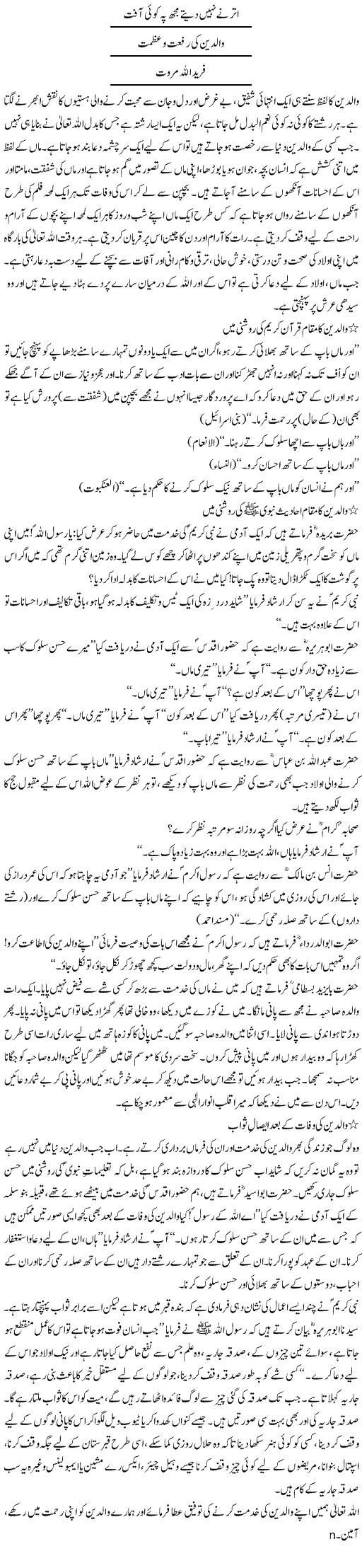
Waldain Ki Rifat-O-Azmat