TAG: Prophet Muhammad (peace be upon him)
Reflect, In The Name Of Islam
Whenever we see our reflection in a mirror what do we see? According to Allah, we should see a reflection of the Prophet (peace be upon him). But do we? The Qur’an says: “Indeed in the Messenger of Allah, you have a good example to follow for him who hopes for (the meeting with) Allah and the Last Day, and remembers Allah much” (Al-Ahzab, 33:21).
Prophet Muhammad (peace be upon him) is supposed to be our role model, our mirror image – that which we are striving to be and the human criteria for us to judge ourselves by. In reality, however, how many of us actually see this beautiful person when we gaze into our mirrors?
Let’s face it. The problem in the Muslim world today is the Muslims. Right now, the “enemies of Islam” are the people we see in the mirror. When we look in the mirror, we don’t see the Prophet (peace be upon him) – rather, what we see are the enemies of Islam.
Let’s go back to basics for a second because that’s really where the problem lies. How many Muslims in the world pray five times a day? And of those who do, how many pray in the congregation? What about Fajr prayers and `Isha?
Of those, how many pray with sincerity and concentration – in full awe of Allah’s greatness? How many perform ablution correctly? When you consider all of these together, the figure is probably less than one percent of all Muslims, and this is only one aspect of the basics of Islam.
Yet, despite this depressing reality about our Ummah, certain members of our community are quick to call for jihad, label non-Muslims as the “enemies of Islam,” or call other Muslims who may not follow their school of thought “kafir” (unbeliever). But what are we doing? Each and every one of us? And what about our families? And then, what about our communities?
As Ummah, we have strayed so far; yet, we still expect Allah to help us (which He often does in His infinite mercy despite the fact that we are not living up to our end of the contract). And we wonder why Allah allows our enemies victory over us.
When will we realize that Islam is not a religion of convenience? When will we stop acting like the Christians who believe that just because they are Christian, they are saved and forgiven and that Allah will help them just because they call themselves Christian? Islam is not a privilege – it is a responsibility.
When will we truly heed Allah’s word in the Qur’an when He says that He will not help a people until they help themselves? Why did the Prophet (peace be upon him), the Companions and scholars of Islam literally spend their entire lives and sacrificed so much to preach and demonstrate to us the correct way to live, and to provide us with all the knowledge and guidance we could ever need? So that we can disregard it – yet still claim to be the greatest Ummah ever and still expect Allah’s mercy and help?
In the Battle of Uhud during the time of the Prophet (peace be upon him), it was apparent that the Muslims – despite being outnumbered by the Quraysh – was going to enjoy an easy victory. However, at the point of triumph, the unit of archers that the Prophet (peace be upon him) had entrusted with the task of rear-guarding the Muslim army fled their positions, as they wanted to take part in collecting the war booty that they saw their brethren starting to collect. They felt that the battle was over, despite strict orders from the Prophet not to leave their posts until he gave the word – “even if you see us being killed, left right and center.”
Despite their disobedience at Uhud, these men were of the highest caliber, bravery, and iman, being Companions of the Prophet (peace be upon him). If Allah granted them defeat because of one act of disobedience, how is it that we can expect success in our endeavors despite our failure to obey Allah in even the most basic aspects of Islam?
The answer to our problems is simple – forget all the complications. The answer was given to us 1,400 years ago, and it is still the same as it has always been. Practice Islam. Just two words – practice Islam.
Don’t follow our desires, our lusts, greed, or emotions just practice Islam. This doesn’t require a new movement, a new sect, a new organization, a lot of arguments over minutiae, or fancy jargon. It just requires humility and effort. Our individual and collective will is in line with Allah’s Will. That’s it.
Start praying – five times a day, each time as if it is our last prayer. Start paying zakat and acting charitably, just like the Prophet (peace be upon him). Start fasting, with the consciousness of Allah. Start raising and teaching our children to be good Muslims, and to fear and love Allah more than anything else – regardless of what society might say.
Start reading and striving to understand the Qur’an. Start seeking knowledge. Start being kind and respectful to our wives, and following Prophet’s (peace be upon him) guidance as to how to treat one another. Start treating non-Muslims not as enemies, but as potential Muslims.
Start putting our egos aside and listening, asking questions, reading, and taking an interest in our education, and, ultimately, our fate. Start treating our neighbors in the way of the Prophet (peace be upon him), with kindness and respect. Start correcting our brothers and sisters when they are wrong in the best way, a way that will create change and not sew hatred. All in all, start practicing Islam.
Now, if all of us, or at least a good percentage of us, began to take these steps toward Allah – looking inwardly at ourselves and outwardly at those for whom we are responsible – what can we expect that Allah’s response would be? Just as the Hadith says, if we walk toward Allah, He will come running toward us. Many of us have experienced this individually, but what would happen if Muslims acted in such a way on a collective basis? One can only imagine, given an Ummah of over one billion followers. Details aside, we can be sure that some amazing things would happen – within ourselves, our communities, and throughout the entire world.
All of the horrible, un-Islamic, inhumane things happening in the world today are caused by illnesses of the heart. Although many of these things are not caused by Muslims, many unfortunately are. Regardless of who is to blame, the illnesses remain the same. Hearts are diseased, and disease likes company so people suffering from the same illnesses often act together in their attempts to bring down as many others as they can with them. The only solution, the only remedy is practicing Islam – not simply “being Muslim”.
“The Day whereon neither wealth nor sons will avail. Except him who brings to Allah a clean heart (clean from shirk, polytheism and nafaq).” (Ash-Shu’ara’, 26:88-89).
As Muslims, we need to stop talking about what is due to us and start thinking about what is due to us, and what and who we are responsible for.
We are responsible to Allah, first, for ourselves, and second, for the world. Thus, we cannot help the world figure out its mess until we clean up our own house, starting with each and every individual Muslim. We must begin the work of returning to Islam through practice. This is the only hope for us and, in effect, for the rest of Creation.
Biography Of A Woman Of Paradise
We do not know precisely how the young Abyssinian girl ended up for sale in Makkah. We do not know her ‘roots’, who her mother was, her father, or her ancestors. There were many like her, boys and girls, Arabs and non-Arabs, who were captured and brought to the slave market of the city to be sold.
A terrible fate awaited some who ended up in the hands of cruel masters or mistresses who exploited their labor to the full and treated them with the utmost harshness.
A few in that inhuman environment were rather more fortunate. They were taken into the homes of more gentle and caring people.
Barakah, the young Abyssinian girl, was one of the more fortunate ones. She was saved by the generous and kind Abdullah, the son of Abd al-Muttalib. ‘She became the only servant in his household and when he was married, to the lady Aminah, she looked after her affairs as well.
Two weeks after the couple were married, according to Barakah, Abdullah’s father came to their house and instructed his son to go with a trading caravan that was leaving for Syria. Aminah was deeply distressed and cried:
“How strange! How strange! How can my husband go on a trading journey to Syria while I am yet a bride and the traces of henna are still on my hands.”
Abdullah’s departure was heartbreaking. In her anguish, Aminah fainted. Soon after he left, Barakah said: “When I saw Aminah unconscious, I shouted in distress and pain: ‘O my lady!’ Aminah opened her eyes and looked at me with tears streaming down her face. Suppressing a groan she said: “Take me to bed, Barakah.”
“Aminah stayed bedridden for a long time. She spoke to no one. Neither did she look at anyone who visited her except Abd al-Muttalib, that noble and gentle old man. “Two months after the departure of Abdullah, Aminah called me at dawn one morning and, her face beaming with joy, she said to me:
“O Barakah! I have seen a strange dream.” “Something good, my lady,” I said.
“I saw lights coming from my abdomen lighting up the
mountains, the hills, and the valleys around Makkah.” “Do you feel pregnant, my lady?”
“Yes, Barakah,” she replied. “But I do not feel any discomfort as other women feel.” “You shall give birth to a blessed child who will bring goodness,” I said.
So long as Abdullah was away, Aminah remained sad and melancholic. Barakah stayed at her side trying to comfort her and make her cheerful by talking to her and relating stories. Aminah however became even more distressed when Abd al-Muttalib came and told her she had to leave her home and go to the mountains as other Makkans had done because of an impending attack on the city by the ruler of Yemen, someone called Abrahah. Aminah told him that she was too grief-stricken and weak to leave for the mountains but insisted that Abrahah could never enter Makkah and destroy the Kabah because it was protected by the Lord. Abd al-Muttalib became very agitated but there was no sign of fear on Aminah’s face. Her confidence that the Kabah would not be harmed was well-founded. Abrahah’s army with an elephant in the vanguard was destroyed before it could enter Makkah.
Day and night, Barakah stayed beside Aminah. She said: “I slept at the foot of her bed and heard her groans at night as she called for her absent husband. Her moans would awaken me and I would try to comfort her and give her courage.”
The first part of the caravan from Syria returned and was joyously welcomed by the trading families of Makkah. Barakah went secretly to the house of Abd al-Muttalib to find out about Abdullah but had no news of him. She went back to Aminah but did not tell her what she had seen or heard in order not to distress her. The entire caravan eventually returned but not with Abdullah.
Later, Barakah was at Abd al-Muttalib’s house when news came from Yathrib that Abdullah had died. She said: “I screamed when I heard the news. I don’t know what I did after that except that I ran to Aminah’s house shouting, lamenting for the absent one who would never return, lamenting for the beloved one for whom we waited so long, lamenting for the most beautiful youth of Makkah, for Abdullah, the pride of the Quraysh.
“When Aminah heard the painful news, she fainted and I stayed by her bedside while she was in a state between life and death. There was no one else but me in Aminah’s house. I nursed her and looked after her during the day and through the long nights until she gave birth to her child, “Muhammad”, on a night in which the heavens were resplendent with the light of God.”
When Muhammad was born, Barakah was the first to hold him in her arms. His grandfather came and took him to the Kabah and with all of Makkah, celebrated his birth. Barakah stayed with Aminah while Muhammad was sent to the badiyah with the lady Halimah who looked after him in the bracing atmosphere of the open desert. At the end of five years, he was brought back to Makkah and Aminah received him with tenderness and love and Barakah welcomed him “with joy, longing, and admiration”.
When Muhammad was six years old, his mother decided to visit the grave of her husband, Abdullah, in Yathrib. Both Barakah and Abd al-Muttalib tried to dissuade her. Aminah however was determined. So one morning they set off- Aminah, Muhammad, and Barakah huddled together in a small hawdaj mounted on a large camel, part of a huge caravan that was going to Syria. In order to shield the tender child from any pain and worry, Aminah did not tell Muhammad that she was going to visit the grave of his father.
The caravan went at a brisk pace. Barakah tried to console Aminah for her son’s sake and much of the time the boy Muhammad slept with his arms around Barakah’s neck.
The caravan took ten days to reach Yathrib. The boy Muhammad was left with his maternal uncles of the Banu Najjar while Aminah went to visit the grave of Abdullah. Each day for a few weeks she stayed at the grave. She was consumed by grief.
On the way back to Makkah, Aminah became seriously ill with fever. Halfway between Yathrib and Makkah, at a place called al-Abwa, they stopped. Aminah’s health deteriorated rapidly. One pitch dark night, she was running at a high temperature. The fever had got to her head and she called out to Barakah in a choking voice.
Barakah related: “She whispered in my ear: ‘O Barakah, I shall depart from this world shortly. I commend my son Muhammad to your care. He lost his father while he was in my abdomen. Here he is now, losing his mother under his very eyes. Be a mother to him, Barakah. And don’t ever leave him.’
“My heart was shattered and I began to sob and wail. The child was distressed by my wailing and began to weep. He threw himself into his mother’s arms and held tightly onto her neck. She gave one last moan and then was forever silent.”
Barakah wept. She wept bitterly. With her own hands, she dug a grave in the sand and buried Aminah, moistening the grave with whatever tears were left in her heart. Barakah returned with the orphan child to Makkah and placed him in the care of his grandfather. She stayed at his house to look after him. When Abd al-Muttalib died two years later, she went with the child to the house of his uncle Abu Talib and continued to look after his needs until he was grown up and married the lady, Khadijah.
Barakah then stayed with Muhammad and Khadijah in a house belonging to Khadijah. “I never left him and he never left me,” she said. One day Muhammad, may Allah bless him and grant him peace, called out to her and said: “Ya Ummah!” (He always called her “Mother”.) “Now I am a married man, and you are still unmarried. What do you think if someone should come now and ask to marry you?” Barakah looked at Muhammad and said: “I shall never leave you. Does a mother abandon her son?” Muhammad smiled and kissed her head. He looked at his wife Khadijah and said to her: “This is Barakah. This is my mother after my own mother. She is the rest of my family.”
Barakah looked at the lady Khadijah who said to her: “Barakah, you have sacrificed your youth for the sake of Muhammad. Now he wants to pay back some of his obligations to you. For my sake and his, agree to be married before old age overtakes you.”
“Whom shall I marry, my lady?” asked Barakah. “There is here now Ubayd ibn Zayd from the Khazraj tribe of Yathrib. He has come to us seeking your hand in marriage. For my sake, don’t refuse.”
Barakah agreed. She married Ubayd ibn Zayd and went with him to Yathrib. There she gave birth to a son whom she called Ayman and from that time onwards people called her “Umm Ayman” the mother of Ayman.
Her marriage however did not last very long. Her husband died and she returned once more to Makkah to live with her “son” Muhammad in the house of the lady Khadijah. Living in the same household at the time was Ali ibn Abi Talib, Hind (Khadijah’s daughter by her first husband), and Zayd ibn Harithah.
Zayd was an Arab from the tribe of Kalb who was captured as a boy and brought to Makkah to be sold in the slave market. He was bought by Khadijah’s nephew and put in her service. In Khadijah’s household, Zayd became attached to Muhammad and devoted himself to his service. Their relationship was like that of a son to a father. Indeed when Zayd’s father came to Makkah in search of him, Zayd was given the choice by Muhammad of either going with his father or staying with him. Zayd’s reply to his father was:
“I shall never leave this man. He has treated me nobly, as a father would treat his son. Not a single day have I felt that I am a slave. He has looked after me well. He is kind and loving towards me and strives for my enjoyment and happiness. He is the noblest of men and the greatest person in creation. How can I leave him and go with you?… I shall never leave him.”
Later, in public Muhammad proclaimed the freedom of Zayd. However, Zayd continued to live with him as part of his household and devoted himself to his service.
When Muhammad was blessed with prophethood, Barakah and Zayd were among the first to believe in the message he proclaimed. They bore with the early Muslims the persecution which the Quraysh meted out to them.
Barakah and Zayd performed invaluable services to the mission of the Prophet. They acted as part of an intelligence service exposing themselves to the persecution and punishment of the Quraysh and risking their lives to gain information on the plans and conspiracies of the mushrikin.
One night the mushrikun blocked off the roads leading to the House of al-Arqam where the Prophet gathered his companions regularly to instruct them in the teachings of Islam. Barakah had some urgent information from Khadijah which had to be conveyed to the Prophet. She risked her life trying to reach the House of al-Arqam. When she arrived and conveyed the message to the Prophet, he smiled and said to her:
“You are blessed, Umm Ayman. Surely you have a place in Paradise.” When Umm Ayman left, the Prophet looked at his companions and asked: “Should one of you desire to marry a woman from the people of Paradise, let him marry Umm Ayman.”
Ali the companions remained silent and did not utter a word. Umm Ayman was neither beautiful nor attractive. She was by now about fifty years old and looked rather frail. Zayd ibn al-Harithah however came forward and said:
“Messenger of Allah, I shall marry Umm Ayman. By Allah, she is better than women who have grace and beauty.”
Zayd and Umm Ayman were married and were blessed with a son whom they named Usamah. The Prophet, may Allah bless him and grant him peace, loved Usamah as his own son. Often he played with him, kissed him, and fed him with his own hands. The Muslims would say: “He is the beloved son of the beloved.” From an early age, Usamah distinguished himself in the service of Islam and was later given weighty responsibilities by the Prophet.
When the Prophet migrated to Yathrib, henceforth to be known as al-Madinah, he left Umm Ayman behind in Makkah to look after certain special affairs in his household. Eventually, she migrated to Madinah on her own. She made the long and difficult journey through the desert and mountainous terrain on foot. The heat was killing and sandstorms obscured the way but she persisted, borne along by her deep love and attachment for Muhammad, may God bless him and grant him peace. When she reached Madinah, her feet were sore and swollen and her face was covered with sand and dust.
“Ya Umm Ayman! Ya Ummi! (O Umm Ayman! O my mother!) Indeed for you is a place in Paradise!” exclaimed the Prophet when he saw her. He wiped her face and eyes, massaged her feet, and rubbed her shoulders with his kind and gentle hands.
At Madinah, Umm Ayman played her full part in the affairs of the Muslims. At Uhud, she distributed water to the thirsty and tended the wounded. She accompanied the Prophet on some expeditions, to Khaybar and Hunayn for example.
Her son Ayman, a devoted companion of the Prophet was martyred at Hunayn in the eighth year after the Hijrah. Barakah’s husband, Zayd, was killed at the Battle of Mutah in Syria after a lifetime of distinguished service to the Prophet and Islam. Barakah at this time was about seventy years old and spent much of her time at home. The Prophet, accompanied by Abu Bakr and Umar often visited her and asked: “Ya Ummi! Are you well?” and she would reply: “I am well, O Messenger of Allah so long as Islam is.”
After the Prophet, may Allah bless him and grant him peace, had died, Barakah would often be found with tears in her eyes. She was once asked, “Why are you crying?” and she replied: “By Allah, I knew that the Messenger of Allah would die but I cry now because the revelation from on high has come to an end for us.”
Barakah was unique in that she was the only one who was so close to the Prophet throughout his life from birth to death. Her life was one of selfless service in the Prophet’s household. She remained deeply devoted to the person of the noble, gentle, and caring Prophet. Above all, her devotion to the religion of Islam was strong and unshakable. She died during the caliphate of Uthman. Her roots were unknown but her place in Paradise was assured.
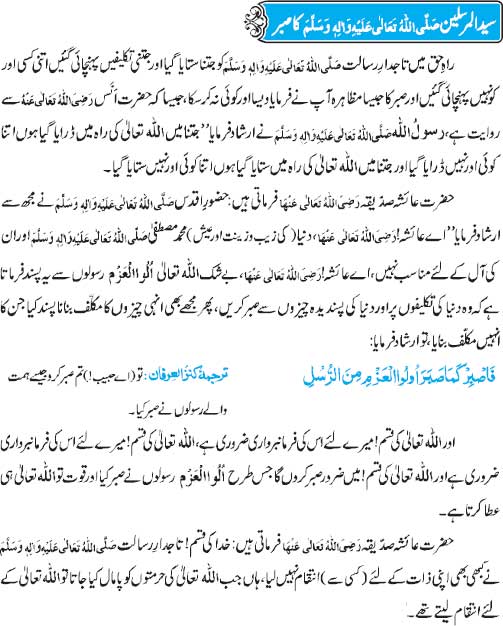
Syed Ul Mursaleen (PBUH) Ka Sabar

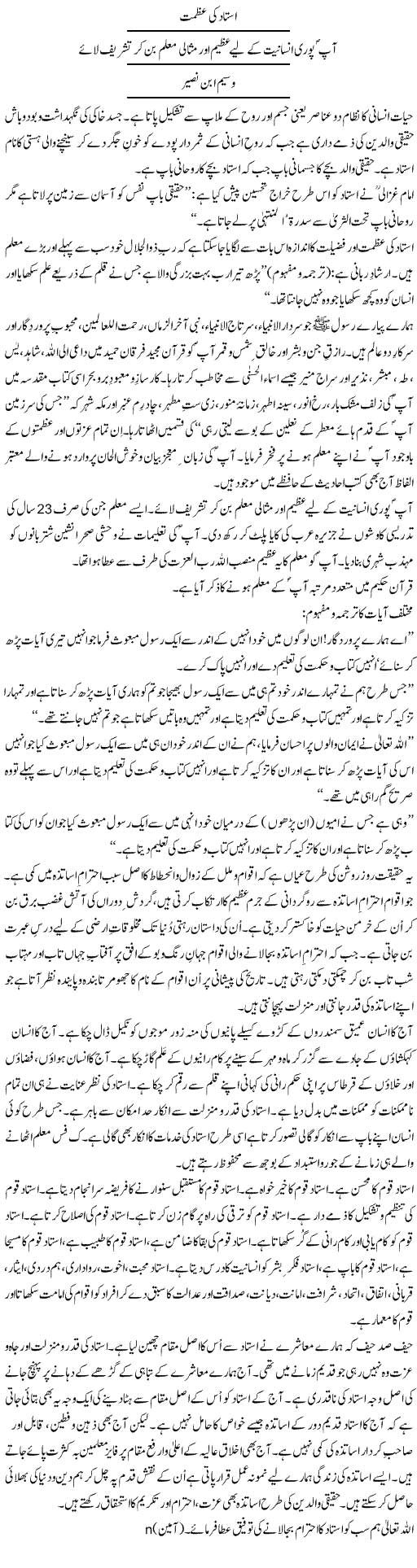
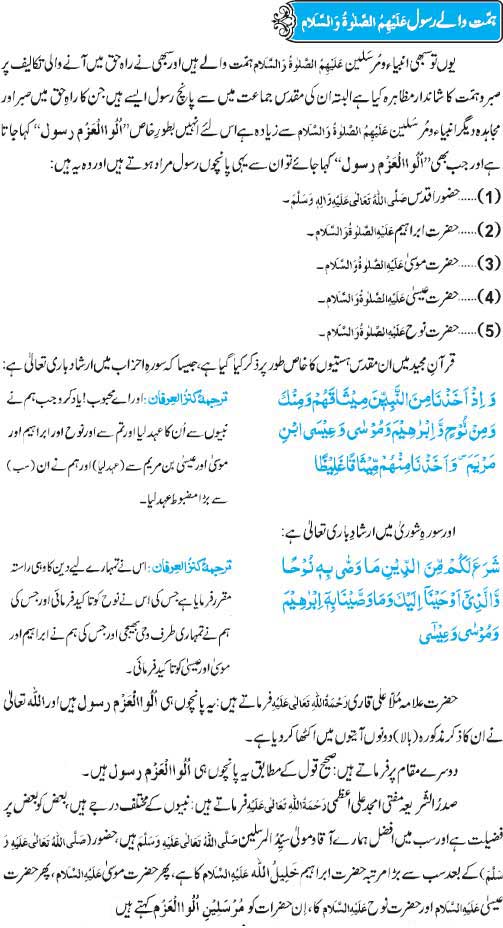
Ulul’azm Ambiya: Himmat Waley Rasool

Maidan E Qitaal Aur Tarbiyat Ka Ehtamam

By Hafiz Muhammad Idrees
Bidding Final Farewell To The Most Beloved
When news of the death of the Prophet (peace be upon him) was known, people were stunned. The believers felt that the whole city of Madinah sank into total darkness. They were like young children losing their parents. They did not know what to do. Despite the repeated hints by the Prophet of his impending death and the fact that the Qur’an mentions that possibility clearly, to lose him was, for his companions, something they could not imagine or visualize. He lived among them as one who was dearer to them than their souls. He was the sun of their lives. His death meant that they had to live in absolute darkness. For the Prophet to be withdrawn from their lives meant to them a vacuum that could never be filled. It was an event, which they could not imagine or comprehend. Some of them were physically paralyzed, others were dumb, and others still made statements, that they could not have thought out properly.
Umar ibn Al-Khattab himself could not make a proper judgment. He stood up to address the people and said: “Some hypocrites are alleging that God’s Messenger has died. God’s Messenger has not died. He has gone to his Lord as Moses (peace be upon him) had done before and was away from his people for 40 nights. He then returned after people had said that he had died. I swear that God’s Messenger shall return and chop off the hands and legs of those who allege that he has died.”
As Umar was making his speech, Abu Bakr arrived. He paid no attention to anything going on around him until he went into the room of his daughter Lady Ayesha, the Prophet’s wife. Abu Bakr went straight to uncover the Prophet’s face, knelt down, and kissed him, saying: “My father and my mother may be sacrificed for your sake. The one death that God has decreed that you shall experience, you have now had. You shall never die again.”
He covered the Prophet’s face and went out to find Umar still speaking to the people. Abu Bakr said to him: “Listen to me.” Abu Bakr began by praising God and thanking Him for His grace. He then said: “People, if any of you has been worshipping Muhammad, let him know that Muhammad is dead. He who worships God knows that God is always alive; He never dies.” He then recited a verse of the Qur’an, which may be translated as follows: “Muhammad is but a messenger before whom other messengers have passed. Should he die or be slain, would you turn back on your heels? He who turns back on his heels shall do God no harm. God shall reward those who give thanks to Him.” (3: 144)
When people heard Abu Bakr reciting that verse of the Qur’an, they seemed as if they had never heard it before. They had indeed heard it repeatedly, and they repeated it then. Umar said: “When I heard Abu Bakr reciting that verse I was stunned and perplexed. I fell down to the ground, feeling that my legs could not support me. I realized, however, that God’s Messenger was dead.”
The next thing to be done was to prepare the Prophet’s body for burial. His body needed to be washed like every dead person. Ali ibn Abu Talib, the Prophet’s cousin, and Al-Abbas’ two sons, Al-Fadl and Qutham, as well as Usamah ibn Zaid and Shaqran, the Prophet’s servant, were given that task. Aws ibn Khawli, a man from the Ansar, appealed to Ali to let him also attend. Ali supported the Prophet’s body on his chest, Al-Abbas and his two sons helped him turn the Prophet’s body while Usamah and Shaqran poured the water and Ali washed him.
Ayesha reports that when they were about to start washing the Prophet’s body, they did not know whether to take off his clothes or to wash him with his clothes on. They were in disagreement when they were overtaken by sleep. All of them sat down and dozed off. They heard a voice telling them to wash the Prophet’s body with his clothes on, so this was how they did it. They poured the water over his shirt and rubbed his body holding his shirt. They did not insert their hands underneath his shirt.
When they had finished washing him, they wrapped him in three robes. There were several suggestions concerning where to bury the Prophet. Some people suggested that he should be buried in his mosque. Others suggested that he should be buried alongside his companions. Abu Bakr, however, told them that he heard the Prophet say: “Every Prophet was buried in the place where he died.” That settled the matter. The bed on which the Prophet died was removed and his grave was dug there.
After the Prophet was wrapped for burial, he was put on his bed. Abu Bakr and Umar entered the room and said: “Peace be upon you, Messenger of God, with God’s mercy and blessing.” A number of the Muhajirin and the Ansar went in with them, as many as the room could accommodate. They spoke the same greetings and stood up in rows to offer the prayer for the deceased, the Janazah prayer. No one led the prayer as an Imam. Abu Bakr and Umar, however, were in the first row next to the Prophet. They said: “Our Lord, we bear witness that he has conveyed to us what has been revealed to him, given good counsel to his nation, struggled for God’s cause until God has given triumph to His religion at his hands, and until God’s words were complete. People believed in Him alone without partners. Our Lord, place us with those who follow the word revealed to him and join us to him so that he recognizes us and You make us known to him. For he was compassionate and merciful to those who believed.
When they had finished they left the room to allow another group of the Muslims to go in and offer the Janazah prayer for the Prophet. They were followed by other groups as the room could accommodate. When all men had offered their prayers, women went in also in groups to do the same. Children then followed in groups. However, there was no congregational prayer for the deceased. Everyone prayed on his own. This took the whole of Tuesday and the Prophet was buried on Wednesday.
Most reports confirm that the Prophet was 63 when he died, although some suggest that he was 65. Normally, prophets start to receive their revelations at the age of 40. The Prophet lived after that for 13 years in Makkah and 10 years in Madinah. That he was 63 is perhaps more accurate.
What Is Islam?
What is Islam?
Islam is an Arabic word meaning “surrender” or “submission.” It is a faith that encompasses approximately one-fifth of humanity. Its adherents reside in almost every country of the world and comprise majorities in large segments of Africa, the Middle East, the Indian subcontinent, and Asia. Approximately more than 6 million Americans follow Islam.
The Origins of Islam
The historical origins of Islam date back to seventh-century Arabia. The Prophet Muhammad (peace be upon him), an aristocratic Arabian born and raised an orphan in the sanctuary city of Makkah, experienced a revelation in his fortieth year. He began to preach to his own people, most of whom initially persecuted him. After thirteen years of suffering with patience and endurance, he migrated to the nearby city of Madinah. For over twenty-three years, beginning in 610 C.E., the Prophet orally transmitted the Qur’an. Muslims believe the Qur’an was revealed from God through the archangel Gabriel. In it, a cosmology, a theology, and an elaborate eschatology are described. By the end of the Prophet’s life in 632 C.E., almost the entire Arabian Peninsula had converted from paganism to Islam, and within a hundred years, its followers stretched from France to China.
Although considered the youngest of the three great Abrahamic faiths that include Judaism and Christianity, Islam does not view itself as a new religion but rather as a reformed Abrahamic faith. Muslims believe that the Qur’an corrects distortions of previous prophetic dispensations while not departing from the aboriginal faith of humanity, which according to the Muslims is Islam or submission to one God. While Muslims believe all prophets have taught the unity of God and that their beliefs about God were the same, their actual practices have changed to suit various times and places. According to Muslims, this is why religions tend to differ outwardly while retaining an essential inward truth common to them all. However, the Qur’an declares its message as uniquely universal applying to all people for all remaining time.
Fazail Syed Ul Mursaleen Muhammad (P.B.U.H)


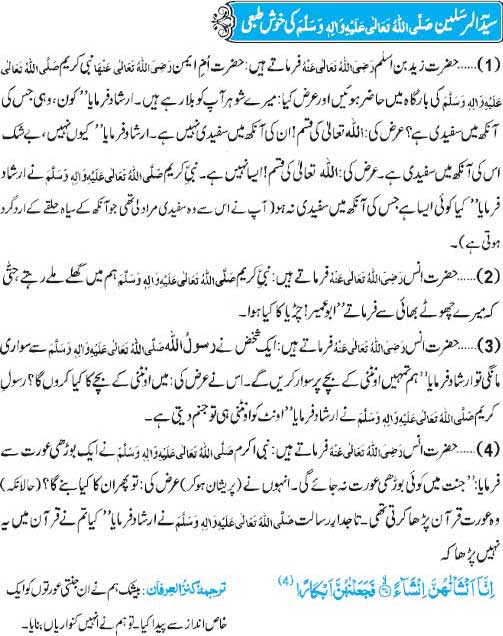
Hazoor ki Misal Koi Nahi