
TAG: Prophet Muhammad (peace be upon him)
Why Do We Follow The Sunnah?
Actually, some people claim that the Qur’an is so inclusive that there is no need for the Sunnah (the Prophetic Tradition). They support their claim by citing the Qur’anic verse, “…And We have sent down to you the Book (the Qur’an) as an exposition of everything” (16: 89)
However, this claim is completely wrong and rejected by the Qur’an itself. Allah Almighty says: ” .. And We have sent down unto you (O Muhammad, peace be upon him) the Dhikr [reminder and the advice (i.e. the Qur’an)], that you may explain clearly to men what is sent down to them, and that they may give thought.” (16: 44)
In addition, Allah declares that obeying the Prophet is obligatory, as it is part of obedience to Him (See: 3: 31; 4: 80; 33: 36; 47: 33; etc.) Therefore, it is not proper for a Muslim who knows Islamic law to say that following the Sunnah of the Prophet (peace be upon him) is not required.
By and large, the Qur’an sets the general rules without details. For example, there is no mention in the Qur’an that there are five obligatory prayers to be performed daily. Nor is the number of rakahs of each prayer specified, as well as the percentage of wealth to be paid in Zakah; the details in the rituals of Haj, and other such ordinances and dealings.
All of these details are elaborately dealt with in the Sunnah.
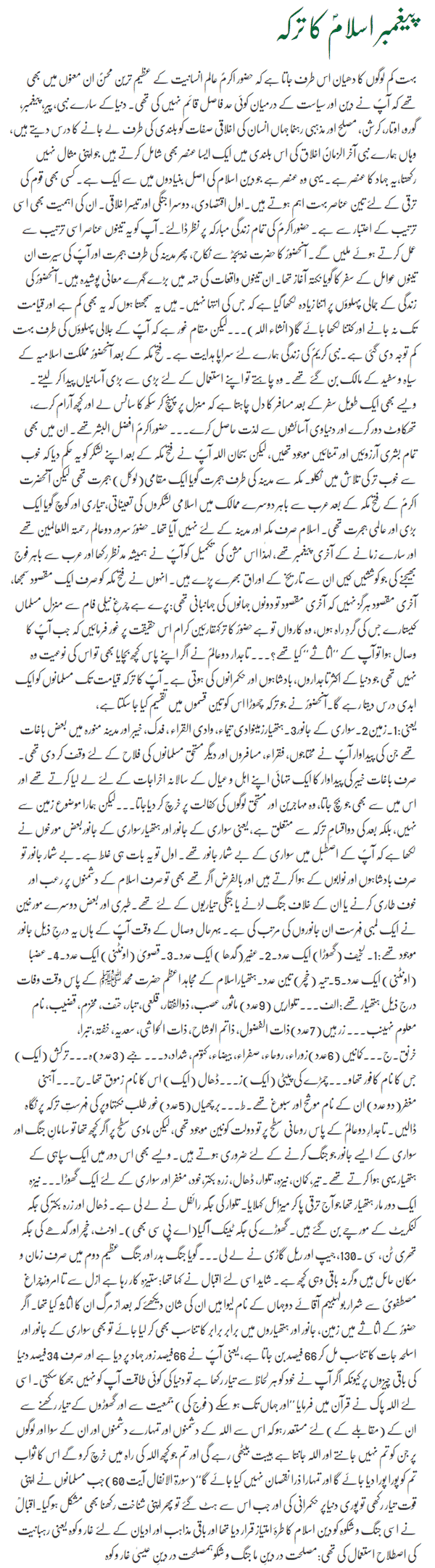
Peghambar-e-Islam Ka Turka
Prophet Muhammad (pbuh) – A Perfect Human Being In All Respects
We always stress that Muhammad (peace be upon him) was a human being who experienced all that a person may experience in life. However, he was chosen by God to be His messenger to mankind, bringing them God’s final message and providing them with practical guidance on how to conduct their lives in accordance with the teachings of God’s message.
We have detailed descriptions of what he looked like, but what is more important to us is to understand his character and how he behaved with other people. From these descriptions we gather that he was a rare example of Arab manly charm who combined all aspects of an attractive physical and personal appearance.
He was handsome, loveable, awe-inspiring, modest, loyal, loving and caring. He was very happy when he brought a smile to anyone, but his happiness would be greater if that person was a child, a helpless woman or an unfortunate elderly person.
The Prophet combined all this with exceptional physical strength and vigor. He consistently overcame strong people in combat. When he was still in Makkah, a man who was renowned for his strength and wrestling ability told Prophet Muhammad that he would believe in him as God’s messenger if he could beat him in wrestling.
The Prophet accepted the challenge and beat the man. The latter tried to find excuses and wanted the match to be restarted. The Prophet beat him again. Moreover, Prophet Muhammad (peace be upon him) could ride an unsaddled horse and easily tame and control him.
However, he did not use his physical strength to press any advantage over others, or to gain their love or respect. He wanted people to take everything easily and live with him as they live with a dear friend. With members of his family, he wanted life to run smoothly and showed them that he was one of them. He would even compete with those he loved in a pleasant way.
Ayesha reports that she was accompanying the Prophet on a journey when she was still young and thin.
“The Prophet told his fellow travelers to go ahead of them. He then said to me: Shall we race? We raced, and I won. He said nothing. Later, when I had put on some weight, we were on another trip, when he told other people to march ahead. He then said to me: Shall we race? We raced and he won. He laughed and said: We thus draw, one race each.” Thus, he took such things so lightly, even though he was approaching sixty years of age, and he was the head of a powerful state where he enjoyed unparalleled popular love.
Yet he would visit his servant’s family and extend his kindness to them. Anas ibn Malik was a servant at the Prophet’s home for 10 years.
The Prophet visited Anas’ home on numerous occasions. Anas reports: “The Prophet visited my mother and saw that my young brother, Abu Umayr, was sad. He asked her: ‘What grieves Abu Umayr?’ She told him that he had a little bird, which died that day. The Prophet asked my brother: ‘Abu Umayr, where is the little bird gone?’ He asked him the same question every time he saw him.
This incident tells us much about the Prophet’s kindness to all people. He visits his servant’s people in their home, and inquires about the reason for a child’s sadness, comforting him about the loss of his bird, and remembers his feelings every time he sees the child.
– by Adil Salahi
Anger Management: An Islamic Perspective
WE Muslims are followers of Prophet Muhammad (peace be upon him), right? What better example of patience do we have than that of our own blessed Prophet himself? Prophet Muhammad (peace be upon him), who was sent to mankind to teach them good moral conduct, learned to control his anger toward the unbelievers and teach them appropriate expressions. He used to speak against being angry. We think that we have it tough, when one of his days was probably tougher than the whole of our lifetimes! When we look at his life, our own difficulties seem so pathetic in comparison. Imagine spending 13 years completely devoting his life spreading the word of Islam and suffering hardship. This was a man who had the burden of the whole of mankind’s future on his shoulder. Yet he had the tolerance and self-discipline to be able to forgive those around him who were themselves so ignorant.
The best example of this was when the Prophet (peace be upon him) went to Ta’if at the time when the followers of Islam were at their weakest and the Prophet (peace be upon him) himself had suffered the loss of both his wife Khadijah (May Allah be pleased with her) and his uncle Abu Talib. He went to this town in the hope that they would listen to what he had to say. Instead he was insulted and chased out of the town by the children who threw stones at him till (it was described) the blood flowed from his body to his feet making his sandals sticky with his own blood. The Prophet (peace be upon him) was so depressed that he prayed to Allah, who then sent down the angel of the mountains who asked for the Prophet’s permission to fold the mountains together and crush to death all those that lived there. But what was the Prophet’s reply? “Yes, kill them all as they did not listen to me”? No, of course not! His answer was “No, I hope Allah will bring from them people who will worship Allah alone, associating none with Him.”
This was the example of the Prophet (peace be upon him), even though he felt bitterness and was very angry with them, he had the discipline and control to not let his emotions control his actions and he forgave them realizing that they were merely misguided.
One companion asked him : “Give me some advice by virtue of which I hope for good in the life Hereafter, and he said, “Don’t be angry.” Another person asked what would save him from the wrath of God, and the Prophet (peace be upon him) said, “Do not express your anger.”
Once the Prophet (peace be upon him) asked his Companions: “Who among you do you consider a strong man?” They said the one who can defeat so-and-so wrestler in a fight, and he said, that is not so. The one who is strong is the one who can control himself at the time of anger. He also said that “anger is like fire, which destroys you from within, and it can also lead you to the fire of Hell by your own expressions of anger unjustly.”
So being angry is similar to being drunk. In both cases, we do not know what we are doing, hurting ourselves or someone else, and afterwards when the intoxication is over, we repent.
Sheikh Hassan Al Basri said that one of the signs of the Believers is that his anger does not get on upper hand over him. One should distinguish between natural response to wrongdoing and disbelief. A person who has no feelings about oppression, wrongdoing and disbelief is, in fact, an impotent person emotionally. It has been said, “Evil flourishes when a few good people do not do anything to oppose it.” Thus response to injustice and operation in a civilized way is the appropriate expression of anger. Being neutral to injustice is equal to contributing to injustice.
The Purity of Islam
It is important in this present day that the children of Adam clearly understand the true meaning of Islam.
We must know the value of its purity, of its peacefulness, its unity, its sincerity, its honesty, and the value of its spirit and justice and truth. We must know the greatness of Allah Who rules over all this, and we must find tranquility in our lives, so that we will be able to guide others toward peacefulness.
To all those who have accepted Allah and His Messenger, Muhammad (peace be upon him), with perfect faith, certitude, and determination before we can bring peace to all life, before we can eliminate poverty, suffering, illusion, and disease in the world, before we can come to love every life as we do our own, we must first understand the value of absolute faith.
To have firm faith in Allah, the Almighty Lord, to know Him, to pray to Him, to believe with complete certitude in His messengers, prophets, and angels, to carry out the commandments sent through them, to bring into our consciousness His gracious qualities and all His attributes, and to dedicate our lives to His worship – this is the true meaning of Islam.
Islam is equality, peacefulness, and unity. Islam is inner patience, contentment, trust in Allah, and greatness of Allah. One who understands this and puts it into practice will be a true believer; he will know Allah and His commandments and practice the injunctions given through His revelations.
Allah sent His prophets to man to free him from his enslavement to earth, wealth, sensual pleasures, desires, thoughts and attachments. And yet man is suffering and can find no freedom; he is a slave to so many things. He has no peace, tranquility, equality, or love. The children of Adam must release themselves from the bondage of worldly pleasures.
If only man could acquire the wealth of Allah’s love and integrity, the wealth of His beautiful laws, then he would never lack in anything. That wealth is pure; it is the purity of Islam. If man had such inner wealth, he would never meet with loss in this world or in the Hereafter. He would be safe and secure in both worlds. Allah has asked mankind to accept this, to find freedom, and to raise the banner of unity on the staff of love.
People with strong faith know that it is important to cleanse their own hearts, while those with unsteady faith seek to find fault in the hearts and prayers of others. This becomes a habit in their lives. But those who pray to Allah with faith, determination, and certitude know that the most important thing in life is to surrender their hearts to Allah.
If the fountain of the heart is full, then all creations can come and partake of its clear water. If it is shallow, then all those who come will stir up the mud and have nothing but dirty water to drink.
Let us constantly strengthen our faith, certitude, and determination. Allah sent this gift of faith to each of the prophets and finally gave it in perfection to Prophet Muhammad (peace be upon him). The fundamental explanations of perfect faith were given to Allah’s messengers, and they in turn shared them with mankind. There are very deep meanings to be found in these.
Sawdah Bint Zam’ah (Radi allahu anha)
Prophet Muhammad (peace be upon him) married Sawdah bint Zam’ah (radi allahu anha) a short while after the death of his first and most beloved wife, Khadijah (radi allahu anha) , with whom he shared a very happy 25 years of his blessed life. Sawdah (radi allahu anha) was a mature woman, around 40 years of age, and a mother of five children. This marriage gave Sawdah (radi allahu anha) uplift in her life, for she had been mourning her husband, Al-Sakran ibn Amr, who died soon after the couple had returned from Abyssinia, where a number of the Prophet’s companions had gone a few years earlier to establish a second base for Islam, away from the persecution in Makkah. She was now married to God’s messenger, who was renowned for his fine character and compassion, in addition to the great qualities that fitted him to be the recipient of God’s final message to mankind.
Scholars and writers about the Prophet and his character often explain his marriages in terms of different needs: Some political, others social, and some even legislative. While such reasons were certainly present in many of his marriages, they are not the overriding reasons for any. Each of his marriages expressed a desire to be united with the lady in question. In Sawdah’s case, we read explanations that he wanted to compensate her for the loss of her husband. The fact is that the Prophet needed a new wife after Khadijah (radi allahu anha) had passed away, and the qualities he needed in his new wife were maturity, kindness, and being a believer in his message. Sawdah (radi allahu anha) answered all these. She was the one to take care of his two unmarried daughters, Umm Kulthoom (radi allahu anha) and Fatimah (radi allahu anha) .
We see some aspects of Sawdah’s (radi allahu anha) maturity in the fact that when other wives came into the Prophet’s home and jealousies surfaced between them, leading to the emergence of two camps, Sawdah (radi allahu anha) did not join either group. She remained loyal to her husband, giving him all that he needed love and care. Nor did she ever express, in word or gesture, any feeling of jealousy when she realized that the Prophet’s heart leaned toward a particular one of his wives. On the contrary, we see her rising to the sublime as she realized that the Prophet’s heart favored Aishah (radi allahu anha) above all others, but he had to maintain fairness between all his wives. He would not allow himself to give Aishah (radi allahu anha) an hour more than he would give every one of his other wives. Therefore, in her eagerness to please the Prophet, Sawdah (radi allahu anha) made a gift of her nights to Aishah (radi allahu anha) . This was a voluntary gift, motivated only by her desire to please her husband. Thus, every time it was Sawdah’s (radi allahu anha) turn, the Prophet would visit her in the evening before going to spend the rest of the night at Aishah’s (radi allahu anha) place.
Sawdah’s (radi allahu anha) action speaks much about her character. She was a woman who loved to be kind to others and enjoyed giving them what pleases them.
She wished to remain married to the Prophet and be always remembered by Muslims throughout the world as a ‘mother of all believers’ as his wives earned this title. At the same time, she wanted to give greater pleasure to her husband and the one whom he loved most among his wives. Hence, her gift became a model for any woman who wishes to forego some of her rights in order to please her husband.
Sawdah (radi allahu anha) died toward the end of Umar’s reign, about ten years after the Prophet had passed away.
Prophet’s (peace be upon him) Mercy To Animals
Allah said in the Qur’an that Prophet Muhammad (peace be upon him) was a mercy, not only for human beings and jinn, but also to the entire creation. His kindness is exemplary even when it comes to animals, who are very often neglected.
While he permitted to use animals for specific purposes, he forbade misusing or abusing them. Muhammad Al-’Arifi mentions this aspect of the Prophet (peace be upon him) in his book “Enjoy your life” published by Darussalam.
ONCE, when the Prophet (peace be upon him) was on a journey with his companions, he stopped over to answer the call of nature. Meanwhile, some of his companions noticed a redstart bird with two chicks. They took the chicks away. The bird came and began to circle around them flapping its wings. When the Prophet (peace be upon him) came and saw the scene, he turned to his companions and said, “Who distressed the bird by taking its chicks from it? Return the chicks to the bird!”
On a different occasion, the Prophet (peace be upon him) noticed a burnt ants’ nest. “Who burnt the nest?” he demanded.
One of his companions replied, “I did.”
The Prophet (peace be upon him) became angry and said, “No one but Allah punishes with fire!”
The Prophet (peace be upon him) was so merciful that if he saw a cat whilst he was performing ablution, he would lower the utensil down for the cat to drink from and then perform ablution from the leftover water.
Once he passed by a man who had laid a sheep on the ground and placed his foot on its neck to slaughter it while sharpening the knife as the sheep looked on. The Prophet (peace be upon him) became angry upon seeing this and said, “Do you want it to die twice? Why didn’t you sharpen your knife before you laid it on the ground?”
On another occasion, he (peace be upon him) passed by two men in the middle of a conversation and each of them was sitting on his camel. When he saw this, he felt pity for the camels and therefore forbade people from using animals as chairs, meaning that one is not to mount it except when required and that when the need is fulfilled, one should dismount and allow it to rest. The Prophet (peace be upon him) also forbade branding an animal on its face.
Universal Facts About Sayyiduna Rasool-Allah (Salallaho Alaihi Wasallam)
Sayyiduna Rasoolullah (sallal laahu alaihi wasallam) occupies an exalted, everlasting, and the most unique position in the religious history of mankind. Of all the Founders of Religion, only Sayyiduna Rasoolullah (sallal laahu alaihi wasallam) is the first and the last to claim that the Message that he brought from Allah Ta’ala to mankind is absolutely complete and final, that his dispensation shall remain in force till the end of the world, and after him, no Divine Messenger will come to modify, add, subtract or abrogate any of his teachings. In him, the institution of Prophethood attained its full, final, and most perfect form.
History shows that the world from the beginning has not produced any other man who can rival the Prophet of Islam (sallal laahu alaihi wasallam) in the field of his teachings, his actions, his deeds or practical way of life.
It was Hazrat Muhammad’s (sallal laahu alaihi wasallam) grandest contribution to the elevation of his fellow-men that he re-affirmed the sovereign principle of Monotheism and universal brotherhood of man transcending all barriers that people erect in ignorance and fear. Hazrat Muhammad (sallal laahu alaihi wasallam) arose in the midst of a society that was cruelly barbarous, which had no culture, no manners, no society, and no civilization. Humanity was coming very close to calamity. Imagine the same society is today the noble torch-bearer of a new and excellent civilization. This is one of the main miracles the Prophet of Islam (sallal laahu alaihi wasallam) performed and world history bears testimony to this truth. In a short span of 23 years, he brought under one banner a most barbarous tribe spread over 2 000 000 square miles of a very remote region of the world.
It is a universal fact that Hazrat Muhammad (sallal laahu alaihi wasallam) is the only Prophet in whose honor praises have been sung by all other religious leaders and some have rather recommended to their followers to follow the path of this great Prophet. People like Guru Nanak, the spiritual head of the Sikh sect, and George Bernard Shaw, the philosopher, are such personalities.
Sayyiduna Rasoolullah (sallal laahu alaihi wasallam) accomplished what he undertook in his own short span of life with limited means and all-round adversities, trials tortures, and tribulations. The task that he accomplished, the work that he did, the manners and the character that he exhibited, and above all, the way in which he completed this stupendous task, is itself clear proof of his being the last and the living Messenger of Allah whose religion is perfect, character blotless and complete, and teachings marvelous in all respects.
What he preached appealed to man’s reasons and rational faculties rather than to mere sentimentalism, fanaticism, irrationality, and superstition. He showed what was crystal clear.
Although he was an apostle, philosopher, reformer, religious head, statesman, orator, commander, soldier, administrator, and the head of state, he never sat an inch above the place where his followers used to sit or ate a morsel more than his Companions ate or wore what was superior than what others used to wear. He was a selfless and sincere friend, a perfect guide, a graceful companion, a loving teacher, an impartial judge, and above all a simple and straightforward person. He sat in such a simple attire and mixed up so freely and simply with all the common people that the foreign delegations visiting his capital used to inquire from others as to who the Prophet of Islam was. Can any head of the state or any religious head in any part of the world boast to possess such an amicable nature? Can any head of state be so courageous?
History has known many great and glorious civilizations. The main among them are the Chinese civilization, Greek civilization, Roman civilization, Marxism, and Imperialistic. None owes its origin and establishment to a single individual. Nor can it be counted as everlasting. Moreover, these civilizations of the world covered a certain field and certain parts of the world. All the civilizations were basically collective efforts of many, but Sayyiduna Rasoolullah (sallal laahu alaihi wasallam) gave Islamic civilization single-handedly for all times to come.
Over the hills of Makkah, there was a heavenly glow. The birth of our Prophet (sallal laahu alaihi wasallam) was an earth-shaking event in the year 570 A.D. Born in the most backward and uncivilized city of Makkah in the Middle East, lived only 63 years in this world, remained unlettered throughout, but changed the destiny of the entire humanity. The whole culture of humanity and the existence of the human race was revolutionized during these 23 years of his Prophethood and throughout the world, he was the only single person with multiple capacities who could successfully carry out this stupendous task in such a short span of time and amidst untold adversities. He was the Prophet who uprooted Polytheism once and for all.
His father, Hazrat Abdullah (radi Allahu anhu) and mother, Bibi Aaminah (radi Allahu anhu), passed away after his birth. His grandfather, Hazrat Abdul Mutallib (radi Allahu anhu), who took care of him, too soon passed away. He was thus an orphan. Dai Halimah (radi Allahu anha) took care of him for full five years in the desert. But no one knew at that time that this shy, sweet and sublime orphan will grow up to be the greatest and the last Prophet of Allah and show the world the real path to salvation in the most simple and straightforward style. They never knew that he is Mercy for them as well as for all the worlds and all the generations and all ages so long as the world lasts. Allah Ta’ala says in the Holy Quran: “We sent to you not but as a Mercy for all mankind“.
The personality of Sayyiduna Rasoolullah (sallal laahu alaihi wasallam) is the most perfect and profound in history. A personification of the moral code of life as enshrined in the Holy Quran, he created a moral society and a just State that blended the spiritual with the temporal in the most beautifully balanced synthesis. This was the only Prophet whose words and deeds were 100% alike. He preached what he and his Companions practiced, he treated the King and commoner alike. He was sweet, simple, civil, and kind to each and every one. He never hurt the feelings of even his deadliest enemy.
Sunnahs Of Prophet Muhammad [PBUH]
Sunnahs of Prophet Muhammad [PBUH]
A Quick Refresher – Sunnahs of Our Beloved Prophet Muhammad [PBUH]
Sunnahs of Eating:
- Sit and eat on the floor.
- Spread out a cloth on the floor first before eating.
- Wash both hands up to the wrists.
- Recite ‘Bismillah wa’la barakatillah’ aloud.
- Eat with the right hand.
- Eat from the side that is in front of you.
- If a morsel of food falls down, pick it up, clean it and eat it.
- Do not lean and eat.
- Do not find fault with the food.
- Remove your shoes before eating.
- When eating, sit with either both knees on the ground or one knee raised or both knees raised.
- Clean the plate and other utensils thoroughly after eating.
- By doing this, the utensils make dua for one’s forgiveness.
- Recite dua after eating.
- First, remove the food then get up.
- After meals wash both hands.
- Thereafter gargle the mouth.
- Whilst eating one should not remain completely silent.
- Eat with three fingers if possible.
- One should not eat very hot food.
- Do not blow on the food.
- After eating one should lick his fingers.
Sunnahs of drinking:
- A Muslim should drink with the right hand. Shaytaan Drinks with the left hand.
- Sit and drink.
- Recite ‘Bismillah’ before drinking.
- After drinking say ‘ Alhamdullilah’.
- Drink in 3 breaths removing the utensil from the mouth after each sip.
- Do not drink directly from the jug or bottle. One should pour the contents into a glass first and then drink.