
TAG: Prophet Muhammad (peace be upon him)
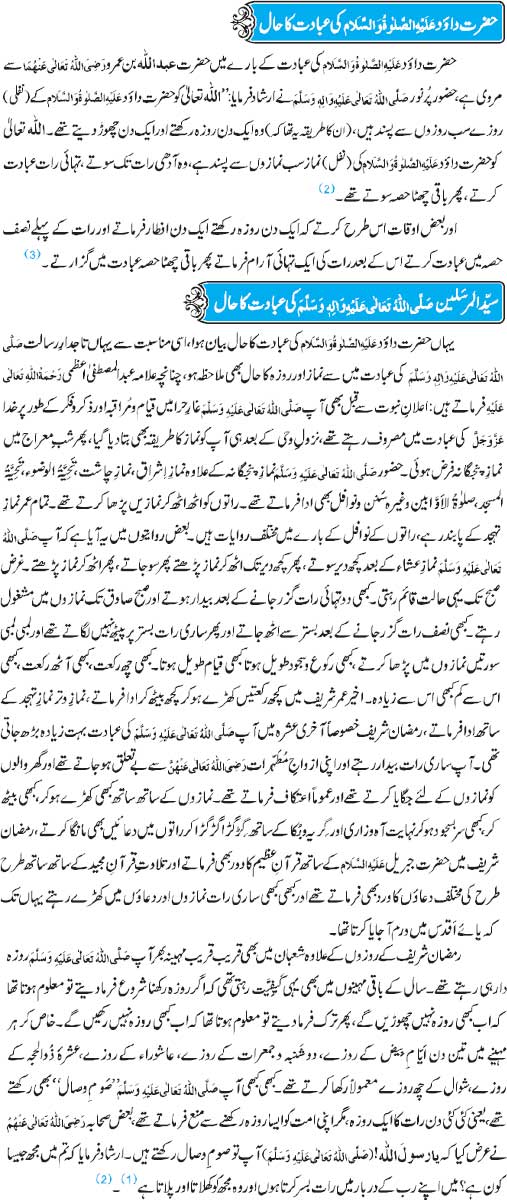
Hazrat Dawood(A.S) Aur Syed-Ul-Mursaleen(PBUH) Ki Ibadat Ka Hall
What Sort Of Married Life
When we try to discern the sort of life the Prophet (peace be upon him) had before the start of his message, we have few reports to hand. Interest in his personal life did not develop until later. Before prophethood, he was an ordinary man living in his community. While he did not take part in idol worship and did not attend festivals organized in the name of any idol, he did not stand out as different from other people. He was well known for his honesty and integrity. In fact, people in his community nicknamed him Al-Ameen, which meant the Trustworthy. People trusted him in every way, realizing that he was a man of his word, and he never tried to cheat in any situation. This earned him immense respect in his community. People continued to deposit their valuables with him for safekeeping, even when they were determinedly opposed to his message.
From the few reports that we have of his life after his marriage, up until he received the Angel Gabriel who told him of his assignment as God’s last messenger to mankind, we realize that he led a very happy life, with a caring and loving wife, Khadijah. She recognized his exceptional qualities and provided him with a comfortable home. Many years later, when he had established the first Muslim community and first Muslim state in Madinah, he mentioned that he had a business partner in Makkah called Al-Saib and he praised his partner for his integrity. This suggests that the Prophet continued to run his wife’s business, as he had no money of his own while she was a wealthy lady who employed people to travel on her business. This was how she met Muhammad and recognized his personal qualities. He must have been successful in this, ensuring a comfortable standard of living. When Makkah went through a rough period and people found it difficult to cope, Muhammad (peace be upon him) said to his uncle Al-Abbas: “Your brother, Abu Talib, has a large family and things are hard for everyone. Let us both help him: you take one of his children and I take one to reduce his burden.” This is how Ali came to live with the Prophet in his home, giving him a good upbringing.
Khadijah was a model wife: loving, caring, supporting, and providing everything a man needs. We have good reports about her support when the Prophet was met with open hostility and determined opposition as he called on people to believe in God and abandon idolatry. Yet this was not new in their relationship. A few years before he began to receive his message, the Prophet used to spend time alone in a cave, in contemplation. She made sure that he lacked nothing. When once his absence was a little longer than usual, she sent a few of her servants looking for him.
Her exceptional care stands out when he received the Angel for the first time. This was not an easy encounter. How could it be when there is nothing in human experience to prepare him for it? He was in fear as he looked at the Angel standing above him, with his head high in the sky, and he told him: “You are the Prophet of this community.” It was Khadijah who reassured him, feeling that a man of his upright nature could not be deceived on such a momentous matter. She enlisted the learned support of her cousin, Waraqah ibn Nawfal, who had studied the Bible and gained exceptional experience in religious matters. The two comforted him and helped him recognize the way that he was to lead as God’s messenger. Khadijah’s support was the best he could have received in his hour of great need.
– By Adil Salahi
Eating Habits And Diet Of The Prophet
The Prophet’s guidance with regard to food is perfect guidance. It was described by Ibn al-Qayyim as follows: When he put his hand in the food, he would say, “Bismillaah (in the Name of Allah), and he told people to say this when eating.
He said, “When any one of you eats, let him mention the name of Allah. If he forgets to mention the name of Allah at the beginning, let him say Bismillaahi fi awwalihi wa aakhirihi (in the name of Allah at its beginning and at its end).”
Saheeh hadeeth, narrated by al-Tirmidhi (1859) and Abu Dawood (3767).
When he raised the food to his mouth, he would say,
“Al-hamdu Lillaahi hamdan katheeran tayyiban mubaarakan fihi ghayri makfiyyin wa laa muwadda wa laa mustaghni ‘anhu Rabbanaa azza wa jall (Allah be praised with an abundant, beautiful, blessed praise. He is the One Who is Sufficient, Who feeds and is never fed, The One Who is longed for, along with that which is with Him, and the One Who is needed. He is Our Lord, may He be glorified).
Narrated by al-Bukhaari (5142).
He never criticized food at all. If he liked it, he would eat it, and if he did not like it, he would leave it and not say anything.
Narrated by al-Bukhaari (3370) and Muslim (2064).
Or he would say, “I do not feel like eating this.” Narrated by al-Bukhaari (5076) and Muslim (1946).
Sometimes he would praise the food, as when he asked his family for food, and they said, “We have nothing but vinegar.” He asked for it and started to eat it, saying, “What a good food is vinegar.”
Narrated by Muslim (2052)
He used to talk whilst he was eating, as is seen from the report quoted above about vinegar.
And he said to his step-son Umar ibn Abi Salamah when he was eating with him: “Say Bismillaah and eat from that which is in front of you in the dish*.” Narrated by al-Bukhaari (5061) and Muslim (2022).
[* At the time of the Prophet (peace and blessings of Allah be upon him), people used to eat together from one dish, and children would sometimes forget the correct etiquette. – Translator]
He would repeatedly urge his guests to eat, as generous hosts do, and as is seen in the hadeeth of Abu Hurayrah, narrated by al-Bukhaari, about the story of drinking milk, where he repeatedly said to him, “Drink!” and he kept telling him to drink until he (the guest) said, “By the One Who sent you with the truth, I have no more room for it!”
Narrated by al-Bukhaari (6087).
When he ate with others, he would not leave until he had made dua for them.
He made dua in the house of Abd-Allah ibn Bisr, and said: “O Allah, bless for them that which You have provided for them, forgive them and have mercy on them.”
Narrated by Muslim (2042).
He commanded people to eat with their right hands and forbade them to eat with their left hands. He said, “The Shaytaan eats with his left hand and drinks with his left hand.”
Narrated by Muslim (2020).
This implies that eating with the left hand is haraam, and this is the correct view, because the one who eats with his left hand is either a Shaytaan (a devil), or he is imitating the Shaytaan.
It was also reported in a Saheeh hadeeth that he told a man who was eating with his left hand in his presence, “Eat with your right hand!”
The man said, “I cannot.”
He said, “May you never be able to!” – and the man never lifted his right hand to his mouth after that. Narrated by Muslim (2021).
If it was permissible (to eat with the left hand), he would not have prayed against him for doing so. It was the man’s stubborn arrogance that made him refuse to obey the command, and this is the utmost disobedience that deserved this prayer against him.
He commanded those who complained that they never felt full to eat together and not separately, and to mention the name of Allah (say Bismillaah) over the food so that He might bless it for them.”
Narrated by Abu Dawood (3764) and Ibn Maajah (3286). (See Zaad al-Maaad, 2/397-406)
It was also reported that he said, “I do not eat reclining.”
Narrated by al-Bukhaari, 5083.
He used to eat using the first three fingers (of his right hand), which is the best way of eating.
See Zaad al-Maaad, 220-222.
The Prophets guidance regarding diet:
The Prophet (peace and blessings of Allah be upon him) used to know what he was eating. He used to eat what was good for him. He used to eat enough to keep him going, but no so much as to make him fat.
Ibn Umar narrated that the Prophet (peace and blessings of Allah be upon him) said: “The believer eats in one stomach whilst the kaafir eats in seven.” Narrated by al-Bukhaari (5081) and Muslim (2060).
He taught his ummah something to protect them from diseases caused by eating and drinking.
He said: “The son of Adam does not fill any vessel worse than his stomach. It is sufficient for the son of Adam to eat a few mouthfuls, to keep him going. If he must do that (fill his stomach), then let him fill one third with food, one third with drink, and one third with air.”
Narrated by al-Tirmidhi (1381), Ibn Maajah (3349); classed as Saheeh by al-Albaani in al-Silsilah al-Saheehah (2265).
And Allah knows best.
Khatam e Nabuwat: Hazrat Muhammad (P.B.U.H)

Qur’an: Witness The Miracle
Night after night in Ramadan, the believers witness a unique spectacle at mosques around the world. They stand in special Taraweeh prayers in which the prayer leader will recite the entire Quran from memory. Those who have accomplished this extraordinary feat of memorizing all of the 6246 verses are not a handful of devotees but there are hundreds of thousands of them. Most, just like most Muslims in the world today, do not speak Arabic. Yet they have painstakingly learnt to pronounce each and every word of the Quran correctly. The phenomenon is not a result of some religious resurgence that would pass. From the very first day that the Quran was revealed, it was memorized. And the number of those who have memorized it has been increasing ever since. Memorization of the Quran has been going on all through the centuries, all over the globe wherever Muslims are.
There are other religions that claim to possess the Word of God. There are none that can show a book that has commanded anything remotely comparable to this level of devotion. Quran is the most read and the only completely memorized book in the whole world. It is also the most studied book in the world. It has stimulated the development of entire disciplines of knowledge dealing with its reading, writing, and interpretation.
Miraculous as it is, this is not the only unique aspect of the Quran.
Quran was the first book in the Arabic language. Yet fourteen centuries later, its language is as alive as it was when it was revealed. And there is no other example of when the very first book in a language became any masterpiece let alone the eternal masterpiece that the Quran is.
This Book is meant to command and guide humanity until the end of time. That the passage of fourteen centuries has not made the slightest dent in its language or literary beauty is only one evidence of that unique role; its contents have also been unassailable by the passage of time. It makes statements of scientific facts that science would discover centuries later but none that science could ever refute. It tells about ancient histories, like the civilization of the ‘Aad people in the Empty Quarter of the Arabian desert that no other historical sources, then or since, contain any information about. Yet, its veracity has only recently been verified by scientific discoveries. Above all, it provides a system of beliefs and a code of conduct for life that is as relevant, illuminating, and true today as it was fourteen centuries earlier and during all the centuries in between.
The believers know that this Book had to be above space and time because this is the Word of the Creator of space and time. And He has promised that it will always be above space and time. But those who are looking from the outside and are just curious may consider these additional facts:
Prophet Muhammad, Sall-Allahu alayhi wa sallam, did not go to any school, study from any teacher, or even learn how to read and write. He even had no interest in poetry, which was one of the most prized disciplines of his time. Yet suddenly at age forty, he began to recite this marvelous revelation.
The style of the Quran is very distinct from the words of the Prophet, Sall-Allahu alayhi wa sallam, himself, which also have been preserved in Hadith collections. His own sayings are embodiments of eloquence, but they have a different style. Moreover, they clearly are the words of a human being. Although never deviating from the truth, they do show human emotions and the effects of the circumstances in which they were said. Quran, on the other hand, never shows the slightest trace of these effects. It always speaks from above.
It was revealed over a twenty-three-year period and covers a very wide range of subjects yet it shows neither a gradual development of style nor any self-contradictions in the voluminous text.
The twenty-three years of Prophetic life was not a period spent in isolation. He did not retire to a cave to produce this miraculous work. The Prophet, Sall-Allahu alayhi wa sallam, did spend long periods of time in quiet meditation in Cave Hira before becoming a Prophet. But after Prophethood was conferred upon him, his life was one of constant struggle with the pagans, and later the Jews, of Arabia who spared no effort to stop and persecute him. It was during this period of persecution, wars, campaigns, and solving problems associated with the bringing about of the greatest civilizational revolution of all times — an extremely busy and challenging period — that Quranic Revelation was also received and compiled.
The Prophet, Sall-Allahu alayhi wa sallam, himself was most deeply moved by the Book. He used to stand for hours in solitary midnight prayers reciting from the Book until his feet used to get swollen. How preposterous that one should attempt to attribute the Book to him. Has there ever been another example of somebody getting so moved by his own words?
This is not meant to be an exhaustive list of all the evidence that proves the Quran to be the Word of God. Scholars have written books expounding the miracle of miracles that the Quran is. But even this small sampler may propel an inquiring mind to go and read the Book himself.
To read this book with an open mind is to believe in it. Those who sincerely seek guidance will find their questions answered, their confusions removed, their problems solved in its pages. From the beginning until the end, every word in the Quran tells the reader that it is the Word of Allah. And those who ignore it do so at their own peril.
“And if you are in doubt as to what We have revealed to Our servant, then produce a Sura like thereunto; and call your witnesses or helpers (if there are any) besides Allah, if your (doubts) are true. But if you cannot – and of a surety, you cannot – then fear the Fire whose fuel is men and stones which is prepared for those who reject Faith.” [Al-Baqarah 2:23-24]
By Khalid Baig
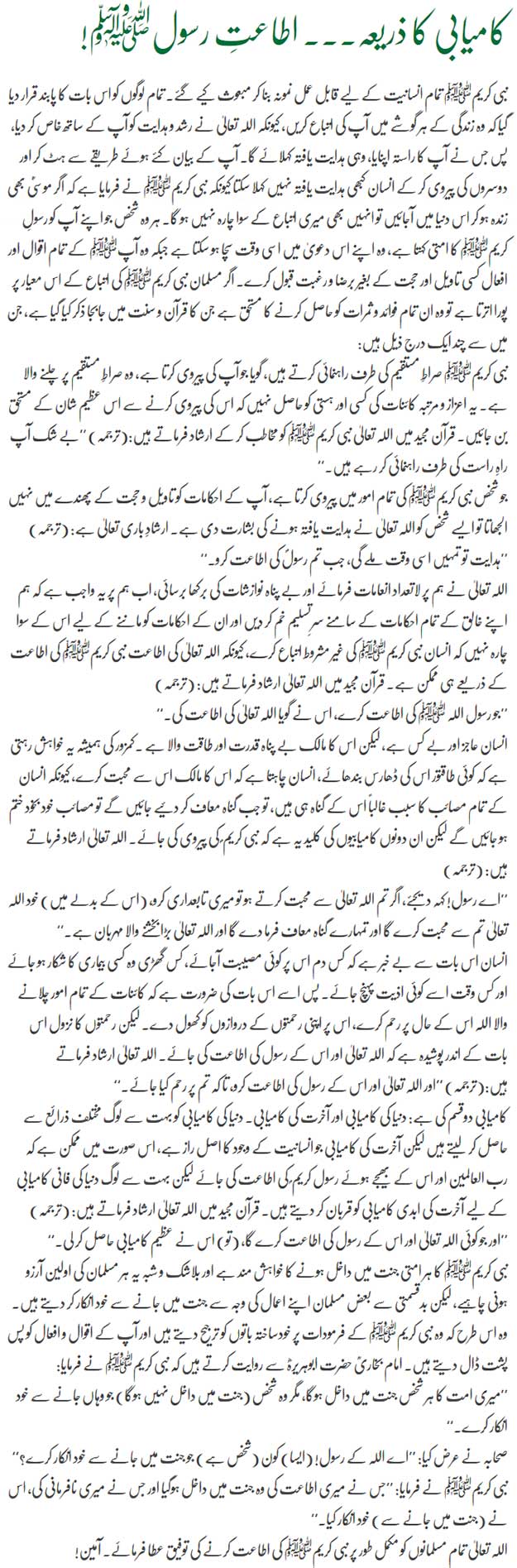
Kamyabi Ka Zirya – Ataat E Rasool (SAW)
Twelve Proofs That Muhammad (s.a.w.s.) Is A True Prophet
My brothers and sisters everywhere! with this essay, I am not singling out the adherents of Islam – to which I ascribe- but rather I am writing this essay to every man and woman throughout the whole world. I ask Allah that He facilitates that this essay reaches every ear, falls under the sight of every eye, and is understood by every heart… Muhammad (s.a.w.s.) the son of `Abdullah is Allah’s Prophet and the Final Messenger Sent by Allah to the Inhabitants of Earth.
My brothers and sisters everywhere! You should know that the Messenger, Muhammad the son of `Abdullah (s.a.w.s.) is Allah’s Messenger in reality and truth. The evidences that shows his veracity are abundant. None but an infidel, who out of arrogance alone, could deny these signs.
Among these proofs:
1. Muhammad (s.a.w.s.) was raised illiterate, unable to read or write, and remained like that till his death. Among all his people, he was known as being truthful and trustworthy. Before receiving revelation, he had no prior knowledge of Religion or any previously sent Message. He remained like that for his first forty years. Revelation then came to Muhammad (s.a.w.s.)with the Qur’an that we now have between our hands. This Qur’an mentioned most of the accounts found in the previous scriptures, telling us about these events in the greatest detail as if he witnessed them. These accounts came precisely as they were found in the Torah sent down to Moosa (a.s.w.s.) and in the Gospel sent down to Eesa (a.s.w.s.). Neither the Jews nor Christians were able to believe him regarding anything that he said.
2. Muhammad (s.a.w.s.) also foretold of everything that would occur to him and his community after him, pertaining to victory, the removal of the tyrannical kingdoms of Chosroes [the royal title for the Zoroastrian kings of Persia] and Caesar, and the establishment of the religion of Islam throughout the earth. These events occurred exactly as Muhammad (s.a.w.s.) foretold as if he was reading the future from an open book.
3. Muhammad (s.a.w.s.) also brought an Arabic Qur’an that is the peak of eloquence and clarity. The Qur’an challenged those eloquent and fluent Arabs of his time, who initially belied him, to bring forth a single chapter like the Qur’an. The eloquent Arabs of his day were unable to contest this Qur’an.
Indeed, till our day, none has ever dared to claim that he has been able to compose words that equal-or even approach-the order, grace, beauty, and splendor of this Glorious Qur’an.
4. The life history of this Noble Prophet Muhammad (s.a.w.s.) was a perfect example of being upright, merciful, compassionate, truthful, brave, generous, distant from all evil character, and ascetic in all worldly matters while striving solely for the reward of the Hereafter. Moreover, in all his actions and dealings, he was ever mindful and fearful of Allah.
5. Allah instilled a great love for Muhammad (s.a.w.s.) in the hearts of all who believed in and met him. This love reached such a degree that any of his companions would willingly sacrifice his (or her) self, mother, or father for him.
Till today, those who believe in Prophet Muhammad (s.a.w.s.) honor and love him. Any one of those who believe in him would ransom his own family and wealth to see him, even if but once.
6. All of history has not preserved the biography of any person in the manner it has preserved the life of Muhammad (s.a.w.s.), who is the most influential human in history.
Nor has the entire earth known of anyone whom every morning and evening, and many times thereafter throughout the day, is thought of by those who believe in him. Upon remembering Muhammad (s.a.w.s.), the believers in him will greet him and ask Allah to bless him. They do such with full hearts and true love for him.
7. Nor has there ever been a man on earth who is still followed in all his doings by those who believe in him.
Those who believe in Muhammad (s.a.w.s.), sleep in the manner he slept; purify themselves (through ablution and ritual washing) in the manner he purified himself; and adhere to his practice in the way they eat, drink, and clothe themselves.
Indeed in all aspects of their lives, the believers in Muhammad (s.a.w.s.) adhere to the teachings he spread among them and the path that he traveled upon during his life.
During every generation, from his day till our time, the believers in this Noble Prophet Muhammad (s.a.w.s.) have fully adhered to his teachings. With some, this has reached the degree that they desire to follow and adhere to the Prophet’s way in his personal matters regarding which Allah has not sought of them to adhere to in worship. For example, some will only eat those specific foods or only wear those specific garments that the Messenger liked.
Let alone all that, all those who believe in Prophet Muhammad (s.a.w.s.) repeat those praises of Allah, special prayers, and invocations that he would say during each of his actions during day and night, like what he would say when he greeted people, upon entering and leaving the house, entering and leaving the mosque, entering and leaving the bathroom, going to sleep and waking from sleep, observing the new crescent, observing the new fruit on trees, eating, drinking, dressing, riding, traveling and returning from travel, etc.
Let alone all that, all those who believe in Prophet Muhammad (s.a.w.s.) fully perform-even to the minute detail-every act of worship like prayer, fasting, charity, and pilgrimage-as this Noble Messenger Muhammad (s.a.w.s.) taught and as he himself performed.
All of this allows those who believe in him, to live their lives in all aspects with this Noble Messenger Muhammad (s.a.w.s.) as their example, as if he was standing before them, for them to follow in all their doings.
8. There has never been nor will there ever be a man anywhere upon this earth who has received such love, respect, honor, and obedience in all matters-small and large alike-as has this Noble Prophet Muhammad (s.a.w.s.).
9. Since his day, in every region of the earth and during every period, this Noble Prophet Muhammad (s.a.w.s.) has been followed by individuals from all races, colors, and peoples. Many of those who followed him were previously Christians, Jews, pagans, idolaters, or without any religion. Among those who chose to follow him, were those who were known for their sound judgment, wisdom, reflection, and foresight. They chose to follow this Noble Prophet Muhammad (s.a.w.s.) after they witnessed the signs of his truthfulness and the evidence of his miracles. They did not choose to follow Prophet Muhammad (s.a.w.s.) out of compulsion or coercion or because they had adopted the ways of their fathers and mothers.
Indeed many of the followers of this Prophet (s.a.w.s.), chose to follow him during the time when Islam was weak, when there were few Muslims, and when there was severe persecution of his followers on earth. Most people who have followed this Prophet Muhammad (s.a.w.s.) have done so not to acquire some material benefits. Indeed many of his followers have suffered the greatest forms of harm and persecution as a result of following this Prophet Muhammad (s.a.w.s.). Despite all this harm and persecution, this did not turn them back from his religion.
My brethren! All of this clearly indicates to anyone possessing any sense, that this Prophet Muhammad (s.a.w.s.) was truly and really Allah’s messenger and that he was not just a man who claimed prophethood or spoke about Allah without knowledge.
10. With all this, Prophet Muhammad (s.a.w.s.) came with a great religion in its credal and legal make-up.
Prophet Muhammad (s.a.w.s.) described Allah with qualities of complete perfection, and at the same time in a manner that is free of ascribing to Him any imperfection. Neither the philosophers nor the wise could ever describe Allah like such. Indeed it is impossible to imagine that any human mind could conceive of an existing being that possesses such complete ability, knowledge, and greatness; Who has subdued the creation; Who has encompassed everything in the universe, small or large; and Who possesses such perfect mercy.
Nor is it in the ability of any human being to place a perfect law based upon justice, equality, mercy, and objectivity for all human activity on earth like the laws that Prophet Muhammad (s.a.w.s.) brought for all spheres of human activity – like buying and selling, marriage and divorce, renting, testimony, custody, and all other contracts that are necessary to uphold life and civilization on earth.
11. It is impossible that any person conceives wisdom, morals, good manners, nobleness of characters as what this honorable Prophet Muhammad (s.a.w.s.) brought.
In a full and complete manner, Prophet Muhammad (s.a.w.s.) spread a teaching regarding character and manners toward one’s parents, relatives, friends, family, humanity, animals, plants, and inanimate objects. It is impossible for the human mind alone to grasp all of that teaching or come with a similar teaching.
All of that unequivocally indicates that this Messenger Muhammad (s.a.w.s.) did not bring any of this religion from his own accord, but that it was rather a teaching and inspiration that he received from the One Who created the earth and the high heavens above and created this universe in its miraculous architecture and perfection.
12. The legal and credal make-up of the religion that the Messenger, Muhammad, (s.a.w.s.) brought resembles the engineering of the heavens and the earth. All of that indicates that He who created the heavens and the earth is the One Who sent down this great law and upright religion.
The degree of inimitability of the Divine law that was sent down upon Prophet Muhammad (s.a.w.s.) is to the same degree of inimitability of the Divine creation of the heavens and earth. For just as humanity cannot create this universe, in the same manner, humanity cannot bring forth a law like Allah’s law that He sent down upon His servant and messenger Muhammad (s.a.w.s.).
Shaykh `Abdul Rahman `Abdul Khaliq
The Prophet As A Man-Wearing Perfume When Going Out
The Prophet (peace be upon him) was known to love good smells. He sums up what he loved of material things in this present world, saying: “Of all that is available in this present life, I am made to love perfume and women, but the thing that gives me best gratification is prayer.” (Related by Ahmad and Al-Nassaie.) This does not mean that the Prophet disliked other things that people find pleasant or enjoyable. It simply means that the Prophet did not feel an urge to have luxuries or expensive articles that people are normally keen to have. Whatever was available was sufficient for him. Anything that served the purpose in hand was good enough.
He did not disdain to have the most modest, simple, and functional things. However, he was always keen that he always had a good smell. If he went through someplace or close to some activity that gave an unpleasant smell, he would immediately try to dispel that smell with some perfume.
The Prophet also loved women. He grew up in a community where women were treated as inferior to men in every respect. The message he was given, i.e. the message of Islam, lays much emphasis on the equality of men and women.
As God’s messenger who delivered His last message to mankind, he demonstrated such equality in the way he treated women and the guidance he provided to both men and women. He always urged his companions to be kind to their womenfolk and to take good care of them.
He also loved women’s company. Moreover, when it became necessary that he should marry several wives, for social, political, and legislative reasons, he did not feel this as a burden.
On the contrary, he was pleased to have them as part of his family. Some may read this Hadith as meaning that the Prophet had an extraordinarily strong sexual desire, but there is no suggestion of that in any Hadith.
However, nothing gave the Prophet greater satisfaction than prayer. Whenever he had a problem or felt stress, he resorted to prayer and it was certain to clear his stress.
Yet a good smell was important to the Prophet. He was keen that whoever was with him should be pleased with his smell. Therefore, the Prophet used to wear perfume when he went out. Lady Ayesha reports: “I used to give the Prophet the best smelling perfume we could have, and I would often see the brightness of perfume in his head and beard.” (Related by Al-Bukhari and Muslim.)
The phraseology of this Hadith indicates that perfume was an important article in the Prophet’s home and that his wives were keen to ensure that he had some perfume to wear when he left home. He wanted to make sure that he had a pleasant smell when he met people.
The Prophet’s practice is a Sunnah, which means that it gives a good example to follow. While this is required or recommended in religious matters, it indicates a good practice in other areas. If the Prophet did something that is unrelated to religion in a particular fashion, without saying anything to suggest that people should follow his example, then his practice is merely a matter of personal choice and is not a Sunnah.
However, if a person follows the Prophet’s example in such matters, believing that whatever the Prophet did was best, he is rewarded for his intention. Hence, many of the Prophet’s companions did that.
Nafi’ reports: “Abdullah ibn Umar used to be perfumed with aromatic smoke, using unsplit aloes and he would add camphor to it. He would say: ‘The Prophet used this type of smoke for perfume.” (Related by Muslim and Al-Nassaie.)
This Hadith speaks of a type of good smell that is still used in all parts of Arabia, which is the aromatic smoke. People everywhere use incense to give a good smell, and there are several types of plants that give such smoke. A type of aloe wood that gives perhaps the best smell is known in Arabia as the Oud, and Ayesha reports: “The Oud was the best type of perfume the Prophet loved.” (Related by Abu Al-Shaykh and Ibn Saad.)
People realized that the Prophet loved a good smell. Therefore, they often offered him a touch of perfume, and he would accept it willingly. Anas reports: “The Prophet never declined to have a touch of perfume offered to him.” (Related by Ahmad, Al-Bukhari, Al-Nassaie, Abu Dawood and Al-Tirmidhi.)
This Hadith is reported in more than one way. Another version that has a different chain of transmission also quotes Anas as saying: “God’s Messenger was never seen to decline perfume offered to him.” (Related by Al-Nassaie and others.)
The last two Hadiths suggest that accepting any perfume offered was a habit of the Prophet. This is clearly confirmed by a Hadith in which Ayesha reports: “The Prophet disliked to go out to meet his companions without wearing some perfume. He would have a touch of perfume toward the end of the night.” (Related by Abu Al-Shaykh.) Needless to say, Ayesha is referring to the time of dawn when the Prophet went out to the mosque to offer Fajr prayer.
He was keen that he should have a pleasant smell, always wearing perfume. It is a good practice to follow that we should wear some perfume before going out in the morning, whether to pray or when we go to work.
Authenticity Of Quran
One of the most common myths about the Qur’an is that Usman (r.a.), the third Caliph of Islam authenticated and compiled one Qur’an, from a large set of mutually contradicting copies. The Qur’an, revered as the Word of Allah (swt) by Muslims the world over, is the same Qur’an as the one revealed to Prophet Muhammad (PBUH). It was authenticated and written under his personal supervision. We will examine the roots of the myth which says that Usman (r.a.) had the Qur’an authenticated.
1. Prophet Muhammad (PBUH) himself supervised and authenticated the written texts of the Qur’an
Whenever the Prophet received a revelation, he would first memorize it himself and later declare the revelation and instruct his Companions (R.A. ‘Radhi Allahu Taala Anhu’) May Allah be pleased with him who would also memorize it. The Prophet would immediately ask the scribes to write down the revelation he had received, and he would reconfirm and recheck it himself. Prophet Muhammad (PBUH) was an Ummi who could not read and write. Therefore, after receiving each revelation, he would repeat it to his Companions. They would write down the revelation, and he would recheck by asking them to read what they had written. If there was any mistake, the Prophet would immediately point it out and have it corrected and rechecked. Similarly, he would even recheck and authenticate the portions of the Qur’an memorized by the Companions. In this way, the complete Qur’an was written down under the personal supervision of the prophet (PBUH).
2. Order and sequence of Qur’an divinely-inspired
The complete Qur’an was revealed over a period of 22½ years portion by portion, as and when it was required. The Qur’an was not compiled by the Prophet in the chronological order of revelation. The order and sequence of the Qur’an too was Divinely inspired and was instructed to the Prophet by Allah (SWT) through archangel Jibraeel. Whenever a revelation was conveyed to his companions, the Prophet would also mention in which surah (chapter) and after which ayat (verse) this new revelation should fit.
Every Ramadhaan all the portions of the Qur’an that had been revealed, including the order of the verses, were revised and reconfirmed by the Prophet with archangel Jibraeel. During the last Ramadhaan, before the demise of the Prophet, the Qur’an was rechecked and reconfirmed twice.
It is therefore clearly evident that the Qur’an was compiled and authenticated by the Prophet himself during his lifetime, both in the written form as well as in the memory of several of his Companions.
3. Qur’an copied on one common material
The complete Qur’an, along with the correct sequence of the verses, was present during the time of the Prophet (PBUH). The verses, however, were written on separate pieces, scrapes of leather, thin flat stones, leaflets, palm branches, shoulder blades, etc. After the demise of the prophet, Abu Bakr (r.a.), the first caliph of Islam ordered that the Qur’an be copied from the various different materials onto a common material and place, which was in the shape of sheets. These were tied with strings so that nothing of the compilation was lost.
4. Usman (r.a.) made copies of the Qur’an from the original manuscript
Many Companions of the Prophet used to write down the revelation of the Qur’an on their own whenever they heard it from the lips of the Prophet. However, what they wrote was not personally verified by the Prophet and thus could contain mistakes. All the verses revealed to the Prophet may not have been heard personally by all the Companions. There were high possibilities of different portions of the Qur’an being missed by different Companions. This gave rise to disputes among Muslims regarding the different contents of the Qur’an during the period of the third Caliph Usman (r.a.).
Usman (r.a.) borrowed the original manuscript of the Qur’an, which was authorized by the beloved Prophet (PBUH), from Hafsah (may Allah be pleased with her), the Prophet’s wife. Usman (r.a.) ordered four Companions who were among the scribes who wrote the Qur’an when the Prophet dictated it, led by Zaid bin Thabit (r.a.) to rewrite the script in several perfect copies. These were sent by Usman (r.a.) to the main centers of Muslims.
There were other personal collections of the portions of the Qur’an that people had with them. These might have been incomplete and with mistakes. Usman (r.a.) only appealed to the people to destroy all these copies which did not match the original manuscript of the Qur’an in order to preserve the original text of the Qur’an. Two such copies of the copied text of the original Qur’an authenticated by the Prophet are present to this day, one at the museum in Tashkent in and the other at the Topkapi Museum in Istanbul, Turkey.
5. Diacritical marks were added for non-Arabs
The original manuscript of the Qur’an does not have the signs indicating the vowels in the Arabic script. These vowels are known as tashkil, zabar, zair, paish in Urdu and as Fatah, damma and qasra in Arabic. The Arabs did not require the vowel signs and diacritical marks for correct pronunciation of the Qur’an since it was their mother tongue. For Muslims of non-Arab origin, however, it was difficult to recite the Qur’an correctly without the vowels. These marks were introduced into the Quranic script during the time of the fifth ‘Umayyad’ Caliph, Malik-ar-Marwan (66-86 Hijri/685-705 C.E.) and during the governorship of Al-Hajaj in Iraq.
Some people argue that the present copy of the Qur’an that we have along with the vowels and the diacritical marks is not the same original Qur’an that was present at the Prophet’s time. But they fail to realize that the word “Qur’an” means a recitation. Therefore, the preservation of the recitation of the Qur’an is important, irrespective of whether the script is different or whether it contains vowels. If the pronunciation and Arabic is the same, naturally, the meaning remains the same too.
6. Allah Himself has promised to guard the Qur’an
Allah has promised in the Qur’an :
“We have, without doubt, sent down the Message; and We will assuredly Guard it (from corruption).”
[Al-Qur’an 15:9]
May Allah guide us true path…Aameen