

TAG: Ramadan
1 Week Before Ramadan
Assalamu Alaikum wa Rahmatullahi wa Barakatuh!
- Connecting with family and friends’ week
- Organize a family get together
- Contact all of your family, those who live locally as well as those abroad, to wish them the best for this Ramadan
- Organize goody bags for your family and friends children to get them excited about Ramadan
- Take time out to sit and talk/listen to the people you live with as it can be easy to take them for granted
General Preparation
- Do your Eid shopping now so as not to consume precious time during Ramadan and especially the last 10 days
- Find out were you will be praying Taraweeh
- Print out the Ramadan check list and put it on your wall
Things You Will Need For Ramadan
- Quran with translation
- Tafsir book
- Tasbeeh/counter
- Book of Adhkar
- Abridged book of Hadith
- Lectures of a scholar that you like and a topic that motivates you
- Books that inspire you and teach you more about Islam and how to become a better Muslim
- Dates
Practical Tips In Preparation For Ramadan
In the Name of Allah, the Most Gracious, the Most Merciful.
All praise and thanks are due to Allah, and peace and blessings be upon His Messenger.
Allah Almighty says, “The month of Ramadan in which was revealed the Qur’an, a guidance for mankind, and clear proofs of the guidance, and the Criterion (of right and wrong).)” (Al-Baqarah 2: 185)
Every Muslim should prepare himself to welcome the blessed month of Ramadan by strengthening his relationship with the Qur’an, busing himself with the spirit of fasting, and recharging his spiritual battery to prepare himself to make the whole blessed month of Ramadan a real occasion of sincere obedience.
Ramadan is an event that occurs in the life of the faithful, as individuals and as an Ummah, once a year. It is intended by Allah to help us to recharge our spiritual batteries and thus prepare us for the great mission of realizing His will on earth. Therefore, in order to benefit from Ramadan, we may do well to prepare for it by opening our hearts and minds to embrace it. Let me offer a few tips:
1. We should empower ourselves by learning as much as we can about the precise laws as well as the benefits of fasting.
2. We should ensure that we gain true benefits from our fasting, let us make sure to realize the spirit of fasting: this can only be done by abstaining, not only from food, drink, and sex, but also by strictly restraining our minds, hearts as well as our eyes, ears, hands, tongue, and so on.
3.We must embrace the spirit of fasting as stressed in Hadith: to be charitable and compassionate as much as we can.
4. We should strengthen our relationship with the Qur’an; for Ramadan is the month of the Qur’an.
5. We should engage in dhikr and condition ourselves to make it second nature.
6. Last but not least, we should build up our community through acts of charity and compassion and extending help to those in need as much as we can.
Let us pray that we come out of Ramadan with our faith recharged, gaining strength in our faith and commitment and relationship with Allah.
OH ALLAH! Make useful for me what You taught me and teach me knowledge that will be useful to me!
(Aameen)
By Sheikh Ahmad Kutty
3 Weeks Before Ramadan
‘Fasting & Quran’ week
- Start making up the qada of the missed fasts from previous Ramadan (s)
- Once you have made up all your Qada fasts, start fasting on Mondays and Thursdays
- Involve your family and friends by encouraging them to fast as well
- Allocate a certain amount of Quran to read every day and ensure that you read this amount regularly
- Get an English translation and a tafsir book to help you understand the Quran and read these regularly
How To Make Tawbha
Tawbah consists of three parts: Knowledge, repentance and determination
Knowledge: If you have knowledge of Islam then you will recognize your sins and understand why they are harmful for you and know what the punishment is if you continue to do those sins. You must also have sincere faith and devotion to Allah, because if you know that something displeases/angers Him then you will feel bad about doing it.
Repentance: Once you understand that the sins you have done are harmful and that you have earned Allah’s displeasure, then you will feel bad about having sinned. You will feel deep regret and remorse, even grief at having committed those sins.
Determination: When you feel so bad about doing those sins, then you will refrain from doing them and be determined never to do them again, especially if you know what the harmful effects and punishment are for those actions.
If you have committed a sin involving taking away someone else’s rights, then you must return those rights and ask forgiveness from that person also. (Adapted from Imam al-Ghazali, Ihya Ulumuddin, translated by Maulana Fazlul Karim, Taj Company, 1982, Vol. 4)
Tips To Help You stay Away From Sins:
- Stay away from the places of sinning
- Keep yourself in the company of those who remember Allah
- Keep your hands busy with useful work and your tongue busy with remembrance of Allah
- Understand the harmful effect of sins and read about the punishment for sinning
- Remind yourself about the rewards for doing good deeds, both in this life and in the hereafter
Night Prayers:
Any nafl (voluntary) prayers offered after Isha but before Fajr are night Prayers. If one prays ‘Isha without going to sleep, then this prayer is called Qiyam ul-Layl. If one prays after waking up from sleep, then this prayer is called Tahajjud.
The Gates of Paradise
Paradise has gates through which the believers, like the angels, will enter:
“‘Adn [Eden – everlasting gardens] of Paradise, whose doors will open for them” [38:50]
“…And angels shall enter unto them from every gate [with the salutation]: “Peace be unto you for that you persevered in patience! How excellent is the final home!” [13:23-24]
Allah (swt) has told us that these gates will be opened when the believers reach them, and they will be welcomed by the angels with greetings of peace:
“…til, when they reach it, its gates will be opened, and its keepers will say, “Salaamun ‘alaykum! You have done well, so enter here to abide therein.” [39:73]
The number of gates in Paradise is eight, one of which is called ar-Rayyaan, which is exclusively for those who fast.
al-Bukhaari and Muslim report from Sahl ibn Sa’eedi that the Messenger of Allah (saw) said,
“In Paradise there are eight gates, one of which is called ar-Rayyaan. No one will enter it except those who fast, and when they have entered it will be locked behind them and no one else will enter it”. [Ibn Katheer, an-Nihaayah, 2/214]
5 Things About Dates
The tradition of eating dates during Ramadan dates back to the 7th century when it is said that the Prophet (peace be upon him) used the dates to break his fast. Here are some facts about dates:
- Eating a date after fasting all day helps the body start the digestive process and it gives the body the energy it needs to deal with more complex foods. Dates are also very high in fiber, and fiber will fill one up faster than other foods, and this may help prevent over eating.
- For Bedouin Muslims, dates are an incredibly important part of their diet. They are easy to transport, they keep well without refrigeration, they are readily available they are a rich source of vitamins. Dates regularly sold at desert oases and are considered a staple food.
- The health benefits of dates are incomparable. Ripe dates contain about 80 percent sugar. These sugars are natural sugars. Sugar travels to the liver faster than anything else, and the sugars are converted to energy faster than other nutrients. Simple sugars are not healthy. Dates contain sugars that come from a complex carbohydrate.
- Dates are high in vitamins A, B6, folic acid, potassium, magnesium, iron and natural sodium. They also contain a small amount of protein, some good fats, and additional minerals including copper, sulphur and fluoric acid. They are extremely beneficial for the stomach and for the digestive tract because they can prevent bad parasites and bacteria from infiltrating the digestive tract and causing all sorts of digestive and intestinal problems.
- Dates are valuable as medicine for their tonic effect. Milk in which clean and fresh dates have been boiled is a very nourishing and restorative drink to children and adults alike, especially during convalescence.
Sunnah Acts On The Day Of Eid
EID AL-FITR is the day of benefits and blessings for all fasting Muslims, as they are promised great reward by Almighty Allah for their good observance of fasting. At the end of Ramadan, Muslims express their gratitude to Allah, Who has enabled them to observe fasting and, at the same time, granted them abundant provision during this blessed month. Eid Al-Fitr, therefore, is a day of joy, acts of worship, thanksgiving to Allah, cooperation, solidarity, brotherhood, unity, and spiritual provision.
On the day of Eid, there are some Sunnah acts that we should do, among which are the following:
1. Engage in takbir (saying “Allahu akbar”) from fajr until the imam comes out for salah. Takbir is recommended for males, females, young and old.
2. It is also important to make sure to pay Zakat Al-Fitr before the salah. Ideally, it should be given in advance so that the poor can enjoy their Eid.
3. Appear in the best clean dress that you can afford to, that are reasonable and modest.
4. It is recommended to go early to the prayer place.
5. And most importantly, to wish every one the joy of Eid and show true signs of Islamic brotherhood by shaking hands and embracing and supplicating: “Taqabbal Allahu Minna wa Minkum” (May Allah accept it from us and you).
6. It is also considered a good Islamic practice to visit one another and exchange gifts. The Prophet (peace be upon him) said: “Exchange gifts in order to foster love.”
7. Remember the true spirit of Eid is reflected in our extreme generosity to the poor and the needy. So, be charitable as best as you can.
8. Make lots of istighfar (asking Allah for forgiveness) and pray that Allah accept our fast, prayers and devotion, and may He grant the Ummah glory and success.
The Inner Secrets Of Fasting
Know, that in the fast (Sawm) is a special quality that is not found in anything else. And that is its close connection to Allah, such that He says:
‘‘The Fast (Sawm) is for Me and I will reward for it.’’
This connection is enough to show the high status of fasting. Similarly, the Ka’bah is highly dignified due to its close connection to Him, as occurs in His statement:
‘‘And sanctify My House.’’
Indeed, the fast is an excellent act of worship due to two significant reasons:
· It is a secret and hidden action, thus, no one from the creation is able to see it; therefore riya‘ (showing off) cannot enter it.
· It is a means of subjugating the enemies of Allah. This is because the road that the enemies (of Allah) embark upon (in order to misguide the son of Adam) is that of desires. And eating and drinking strengthens the desires. There are many Prophetic traditions that indicate the merits of fasting, and they are well-known
Recommended acts of fasting
The pre-dawn meal (suhoor) and delaying in taking it are preferable, as well as hastening to break the fast and doing so with dates. Generosity in giving in charity is also recommended during Ramadan, as well as doing good deeds and giving more and more in charity. This is in accordance with the Sunnah of the Messenger of Allah (peace be upon him).
It is also recommended to study the Qur‘an and perform I‘tikaf (seclusion for worship) during Ramadan, especially in its last 10 days, as well as exerting in doing good deeds in it. In the two Saheehs, ’Aa‘isha said: ‘‘When the last 10 days (of Ramadan) would come, the Prophet would grid up his loins’’
The scholars have mentioned two views concerning the meaning of ‘girding up his lions.’ The first is that it means the turning away from women.
The second is that it is an expression denoting his eagerness and diligence in doing good deed. They also say that the reason for his making an extra effort the last 10 days of Ramadan was due to his seeking of the Night of al-Qadr (Laylatul-Qadr).
Inner secrets of fasting
There are three levels of fasting, the general fast, the specific fast and the more specific fast. As for the general fast, it is the restraining of one’s stomach and private parts from fulfilling their desires.
The specific fast is the refraining of ones gaze, tongue, hands, feet, hearing and eyes, as well as the rest of one’s body parts from committing sinful acts. As for the more specific fast, it is the heart’s abstention from its yearning for the worldly objects and the thoughts which distance one away from Allah, as well as its (the heart’s) abstention from all the things that Allah has placed at the same level.
Among the characteristics of the specific fast is that one lowers his gaze and safeguards his tongue from the repulsive speech that is forbidden, disliked, or which has no benefit, as well as controlling the rest of his body parts. As is mentioned in a Hadith by Al-Bukhari: ‘‘Whosoever does not abandon false speech and acting upon it, Allah is not in need of his giving up food and drink.’’
Another characteristic of the specific fast is that one does not overfill oneself with food during the night. Instead, he eats in due measure, for indeed, the son of Adam does not fill a vessel more evil than his stomach. If he were to eat his fill during the first part of the night, he would not make good use of the remainder of the night.
In the same way, if he eats to his fill for suhoor, he does make good use of himself until the afternoon. This is because excessive eating breeds laziness and lethargy.
Therefore, the objective of fasting is lost due to one’s excessive in eating, for what is indeed intended by the fast, is that one savours the taste of hunger and readily shuns his carnal desires.
The Quran On Fasting
“O you who believe! Fasting is prescribed for you as it was prescribed for those before you, that you may become Al-Muttaqun (the pious).
(Fasting) for a fixed number of days, but if any of you is ill or on a journey, the same number (should be made up) from other days. And as for those who can fast with difficulty, ( i.e. an old man, etc.), they have (a choice either to fast or) to feed a poor person (for every day). But whoever does good of his own accord, it is better for him. And that you fast, it is better for you if only you know.” (2:183-84)
“The month of Ramadan in which was revealed the Quran, a guidance for mankind and clear proofs for the guidance and the criterion (between right and wrong). So whoever of you sights (the crescent on the first night of) the month (of Ramadan), he must fast that month, and whoever is ill or on a journey, the same number (of days which one did not fast must be made up) from other days.
Allah intends for you ease, and He does not want to make things difficult for you. (He wants that you) must complete the same number (of days), and that you must magnify Allah for having guided you so that you may be grateful to Him” (2: 185).
“It is made lawful for you to have sexual relations with your wives on the night of the fasts. They are garments for you and you are the same for them. Allah knows that you used to deceive yourselves, so He turned to you and forgave you. So now have sexual relations with them and seek that which Allah has ordained for you, and eat and drink until the white thread (light) of dawn appears to you distinct from the black thread (darkness of night), then complete your fast till the nightfall.
And do not have sexual relations with them (your wives) while you are in Itikaf in the mosques. These are the limits (set) by Allah, so approach them not. Thus does Allah make clear His signs to mankind that they may become Al Muttaqun (the pious)” (2:187).
“Verily! We have sent it (this Quran) down in the night of Al-Qadr.
And what will make you know what the night of Al-Qadr is?
The night of Al-Qadr is better than a thousand months
Therein descend the angels and the Ruh (Gabriel) by Allah’s Permission with all Decrees,
Peace! until the appearance of dawn (97:1-5).
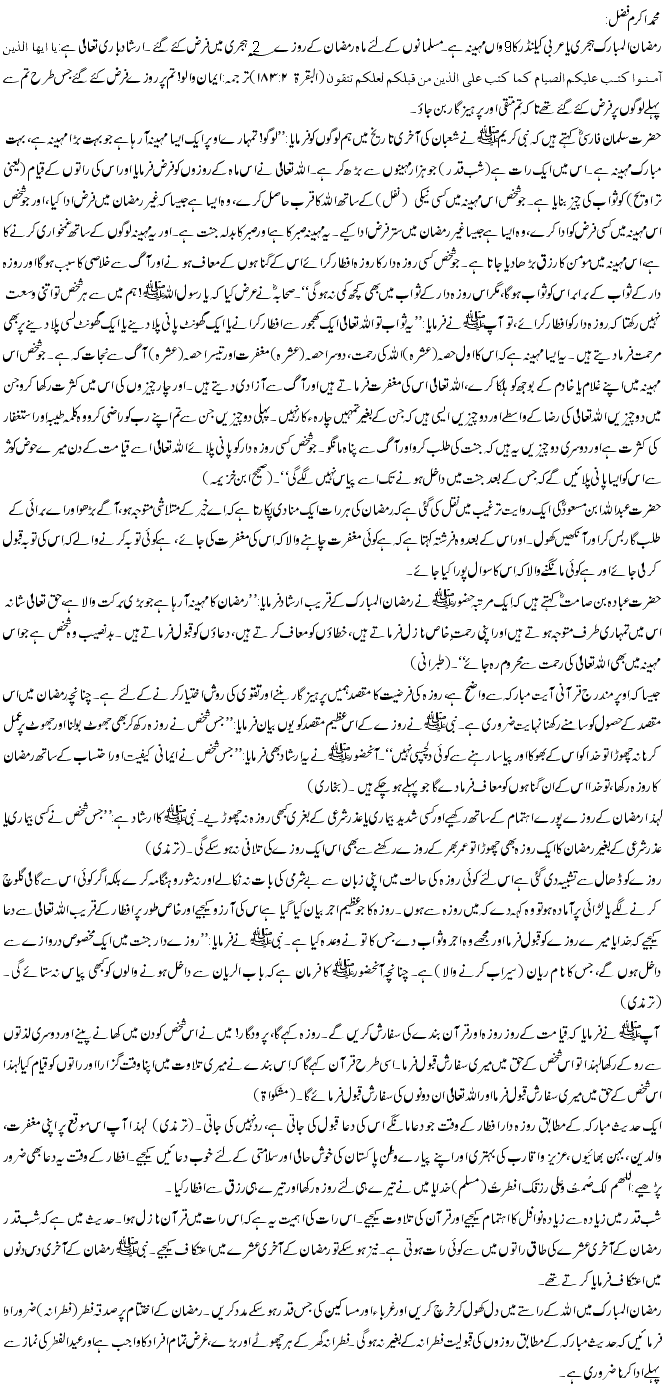
Ramadan ul Mubarik Rehmat O Magfirat Ka Maheena