
- Do Taubah, be it salah, dhikr, read Quran, etc.
- After Fajr, sit in your spot and don’t talk to anyone, and just do dhikr/read Quran. Then after sunrise, do salatul Ishraaq. Outside of Ramadan, the reward is as much as an accepted hajj and umrah (and more). So in Ramadan, that is quantified even more.
- Do Salatul Tahajud etc. as much as possible.
- Throughout Ramadan (especially the last 10 nights because they are about protection from hellfire) make as much dua as you humanly can. Especially ‘Allah Huma Ajirni Min An-naar.
- Before the iftar, spend a couple of minutes making dua. Specifically for forgiveness, your family, mankind, the environment, the world condition, closeness to Allah, etc.
- Read Quran. Keep reading until you get tired. Rest then do fresh wudu and read some more. And then more (if you can)
- Try to go to Taraweeh and even if you don’t pray all the rakahs, listen to the recitation of the Quran
- When you wake up for Suhoor, do two rakahs so it counts as ibadah in the last 1/3 of the night.
- Try to make or help make iftar. You will get the barakah of the people who fasted when they eat your food.
- Make prayer on Rasulullah (saw) as much as possible. People often underrate this and need to understand that he is one of our connections to Allah SWT.
- Say Ayatul Qursi right after every fard prayer.
- Smile at people.
- Brush your teeth (with a miswak) before going to Taraweeh and after you eat Suhur. And before going to the masjid. It is sunnah.
- Make spiritual goals to improve yourself as a human being. Ramadan isn’t about being a good Muslim for a month. It is a time to improve ourselves even more for the rest of our lives.
- Don’t fight. Just don’t. Even if everyone is an idiot or someone in the masjid is insulting you. Suck it up. isn’t worth wasting your valuable Ramadan time.
- Get up for Suhoor and get the barakah for doing so. Even by drinking water during suhoor, we receive barakah.
- Help your mom with the dishes and household work.
- Don’t get angry.
- Be courteous. Be kind. Don’t backbite. Smile. Hold the door open for someone behind you coming into the masjid, Help pick up trash in the masjid. These simple deeds often feel unmarked, but they get you closer to Allah SWT.
- Call on Allah for anything and everything. That’s all I have for this list, may Allah SWT help us to apply these during the month of Ramadaan and during our everyday life inshallah.
TAG: Ramadan
The Virtues of Ramadan
Bismillah Walhamdulillah Was Salaatu Was Salaam ‘ala Rasulillah
As-Salaam Alaikum Wa-Rahmatullahi Wa-Barakatuhu
Ramadan – Nawafil Prayers
Narrated by Abu Huraira (Radhiallaho anho):
Allah’s Messenger (sallallaahu ‘alaihi wasallam)said, “Whoever fasted the month of Ramadan out of sincere Faith (i.e. belief) and hoping for a reward from Allah, then all his past sins will be forgiven, and whoever stood for the prayers in the night of Qadr out of sincere Faith and hoping for a reward from Allah, then all his previous sins will be forgiven .”
Sahih Al-Bukhari Vol. 3 : No. 231
Ramadan – Umra in Ramadan equivalent to Hajj
Narrated by Ibn Abbas (Radhiallaho anho):
When Allah’s Messenger (sallallaahu ‘alaihi wasallam) returned after performing his Hajj, he asked Um Sinan Al-Ansari, “What did forbid you to perform Hajj?” She replied, “Father of so-and-so (i.e. her husband) had two camels and he performed Hajj on one of them, and the second is used for the irrigation of our land.” The Prophet said (to her), “Perform ‘Umra in the month of Ramadan, (as it is equivalent to Hajj or Hajj with me (in reward).”
Sahih Al-Bukhari Vol. 3 : No. 86
Ramadan – Fasting on one’s behalf
Narrated by Aisha (Radhiallaho anha):
Allah’s Messenger (sallallaahu ‘alaihi wasallam)said, “Whoever died and he ought to have fasted (the missed days of Ramadan) then his guardians must fast on his behalf.”
Sahih Al-Bukhari Vol. 3 : No. 173
Ramadan – Suhur
Narrated by Anas bin Malik (Radhiallaho anho):
Allah’s Messenger (sallallaahu ‘alaihi wasallam)said, “Take Suhur as there is a blessing in it.”
Sahih Al-Bukhari Vol. 3 : No. 146
Important Dua’s – Part 2

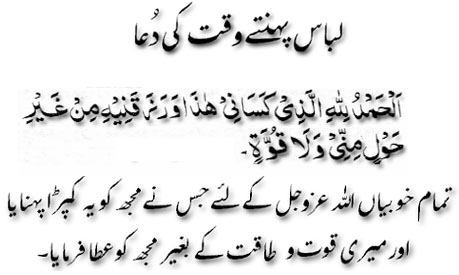
dua at the time of wearing dress

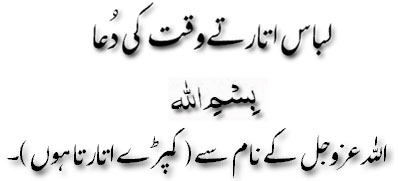
dua at the time of taking off clothes

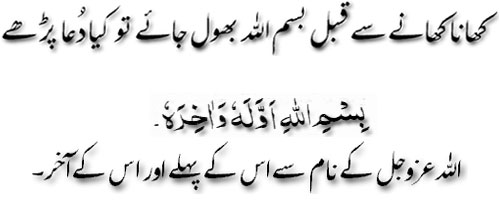
Khana dua
Qurani Surah’s and Their Benefits!
Please find some time to read this information. Insha Allah it will help YOU.
Night Of Lailatul Qadr
Wow! Is it actually that time again? Mash’Allah! Please do make the time and effort for this auspicious night, as it may or may not come again.
It’s surely unbelieve how quickly Ramadan has almost come to an end this year once again. It feels like the month just began and we were all preparing ourselves for it. Rather now, we are preparing ourselves for Eid ul Fitr instead. Even though at the start of the month, it seems as if we have so many weeks ahead of us to fast and it will take quite a bit of time before we come to the end. I must honestly admit that I miss this beautiful month of blessings once it is all over and done with. And of course, how can I forget to mention all those sehri’s and iftar’s and looking forward to eating dates, fruit chaats, pakoras, dhai baras, paratha’s, etc., etc. on such a regular basis. Foods we hardly pay attention to during the rest of the year, yet they taste so good and we look forward to enjoying them during this blessed month 🙂 It’s kinda funny though, isn’t it?
So most of us are only a night or so away from that ever-powerful and blessed night. The greatest nights of all nights during this month of fasting before the ‘ actual ‘ end rolls around. I would just like to take a moment and convey the message to all, that it is one of the most precious nights of all nights, this night of Lailatul Qadr. Let’s all please pray together as much as we can and remember Allah SWT and his graciousness and mercy that he bestows upon us every day of our lives. Let’s all pray for forgiveness of our sins from the Al-Mighty and request that he accepts repentance for all our mistakes whether made intentionally or unintentionally. Let’s pray that ( as Muslims) we may try to unite and assist one another as much as we can in times of desperation and despair. I don’t feel that anyone should feel helpless and hesitant going to another fellow Muslim brother or sister ( in Islam ) in times of need or urgency. Let’s pray that may Allah SWT always gives us that rank and capability to help one another whenever possible instead of turning our backs and walking away. Whether it be financial, moral, spiritual, or emotional support, we should be there for one another, as that is what Islam and being Muslim is all about. It’s something we should learn from practice not only during this one-month time span but rather all year round.
I don’t think any practice is impossible or difficult if we are just willing to at least give it a chance and seek a reward from Allah SWT only for it at the end of the day. He is the Supreme being that will surely listen to our hearts and know what is on our minds.
Also please do pray for the well-being of Pakistan (as a whole) and our countrymen. Even if you do not directly have family, friends, or relatives living there, I am sure that there would be some sort of connection that your parents or grandparents would have with their roots being attached to Pakistan in one way or another.
Aside from that, I would request that you all remember those women in your special of special prayers that recently died during the dreadful mishap, whilst the distribution of flour (atta) was in progress. It was deeply saddening and disturbing to hear about and view on television the incident that happened with these women and some children of theirs, that was only struggling for the most needed commodity of commodities in order to keep their families fed and alive. After all, isn’t it extremely shameful and disgusting that something like this had to happen over such a commodity of flour? We are not even talking of an item of luxury here people. For the love of God, it was an item of necessity, and something as pathetic and tragic as this had to happen.
It really didn’t have to all happen the way it did and it is unfortunate. Just hearing about it all brought a few tears to my eyes only because of the thought of those children that these deceased women left behind that were needing to be fed. What will happen to them now and where will they go to receive that maternal love and care that they always had and lived for? Will there be a replacement for that unconditional love that they lost within minutes? Someone, please tell me, how fair was that to them and their families? Why did the poor and needy ( who have challenges and struggles in life of their own already) have to be punished for all of this nonsense? And of course, as I write about all this, I tend to get teary-eyed and emotional once again myself.
Last but not least, I would simply request from all of you ( not only during Ramadan) but rather all year round and in all seasons and times to come to try and lend a hand to one another. Even if that means sparing some of your precious time for someone that needs your advice or undivided attention. It doesn’t always have to be financial assistance, even providing moral support may mean a lot to someone. You would never know how they would be benefitting from all that you would be doing for them. Do keep in mind that we often ask others to remember us in their prayers and they expect the same from us, so then at any given time each of us is either praying for someone or someone is praying for us and our good health and happiness. That is how it should be. As the Holy Qur’an and our religion of Islam dictates brotherhood and generosity towards mankind, we should surely be on top of that first and foremost if indeed we are practicing Muslims.
May Allah (SWT) always allow us to be led on the path of goodness and justice. May he also allows us to live a life that safeguards our dignity and self-respect and keeps us away from all evils & sins…Insh’Allah. Beyond all that, Allah swt is well aware of what’s best for all of us.
Thank you all for your time and consideration.
Reaping The Opportunities In Ramadan
by Iman Badawi
In the name of Allah, the source of Mercy, the Mercy-giving.
Reaping the opportunities in Ramadan:
The Prophet’s (may Allah send His blessing and peace upon him) companions used to say, “Let not the day that you fast and the day that you do not fast be equal.” It is important that one’s behavior, attitude, and outlook should not be the same on the day that one is fasting and when one is not fasting. There should be a change, as one is trying to worship Allah more, so one’s fasting should have an effect.
Lesson 1:
Gaining taqwa (fear of Allah)
Allah legislated fasting for gaining taqwa,
“O you who believe fasting has been prescribed upon you as it has been prescribed upon those before you, so that you may attain taqwa.” (meaning of Sooratul Baqarah (2):138)
Taqwa in this case means, to make a shield between oneself and Allah’s anger and hellfire. So we should ask ourselves when we break our fasts, ‘Has this fasting day made us fear Allah more? Has it resulted that we want to protect ourselves from the hellfire ?’
Lesson 2:
Drawing us closer to Allah
This is achieved by reciting and reflecting on Al-Qur’an during the night and the day, attending the Taraweeh prayers, remembering Allah, sitting in circles of knowledge, and for those who can, making umrah.
The Prophet (may Allah send His blessing and peace upon him) said, “An umrah in the month of Ramadan is equal (in reward) to performing a hajj.” (Ahmad & Ibn Majah).
Also for those who can make i’tikaf (seclusion) in the last ten days of Ramadan, so to leave all worldly pursuits and seclude oneself in a masjid just thinking of Allah, brings us closer to Allah.
When one sins, one feels distant from Allah. That is why one might find it hard to read and reflect on the Qur’an and come to the masjid. However, the obedient worshipper feels closer to Allah and wants to worship Allah more, because Allah forgives and is merciful.
Lesson 3:
Acquiring patience and strong will
Allah has mentioned patience more than seventy times in the Qur’an and has commanded patience in more than sixteen ways in His Book. So when one fasts, and gives up one’s food and drink, and one’s marital sexual relations for those hours, one learns restraint and patience. This ummah needs men and women that are strong-willed, who can stand upon the Sunnah and the Book of Allah and not waver in front of the enemies of Allah. We do not need emotional people, who raise slogans and shout, but when the time comes to stand upon something firm, they cannot do so, they waver.
Lesson 4:
Striving for Ihsan (righteousness & sincerity)
and staying away from Riya (showing off
Ihsan means to worship Allah as if one sees Him, for if one does not see Him, He sees all. Hasan al-basri said, “By Allah in the last twenty years, I have not said a word or taken something with my hand or refrained to take something with my hand or stepped forward or stepped back, except that I have thought before I have done any action,’ Does Allah love this action? Is Allah pleased with this action ?’ ” So when one is fasting, one should gain this quality of watching oneself and also staying away from riyah (showing off).
That is why Allah said in a Qudsi hadith, “..Fasting is for Me and I will reward it..” (Bukhari) Allah singles out fasting from all other types of worship saying, “..Fasting is for Me..”, because no one knows whether you are fasting or not, except Allah. For example, when one is praying or giving charity, or making tawaf, one can be seen by the people, so one might do the action by seeking the praise of the people.
Sufian at-thawri used to spend the nights and the days crying and the people used to ask him, “Why do you cry, is it due to the fear of Allah ?”, he said,’ No.’, they said, “Is it due to the fear of the hell-fire ?”, he said, ‘No. It is not the fear of Allah that makes me cry, what makes me cry is that I have been worshiping Allah all these years and doing scholarly teaching, but I am not certain that my intentions are purely for Allah.’
Lesson 5:
Refinement of manners, especially those related to truthfulness and discharging trusts.
The Prophet (may Allah send His blessing and peace upon him) said,”Whoever does not abandon falsehood in word and action, then Allah, the Mighty and the Majestic has no need that he should leave his food and drink.” (Bukhari)
And the Prophet (may Allah send His blessing and peace upon him) said, “It may be that a fasting person attains nothing but hunger and thirst from his fast.” (Ibn Majah)
What we learn from this, is that we must pay attention to the purification of our manners. The Prophet (may Allah send His blessing and peace upon him) said, “I was sent to perfect good manners.” (Muwatta) So we must check ourselves, are following the behavior of the Prophet (may Allah send His blessing and peace upon him). For example, Do we give salam to those we don’t know and those we do know? Do we follow the manners of Islam, by telling the truth and only telling the truth? Are we merciful to the creation?
Lesson 6:
Recognizing that one can change for the better
The Prophet (may Allah send His blessing and peace upon him) said, “Every son of Adam sins, and the best of the sinners are those who repent.” (Ibn Majah) Allah provides many opportunities to repent to Him and seek His forgiveness. If one was disobedient they can become obedient.
Lesson 7:
Being more charitable
Ibn Abbas said, “The Prophet (may Allah send His blessing and peace upon him) was the most charitable amongst the people, and he used to be more so in the month of Ramadan when Gibreel used to meet him every night of Ramadan till the end of the month. The Prophet (may Allah send His blessing and peace upon him) used to recite the Holy Qur’an to Gibreel.” (Bukhari)
The Prophet (may Allah send His blessing and peace upon him) said, “He who gives food for a fasting person to break his fast, he will receive the same reward as him, without nothing being reduced from the fasting person’s reward.” (Tirmidhi )
Lesson 8:
Sensing the unity of the Muslims
The Prophet (may Allah send His blessing and peace upon him) said, “…Those of you who will live after me, will see many differences. Then you must cling on to my Sunnah and the Sunnah of the rightly guided Khalifah. Hold fast to it and stick to it..” (Abu Dawud)
It is possible for Muslims to be a single body, but this will only be achieved when obedience is only to Allah and His Messenger. One senses unity because the Muslims pray and fast together.
Lesson 9:
Learning discipline
The Prophet (may Allah send His blessing and peace upon him) said, “Bilal makes the adhan, while it is still night; therefore, eat and drink until Ibn Umm Maktum makes the adhan.” (Bukhari)
The Prophet (may Allah send His blessing and peace upon him) made us adhere to this strictness. Similarly one cannot knowingly break the fast before the sunset, as this will not be accepted by Allah. Muslims should learn to be very strict in their lives because they are people of an important message, which they mold their lives around.
Lesson 10:
Teaching the young to worship Allah
It was the practice of the people of Madinah, that during the fast of Ashura (which is now a recommended fast of one day) to get their children to fast with them. When the children would cry from hunger and thirst, their parents would distract their attention by giving them some sort of toy to play with. The children would break their fast with their parents. (mentioned in Bukhari) So the young should be brought to the masjid and they should pray with their parents so that they are able to get into the habit of becoming worshippers of Allah.
If one does not encourage children to fast when they are young, they will find it very difficult to fast for thirty days at the age of puberty. This is why the Prophet (may Allah send His blessing and peace upon him) said, “Command your children to pray at the age of seven and beat them at the age of ten (if they do not pray)” (Hakim)
Lesson 11:
Caring for one’s health
Fasting teaches Muslims to take care of their health and to build strong bodies. The Prophet (may Allah send his blessing and peace upon him) said,”A strong believer is better and is more beloved to Allah than a weak believer, and it is good in everyone.” (Muslim)
O, Allah!
For us let this month of Ramadan be a period of peace,
faith safety and total submission to Thy will;
make us walk apace swiftly to that
which Thou likes and approves.
O, Allah!
Pour out many blessings on us in this month, make available for us its generous good and assistance, and keep us safe from the harm, evil, misfortune, and mischief that may try to trap us in this month.
(Aameen)
May Allah Subhanuhu Wa Ta’ala keep all of us guided on Siraat-al-Mustaqeem, and grant us the taufeeq to utilize this most blessed month of Ramadan. May Allah accept our fasts, sujood o qayam, and Tauba for indeed His mercy prevails over His wrath, and indeed we are sinners in dire need of Allah’s mercy.
(Aameen Ya Rabb-ul-Aalaameen)
Wassalamu Alaykum Wa Rahmatullah!
The Inner Dimensions Of Fasting
It should be known that there are three grades of Fasting: ordinary, special, and extra-special.
Ordinary Fasting means abstaining from food, drink, and sexual satisfaction.
Special Fasting means keeping one’s ears, eyes, tongue, hands, and feet — and all other organs — free from sin.
Extra-special Fasting means fasting of the heart from unworthy concerns and worldly thoughts, in total disregard of everything but Allah, Great and Glorious is He.
This kind of Fast is broken by thinking of worldly matters, except for those conducive to religious ends, since these constitute provision for the Hereafter and are not of this lower world.. Those versed in the spiritual life of the heart have even said that a sin is recorded against one who concerns himself all day with arrangements for breaking his Fast. Such anxiety stems from a lack of trust in the bounty of Allah, Great and Glorious is He, and from a lack of certain faith in His promised sustenance.
To this third degree belong the Prophets, the true awliya and the intimates of Allah. It does not lend itself to detailed examination in words, as its true nature is better revealed in action. It consists of utmost dedication to Allah, Great and Glorious is He, to the neglect of everything other than Allah, Exalted is He. It is bound up with the significance of His words: ‘Say: “Allah (sent it down)”: then leave them to play in their vain discussions.’ [al-An’am,6:91]
Inward Requirements
As for Special Fasting, this is the kind practiced by the righteous. It means keeping all one’s organs free from sin and six things are required for its accomplishment:
1. SEE NOT WHAT DISPLEASES ALLAH
A Chaste regard, restrained from viewing anything that is blameworthy or reprehensible, or that distracts the heart and diverts it from the remembrance of Allah, Great and Glorious is He.
Said the Prophet, on him be peace: ‘The furtive glance is one of the poisoned arrows of Satan, on him be Allah’s curse. Whoever forsakes it for fear of Allah will receive from Him, Great and Glorious is He, a faith the sweetness of which he will find within his heart.’
Jabir relates from Anas that Allah’s Messenger, on him is peace, said: ‘Five things break a man’s Fast: lying, backbiting, gossiping, perjury and a lustful gaze.’
A Ramadan Checklist
1. Ask Allah to enable you to reach Ramadan and to get the most out of it as the Salaf used to do.
2. Intend to fast every day with Iman and pure intention seeking the reward from Allah alone. The Prophet peace be upon him said, “Whoever fasts in Ramadan with Iman and seeks reward (from Allah) his past sins will be forgiven”. (Bukhari)
3. Read the whole Qur’an at least once as the Prophet peace be upon him did.
4. Have Suhoor as the Prophet peace be upon him said, “Have Suhoor because it is blessed”.
5. Make Du’a during the fast because the Prophet peace be upon him said that three people’s supplication is not rejected one of them is the fasting person. Ask for the good of this life and the next for yourself, your family, and Muslims in general.
6. Make Dua before opening the fast. The Prophet peace be upon him said, “The fasting person has a supplication that is answered when he opens his fast”.
7. Give Sadaqah and be good to people. The Prophet peace be upon him was the most generous of people and he was most generous in Ramadan.
8. Avoid anything that diminishes the fast such as lying, backbiting, cheating, or getting angry. The Prophet peace be upon him said “Whoever does not give up false statements (i.e. telling lies), and evil deeds, and speaking bad words to others, Allah is not in need of his (fasting) leaving his food and drink.” [Bukhari] 9. Do not eat too much after Iftar.
10. Ask for forgiveness since this is the month Allah frees people from the fire.
11. Pray At-Tarawih with Khushoo. If you pray in the Masjid complete the Salah with the Imam. If you pray at home prolong the Salah as long as you can. The Prophet peace be upon him said, “Whoever prays during Ramadan with Iman and seeks reward (from Allah) his past sins will be forgiven”.
12. Feed the poor and invite others for Iftar. The Prophet peace be upon him said, “Whoever gives Iftar to someone fasting he will have the same reward without decreasing the reward of the person fasting”.
13. Try harder the last ten nights, especially the odd nights. The prophet would strive in Ramadan more than he would in any other month and more so in the last ten days.
14. Say this Dua on the nights that Laitul-Qadr is likely to fall on: Allhumma innaka afuwun tuhibbul-afwa fa’fu anni (O Allah you are Forgiving and love forgiveness so forgive me).
15. Ask Allah to accept all your good actions during this month.
By Abu Talha
Say (O Muhammad ): “O Allah! Possessor of the kingdom, You give the kingdom to whom You will, and You take the kingdom from whom You will, and You endue with honor whom You will, and You humiliate whom You will. In Your Hand is the good. Verily, You are Able to do all things.
You make the night to enter into the day, and You make the day to enter into the night (i.e. increase and decrease in the hours of the night and the day during winter and summer), You bring the living out of the dead, and You bring the dead out of the living. And You give wealth and sustenance to whom You will, without limit (measure or account). (3:26,27)