Logon Say Mail Mulaqat Ki Sunnatien Aur Adaab: Salam Kerna, Musafiha Kerna, Aur Achi Baat Kerna
TAG: Salam
Al-Salam
Surah Al-A’raf 7:180
﴾وَللَّهِ الأَسْمَآءُ الْحُسْنَى فَادْعُوهُ بِهَا وَذَرُواْ الَّذِينَ يُلْحِدُونَ فِى أَسْمَائِهِ سَيُجْزَوْنَ مَا كَانُواْ يَعْمَلُونَ ﴿
(180. And (all) the Most Beautiful Names belong to Allah, so call on Him by them, and leave the company of those who belie His Names. They will be requited for what they used to do.)
About the Meaning
On one occasion in the Quran [Surah al-Hashr:23], Allah introduces Himself as As-Salaam, the Perfection and Giver (or Bestower, or Source) of peace.
Linguistically, salaam can mean “immunity”, to be free of something. Another opinion is that it implies wellbeing – to be safe and good.
What Does it Mean that Allah is As-Salaam?
Ibn Kathir rahimahullaah explains: As-Salaam is the One who is free from all imperfections and deficiencies, because of the Perfection of His Being, of His Attributes, and His Actions. He is So Perfect, He does not have any imperfections. He is free from death, free from forgetfulness, etc. His Actions are perfect, whatever He does there is wisdom (hikmah) behind it. That is why The Perfection is one of the translations of this Beautiful Name.
Examples of Salaam
The root seen, laam, meem – also makes Saleem, for example, qalbun saleem, a sound heart, which is unblemished. Islam is also made up from this root, the state of submission. So ask As-Salaam to make Islam your safe harbor and to bring peace to your heart.
Paradise is called Daar us Salaam [Quran 10:25)] because it is free of all pain, death, worries, etc., and it is a place of safety. Allah will give salaam to the people who get Jannah.
Also the greeting of assalaamu alaykum we use in this world really means: you are safe from me; you will not receive any evil from me.
How Can You Live By This Name?
1. If you want the salaam, the security, and the protection of Allah don’t wrong yourself, don’t wrong others, and don’t wrong Allah As-Salaam. Allah is As-Salaam, which means He cannot be unjust. We wrong ourselves.
2. Make yourself Saleem for Allah and get Allah’s salaam. Work on yourself and try to commit yourself and your intentions purely to Allah subhanahu wa ta’ala so you will receive Allah’s salaam in Jannah.
3. Submit to Allah so you can be secure. If you submit (to Islam) you will get Allah’s salaam. When the Prophet salallaahu ‘alayhi wa sallam did dawah, he said: Idha sallamta nafsaka lillah, salimta— “When you submit yourself to Allah, you will be safe.” Believing is to follow the guidance and do the actions!
4. Be patient in trials and Allah will give you peace inside. Your heart will have salaam, a feeling of well-being, serenity, and peace.
5. Say salaam upon the Prophet, upon righteous people, and to each other, but never say salaam upon Allah, because He is As-Salaam! He does not need security and safety, because He is Salaam and Perfect.
6. When you are very worried, make dua’ by this name. You can say, Allahumma antas Salaam (O Allah, You are As-Salaam), save me from this.
Homework: Use This Name of Allah After Your Salah
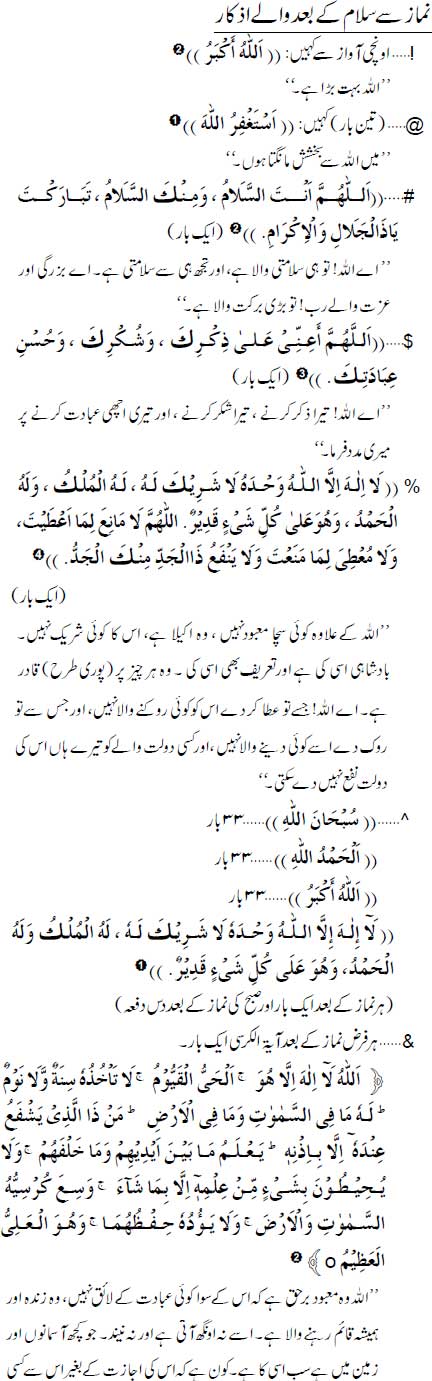
It is from the Sunnah to use this name of Allah subhanahu wa ta’ala after your prayer. When you finish your Salah, supplicate: Astaghfirullah (3 times). Allahumma antas salaam wa minkas salaam, tabaarakta yaa Dhal Jalaali wal Ikraam. (“I seek Allah’s Forgiveness. O Allah, You are As-Salaam, and from You is all peace. Blessed are You, O Possessor of majesty and honor.”)
What a gem; straight after our prayer, we ask for protection and safety from the mistakes committed during the Salah!
Wallahu ta’alaa ‘alem.
O Allah, As-Salaam, keep us safe from worries and distress— give us all hearts that are saleem, and may we be of those who receive Your Salaam in Jannah, Ameen!
Salam Kehne Mein Musalman Ka Haq

Salam Kehne Mein Musalman Ka Haq
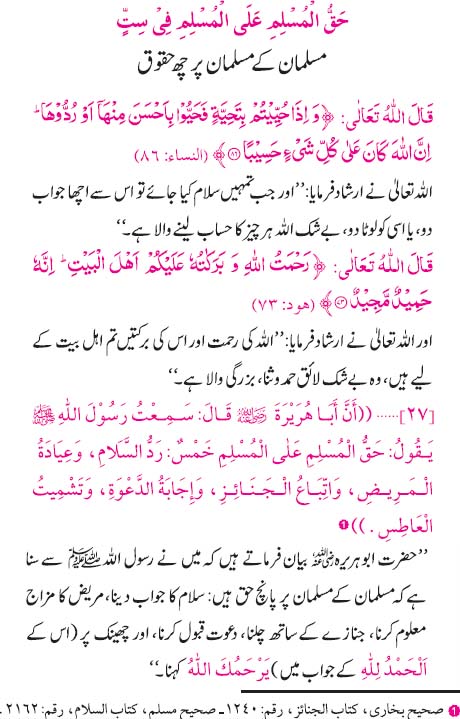
Musalman Kay Musalman Par Haqooq

Musalman Kay Musalman Par Haqooq
Spreading Salams
“And when you are greeted with a greeting, greet in return with what is better than it, or (at least) return it equally.” (Qur’an, An-Nisa 4:86)
Human interaction is an important facet of any society. In Islam, proper relationships are stressed at all phases of interaction and the common greeting holds a special place in Islamic manners. Allah says in the Qur’an:
“O you who believe! enter not houses other than your own, until you have asked permission and greeted those in them, that is better for you, in order that you remember.” (Qur’an, An-Nur 24:27)
“….But when you enter houses, greet one another with a greeting from Allah, blessed and good….” (Qur’an, An-Nur 24:61)
Too often, we take greetings for granted and attach minimal importance to them. In these verses, however, Allah reminds the Muslims that offering greetings and the manner of the greeting are of utmost importance. Similarly, in a Hadith narrated by Bukhari and Muslim, the Prophet stressed the importance of greetings when he defined the rights of a Muslim:
“The rights of a Muslim upon another are five: returning greetings, visiting the sick, following the funeral procession, responding to invitations, and offering ‘Tashmeet’ for one who sneezes.” (Bukhari and Muslim)
The recommended greeting of a Muslim is to say: “As-salaamu a’laykum” (peace be upon you). According to a Hadith related by Bukhari and Muslims, this form of greeting was ordained by Allah from the time of Prophet Adam (peace be upon him).
The Virtues Of Salam
Exchanging salam holds a high position in Islam. Not only is salam equated with many other important deeds, but it is one of the defining criteria of belief. We observe many Hadiths pertaining to the position of exchanging salaam in Islam.
In one Hadith a man asked the Prophet (PBUH- peace be upon him) about which aspect of Islam was best. The Prophet (PBUH) replied: “Feeding the hungry, and saying salam to those you know and those you don’t know.” (Bukhari and Muslim)
The Prophet (PBUH) also said: “You will not enter paradise until you believe, and you will not believe until you love one another: ‘spread salam’ (the greeting of peace) among you.” (Muslim)
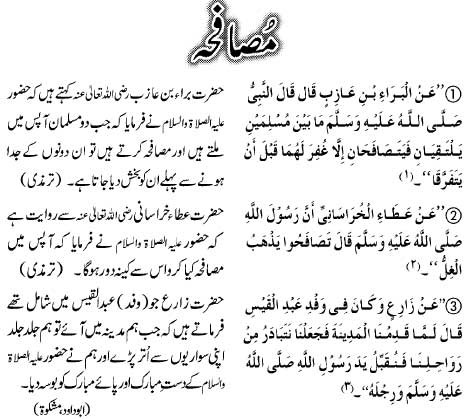
The Prophet Muhammad (PBUH) also explained another virtue of salam in the following Hadith: “When two Muslims meet (give salam), and shake hands, they are forgiven their sins before they part (with each other).” (Abu Dawud)
“O people! spread salaam, feed the hungry, be in touch with your kin, and pray while people are asleep (at night) you shall enter paradise peacefully.” (Tirmithi)
The Grades Of Salam
There are several forms of exchanging salam. Each has its grade which corresponds to the extent of the phrase. There is a Hadith where Imran Ibn Hussayn (may Allah be pleased with him) narrated that: “A man came to the Prophet (PBUH) and said, ‘As-salaamu a’laykum!’ The Prophet (PBUH) returned his greeting and when the man sat down, the Prophet (PBUH) said: ‘Ten.’ Another man came and said: ‘As-salaamu a’laykum wa rahmatullah (may the peace and mercy of Allah be upon you) .’ to which the Prophet also responded, and when the man sat down, He said ‘Twenty.’ Another man came and said: ‘As-salaamu a’laykum wa rahmatullahi wa barakatuh (may the peace, blessings, and the mercy of Allah be upon you).’ The Prophet (PBUH) returned his greeting, and after the man sat down, he said: ‘Thirty.” (Abu Dawud and Tirmithi)
The Hadith has been interpreted to mean that the minimum form of the Islamic greeting which is acceptable is “As-salaamu a’laykum” and one is rewarded with ten good deeds for saying it. The second grade, adding “wa rahmatullah”, raises the reward to twenty good deeds. The best grade of salaam is “As-salaamu a’laykum wa rahmatullahi wa barakatahu”, and this is worth thirty good deeds.
The response to the greeting is similar in form and rewards. The least one could say is “Wa a’layku-mus-salaam” and the best answer is: “Wa alayku-Mus-salaam wa rahmatulahi wa barakatahu” (and may the peace, blessings, and the mercy of Allah be upon you).
In the time of the Prophet (PBUH) the Sahabah (companions of the Prophet ) would compete with each other, to see who could give salaams first.
The Prophet (PBUH) said: “The best of the two persons is the one who begins with salam.” (Related by Nawawi in his book Al-Adkar)
“The Prophet (PBUH) was asked: ‘O Messenger of Allah ! When two persons meet with each other, who should take the lead in greeting the other? He answered: ‘The one who is closest to Allah.” (Tirmithi)
The Prophet (PBUH) said: “The person closest to Allah is the one who precedes others in greeting.” (Abu Dawud)
The Islamic Ruling On Salam
Initiating salams is considered ‘Sunnah’ or optional, returning the salaams after it is offered is considered ‘wajib’ or obligatory, based on the first Qur’anic ayah mentioned. Islam also encourages people to offer the first greeting as mentioned in the Hadiths mentioned previously.
The Prophet (PBUH) was asked about the most appropriate way to give salams as shown in the following Hadith: Anas (may Allah be pleased with him) says that a man asked the Prophet:”O Messenger of Allah when any one of us meets a Muslim brother or a friend then should he bow his head (as a sign of courtesy to him)?’ He said: ‘No.’ The man said: ‘Should he embrace him?’ He said: ‘No.’ The man then asked: ‘Should he clasp his hands?’ He said: ‘Yes.” (Tirmithi)
Unfortunately, now in our community, Muslims have adopted other methods of giving salutations. As we can see in this Hadith, The Prophet (PBUH) was very precise about how salams were to be given.
We as Muslims, should remember that Prophet Muhammad (PBUH) is the best example for us to follow in all aspects of our life, and we should be careful not to add anything new to the Deen of Islam, for fear of implying that the Prophet Muhammad did not complete his mission.
As Allah (Most Exalted is He) says in the Qur’an: “You have indeed in the Messenger of Allah, a beautiful example for anyone whose hope is in Allah and the Last Day.” (Qur’an, Al-Ahzab 33:21)
The Messenger of Allah (PBUH) said: “I have not left anything which Allah (Most Exalted is He) ordered except that I have ordered you with it, nor anything that Allah forbade you, except that I forbade you from it.” (Buhaiqi)
Conditions Under Which Salam Is Discouraged
There are certain situations under which it is preferable not to offer salam. These include; when a person is relieving himself, when one is having a marital relationship, when someone is sleeping, or when in the bathroom.
Offering salam when someone is reciting the Qur’an is permissible but discouraged. The same rule applies to someone who is making dua (supplication) or one who is praying.
Exchanging Salam With Non-Muslim
The Prophet (PBUH) said: “Do not greet the Jews and the Christians with salam.” However, if they salam first, we may reply by saying “wa a’laykum” (and upon you).” (Bukhari and Muslim)
Salutation and Meeting Non-Muslims
Amr bin Shu’aib – Tirmithi: The Messenger of Allah (PBUH) said: “He does not belong to us who imitates people other than us. Do not imitate the Jews or the Christians, for the Jews’ salutation is to make a gesture with the fingers and the Christians’ salutation is to make a gesture with the palms of the hands.”
Ayesha – Bukhari: When some Jews came to the Messenger of Allah (PBUH) and said, “As-saamu ‘a’laikom” (Death be upon you) and he replied, “Wa ‘a’laikom” (and upon you), she (‘A’isha) said, “Death be upon you and may Allah curse you and be angry with you.” The Messenger of Allah (PBUH) then said, “Gently, ‘A’isha, keep to kindness and avoid harshness and coarseness.” She asked if he had not heard what they said, and he asked if she had not heard what he said, saying, “I replied to them, and my prayer regarding them will be answered, but theirs regarding me will not.”
Surah Mujadila:8: “And when they (Non-Muslims) come to thee, they salute thee, not as Allah salutes thee (but in crooked ways).” E.g. As-saamu ‘alaikom.
Abu Hurairah – Muslim: The Messenger of Allah said, “Do not salute the Jews and Christians before they salute you, and when you meet one of them on the road force him to go to the narrowest part.”
Greeting The Youn
It is considered a part of the Sunnah for adults to offer salam to children in order to teach them the proper greeting manners and to build their self-esteem. In both Al-Bukhari and Muslim, Anas (may Allah be pleased with him) narrated that the Prophet passed by some youth and he offered salaam to them. Anas (may Allah be pleased with him) also reported that the Prophet used to do this quite often.
Etiquette Of Salam
There are several etiquettes to be followed with respect to the exchanging of salam. The Prophet (SAWS), for example, said: “The person who is riding should offer salam to the one who is walking, and the one who is walking should greet the one who is sitting, and the smaller group should greet the larger one.” (Bukhari and Muslim)
Aside from the situations mentioned in the Hadith, the one who enters a house should initiate salam to those already there. Furthermore, if one enters his home, it is preferable to offer salam, even if there is no one at home. With respect to the salam between the young and the old, the young are expected to begin the greeting.
It is also considered improper for someone to meet a group of Muslims and offers salam only to some of them. The greeting must be for all in the group. If a group of people offers salam to an individual at the same time, he may reply only once to all of them.
The head should never be bent as a sign of greeting. We bend our heads only to Allah. It must also be emphasized that other body gestures in any form or shape (for example, raising eyebrows, extending the arms, smiling, winking, etc.), cannot replace uttering the words salam.
Salam for someone at a distance can be offered by saying the salam and waving a hand. Waving the hand alone, however, is not considered a salam.
Salam is not only confined to the time of meeting only but extends to when separating as well.
Abu Hurairah (may Allah be pleased with him), relates that the Prophet said: “When one of you joins a gathering, he should greet those present; and when he leaves them he should salute them because the first salutation is not better than the last one.” (Abu Dawud and Tirmithi)
Saying Of The Sahaba Regarding Salam
Umar bin Khattab: “There are three ways of showing sincere brotherly love: give him the greeting of Salaam when you first meet him, make him comfortable, and call him by his favorite name.”
Sa’id bin al-As: “I owe my sitting companion three things: on his approach, I greet him, on his arrival I make him welcome, and when he sits I make him comfortable.”
Conclusion
There are two fundamental categories of human beings: Muslims and Non-Muslims. Any human being who chooses to submit to his Creator is called a Muslim and his way of life is Islam. A Muslim is a precious being in the sight of Allah. Muslim gains special privileges, honor, and dignity because of Islam. They are people (Muslims) who have achieved peace (Salam) by accepting Peace (Islam). The salutation of Salam is a special blessing of Allah for Muslims. The first conclusion is that Muslims should use Salam to salute fellow Muslims because it is only befitting for them to do so.
It is below the dignity of the Muslim to use such expressions below their noble status. The Muslim should not degrade himself, by using Non-Muslim salutations; or his fellow Muslims, by saluting them with Non-Muslim salutations; and nor his Deen al-Islam, by adopting the ways of the Non-Muslims. The second conclusion is that Muslims should not use Non-Muslim salutations amongst themselves because these are unfit for them. Muslims should not only refrain from using Non-Muslim salutations, but they should abhor such practices.
The Non-Muslim human being, a Kafir (dis-believer), is one who chooses to reject the message of Peace and adopt his own anti-Islamic way of life, Kufr. Such beings are in utter discord, and their life is in contradiction with any concept of peace or harmony. These people will never attain the magnanimity of the Muslims, but the contrary, ignominy.
The salutations of these people are likewise only worthy of their status, rather meaningless and unworthy of noble people. They do not deserve the peaceful salutation of Salam because they have chosen to reject it. The third conclusion is that Non-Muslims should not be saluted with the full Salam as they are unworthy of it. They are deprived of the blessings of Salaa as they rejected them. How can a Muslim pray, “Peace be upon you, and Allah’s Mercy and Blessings” for a person who does not believe in Allah or lead his life in accordance with the teachings of Islam, for this dua to become effective for him? The salutation of Salam cannot be used for them.
Allah says in the Qur’an: “It is not fitting for the Prophet and those who believe, that they should pray for forgiveness for the Mushriks (pagans), even though they be of kin after it is clear to them that they are companions of the fire.” (Qur’an, At-Taubah 9:133)
Further: “Muhammad is the Messenger of Allah and those who are with him are hard against the unbelievers, (but) full of Mercy for one another.” (Qur’an, Al-Fath 48:29)
The general conclusions are: the salutation of Salam is for Muslims and the Non-Muslim salutations are for Non-Muslims.
Muslims should not use bad language when saluting Non-Muslims but should be polite and courteous. The wording of the Salutation for the Non-Muslim according to the Qur’an and Hadith should be noted. The ayat in the Qur’an, like all other ayats, is beautiful. The wording is, “Peace on him who is rightly guided.” Although this is used for the Non-Muslims it is in reality, only applicable to those who are rightly guided, the Muslims. The salutation for the Non-Muslims in the Hadith is that the Muslims should say, “Wa ‘alaykum” when greeted by the Non-Muslims. That is, they should say, “The same to you” or “Upon you” concerning whatever Non-Muslims have said.
References:
1. Article, Al Jumuah Magazine, Salam by Rafil Dhafir
2. Riyadh-Us-Saleheen
3. Salaam – Salutation of the Muslims by Ibn Aslam
Durood-o-Salam Kay Fazail-o-Barkat

Durood-o-Salam Kay Fazail-o-Barkat
Namaz Say Salam Kay Baad Ki Duaain Aur Azkar


The Importance Of Saying “Assalaamu ‘Alaykum” And Returning The Greeting
All people have the custom of greeting one another, and every group has its own distinctive greeting that distinguishes them from other people.
The Arabs used to greet one another with the words An’im sabaahan or An’imu sabaahan [equivalent to Good morning], using words derived from al-ni’mah, which means good living after the morning. The idea was that because the morning is the first part of the day if a person encounters something good in the morning, the rest of the day will be good too.
When Islam came, Allah prescribed that the manner of greeting among Muslims should be Assalaamu alaykum [not salam or salams or whatever] and that this greeting should only be used among Muslims and not for other nations. The meaning of salaam (literally, peace) is harmlessness, safety, and protection from evil and from faults. The name al-Salaam is a Name of Allah, may He be exalted, so the meaning of the greeting of salaam which is required among Muslims is, May the blessing of His Name descend upon you. The usage of the preposition ala in alaykum (upon you) indicates that the greeting is inclusive.
Ibn al-Qayyim said in Badaa’i’ al-Fawaa’id (144): Allah, the Sovereign, the Most Holy, the Peace, prescribed that the greeting among the people of Islam should be al-salaam Alaykum, which is better than all the greetings of other nations which include impossible ideas or lies, such as saying, May you live for a thousand years, or things that are not accurate, such as An’im sabaahan (Good morning), or actions that are not right, such as prostrating in greeting. Thus the greeting of salaam is better than all of these because it has the meaning of safety which is life, without which nothing else can be achieved. So this takes precedence over all other aims or objectives. A person has two main aims in life: to keep himself safe from evil, and to get something good. Keeping safe from evil takes precedence over getting something good.
The Prophet (peace and blessings of Allah be upon him) made spreading salaam a part of faith. Al-Bukhaari (12, 28 and 6236), Muslim (39), Ahmad (2/169), Abu Dawood (5494), al-Nisaa’i, (8/107), and Ibn Hibbaan (505) narrated from Abd-Allah ibn Umar that a man asked the Messenger of Allah (peace and blessings of Allah be upon him): What is the best thing in Islam? He said, Feeding others and giving the greeting of salaam to those whom you know and those whom you do not know.?
Ibn Hajar said in al-Fath (1/56): i.e., do not single out anybody out of arrogance or to impress them, but do it to honor the symbols of Islam and to foster Islamic brotherhood.
Ibn Rajab said in al-Fath (1/43): The hadeeth makes the connection between feeding others and spreading salaam because this combines good actions in both word and deed, which is perfectly good treatment (ihsaan). Indeed, this is the best thing that you can do in Islam after the obligatory duties.
Al-Sanoosi said in Ikmaal al-Mu’allim (1/244): What is meant by salam is the greeting between people, which sows seeds of love and friendship in their hearts, as does giving food. There may be some weakness in the heart of one of them, which is dispelled when he is greeted, or there may be some hostility, which is turned to friendship by the greeting.
Al-Qaadi said in Ikmaal al-Mu’allim (1:276): Here the Prophet (peace and blessings of Allah be upon him) was urging the believers to soften their hearts. The best Islamic attitude is to love one another and greet one another, and this is achieved by words and deeds. The Prophet (peace and blessings of Allah be upon him) urged the Muslims to foster love between one another by exchanging gifts and food, and by spreading salaam, and he forbade the opposite, namely forsaking one another, turning away from one another, spying on one another, seeking out information about one another, stirring up trouble and being two-faced.
Love is one of the duties of Islam and one of the pillars of the Islamic system. One should give salaams to those whom one knows and those whom one does not know, out of sincerity towards Allah; one should not try to impress other people by giving salaams only to those whom one knows and no one else. This also entails an attitude of humility and spreading the symbols of this ummah through the word of salaam.
Thus the Prophet (peace and blessings of Allah be upon him) explained that this salaam spreads love and brotherhood. Muslim (54), Ahmad (2/391), and al-Tirmidhi (2513) narrated from Abu Hurayrah (may Allah be pleased with him) that the Messenger of Allaah (peace and blessings of Allaah be upon him) said:
You will not enter Paradise until you believe, and you will not believe until you love one another. Shall I not tell you about something which, if you do it, you will love one another Spread salaam amongst yourselves.
Al-Qaadi Ayaad said in al-Ikmaal (1/304): This is urging us to spread salaam, as mentioned above, among those whom we know and those whom we do not know. Salaam is the first level of righteousness and the first quality of brotherhood, and it is the key to creating love. By spreading salaam the Muslim’s love for one another grows stronger and they demonstrate their distinctive symbols and spread a feeling of security amongst themselves. This is the meaning of Islam.
The Prophet (peace and blessings of Allah be upon him) also explained the reward earned by the one who says salaam, as was reported by al-Nisaa’i in Aml al-yawm wa’l-laylah (368) and al-Bukhaari in al-Adab al-Mufrad (586) and by Ibn Hibban (493). They reported from Abu Hurayrah (may Allah be pleased with him) that a man passed by the Messenger of Allah (peace and blessings of Allah be upon him) whilst he was sitting with some others and said Salaam Alaykum (peace be upon you). The Prophet (peace and blessings of Allah be upon him) said, [He will have] ten hasanaat (rewards). Another man passed by and said Salaam Alaykum wa rahmat-Allah (peace be upon you and the mercy of Allah). The Prophet (peace and blessings of Allah be upon him) said, [He will have] twenty hasanaat. Another man passed by and said Salaam Alaykum wa rahmat-Allahi wa barakaatuhu (peace be upon you and the mercy of Allah and His blessings). The Prophet (peace and blessings of Allah be upon him) said, [He will have] thirty hasanaat.
The Prophet (peace and blessings of Allah be upon him) commanded us to return salaams, and made it a right and a duty. Ahmad (2/540), al-Bukhaari (1240), Muslim (2792), al-Nisaa’i in al-Yawm wa’l-Laylah (221), and Abu Dawood (5031) all reported that Abu Hurayrah (may Allah be pleased with him) said that the Prophet (peace and blessings of Allah be upon him) said: The Muslim has five rights over his fellow Muslim: he should return his salaams, visit him when he is sick, attend his funeral, accept his invitation, and pray for mercy for him [say Yarhamuk Allah] when he sneezes.
It is clear that it is obligatory to say salaam and return salaams because by doing so a Muslim is giving you safety and you have to give him safety in return. It is as if he is saying to you, I am giving you safety and security, so you have to give him the same so that he does not get suspicious or think that the one to whom he has given salaam is betraying him or ignoring him. The Prophet (peace and blessings of Allah be upon him) told us that if Muslims are ignoring or forsaking one another, this will be put to an end when one of them gives salaam. Al-Bukhaari (6233) reported that Abu Ayyoob (may Allaah be pleased with him) said: The Messenger of Allah (peace and blessings of Allah be upon him) said: It is not permissible for a Muslim to forsake his brother for more than three days, each of them turning away from the other if they meet. The better of them is the first one to say salaam.
Musafiha Kay Ahkam

Musafiha Kay Ahkam
Salam Kay Mutaliq Ahkam