
TAG: Salam
Musafiha Kay Fazail

Dosroo Kay Ghar Janey Kay Ahkam
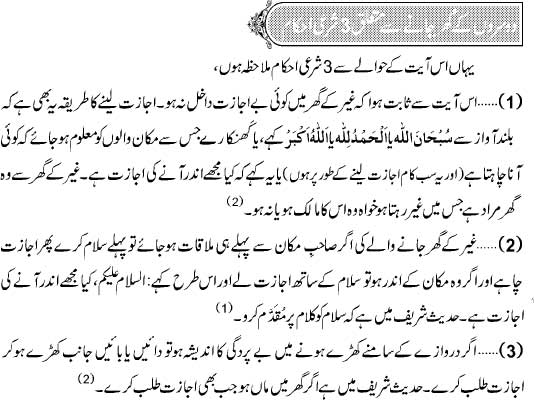
Say ‘Assalam Alaikum’, When You Enter Houses
Make sure you say the greeting of Salam when you enter your, or anyone else’s, house. Some of the benefits are as great as Paradise, provision in this world and Allah’s blessings.
The Prophet (peace be upon him) said, “There are three who are under the protection of Allah and if he lives, he will be provided for and it will be sufficient for him, and if he dies, Allah will enter him into Paradise: Whoever enters his house and gives the Salam; whoever goes out to the mosque; and whoever leaves in the way of Allah.” (Abu Dawood; authenticated by Al-Albani)
Allah says in the Qur’an:
“When you enter houses, give greetings of peace upon each other – a greeting from Allah, blessed and good.” (Qur’an, 24:61)
In Fiqh Al-Ad’iyah wal Adhkar, Imam As-Sa’di said, “The word ‘houses’ (Buyoot) is indefinite, so it includes any house that you enter and not just our own, even if there is no one present at the time. (The words) ‘upon yourselves’ (Alaa Anfusikum) means to give Salam to one another. The words are used to show that Muslims are like one entity due to their mutual care, love, and mercy. Then Allah praises this greeting by saying, “a greeting from Allah, blessed and good.” The greeting is to say: As-Salamu Alaykum wa Rahmatullahi wa Barakatuhu.
‘From Allah’, means that He has ordained it for you and has made it your greeting. It is ‘blessed’ because it is a Du’a that includes peace, safety, seeking blessings, mercy, and an increase in goodness. It is Tayyibah (good) because it is good speech from the One who is Good (At-Tayyib).”
Also, Anas narrated that the Prophet (peace be upon him) said to him, “Dear son, when you enter your house, say As-Salamu Alaykum to your family, for it will be a blessing (Barakah) both to you and to your family.” (Al-Tirmidhi; Hasan according to Al-Albani)
Muslims Should Strive For Unity
MUSLIMS should strive their best to achieve unity in all aspects. It is against the spirit of Islam to see Muslims divided. It is high time for Muslims to be united and forget about their differences. Unity is a unique feature of Islam.
Allah says: “O you who believe! Be conscious of Allah as you aught to be conscious of Him, and die not except in a state of Islam. And hold fast, all together, by the Rope which Allah (stretches out for you), and be not divided among yourselves…” (Qur’an 3:102-105).
At another place the Qur’an says: “As for those who divide their religion and break up into sects, you have no part in them in the least: their affair is with Allah: He will in the end tell them the truth of all that they did.” (6:159)
Disunity among Muslims is our greatest problem today. We are at present a very fragmented and divided people. We have disunity at every level: within our communities, at the local level, national and international level. We talk about unity and discuss the problem of disunity in our meetings and conferences, but we fail to be united. We fail to work together, although everything in our religion and in our condition demands that we come together and work together.
Unity is our religious obligation. In Islam unity and faith are interrelated. People of faith are united. The more faith they will have, the more united they will be. Allah says in the Qur’an, “Indeed the Believers are brothers to each other … ” (49:10)
50 Things To Be Done During Hajj
[..1] Smile in another Muslims face
[..2] Say Salam to strangers
[..3] Shake someone’s hand and ask about their health
[..4] Buy tea for someone
[..5] Offer to get someone’s groceries
[..6] Sit with a Hajj group from another country and ask about Islam in their village
[..7] Carry someone’s bags for them
[..8] Guide someone ill to the infirmary
[..9] Shun vain talk
[10] Recite talbiyah loudly, encouraging others
[11] On the days of Eid, walk through the tents reciting Talbiyah loudly reminding others
[12] Gather stones for people
[13] Offer to throw on behalf of unable Hajjis
[14] Guide people to the Jamarat
[15] Lower your gaze
[16] Remind people of the lives of the Sahaabah
[17] Read Qur’an with the Tafseer
[18] Do the authentic Dhikr of the morning and evening
[19] Make dua during your Sajdah
[20] Stand to the side of a gate and offer people water/tea as they leave
Importance Of Giving Salaams
Offering Salaam Is An Islamic Duty
It has been narrated from Hazrat Ali May Allah be pleased with him that the Rasullah Peace & Blessings Be Upon Him said,
“Commonly in Islam there are six rights of a Muslim upon a Muslim:
- when he meets him he should give him salaam;
- when he invites him (to a meal) he should accept it;
- when he sneezes he should bless him;
- when he falls ill he should visit him;
- when he dies he should accompany his funeral
- and he should prefer for him that which he prefers for himself.“
Warning Upon Not Replying To The Salaam
It has been narrated by Abdur Rahmaan ibn Shayba; says the Holy Prophet Peace & Blessings Be Upon Him said, “A rider should give salaam to a walking person, a walking person should give salaam to a seated person, a small group should give salaam to a larger group, whoever then responds to salaam, it is for his benefit, and he who does not respond to salaam, is not from amongst us.”
Ibn Sunni has narrated this and also Imam Bukhari in his book Al Adabul Mufrad. On these bases, Allama Nawawi in his commentary on Sahih Muslim has said, “To commence salaam is Sunnah and to reply is Wajib.”
Similarly, Hafiz ibn Abdul Bar says, “It is a unanimous agreement of the Muslims that to commence Salaam is Sunnah and to reply is Wajib.”
The Virtue of Commencing Salaam
It has been narrated by Abu Umamah that the Holy Prophet Peace & Blessings Be Upon Him said, “Whoever commences Salaam is very close to Allah and His Messenger Muhammad (Peace & Blessings Be Upon Him)” Ibn Sunni narrated this.
In Imaam Ahmads’ narration, there is, “The closest to Allah, the most glorious and eminent one, from amongst all the people is the one who commences salaam.”
Similarly, Tabrani narrates from Abu Darda, who says that we asked the Holy Prophet Peace & Blessings Be Upon Him, “O Prophet of Allah, we meet each other, so who from amongst us should give salaam first?” The Holy Prophet Peace & Blessings Be Upon Him replied, “The one who is the most obedient to Allah from amongst you.“
Embracing Islam In Daily Life
Islam has existed since the beginning of time and it is the natural religion of mankind. Since the beginning of His creation, Almighty Allah had planned that Islam would be the way His creation would find true happiness.
Unlike other religions, Islam is not just a religion of rituals and religious observance, but it is a complete way of life. In Islam, we find a complete way of living. In fact, the ordinary routines of life become for us a way of worshiping Almighty Allah.
The first and most important way in which we embrace Islam in our daily lives is to be regular about the five daily prayers. These five prayers are essential for us. Without them, we are just pretending to be Muslim. Without them, we are not taking our faith seriously.
The five daily prayers are the way in which our whole day becomes grounded and rooted in Allah. They have been given to us to make it possible to live as good Muslims, turning our eyes and our hearts throughout the day to Allah.
If we are looking for ways to live as Muslims, we need to look no further than to try to be faithful and prompt in the five daily prayers. By doing this, our whole day revolves around Allah and all the activities of the day; all our thoughts and all our intentions become devoted to Him.
It is only natural for us, as humans, to get caught up in the rushing around and the business of the day. It is only natural that the television news and the newspapers will affect us with their stories of tragedy and disaster. This is why so many people in the world become depressed and anxious.
We, too, as Muslims, might fall into the trap of getting caught up in the affairs of the world if it were not for the five daily prayers. Just as an air raid siren calls citizens in a time of danger to rush and take shelter, so the Adhan, the Call to Prayer, urges us to rush and take shelter from the cares of the world and to take refuge with Almighty Allah, Who is in control of all things. So prayer is the first way to embrace Islam in our daily lives.
We might find some time, too, during the day to read the Qur’an and ponder its message. This might not take a great deal of time, but it will heap rewards upon us and will make our day richer. Setting aside a few minutes each day, maybe early in the morning or late at night, to read the Qur’an will make our day a better day.
Aside from these two central things, we may take a whole book to list just some of the ways in which to take our faith seriously and embrace Islam in our daily lives.
The way we greet others, for example, reminds them that we are Muslim and it reminds us, too, that we are Muslim.
The greeting of salam, a greeting of peace, reminds us that Islam is a religion of peace.
In some countries, it may not be the custom to greet all people with as-salamu alaykum, but we can at least not forget to do this with our Muslim brothers and sisters. There is an unfortunate trend at the moment to answer the telephone by saying “hello.” Where did this “hello” come from? Are we not Muslim? Is our greeting not always the greeting of peace?
Throughout our conversation during the day, we remind ourselves that we are Muslim by words and phrases that call to mind Almighty Allah. For example, we praise Almighty Allah with exclamations like al-hamdu lillah (all praise to Allah) and ma sha’ Allah (whatever Allah wants). We can remain strong in faith by saying aloud such phrases as la hawla wa la quwwata ill bil-lah (There is neither strength nor power save from Allah,) whenever we hear of something bad or of some tragedy or disaster in the news.
Of course, as Muslims, we embrace Islam in our daily lives by the way we dress modestly, which applies to both men and women, the way we lower our gaze at the proper time, and the way we relate to others during the course of the day. The way we talk, the topics of our conversation, and the people we mix with are all part of our Islam. The choice of friends is all a part of who we are as Muslims.
Good manners are a complete part of our Muslim way of life. In fact, it is these Islamic good manners that can be a very strong part of our da’wah to others, telling them about Islam in a gentle way, without “preaching” to them.
Muslims are courteous toward others and are respectful to others and to all of Allah’s creation. In this sense, Muslims are the world’s natural environmentalists, since we love and respect our environment as part of creation.
In addition to all these natural ways of being a good Muslim, we can add extra things to help us even more. We can get up in the middle of the night, for example, to pray extra prayers, knowing that Almighty Allah is ready to listen to us. We might pray an extra two rak’ahs at different times during the day to ask Allah for our needs or to pray for the needs of others.
We might choose to follow the example of our beloved Prophet (peace be upon him), by fasting on Mondays and Thursdays. During the special month of Ramadan, we are given an even greater opportunity to dedicate our whole day to Almighty Allah, by fasting for His sake.
So there are so many ways in which Islam becomes a part of our daily lives. It is easy for anyone to say with their lips that there is no god but Allah and that Muhammad (peace be upon him) is His Messenger, but as Muslims, we must mean it with all our hearts.
We can show how much we mean it by embracing Islam daily and making it, as you say, a part of our daily lives. In Sha’ Allah, Almighty Allah will give us the will to do this and reward our efforts.
Assalamu Alaikum, Not Just Words
Narrated Abu Huraira: The Prophet said, “When Allah created Adam, He said to him: `Go and greet that company of angels who are sitting there – and then listen to what they are going to say in reply to your greetings because that will be your greeting and your off-springs.’ Adam said to the angels: `As-Salamu `Alaikum.’ They replied: `As-Salamu `Alaikum wa Rahmatullah.’ Thus adding in reply to him: `wa Rahmatullah (and Mercy of Allah)’ to his greeting.’’ (Al-Bukhari)
All right, mate! What’s up! How are you? Good morning and afternoon are all famous greetings around the world. Different cultures, races, and communities say it in their own way and languages. Muslims, however, no matter from which country, race, or culture, greet each other in the same way all over the world. But have we ever stopped to think about the impact and beauty of what we utter? Hearts and bonds are strengthened every time we exchange this greeting.
This salutation was prescribed from the beginning of time as mentioned in the Hadith. The meaning translates: “May peace, mercy, and blessings of Allah be upon you.” By saying this, we are in fact making Du’a for our brothers and sisters and spreading love and peace simultaneously. Another benefit is that it ends enmity. We may see someone whom we don’t like, but by saying these words, our hearts may Insha Allah open up and allow friendship to sow its seeds.
The importance of this greeting is exemplified in a Hadith collected by Al-Bukhari and Muslims from Abdullah Bin Umar. A man asked the Messenger of Allah (peace be upon him): “What is the best thing in Islam?” He replied, “Feeding others and giving the greeting of Salam to those whom you know and those whom you do not know.”
The Prophet mentioned feeding someone and giving salaams together as the best things in Islam. We often lose sight of the simplest things that have great rewards.
Among the perfect attributes of Imaan – believing in the six articles of faith – is passing on salams.
The Messenger of Allah (peace be upon him) said: “By Him in Whose Hand is my soul, you will not enter Paradise until you believe, and you will not believe until you love one another. Should I not guide you to something which will install love amongst you? ‘Spread Salams amongst you.’” (Abu Dawood, vol. 3, no. 5174)
In today’s scenario, love and a stronger bond between Muslims is more than needed. Several people embrace Islam every day and many face hostility and are sometimes boycotted by their non-Muslim relatives as a result. It is upon us Muslims to welcome them. We are their kinsfolk.
By spreading salams we are obeying the Prophet (peace be upon him) as he told us that we should give salams to people we know and people we do not. Is this what we are doing? I’m afraid we are not. When walking down the street how many of us greet those who pass by?
Here are a few things to keep in mind next time we meet each other:
- Be the first to initiate the Salam.
- Greet Muslims whom you know and you don’t.
- Begin your conversation with the Salam.
- If someone tells us that so-and-so gave their Salaams to us, then reply, “Wa Alaika Wa Alayhis Salam.”
- A person riding a mount should greet the one who is walking; a person on foot should greet the one who is sitting; a smaller group should greet a larger group; and the young should greet their elders. (Al-Bukhari, vol. 8, book 74, no. 250-251)
- Whenever you enter a house, yours or others, enter by saying the Salam. (Qur’an, 24:61)
- Shake hands because it wipes out the (minor) sins. (Al-Tirmidhi)
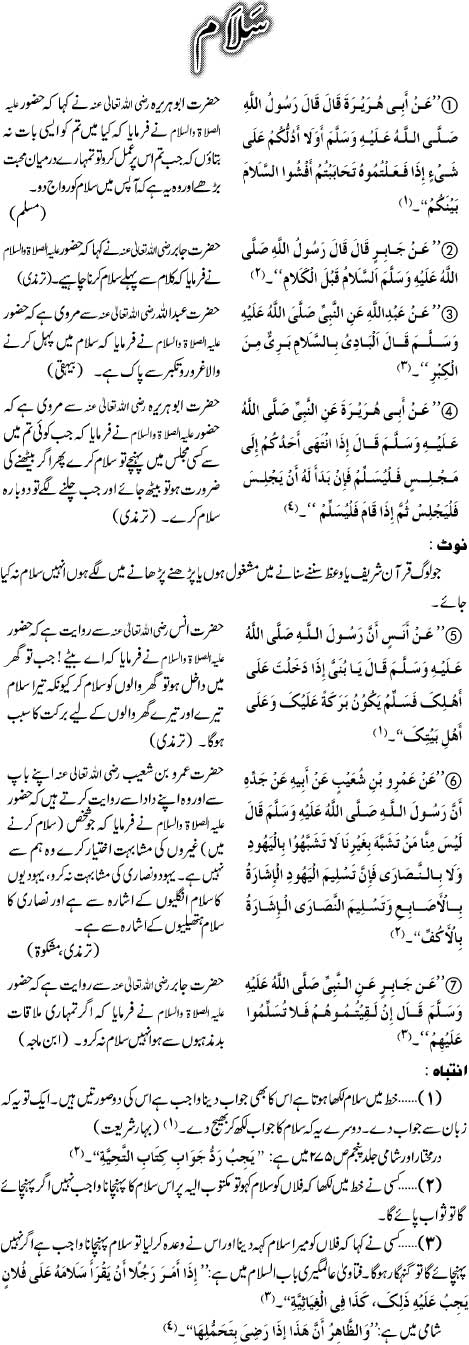
Salam Ki Sunnatain Aur A’adab
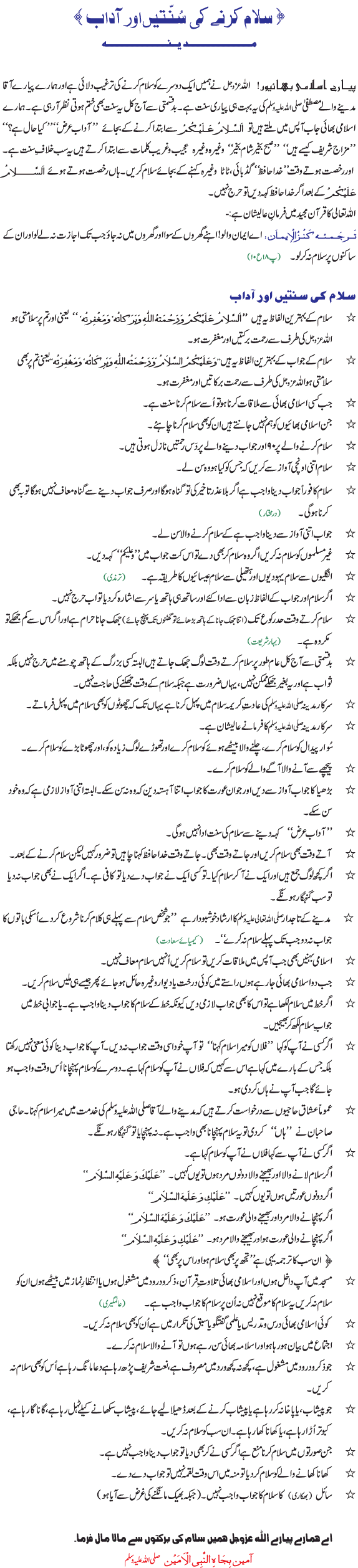
Salam Ki Sunnatain Aur A’adab