

TAG: Wife
Emotional And Physical Abuse In Marriage
In Islam, the marriage of a man and a woman is not just a financial and physical arrangement of living together but a sacred contract, a gift of Allah, to lead a happy, enjoyable life and continue the lineage. The main goal of marriage in Islam is the realization of tranquility and compassion between the spouses.
The relationship between the spouses should be based on tranquility, love, and mercy. These three summarize the ideals of Islamic marriage. It is the duty of the husband and wife to see that they are a source of comfort and tranquility for each other.
While the meaning of physical abuse is rather obvious, the meaning of emotional abuse might not be, and the abuse itself may be more insidious. Emotional abuse includes name-calling, belittling, using the threat of divorce as a weapon to manipulate the other, threatening with a real weapon (even with no intention to use it). There may be other elements such as not allowing the wife to visit or contact family or friends. Even frequent teasing, though it starts in fun, may become a type of abuse if it takes the form of sarcasm or demeaning remarks.
It is common for some people when they are angry to call others names or belittle them. If one gets angry quickly and easily with one’s spouse, it could lead to emotional abuse. The Prophet (peace and blessings be upon him) advised us to control our anger, not to call each other names, not to use vulgar language, and not to point a weapon at another person. This advice was general for all, but it should be taken even more seriously within a marriage.
These general guidelines are established by the Qur’an in the following verses: “O ye who believe! Let not a folk deride (ridicule) a folk who may be better than they (are), nor let women (deride) women who may be better than they are; neither defame one another nor insult one another by nicknames. Bad is the name of lewdness after faith. And whoso turneth not in repentance, such are evil-doers. O ye who believe! Shun much suspicion; for lo! some suspicion is a crime. And spy not, neither backbite one another. Would one of you love to eat the flesh of his dead brother? Ye abhor that (so abhor the other)! And keep your duty (to Allah). Lo! Allah is Relenting, Merciful.” (Al-Hujurat: 11-12)
Moreover, Prophet Mohammad (SallAllaho Alaihi Wasallam – may the peace and blessings of Allah be upon him) said: ?It is not lawful for a Muslim to scare his fellow Muslim.? (Reported by Ahmad & Abu Dawud)
Abu Hurayrah (may Allah be pleased with him) reported that the Prophet (SallAllaho Alaihi Wasallam) also said: ?None of you should point his weapon at his brother, as Satan may provoke him (to hurt his brother) and as a result, he would fall into a pit of Fire.? (Reported by al-Bukhari) In another version: ?He who (even) points at his brother with a piece of iron is cursed by the angels until he puts it down, even if the other was his blood brother.? (Reported by Muslim)
“Emotional abuse truly damages and hurts as much as physical abuse does. In Islam, there is a special consideration of the relationship between the spouses. Allah says, “And among His Signs is this, that He created for you mates from among yourselves, that you may dwell in tranquility with them, and He has put love and mercy between your (hearts): verily in that are Signs for those who reflect.” (Ar-Rum 21)
It is shown that the basis of the relationship between husband and wife is affection and mercy. In many Hadiths, the Prophet (SallAllaho Alaihi Wasallam) mentioned that if a husband looks at his wife with kindness and mercy, Allah Almighty looks at them with His mercy, and if they shake hands all their sins vanish. So, we have to study very well how the Prophet (peace SallAllaho Alaihi Wasallam) dealt with his wives. In fact, he was very merciful, kind, and loveable, bearing in mind that there were some problems that they faced in their marital life but they dealt with these problems with extreme wisdom and kindness. The Prophet (SallAllaho Alaihi Wasallam) never abused his wives either physically or emotionally.
Therefore, neither of the spouses is allowed to abuse the other emotionally. This is prohibited in Islam. If either does so, Almighty Allah will hold him or her accountable for that, and they should repent to Allah for this. It is clear now that the best guide to us to live a very successful marital life is to follow the Prophet (SallAllaho Alaihi Wasallam).”
Habits For Success In The Family
1. Start by choosing the right spouse (Nur : 34)
2. Efforts must be exerted to correct any defects in a spouse once married. Develop the family spiritually. Remember Allah often. (Nur : 87)
3. Inculcate iman in the children. Follow the sunnah and read the Quran regularly especially sura baqara. Take care of your family’s education. Teach your spouse and children. Set up both book and audio-visual libraries. Invite good people to visit your home (Nuh : 28)
4. Treat your family as a small social unit. Establish shura by discussing family matters with your spouse and children. Some problems amicably and within the family. Children should not be allowed to see differences or conflicts between the parents. Exchange visits with good families. (Nur : 61)
5. Guard jealously the privacy of your home (Nur : 23, 28, 53)
6. Keep family secrets within your home.
7. Exercise control. Monitor what the children are doing.
8. Make sure that the family follows a fixed meal and sleep times.
9. All members of the family should co-operate in household work.
10. Joke and have some fun and humor with the members of your family. Avoid waste and extravagance. Waste leads to poverty.
11. Do not live a life of hyperconsumerism. Buy only what you need. It’s even advisable to buy less than what you think your needs are, because you often over-estimate those needs. Resist temptation to always ‘want’ things. Do not try to show off or compete.
12. Avoid debts. A debt is an instrument of enslavement.
WHAT ELSE YOU WANT TO KNOW?
1. Religion is the basis for family formation (Quran 2 : 221)
2. Family relations based on marriage and blood (Quran 25 : 54)
3. Family is a source of tranquility (Quran 25 : 74)
4. Husband as head of the family (Quran 4 : 34)
5. Wife is a leader in her home – Narrated Ibn Umar : The Prophet said, ‘All of you are guardians and are responsible for your wards, The ruler is a guardian and the man is a guardian of his family; the lady is a guardian who is responsible for her husband’s house and his offspring; and so all of you are guardians and are responsible for your wards’ (Bukhari 7:98 hadith #128)
6. Duty to save family (Quran 66 : 1, 3-6)
7. Kindness for the young; respect for the old – ‘Hazrat Amr bin Shuaib relates on the authority of his father who heard it from his father, that the Holy Prophet (may peace be upon him) said: A person who has no compassion for our children and does not honor our elders is not from us’ (Abu Daud and Tirmidhi) (Riyadh 1:217, hadith #355)
8. Expenditure on the family is sadaqa – Narrated Abu Mas’ud Al-Ansari : The Prophet said, ‘When a Muslim spends something on his family intending to receive Allah’s reward it is regarded as sadaqa for him’ (Bukhari 7:201, hadith #263)
9. Justice takes precedence over family (Quran 4 : 135)
10. Financial security – Narrated Umar: The Prophet used to sell the dates of the garden of Bani An-Nadir and store for his family so many foods as would cover their needs for a whole year’ (Bukhari 7:204, hadith # 270)
Violence Against Spouses Forbidden In Islam
[Quran 4:34] “Men are responsible for the welfare of women since God has given some (of you) more wherewithal than others, and because they must spend of their wealth (to maintain the family). Therefore pious and devout women safeguard the private matters that God would have them safeguard. As for those (women) from whom you fear aggressive defiance, caution them (to piety). (If they remain unmoved by your words), then leave them alone in their beds, and finally (if they continue in their aggressive defiance), then separate from them. However, if they accede to you (by abandoning their aggressively defiant behaviour), then you have no (legitimate) grounds to act against them (any further), and God is full of knowledge and
greatness.”
The Prophet (Peace Be Upon Him) has commanded:
[Sunan Abudawud, Book #11, Hadith #2138] “Narrated Mu’awiyah ibn Haydah: I said: Apostle of Allah, how should we approach our wives and how should we leave them? He replied: Approach your tilth when or how you will, give her (your wife) food when you take food, clothe when you clothe yourself, do not revile her face, and do not beat her.”
[Sunan Abudawud, Book #12, Hadith #2220] “Narrated Aisha, Ummul Mu’minin: Habibah daughter of Sahl was the wife of Thabit ibn Qays Shimmas He beat her and broke some of her part. So she came to the Prophet (peace be upon him) after morning, and complained to him against her husband. The Prophet (peace be upon him) called on Thabit ibn Qays and said (to him): Take a part of her property and separate yourself from her. He asked: Is that right, Apostle of Allah? He said: Yes. He said: I have given her two gardens of mine as a dower, and they are already in her possession. The Prophet (peace be upon him) said: Take them and separate yourself from her.”
Advice To Daughter-in-Laws
1. Accept your in-laws as your own parents. You have them to thank for the wonderful man who has become your life partner.
2. Don’t compare them to your parents as to show your spouse how inadequate his parents are.
3. If your in-laws give a gift, appreciate it and do not pass unkind remarks.
4. Praise them often in the presence of your husband, family, and friends in that way, even though you have not grown to like them, you will in time.
5. Realize that they are also humans. They have their faults. You would never disown your parents for their flaws, so how can you expect the same from your husband’s parents? Hide their faults. Allah Ta’ala will conceal your faults in the hereafter.
6. Lower your expectations. As much as you might feel that marriage is a huge adjustment to you, having their son married is an adjustment for them too. Their son no longer belongs exclusively to them. You will now have to learn to share.
7. Treat them respectfully. A bad word creates a permanent rift.
8. When your children show them love, be thankful rather than jealous. Would you deprive your own children of the love of their grandparents, confining them only to the love of your own parents because of jealousy? How would you feel if your brother’s wife did the same with your parents?
9. Do all you can to make them feel at home when they come by to visit. When you visit them, assist them as much as possible. They should feel pleased when you come.
10. Treat every instruction of your mother-in-law like an instruction of your own mother. Give her pleasure precedence even though she may ill-treat you. Speak to her with respect and not as you speak to an equal. Never say anything if she scolds you. Never speak harshly to her.
11. Never speak ill of them in the presence of your children. If they have overstepped the boundaries, discuss this in private with your husband.
12. Never drag your husband into an argument between your mother-in-law and yourself. By doing this, you place your husband in a very precarious position. Should you have any issue you need to address with your mother-in-law, do so in a respectful manner. By holding mature adult discussions, an amicable agreement can be reached.
13. Be a giver instead of a demander. Always remember that it is sheer folly to always go around demanding that your rights be fulfilled. Rather, concentrate on fulfilling the rights of others. In doing so, you will find that those around you will automatically begin to fulfill your rights.
14. If your in-laws have no one else to reside with, offer them to reside with you. This is more so when the father-in-law passes away. By being of service to your mother-in-law, you will attain lofty stages in the hereafter, since service grants one Allah Ta’ala Himself. Never be selfish and ask your husband to choose between his mother and you. Remember; as you do, so will you be recompensed. One day, you too will reach old-age and will require assistance.
Nabi (Sallallahu Alayhi Wasallam) said, “Whichever young person honors an old person due to his age, Allah Ta’ala will create someone who will honor him in old age.”
15. If your in-laws oppress you, firstly turn to Allah Ta’ala and make dua to Him. Speak to your husband in a polite manner, and inform him of your plight. Learn to forgive and forget. Nabi (Sallallahu Alayhi Wasallam) said: “Allah Ta’ala increases a person in honor who forgives. Whoever humbles himself for Allah Ta’ala, Allah Ta’ala will raise him.”
16. Always encourage your husband to keep good ties with his family members, especially parents and brothers and sisters. Many brothers and sisters become estranged after marriage due to the stories carried by the wives to their husbands. Behave respectfully to all elders like the wives of the husband’s elder brother. If younger, be kind and loving and assist as far as possible in their work.
17. Recompense comes from Allah Ta’ala. Give and give and do not ever expect something in return. Always remember that the best recompense is always from Allah Ta’ala. Allah Ta’ala says: “And what is the reward of good except good?” (Ar-Rahman. 55:601)
By Moulana Abdul Hameed Ishaq
Husband And Wife: Mutual Rights And Obligations
In Islam the marriage of a man and a woman is not just a financial and physical arrangement of living together but a sacred contract, a gift of God, to lead a happy, enjoyable life and continue the lineage. The main goal of marriage in Islam is the realization of tranquility and compassions between the spouses. For the attainment of this supreme goal, Islam defines certain duties and rights for the husband and wife.
Piety is the basis of choosing the life partner. Several statements of Holy Qur’an and Sunnah prescribe kindness and equity, compassion and love, sympathy and consideration, patience and goodwill. The Prophet (peace be upon him), says: “The best Muslim is the one who is best to his family.” Also, he says, “… and the most blessed joy in life is a good, righteous wife.” (Reported by At-Tirmidhi)
The role of the husband revolves around the moral principle that it is his solemn duty to Allah to treat his wife with kindness, honor, and patience; to keep her honorably or free her from the marital bond honorably; and to cause her no harm or grief. Allah Almighty says : “…and live with them honorably. If you dislike them, it may be that you dislike a thing through which Allah brings a good deal of good.” (4:19)
The role of the wife is summarized in the verse that women have rights even as they have duties, according to what is equitable; but men have a degree over them. Allah Almighty says, “And they (women) have rights (over their husbands as regards living expenses) similar (to those of their husbands) over them (as regards obedience and respect) to what is reasonable, but men have a degree (of responsibility) over them. And Allah is All-Mighty, All-Wise.” (2:228)
This degree is usually interpreted by Muslim scholars in conjunction with another passage which states, among other things, that men are trustees, guardians, and protectors of women because Allah has made some of them excel others and because men expend of their means. Allah Almighty says: “Men are the protectors and maintainers of women, because Allah has made one of them to excel the other, and because they spend (to support them) from their means. Therefore the righteous women are devoutly obedient and guard in their husband’s absence what Allah orders them to guard. As to those women on whose part you see ill condct, admonish them (first), (next) refuse to share their beds (and last) and beat them (lightly, if it is useful). But if they obey you, seek not against them means (of annoyance). Surely, Allah is ever Most High, Most Great.” (4:34)
Since the Holy Qur’an and the Sunnah have commanded kindness to women, it is the husband’s duty to: consort with his wife in an equitable and kind manner; have responsibility for the full maintenance of wife, a duty which he must discharge cheerfully, without reproach, injury, or condescendence. Allah Almighty says: “Let the rich man spend according to his means; and the man whose resources are restricted, let him spend according to what Allah has given him. Allah puts no burden on any person beyond what He has given him. Allah will grant after hardship, ease. (65:7)
Components of maintenance:
Maintenance entails the wife’s incontestable right to lodging, clothing, nourishing, and general care and well-being.
The wife’s residence must be adequate so as to provide her with the reasonable level of privacy, comfort, and independence. The welfare of the wife and the stability of the marriage should be the ultimate goal.
What is true of the residence is true of clothing, food, and general care. The wife has the right to be clothed, fed, and cared for by the husband, in accordance with his means and her style of living. These rights are to be exercised without extravagance or miserliness.
Non-material rights:
A husband is commanded by the law of God to treat his wife with equity; respect her feelings, and to show her kindness and consideration.
The husband is also commanded not to show his wife any aversion or to subject her to suspense or uncertainty. He should not keep his wife with the intention of inflicting harm on her or hindering her freedom.
Let her demand freedom from the marital bond, if he has no love or sympathy for her.
Wife’s obligations:
The main obligation of the wife as a partner in a marital relationship is to contribute to the success and blissfulness of the marriage as much as possible. She must be attentive to the comfort and well being of her mate. She may neither offend him nor hurt his feelings. Perhaps nothing can illustrate the point better than the Qur’anic statement which describes the righteous people as those who pray saying: “… Our Lord! Bestow on us from our wives and our offspring the comfort of our eyes, and make us leaders of the Muttaqun (the pious).” (25:74)
This is the basis on which all the wife’s obligations rest and from which they flow. To fulfill this basic obligation, a wife must be faithful, trustworthy, and honest. She must not deceive her mate by deliberately avoiding conception lest it deprives him of legitimate progeny. She must not allow any other person to have access to that which is exclusively the husband’s right, i.e. sexual intimacy. She must not receive anyone in his home whom the husband does not like. She may not accept their gifts without his approval. This is probably meant to avoid jealousy, suspicion, gossip, etc., and also to maintain the integrity of all parties concerned.
The husband’s possessions are her trust. If she has access to any portion thereof, or if she is entrusted with any fund, she must discharge her duty wisely and thriftily. She may not lend or dispose of any of his belongings without his permission.
With respect to intimacy, the wife is to make herself desirable, to be attractive, responsive, and cooperative.
A wife may not deny herself to her husband; due consideration is, of course, given to health and decency.
Moreover, the wife is not permitted to do anything that may render her companionship less desirable or less gratifying. If she neglects herself, the husband has the right to interfere with her freedom to rectify the situation and ensure maximum self-fulfillment for both partners. She is not permitted to do anything on his part that may impede her gratification.
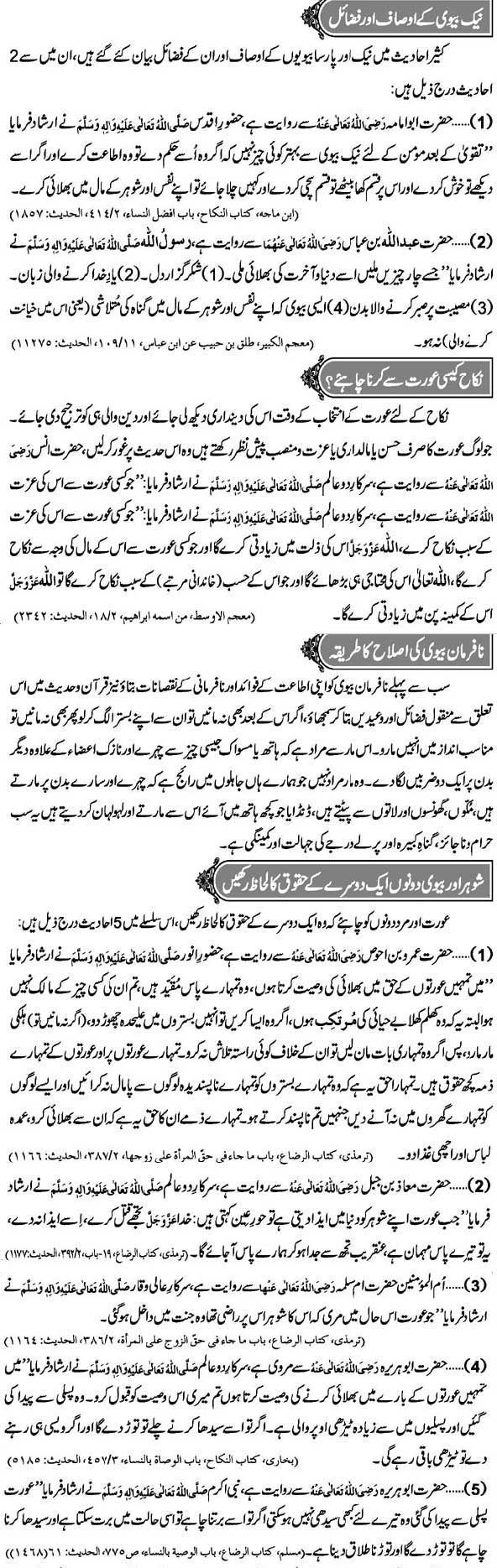
Naik Biwi Kay Fazail
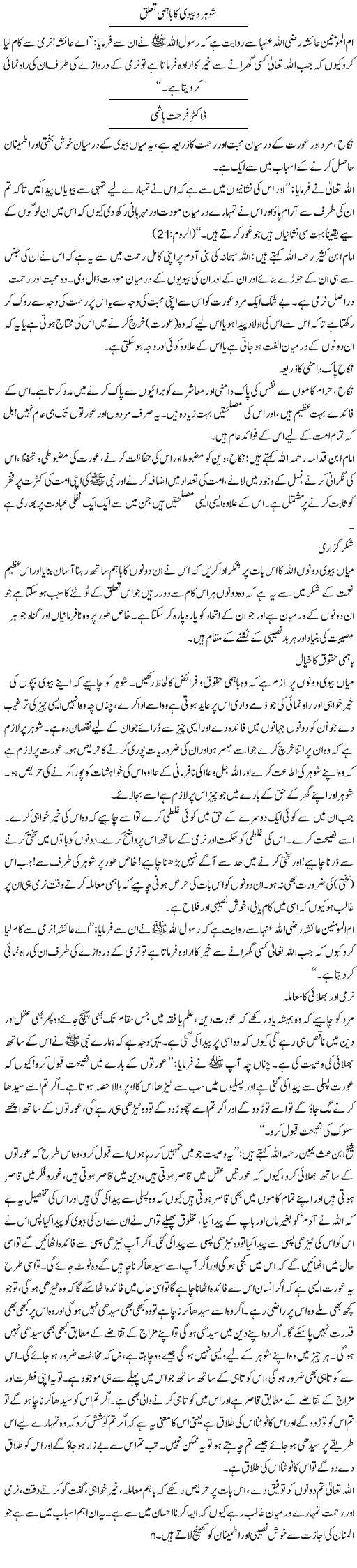
Shohar Biwi Ka Bahmi Taluq
Family Relationship In Islam
Islam is a complete way of life. It considers the family the cornerstone of Islamic society. It bases the atmosphere in the family on sacrifice, love, loyalty, and obedience. When we say “family” we mean the traditional definition of it, namely husband, wife and children. Grandparents are also part of the extended Muslim family.
It may be asked here: how does Islam organize family relationships? To answer this, we have to concentrate on husband-wife relationship and parent-children relationship.
As for husband wife relationship the following verse portrays the right Islamic atmosphere:
“And among His Signs is this: He created for you spouses from yourselves, that you may find rest in them, and He ordained between you affection and mercy.” (Qur-an, 30-21)
If we contemplate the Noble Qur-an, we find that it refers to parents-child relationships in four main places. Before it asks children to be good and loyal to their parents, it requires parents to be extremely careful in upbringing their children. In other words it asks parents to do their duty before asking for their rights.
These are the two main chapters of the Noble Qur-an that decide and clearly depict the Islamic relationship between parents and children. It is a relationship based, as we see, on belief in Allah, and feeling that He observes all that we do and that we are accountable to Him even in the bad breath that we may release against our parents when we are angry. Even this has to be controlled.
Let us remember, however, that it is only parents who do their duty, who deserve this honorable treatment of their children. That is why when a parent came to the Prophet (Peace Be Upon Him) and complained to him about the ingratitude of his son, the son said: He was ungrateful to me oh Messenger of Allah, before I showed ingratitude to him. So the Prophet (Peace Be Upon Him) did not blame the son but disliked the attitude of his parent. This is a message to all parents.
The third place in the Noble Qur-an that refers to parents child relationship is in chapter 46 called Al Ahqaf where Allah says:
“And We have enjoined on man to be dutiful and kind toward his parents. His mother bears him with hardship and delivers him with hardship. His bearing and weaning are thirty months, till when he attains full strength and reaches forty years, he says: ‘My Lord! Arouse me that I may give thanks for the favor where with you have favored my parents, and I may do right acceptable unto you. I have turned unto you repentant and Lo! I am one of the Muslims.”
Concerning this type of child the Noble Qur-an has the following comment: “Those are they from whom We accept the best of what they do, and We overlook their evil deeds among the dwellers of Paradise – a promise of truth, which they have been promised (in the world).”
The Noble Qur-an then turns to the other category of or children who are disbelievers and are, as a result, ungrateful to their parents. It declares:
“As for him who said to his parents: Fie upon you both! Do you threaten me that I shall be brought forth (again) when generations before me have passed away! While they too cry unto Allah for help and say: Woe unto you! Believe! Verily, the promise of Allah is true. But he says: This is nothing but fables of the ancient.”
Commenting on this attitude Allah says:
“Such are those whom the Word concerning nations of the jinn and mankind which have passed away before them has effect. Verily, they are the losers. And for each there will be degrees due to what they did; that He may recompense them in full for their deeds! And they will not be wronged.” (Qur-an, 46:15-19).
The forth and last place in the Noble Qur-an that refers to parents-child relationship is what is mentioned briefly in chapter 29 that says:
“We have enjoined on man to be good and dutiful to his parents. But should they strive to make you join with Me that of which you have no knowledge, then obey them not. Unto Me is your return and I shall tell you what you used to do.” (Qur-an, 29:8)
Your Wife And Kids
Abu Saeed Khudri (radhiyallahu anhu) reported that Rasullullah (The Messenger of Allah) has said that whosoever spends anything on his family members for reward, will enjoy the divine credit of charity. (Bukhari, Muslim)
It is described by Abu Huraira(radhiyallahu anhu) that Mohammed (sallallahu alaiyhi wassallam) has said that, to spend on one’s wife, has great merit than giving charity to male and female slaves and beggars. (Muslim)
Abdullah bin Masood (radhiyallahu anhu) reported that the greatest preference is to spend on one’s wife and children which is necessary and then it should be spent on close relatives. (Tibrani)
It is narrated in the extract of Arbez bin Saarya(radhiyallahu anhu) that even to give water to one’s wife is charity.
Abu Huraira (radhiyallahu anhu) reported that someone asked Rasullullah(sallallahu alaiyhi wassallam) that he had one gold coin with him, where should he spend it ? Rasullullah(sallallahu alaiyhi wassallam) said that he should spend it on himself. The man said that he had one more and Mohammed(sallallahu alaiyhi wassallam) said that he should spend it on his wife. The man again said that he had yet another and Rasullullah(sallallahu alaiyhi wassallam) said ,that he should spend on his servants. The man said that he had a fourth and Rasullullah(sallallahu alaiyhi wassallam) said that he should spend it, on whatever he preferred. (Ibn Habban)
Sa’ad bin Waqqas(radhiyallahu anhu) reported that Mohammed (sallallahu alaiyhi wassallam) said that whosoever spends his money to gain Allah’s pleasure and goodwill, gets the credit of charity so much that even a morsel which he puts in the mouth of his wife, has the credit of charity. ( Bukhari, Muslim)