

Talaq: Haqooq-O-Faraiz Mein Adam Tawazun Ka Natija
TAG: Wife
How To Prevent Family Disorders
To prevent family disorders, married men and women need to keep certain points in mind and practice them in their lives, as below:
1) One of the basic points for successful family life is self-knowledge. Every man and woman has certain capabilities and limitations, which they need to discover within themselves. The husband and wife, who are clearly aware of their good and bad points and the reality of their personalities, will have fewer disputes in their family lives. Then it is necessary that the husband and wife accept one another and love one another with all his/her faults and finer points.
2) The husband and wife should respect one another and should not do anything to cause disrespect or hate in the other party. Married couples should hold themselves and their spouses in high regard and should be aware that if they want or like their spouses to be or act according to their own opinions, it is only going to be a waste of time and effort. People are all different. Married couples should accept one another as they are, and not try to compare one another to others because this only inflicts psychological injury.
3) Married couples should foster their talents. Couples can become acquainted with their particular talents in various fields, for example, sports, physical expertise, interest in study, and other fields. The more that couples study and read about different topics, on a daily basis, the more valuable their lives will become.
4) Couples need to form close relationships with others. The reason for many family disputes lies in separation and seclusion from others. A husband and wife, who like others are part of society, need the support, calm, and assurance that come from others – ( e.g., family members, friends, neighbors, etc.). For this reason, it is necessary to have close, active affectionate, and at the same time healthy and well-rooted relationships with others in order to prevent family disputes.
Zaynab: The Poor’s Mother
The wives of the Prophet (peace be upon him) are known as the mothers of all believers. This status has been conferred on them by God, as He says in the Qur’an: “The Prophet has more claim on the believers than they have on their selves, and his wives are their mothers.” (33: 6). One of them, however, has an additional title of motherhood. She is Zaynab bint Khuzaymah (radiAllahu anha), known as the mother of the poor. She earned this title because of her compassionate heart and her ready generosity. She was apparently always kind to the poor, and her kindness became greater when she married the Prophet.
The Prophet married Zaynab bint Khuzaymah (radiAllahu anha) in the third year of the Islamic calendar, only a few months after he had married Hafsah bint Umar (radiAllahu anha). The exact date of the marriage cannot be ascertained, as we have different reports none of which can be given greater weight. Moreover, there is some confusion about her earlier marriages. What is certain is that she was married to Ubaydah ibn Al-Harith (radiAllahu anha), who was the first martyr in the Battle of Badr, the first major battle fought by the Muslims under the Prophet’s leadership. Reports suggest that before Ubaydah, Zaynab was married to his brother Al-Tufayl, but other reports say that she was married to Jahm ibn Amr, who was her cousin.
Zaynab (radiAllahu anha) does not feature in any reports of major events that took place during the Prophet’s lifetime. This is mainly due to the fact that she did not stay long in the Prophet’s home. She died soon after her marriage. Some reports suggest that she only stayed with the Prophet for two or three months, while others put the figure at eight months. She then died, aged 30. Her short stay in the Prophet’s home meant that she was not involved in any disagreement or friction of the type that occurs between women living in the same home. Her marriage to the Prophet seems to be a mere short stay before she completes her journey of this life, passing away into the everlasting world.
It is important not to confuse this Zaynab (radiAllahu anha) with another wife of the Prophet with the same name. The other was Zaynab bint Jahsh (radiAllahu anha), also known for her kindness to the poor. That one was the Prophet’s own cousin and her marriage involved the implementation of new legislation clearly outlined in the Qur’an. We will have more to say about this when we look at the Prophet’s marriage to her.
Apart from Khadijah (radiAllahu anha), Zaynab bint Khuzaymah (radiAllahu anha) was the only one of the Prophet’s wives to die during his lifetime. All the others survived him. She was buried at Al-Baqee, the cemetery of Madinah, which was the resting place of many of the Prophet’s companions.
By: Adil Salahi
Prophet Muhammad: Normal Family Relations
After marriage women need to adjust to the demands of their new status. The couple would have known each other very well and they would be familiar with what each of them requires for a happy and settled home life. It is often the case that families stay together because of public duty, or because a break-up is too costly, socially or materially.
Prophet Muhammad (peace be upon him) lived with his first wife, Khadijah (Radi Allahu anha), for 25 years. After her death, he married several wives, but he was with the first of these, Sawdah (Radi Allahu anha), for several years before he married again. All his marriages were necessitated by legislative, social, or political reasons. This means that each one of his wives realized at the time of her marriage that she was being married to a person who received direct revelations from God. This was a far more honorable position than that of any king or emperor. How could they adjust to their new positions? What sort of training did they need for such an adjustment?
Umar ibn Al-Khattab (Radi Allahu anhu) tells us of an occasion when he was at home thinking about a problem he was facing when his wife asked him what was on his mind. He told her that it was none of her business. She said: “How could you say that when your daughter, Hafsah, would ask her husband, the Prophet, about his affairs and would object to something he might wish?” Shocked, Umar (Radi Allahu anhu) went to his daughter and asked her if that was true. She confirmed that it was. Umar (Radi Allahu anhu) counseled his daughter not to do this again, reminding her that should she be divorced, her position with God and the Muslim community would be greatly undermined. Umar (Radi Allahu anhu) further asked another of the Prophet’s wives, Umm Salamah (Radi Allahu anha), about this, because she was related to him. She confirmed it and he tried to counsel her, but she said: “How strange that you, Umar (Radi Allahu anhu), are trying to interfere between God’s messenger and his wives?”
What this tells us is that life in the Prophet’s home was just as normal as it was, and remains, in most families. A married couple may have the occasional disagreement, and if a wife feels that she did not receive what she wants, she may be upset with her husband. She may object to a decision he might have taken and tries to persuade him to change it. If she fails, she may decide not to speak to him, or she may sulk for a while. A little later, things may sort themselves out. The fact that the other party was God’s messenger did not affect this relationship. They looked at it as a normal married life. Thus, the position of the Prophet as God’s messenger disappears, and what is left is the relationship between a man and his wife.
In the Prophet’s case, this was governed by his advice to us all: “The best of you is the one who is best to his wife and family. I am the best of you to my wives and family.” This Hadith sets a principle that the best of all people are those who are kind and compassionate in their dealings with their wives and children. It also sets a practical example that we should all follow. This was the example provided by the best person to have ever lived on earth, Muhammad (peace be upon him).
– by Adil Salahi
Blessings Of A Simple Marriage
A man came to Sufyan Bin Uyainah (may Allah have mercy on him) and complained about his wife. “I am the lowest and most despicable thing to her,” he said. Sufyan lowered his head for a few moments and asked, “Perhaps you wanted her in order to better your status?” The man said, “Indeed, Abu Muhammad.” Sufyan replied, “Whoever goes for glory will be tested with humiliation; whoever goes for wealth will be tested with poverty; but whoever goes for religiousness, Allah will bring together for his glory and wealth with the religion.”
Sufyan then mentioned his own story to the man. “We were four brothers,” he said. “Muhammad, ‘Umran, Ibrahim, and I. Muhammad was the eldest, ‘Umran was the youngest, and I was in the middle. When Muhammad wanted to marry, he desired status and married a woman of higher standing, so Allah tested him with ignominy. ‘Umran desired wealth, so he married a richer woman and Allah tested him with poverty, as (her family) took everything from him and gave him nothing.”
“I pondered over their situation,” Sufyan continued. “Once when Mu’ammar Bin Rashid came to us, I consulted him and told him the story of my brothers. He reminded me of the Hadith of Yahya Bin Ja’dah and the Hadith of Ayesha.” The first Hadith states that the Prophet (peace be upon him) said, “A woman is married for four things: her religion, her status (lineage), her wealth or her beauty; so take the religious one and be successful.” (Al-Bukhari and Muslim) The second Hadith of Ayesha states that the Prophet (peace be upon him) said, “The most blessed woman is she who is easiest to maintain.” (An-Nasa’i)
“Thus,” Sufyan said, “I chose (to marry a woman of) religion and with a modest dowry, in accordance with the Sunnah of Allah’s Messenger (peace be upon him) and Allah gave me status and wealth along with the religion.” – Abu Nu’aym, Hilyatu Al-Awliya (7/289, 290)
Note: The second Hadith has been graded weak by scholars. However, scholars point out there is another narration that supports and adds to its meaning, which states: “It is from the good qualities in a woman that she (is taken in marriage with) an easy dowry, an easy proposal (via her guardian) and an easy womb (i.e. she is fertile and bares children without difficulty).” (Musnad Ahmad)
Achieving A Strong Marriage Bond
Marriage is considered an ‘ibaadah, an act that is pleasing to Allah Ta’aala. It is in accordance with His commandments that husbands and wives love each other and help one another to rear their children as true servants of Allah Ta’aala.
Most spouses start out with hopes and rosy dreams; truly committed to making their marriage work. However, as the reality of living with a less than perfect spouse lurks in, and as the pressures of life builds, many individuals do not find as much satisfaction in their relationships. All marriages change over time. However, with hard work and dedication, people can keep their marriages strong and enjoyable. How is it done? What does it take to create a long-lasting, satisfying marriage?
Researches indicate that the most successful marriages share some key characteristics. These are some of the characteristics that researchers have found to be common in successful marriages. Let’s look at each of these factors.
Characteristics Of Happy And Satisfying Marriages
Positivity
Successful spouses have far more positive than negative interactions. If there is too much negativity — criticizing, demanding, name-calling, holding grudges, etc. — the relationship will suffer. However, if there is never any negativity, it probably means that frustrations and grievances are not getting air time and unresolved tension is accumulating inside one or both partners.
The key is a balance between the two extremes. There are many ways to foster positivity in a marriage. Being affectionate, truly listening to each other, taking joy in each other’s achievements, and being playful are just a few examples of positive interactions that help make marriages successful.
Empathy
Another characteristic of happy marriages is empathy. Empathy means understanding a person’s perspective by putting oneself in his or her shoes. Many researchers have shown that empathy is essential for relationship satisfaction.
People are more likely to feel good about their marriage and spouse if their partner expresses empathy towards them. Husbands and wives are more content in their relationships when they perceive that their spouses truly understand their thoughts and feelings.
Kind Treatment of Wives
ALLAH instructs men to be nice to their wives and to treat them well to the best of their ability: “And live with them in honorably.” (4:19)
The Messenger of Allah (peace be upon him) said, “The most perfect of believers in belief is the best of them in character. The best of you are those who are the best to their women.” (Al-Tirmidhi).
The Prophet of Mercy (PBUH) tells us that a husband’s treatment of his wife reflects a Muslim’s good character, which in turn is a reflection of the man’s faith. How can a Muslim husband be good to his wife? He should smile, not hurt her emotionally, remove anything that will harm her, treat her gently, and be patient with her.
Being nice includes good communication. A husband should be willing to open up and be willing to listen to his wife. Many times a husband wants to air his frustrations (like work). He should not forget to ask her about what annoys her (like when children would not do their homework). A husband should not talk about important things with her when he or his wife is angry, tired, or hungry. Communication, compromise, and consideration are the cornerstone of marriage.
Being nice includes encouraging one’s wife. The most meaningful admiration comes from a sincere heart that notices what really matters — what the wife really values. So a husband should ask himself what she feels most insecure about and discover what she values. That is the wife’s sweet spot of praise. The more the husband compliments it, the more the wife will admire it, and the more on-target this healthy habit will be. Kind words are like, “I like the way you think,” “You look beautiful in those clothes,” and “I love hearing your voice on the phone.”
Human beings are imperfect. The Messenger of Allah (PBUH) said , “A believing man should not hate a believing woman. If he dislikes something in her character, he should be pleased with some other trait of hers.” (Sahih Muslim)
Behtreen Biwi
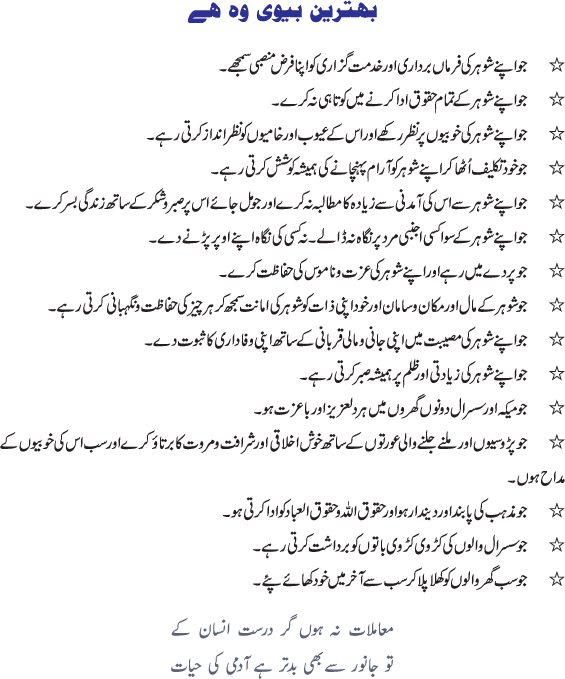
Behtreen Biwi
How To Make Your Wife Happy?
The following is a summary of the book “How to make your wife happy by Sheikh Mohammed Abdelhaleem Hamed.
Beautiful Reception
- After returning from work, school, travel, or whatever has separated you:
- Begin with a good greeting.
- Start with Assalamau ‘Alaykum and a smile. Salam is a sunnah and a du’a for her as well.
- Shake her hand and leave bad news for later!
- Sweet Speech and Enchanting Invitations
- Choose words that are positive and avoid negative ones.
- Give her your attention when you speak of she speaks.
- Speak with clarity and repeat words if necessary until she understands.
- Call her with the nice names that she likes, e.g. my sweetheart, honey, saaliha, etc.
Friendliness and Recreation
- Spend time talking together.
- Spread to her good news.
- Remember your good memories together.
- Games and Distractions
- Joking around & having a sense of humor.
- Playing and competing with each other in sports or whatever.
- Taking her to watch permissible (halal) types of entertainment.
- Avoid prohibited (haram) things in your choices of entertainment.
- Assistance in the Household
- Doing what you as an individual can/like to do helps out, especially if she is sick or tired.
- The most important thing is making it obvious that he appreciates her hard work.
Consultation (Shurah)
- Specifically in family matters.
- Giving her the feeling that her opinion is important to you.
- Studying her opinion carefully.
- Be willing to change an opinion for hers if it is better.
- Thanking her for helping him with her opinions.
Visiting Others
- Choosing well-raised people to build relations with. There is a great reward in visiting relatives and pious people. (Not wasting time while visiting!)
Choosing A Good Wife
Marriage is for enjoyment and building a righteous family and a sound society. One should, therefore, marry a woman through whom these two goals can be fulfilled; a woman adorned with both physical (outer beauty) and abstract (inner) beauty.
The outer beauty is the perfection of physical characteristics because a woman who is beautiful and has a soft voice will give tranquility to the eyes that look at her and the ears that listen to her speech and the heart becomes receptive to her.
Allah said: “And among His Signs is that He created for you wives from among yourselves, that you may find repose in them, and He has put between you affection and mercy.” (Qur’an, 30:21)
As for inner beauty, it is completeness in religion and manners. The more a woman is religious and perfect in her manners, the more beloved she will be and hence is a more suitable choice.
A religious woman will fulfill the commands of Allah, and protect the rights of her husband, children, and money. She will support him in obedience to Allah. If the husband forgets, she reminds him. If he slackens, she invigorates him, and if he gets angry she pleases him. The well-mannered woman endears herself to her husband and respects him; she does not delay anything that he likes to be done quickly, and she does not hasten anything he likes to be delayed.
The Prophet (peace be upon him) was asked: “Which of the women are best?” He replied, “If he (husband) looks at her, she pleases him, and she obeys him when he commands, and she does not deny him regarding herself, or his wealth in what he hates.” (Ahmad, An-Nasa’i)
If it is possible to find a woman who has inner and outer beauty, then this is perfection and bliss granted by Allah.