
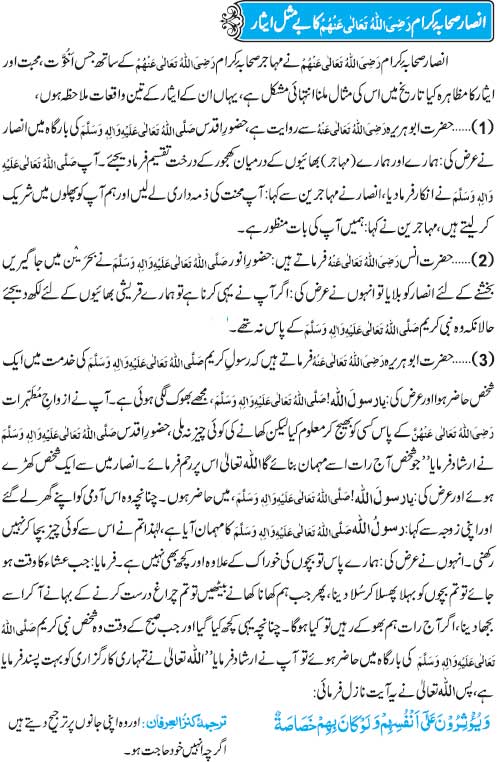
Ansar Sahaba Karam (RA) Ka Bay Misl Esaar
Tawaf Direction & The Movement Of The Universe
The Arabic word Tawaf linguistically means going around a fixed core. The whole universe – from the smallest atoms up to the largest galaxies – are all obedient servants of Allah, Who has created and managed them. The worship of matter in general is a kind of movement; that is to say, every atom in the universe has a special system of movement and has its own orbit. The electrons in the atom go around a core called the nucleus, in a tiny planetary-like system. The planets also revolve around the sun, each in a separate orbit, with a specific speed.
In the same way, the Holy Ka’bah, which Allah Almighty has made the first sanctuary appointed for mankind on earth, is located in the center of the earth, as proved by modern astronomical research. It is like the heart in the body. Allah Almighty connected the Muslims’ worship with that Holy place; hence, He obligated them to go to the Ka’bah for Haj, and Tawaf is, thus, one of the most important rituals of Haj.
The direction in which Muslims go around the Ka’bah during Tawaf agrees with the prevailing movement in the universe around a fixed axis. A pilgrim starts Tawaf from the Black Stone; he keeps the Ka’bah to his left and goes around it till he reaches the Black Stone again and starts another round and so on. This establishes a relation between a believer’s heart and the Ka’bah, the heart of the earth, and, thus, he draws closer to Allah (the Creator of the Ka’bah), senses true love for Allah, and enjoys His company.
Surrogate Mother

Surrogate Mother by Mufti Muneeb-ur-Rehman
Prophets Ibrahim And Ismail Exemplify Sacrifice
Hajj and Eid Al-Adha take us back in history to the time of a 97-year-old (approximately) man being asked to take the life of a 13-year-old (approximately) boy. Who is that man? And who is that boy? And who is the one who is making this command? If we know who the three points in this equation are, we would have a better perspective on life and on what life is all about.
The man who was asked at 97 years of age to take away the life of a 13-year-old boy is none other than Prophet Ibrahim (peace be upon him), the father of prophets and messengers. And the 13-year-old boy whose life Prophet Ibrahim was asked to take away is none other than his own son. But when the boy reached the age when he was able to run and play around his father, Ibrahim went to him and said, “My darling son, I saw in my dream that I was sacrificing you.” We all know that the dreams of prophets and messengers are forms of revelation from Allah Almighty. So it was the truth.
Now, who was the one who gave that command? It was none other than Allah. The One Who created life had asked Ibrahim to take away the life of his son. And we know that His decree was that Ismail’s life would not be taken away, but it was a lesson for humanity to understand what life is all about.
Allah wanted Ibrahim to teach humanity a lesson. Thus we have to understand this lesson and reflect upon it. There are two things that Allah Almighty made beautiful in this life. These two things are mentioned in the Qur’an more than once: “Wealth and children are the ornaments of the life of this world ….” (18:46)
That is it! Wealth and children make life beautiful. Look what happened! Allah Almighty chose one individual to sacrifice one of these two things, and He did not ask any other human being to do the same. One individual became an Ummah. Why? Because Ibrahim passed the test of a whole Ummah. He was asked to sacrifice one of the two things that are ornaments of life, and all of us have been asked to sacrifice the second. So because of that, he indeed, is an Ummah in the same way that we are an Ummah. He truly deserves that title: “Verily, Ibrahim (Abraham) was an Ummah, obedient to Allah, Hanif…” (16:120)
This is the spirit of Eid Al-Adha. We have to sacrifice, brothers and sisters, when we are called upon to sacrifice what we really like to keep: “By no means shall you attain Al-Birr (piety and righteousness, here it means Allah’s reward, i.e. Paradise) unless you spend (in Allah’s cause) of that which you love; and whatever of good you spend, Allah knows it well.” (3:92)
If you have a lot of money and you take a thousand dollars and give it, this would not be birr. Birr is to have two dollars and to give one of the dollars away although you need the two dollars and would like to keep them for essentials.
This is a sacrifice. Sacrifice is to do something that is difficult to do. This is sacrifice. It is not a sacrifice to do an easy thing and then to claim at the surface as if you did a lot. No, only Allah Almighty knows what sacrifice is all about.
Hadith Qudsi: La ilaha illallah
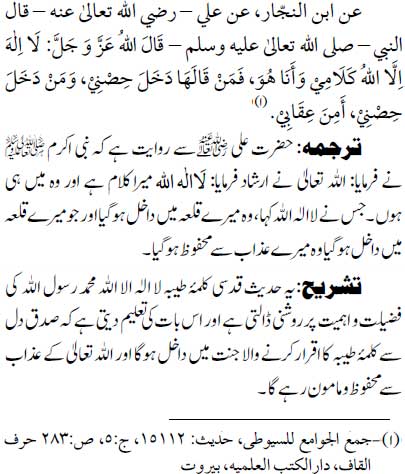
Hadith Qudsi: La ilaha illallah
The Prophet As A Man – Conducting Human Affairs
History has not recorded the detailed life of any person in the same way as it has done in the case of the Prophet Muhammad (peace be upon him). This is due to the fact that his practices, particularly in matters of religion, provide an example that we are urged by God to follow. The encouragement applies even in ordinary matters where no religious edict is needed and where people are free to choose whatever method they wish. In such matters, following the Prophet’s example earns us a reward. God states in the Qur’an: “In God’s Messenger, you have a good example to follow, for those of you who hope to please God and to be successful on the Last Day.” Therefore, the Prophet’s companions were keen to watch his practice for guidance and they reported what they saw and heard. Scholars in succeeding generations have emphasized the need to follow the Prophet’s guidance and practice, outlining this and explaining it.
Thus, we have a complete record of how the Prophet conducted himself even in his private and personal life. We learn how he behaved at home, what he used to do when resting and relaxing, and how he talked, joked, ate, and dressed. Books have been written on his character and behavior, in addition to what has been recorded about his public life and how he ran his community and state. It is acknowledged by all scholars that we are required to follow the Prophet’s example only in what pertains to faith and religion. But in private and personal matters such a requirement does not apply. However, if we learn how the Prophet behaved in a certain situation and we follow his example with the intention of being close to him and learning from him, such intention earns us a reward from God.
Thus, if we follow the Prophet’s example in how he sat when eating, we are not doing a religious duty or recommended practice, but our desire to do as he did is acknowledged by God and granted a reward. Therefore, scholars have recorded such private matters and ascertained that their reporting is accurate and authentic.
Abbad ibn Tameem quotes his uncle saying that he “saw God’s Messenger lying down in the mosque, with one of his legs over the other.” [Related by Al-Bukhari, Muslim, Malik and Al-Tirmidhi). This Hadith serves to tell us that it is permissible to lie down in a mosque, and the posture of the Prophet is perfectly permissible. Moreover, when we know that the Prophet did something in a particular fashion, it means that his way is not harmful.
Al-Baraa’ ibn Azib, a companion of the Prophet, reports: “When the Prophet lied down to sleep, he would put his right hand under his right cheek and say: ‘My Lord! Protect me from Your punishment on the day You resurrect Your servants.'” (Related by Al-Tirmidhi, Abu Dawood and Al-Baghawi). The supplication the Prophet used to say at a particular time is recommended for us to say, but the posture is not. However, it is a comfortable position that we may wish to try.
Abu Qatadah reports: “When the Prophet stopped at night for rest on a travel, he would lie down on his right side, and if he stopped before dawn, he would put up his arm and place his head on his palm.” (Related by Muslim, Ahmad, and Al-Tirmidhi). The Prophet placed his hand under his head in the latter case because he wanted to be sure not to sleep long and miss the dawn prayers. Otherwise, if the night were still long, he would take a more comfortable position. To him, prayer was of extreme importance. Hence, he wanted to make sure not to miss it.
Naturally, the Hadiths describing the Prophet’s sleep mostly come from some who were closely related to him. His cousin, Abdullah ibn Abbas, who was young during the Prophet’s lifetime, reports: “I stayed overnight at Maymoonah (the last of the Prophet’s wives) when the Prophet woke up, relieved himself, then he performed the ablution in a middle-of-the-way fashion, making it complete but not too elaborate, then he prayed and completed his prayer in 13 rak’ahs, then he lied down and slept until his breathing was audible, which was his habit when he slept. Then Bilal called him for prayer and he prayed without performing a fresh ablution.” (Related by Al-Bukhari, Muslim, and Al-Tirmidhi).
Another Hadith which is similar in many ways is also reported by Ibn Abbas: “I stayed overnight in the home of my maternal aunt Maymoonah, the Prophet’s wife when the Prophet was also staying there as it was her night. The Prophet prayed the obligatory prayer of Isha and came home to her where he offered four rak’ahs of prayer before he went to sleep. He then woke up and said: ‘The young lad is asleep’, or words to this effect. He stood up for prayer and I joined him standing to his left, but he moved me to his right. He prayed five rak’ahs, then added two more rak’ahs, then he slept until I heard his breathing. He later went out for prayer.” (Related by Al-Bukhari, Muslim and Al-Baghawi).
These two Hadiths could be speaking of the same occasion, or of two different occasions. The discrepancy in the number of rak’ahs of prayer is easily reconciled. The first mentions that the Prophet completed his prayer in 13 rak’ahs, while the second mentions his prayer in three lots adding up to 11 rak’ahs but if we add the 4 rak’ahs of obligatory Isha prayer the complete number becomes 13, except for the last two which were the recommended, or Sunnah, prayer before the obligatory one Fajr, at dawn. This last prayer does not count as a night prayer and should not be confused with what the Prophet prayed at night.
In the first Hadith, Ibn Abbas does not mention that he joined the Prophet in his prayer, while he mentions it in the second. Perhaps he mentioned the occasion at different times, and he felt in the second that it would be useful to mention the fact that the Prophet moved him to his right-hand side when he was the only one joining him in prayer. This defines the position of the imam in relation to the only person joining him.
We have mentioned these Hadiths here as they relate to the description of the Prophet’s sleep. We learn from them that he used to sleep soundly, as his breathing would be audible. We also learn that the Prophet used to offer voluntary night prayer often, particularly if the Hadiths are speaking of different occasions.
In the first Hadith, Ibn Abbas makes clear that the Prophet did not renew his ablution when he woke up for prayer, while in such a situation we are required to perform a fresh ablution, or else our prayer would not be valid. The Prophet might have been informed by Gabriel that his ablution remained valid as sleeping does not invalidate ablution if one is certain that no wind or urine discharge took place during sleep.
Dua Maghfirat Nihayat Mehboob Shay Hai
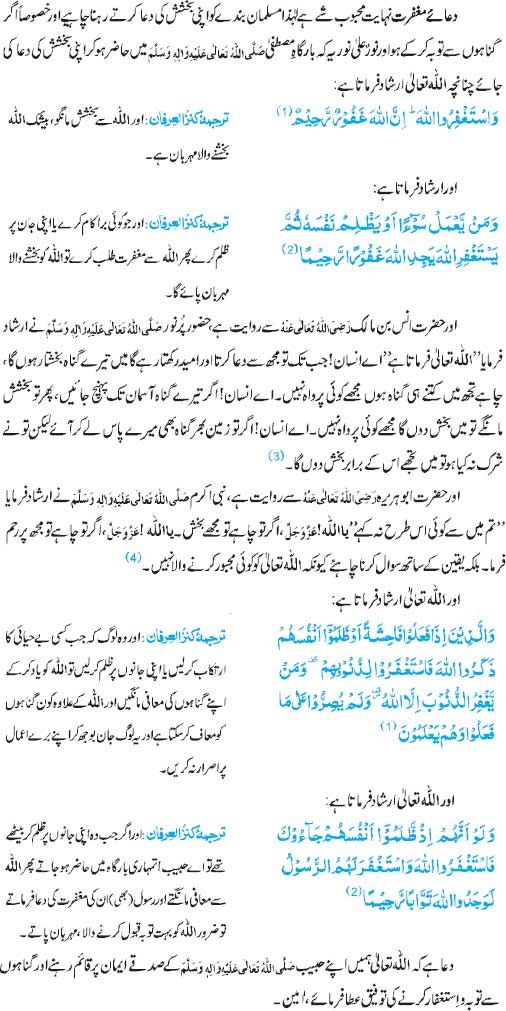
Dua Maghfirat Nihayat Mehboob Shay Hai
Muslims And Modern Sciences
That’s true…In fact, we know what we, our ancestors did in past, in the field of science.
That’s the reason, the world’s renowned scientists were among the Muslims. Some of them are produced below
1- JABIR IBN HAIYAN: Father of Modern Chemistry, a geographer, lawyer
2- Abu Abdullah Mohammad Ibn Musa al-Khawarizmi: The founder of Algebra, A mathematician, astronomer, and geographer
3- Ibn Sina (commonly known as Avicenna) -doctor of doctors
4- Abu Yousuf Yaqub Ibn Ishaq al-Kindi: A philosopher, mathematician, physicist, astronomer, physician, geographer
5- Abu’l Waleed Muhammad Ibn Ahmad Ibn Muhammad Ibn Rushd, known as Averroes in the West: philosopher, logician, Jurisprudence, Medicine…etc, etc…
But the need is for the Muslims to get them aware of the modern sciences, although Muslims are making contribution efforts in sciences, the need is to materialize their work, which so far has not been done, keeping in mind that whatever the sciences they are studying, are made easy / discovered for us by ALLAH SWT…as he is the only creator.
Some Historical Facts:
In fact, during the British regime in undivided India, when Britishers were gaining power over there and Muslims were losing the same, important discoveries were made by western scientists.
On one hand, where these discoveries were made in the west, a strong mentality was developed in the West that science is ALL for us, and one can answer all questions with the help of the sciences. In fact, sciences were treated as GOD for all and this situation still continues.
Why this extremist behavior was developed in the West?
Ans: Under the Pops regime, people were kept under strict observance and studying sciences was prohibited in the West. Even if someone was found studying sciences, their homes were set on fire.
So as a reflex action, Western people developed strong hate against religion. The affected regions were the western and southern sides of Europe.
Result: So they lift up their faith in the existence of religion.
On the other hand, being the strong followers of Islam as a religion, this mentality invaded Muslims.
Keeping in mind where Muslims were involved in
– dis-obedience to Islamic Shari’ah,
– had left Qur’an and Sunnah,
– they lost their basis and forget to keep the momentum of scientific research and development.
They stood as the prime target for the scientific invasions…..no existence of GOD…sciences are all…
At this point, the conflicts/downfalls begin.
Science with knowledge (whether right or wrong) invaded Muslims and challenge the era of Muslims to answer their questions.
Muslims were not prepared to answer this invasion, as they left research and development somewhere in past.
So Muslims didn’t comes up with answers.
As a reflex action, Muslims of that time decided in order to save their religion, let’s refrain from studying Modern sciences.
Here once more things appear…. the concept of separation of Science from religion, arose in Muslims…
Muslims, unfortunately, being the followers of a religion, stand as the prime target for scientific invasions, had closed their doors to studying sciences, and think that science had invaded their religion.
Off course, they were right at that time. Their strategy was right at that time as we can’t imagine the severity of that situation.
That was the situation, where Muslims left the sciences. But before that Muslims were studying sciences and made remarkable achievements in sciences which provides the basis for modern sciences.
Dushman Kay Sakhat Khatre Kay Waqt Ki Duayen
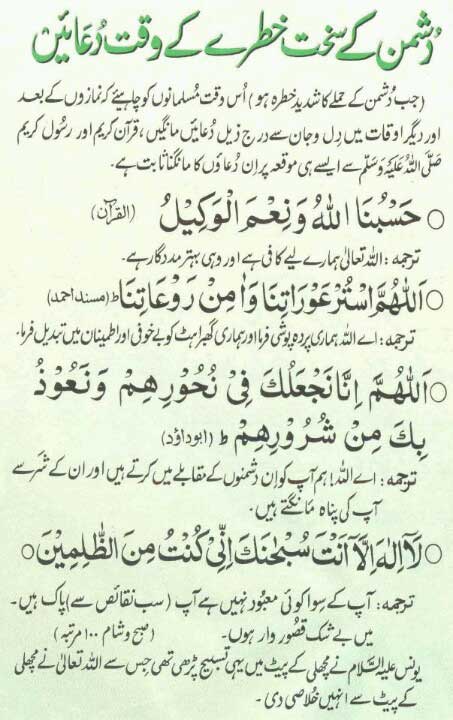
Dushman Kay Sakhat Khatre Kay Waqt Ki Duayen
Allah Condemns Terrorism
The QURAN
“And it is not conceivable that a believer should slay another believer unless it be by mistake……………………. But whoever deliberately slays another believer, his requital shall be hell, therein to abide; and God will condemn him, and will reject him, and will prepare for him awesome suffering.”
[Quran – 4:92-93]
“Because of this did We ordain unto the children of Israel that if anyone slays a human being-unless it be [in punishment] for murder or for spreading corruption on earth-it shall be as though he had slain all mankind; whereas, if anyone saves a life, it shall be as though he had saved the lives of all mankind.”
[Quran – 5:32]
Babylonian TALMUD
“FOR THIS REASON WAS MAN CREATED ALONE, TO TEACH THEE THAT WHOSOEVER DESTROYS A SINGLE SOUL OF ISRAEL,39 SCRIPTURE IMPUTES [GUILT] TO HIM AS THOUGH HE HAD DESTROYED A COMPLETE WORLD; AND WHOSOEVER PRESERVES A SINGLE SOUL OF ISRAEL, SCRIPTURE ASCRIBES [MERIT] TO HIM AS THOUGH HE HAD PRESERVED A COMPLETE WORLD”
[Tractate Sanhedrin Folio 37a, 39-40]
Prophet of Islam (Peace Be Upon Him) has said: [Muslim, Book #020, Hadith #4555] “Whoso attacks my Umma (indiscriminately) killing the righteous and the wicked of them, sparing not (even) those staunch in faith and fulfilling not his promise made with those who have been given a pledge of security-he has nothing to do with me and I have nothing to do with him.”
[Bukhari, Book #58, Hadith #233] “Narrated ‘Ubada bin As Samit: I was one of the Naqibs who gave the (‘Aqaba) Pledge of Allegiance to Allah’s Apostle. We gave the pledge of allegiance to him that we would not worship anything other than Allah, would not steal, would not commit illegal sexual intercourse, would not kill a person whose killing Allah has made illegal except rightfully, would not rob each other, and we would not be promised Paradise if we did the above sins, then if we committed one of the above sins, Allah will give His Judgment concerning it.”
[Muslim, Book #017, Hadith #4238] “Ubida b. as-Samit reported: I was one of those headmen who swore allegiance to Allah’s Messenger (may peace be upon him) that we will not associate anything with Allah, and will not commit adultery, and will not steal, and will not kill any soul which Allah has forbidden, but with justice nor plunder, nor disobey (Allah and His Apostle), then Paradise (will be the reward) in case we do these (acts); and if we commit any outrage (and that goes unpunished in the world), it is Allah Who would decide about it. Ibn Rumh said: Its judgment lies with Allah.”
[Sunan Abu Dawud, Book #14, Hadith #2526] “Narrated Anas ibn Malik: The Prophet (peace be upon him) said: Three things are the roots of faith: to refrain from (killing) a person who utters, “There is no god but Allah” and not to declare him unbeliever whatever sin he commits, and not to excommunicate him from Islam for his any action, and jihad will be performed continuously since the day Allah sent me as a prophet until the day the last member of my community will fight with the Dajjal (Antichrist). The tyranny of any tyrant and the justice of any just (ruler) will not invalidate it. One must have faith in Divine decree.”