


Mufti Muneeb Ur Rehman
The Reality of Fasting
The crescent of a noble month has been sighted, marking the start of a blessed season. The Prophet sallallaahu ‘alayhi wa sallam used to give glad tidings to his companions upon the arrival of this month.
O, Believers! Therefore, glad tidings to you for the month of Ramadhan, the month in which Allah ordained fasting and revealed the Qur’an. He made this month a season of worship and hard work, a season of goodness and blessings. He made it a time of action and striving for four things: fasting, Qur’an, worship, and other righteous deeds – these are the most obvious gifts and features of this month. I shall talk about these four things during the coming Fridays of this month, Allaah willing.
Abu Hurayrah, may Allah be pleased with him, reported that the Prophet sallallaahu ‘alayhi wa sallam said: “When Ramadhan arrives, the gates of Heaven… (and in another narration) …the gates of Paradise… open, the gates of the Hellfire are sealed, and the Shayaateen (devils) are chained.” (Bukhaari & Muslim). He sallallaahu ‘alayhi wa sallam also said: “On the first night of Ramadhan, the Shayaateen and the leaders of the Jinn are chained.” (Ibn Maajah). This means that their ability to tempt people is diminished during this month. Evil and disobedience decrease, because, although the causes of disobedience are many, the greatest factor of all is the whispers of Satan. However, not all Shayaateen are chained during this month for other narrations prove that only the leaders of the Shayaateen are chained. That is why, even though evil and disobedience diminish during this month, it does not come to a complete halt.
There are many other sources of evil that still remain, one of them is the human soul, which is naturally inclined toward evil and accompanies one at all times. Human devils are another reason for immorality in addition to man’s own lusts and desires. Yet another reason is that the remaining soldiers of the devils that do not get chained continue to misguide people. Nevertheless, all of these reasons and causes have a lesser effect on fasting people because fasting bestows upon them a certain blessing.
O Muslims! This is the value of Ramadhan, the month of fasting. Allah ordained fasting during this month whereby people refrain from food, drink, and conjugal relations from dawn until sunset. When the sun sets, a fasting person can eat and drink and have marital relations. The nations that came before us were not allowed to touch their spouses, even at night, and if a person from them fell asleep before he had the chance to eat or drink anything, then it was forbidden for him to eat or drink after that; he had to continue fasting until the end of the next day.
However, Allah has made it easy for this Nation. It is from Allah’s mercy that He made all of this permissible, thus releasing the believers from the heavy burdens that were upon the previous nations. As soon as the sun sets, it becomes lawful for the fasting person of this Nation to eat, drink, and to have relations with his/her spouse. Allah says that which means: “… Allah intends for you ease and does not intend for you hardship and [wants] for you to complete the period and to magnify Allah for that [to] which He has guided you, and perhaps you will be grateful.” (Al-Baqarah: 185).
Moreover, in another verse, to demonstrate to this Nation His favors upon it, Allah says that which means: “It has been made permissible for you the night preceding fasting to go to your women [for sexual relations]….” (Al-Baqarah: 187). This means, in other words, that this was not lawful for the people before you but now it is lawful for you, O Nation of Muhammad sallallaahu ‘alayhi wa sallam.
Of the signs of ease of this religion and the mercy that Muhammad sallallaahu ‘alayhi wa sallam came with is that the ill person and the traveler can break his fast and make it up at a later time after Ramadhan. Also, the elderly who cannot bear fasting, as well as people who have no hope of a cure (i.e., the chronically ill), can feed the needy and they do not have to make up for their missed fasting. It is not righteous to fast while traveling, nor is it better for the ill to fast if it is difficult for them to do so. In these cases, they are to make use of the permission that Allah has furnished them with because He likes it when people take heed of the mercy that He has endowed.
O Muslims! Know that fasting is a protection from wrongdoing. This month is an opportunity for you to purify yourselves and release yourselves from the effects of sins, so take advantage of it. During Ramadhan, a Muslim has fewer burdens as his desires are diminished and he acquires more goodness from being involved in fasting; one can rid himself of bad habits, such as overdoing matters which are lawful, such as overeating, talking too much, and being over indulgent in sexual relations with one’s spouse; we must stop the awful habit of going to extremes in fulfilling these desires.
Some people fail to understand the reality of fasting. They refrain from eating and drinking in the daytime but do not abstain from sin or oppression. They continue their practices as usual or if they do stop in the daytime, they continue with their normal routine as soon as they break the fast. They spend their mornings hungry and thirsty and their evenings are full of sin and evil. They spend the whole night watching television with their wives and children. Others refrain from food during the daytime, and after sunset, they eat all night long to make up for the food they missed. Therefore, fasting is nothing for such people except a change in the times of eating – for they eat during the night rather than the day. When night comes, all kinds of foods are put forth for them to consume – one kind of food is not sufficient for these people – and they stuff their stomachs with all these various types. It is as if these people have never heard of the saying of the Prophet sallallaahu ‘alayhi wa sallam: “The believer eats in one stomach, and the disbeliever and the hypocrite eat in seven.” (Bukhaari and Muslim).
In another narration of this Hadeeth, it is mentioned: “A man by the name of Abu Ghazwaan came to visit the Prophet sallallaahu ‘alayhi wa sallam. This was before Abu Ghazwaan had become Muslim. The Prophet sallallaahu ‘alayhi wa sallam was the most generous of all people. He milked seven sheep for him, so the man drank all of the milk. Then the Prophet sallallaahu ‘alayhi wa sallam said to him: “Isn’t it time you became a Muslim?” He replied: ‘Yes’ and became Muslim. The Prophet sallallaahu ‘alayhi wa sallam then stroked his chest (while supplicating for him). The next day, the Prophet sallallaahu ‘alayhi wa sallam milked only one sheep for him, but Abu Ghazwaan, may Allah be pleased with him, was not able to drink all of the milk. So, the Prophet sallallaahu ‘alayhi wa sallam asked: “What is the matter Abu Ghazwaan?” He, may Allah be pleased with him, responded: ‘I swear by the One Who sent you as a Prophet, I have had enough.’ So the Prophet sallallaahu ‘alayhi wa sallam said: “Last night you had seven stomachs while you were a disbeliever and today you only have one stomach.” (At-Tabaraani). This saying of the Prophet sallallaahu ‘alayhi wa sallam means that a believer can eat less and control his desires more since he does not eat to enjoy nor to fulfill a desire, but rather to stop hunger and become stronger so that he can worship Allah. The disbeliever, however, who does not believe in the Day to come, eats with a strong desire and the lust of animals, as Allah describes him in the Qur’an saying that which means: “…But those who disbelieve enjoy themselves and eat as grazing livestock eat, and the Fire will be a residence for them.” (Muhammad: 12).
O Muslims! One type of cooked food is enough; let us not be like the Children of Israel who would not settle for only one kind of food. O people who observe fasting! When you put these different types of foods on the table in front of you, remember before you begin to eat, that the master of all the creations of Allah, the leader of all Messengers and creation, the Seal of the Prophets sallallaahu ‘alayhi wa sallam, would remain without lighting a fire in his house (i.e. without cooking) for one or even two months. “He and his family only ate dates and drank water.” (Bukhaari). One or two months! This was not because he sallallaahu ‘alayhi wa sallam could not have obtained it and that he had no choice because he could have had all he had wanted. It was only due to the fact that he stayed away from worldly pleasures, living an ascetic life, and aimed to draw ever closer to Allah. Even though Allah offered him control of the treasures of the earth and the opportunity to live like kings, having a nice, easy, and comfortable life, he sallallaahu ‘alayhi wa sallam chose to live in poor conditions, eating as a slave eats, sitting as a slave sits. He sallallaahu ‘alayhi wa sallam used to say: “O Allah! Let me live as a Miskeen (humble servant) and resurrect me with the Masaakeen (humble).” (Tirmithi & Bayhaqi).
O Muslims! Let this month be an opportunity that we take full advantage of. Let us get used to these customs – the customs of the Prophet sallallaahu ‘alayhi wa sallam. Let us get rid of the habit of overeating like animals. Let this month be a chance to purify ourselves and become elevated from lusts, desires, and trivialities that are of no real value. Let us elevate our souls to the heavens with faith – we can elevate them from the pleasures of this world to the pleasures of the world to come.
Abu Hurayrah, may Allaah be pleased with him, reported that the Prophet sallallaahu ‘alayhi wa sallam said: “Fasting is a shield (protection), so when one of you fasts, let him not touch his wife (for sexual relations) and let him not badmouth anyone; and if someone fights him or upsets him, let him say, ‘I am fasting, I am fasting.’ I swear by the One in Whose Hand my soul is! The smell of the mouth of a fasting person is better to Allah than the smell of musk.” Also, Allah says as reported in a Hadeeth Qudsi: “He left eating and drinking and his desires for My sake. Fasting is for Me and I give reward for it – one blessing (for fasting) is multiplied ten times.” (Bukhaari).
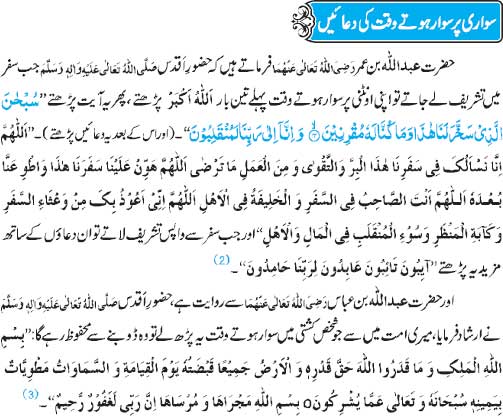
Sawari Par Sawar hotay Waqt Ki Duaaien
What Nourishment Does The Body Need In Ramadan?
Make your Ramadan this year special, fruitful, and life-changing… It is a time to eat less, not more food, help the needy, organize a food or gift drive for poor families, and strengthen family ties.
Fasting promotes healing and rejuvenation of the body, mind, and spirit. In fact, it frees up energy that your body normally spends on digesting food. The liver can break down toxic chemicals circulating in the bloodstream now with a lighter workload.
As long as you do not end your fast with a large feast, you can gain many health benefits: clearer skin, overcoming addictions, improved immunity, mental creativity, better attitude and motivation, weight loss, and lower blood pressure. Follow these steps to get through Ramadan with better health, some weight loss, and an elevated spirit:
Breaking the fast
At the call for maghrib prayer, start with a glass of water to replenish fluids, several dates, and a short prayer. A glass of water before mealtime diminishes your appetite. The sugar in dates will give you a quick boost of energy, which is much needed after a long fast. Dates are easy to digest and rich in B vitamins, fiber, calcium, magnesium, potassium, and iron.
Beverages
It is difficult to get enough vitamins, anti-oxidants, and fluids during Ramadan. Drink one cup of freshly squeezed orange or grape juice to stimulate digestion. Try a glass of water with the fresh juice of half a lemon and a teaspoon of honey to cleanse the liver and help break down fat. Pineapple juice can promote weight loss and improve digestion. An excellent refreshing cold beverage common in Ramadan is a licorice drink. Licorice is a mild laxative, a remedy for fever, coughs, lung problems, and ulcers, and is low in sugar. Use caution if you have hypertension.
Salads
Almost unheard of during Ramadan, they are low in fat and calories and give your fasting body much-needed vitamins, fluids, and fiber. Try tabouleh, a Greek green salad with feta cheese, or a salad of fresh watercress and spinach leaves, olive oil, lemon juice, and crushed garlic, or a garbanzo bean salad.
Soup
It is a comforting and healthy mainstay of Ramadan. The famous lentil soup is rich in protein and free of fat and cholesterol. Make this soup that is loaded with anti-cancer and anti-aging beta carotenes with sauteed chopped onions, shredded carrots, or chopped orange pumpkin cubes. Puree in a blender and season as you wish.
Main course
After all those starters, your main course should be very light. Avoid highly spiced foods with a rich sauce and fried foods because they will cause indigestion. A big meal places a heavy load on the stomach and digestive system after a long fast. Steamed rice and sautéed vegetables is ideal. Or you can have baked fish or baked chicken breast with steamed vegetables.
Suhoor should be light
Quick healthy suhoor ideas include grilled cheese and tomato sandwich, yogurt with whole wheat crackers, a glass of milk and a slice of toast with jam or honey, a small vegetarian pizza, hummus with whole wheat bread, and cucumbers, or tuna with lemon juice. I find a boiled egg with toast to be filling without making you feel bloated. Finally, eat your favorite fruit. Avoid salty foods so you will not be thirsty the next day. Try not to get to bed for about two hours after eating suhoor.
Qayamat Aaney Ka Haal Aur Iss Ki Nishanian

10 Ideas For Ramadan At Your Workplace
If work is simply the place you earn your bread and punch in your hours, why not redefine it this Ramadan? Make your workplace the scenario for Dawa, especially in the current tension-filled atmosphere of misunderstandings about Islam and Muslims.
Here are some ideas that can help you share Ramadan with your boss and coworkers this year.
1. Begin informing people about it as soon as possible
Start telling bosses, supervisors, and coworkers about Ramadan now. Bring it up in the course of conversation casually.
In terms of when Ramadan starts and ends, just give the projected date. Don’t get non-Muslims involved in the technicalities of finding out the correct date. Do the same for Eid. You can decide for yourself which date to start and stop fasting on.
2. Post it up
On your office or department bulletin board, put up a factsheet on Ramadan, with a short introduction of yourself and which department you are from. Don’t just give the facts, but also include a few sentences about what this blessed month means to you (i.e. spiritual growth, closeness to God, being more generous, etc.).
3. Get an article printed in your local newspaper and circulate copies
This will not only be good for Dawa – it may even promote department/company pride (i.e. one of our employees is a writer too!). Post it up with the masthead of the newspaper on top.
4. Negotiate your lunch hour with the boss
This is another task that needs to be done as soon as possible. Explain that you will need a short break for prayer and then you will take a lunch break at Iftar time.
5. Talk to the office cafeteria people about your Iftar needs
If you normally buy lunch at the cafeteria, explain to the cafeteria staff that you would like to arrange to have your lunch saved for Iftar time. Ask them to keep one serving of lunch in the fridge so you can pick it up at Iftar time.
6. Create a “Ramadan corner” at your desk
If you have your own desk at work, dedicate a corner of it that is accessible to passersby the “Ramadan corner”. Put a basket of dates, sweets, written information on Ramadan, and maybe a small frame of eye-catching Islamic calligraphy on it. Post a note inviting coworkers to the free sweets and information.
7. Have a small Iftar gathering at your desk
Invite coworkers to a snack of dates and fresh fruits during Iftar time. At least once, have a more formal meal ready for everyone (check with your boss before you do this).
8. Distribute written material on Ramadan
If you’ve got a central location in your workplace where people can pick up free newspapers, get permission to stack a factsheet and pamphlets on Ramadan. You can also leave the sheets on the Ramadan corner of your desk.
9. Get a Ramadan greeting from your boss
Have your boss, commanding officer, or head of the department issue a public notification that Ramadan is coming up or is here and they and the company congratulate all Muslim employees on this occasion.
10. Put an article about Ramadan in the office newsletter
If you have a company or department newsletter, write up a personal article about why you are looking forward to Ramadan and what Ramadan is. Then arrange for them to publish it.
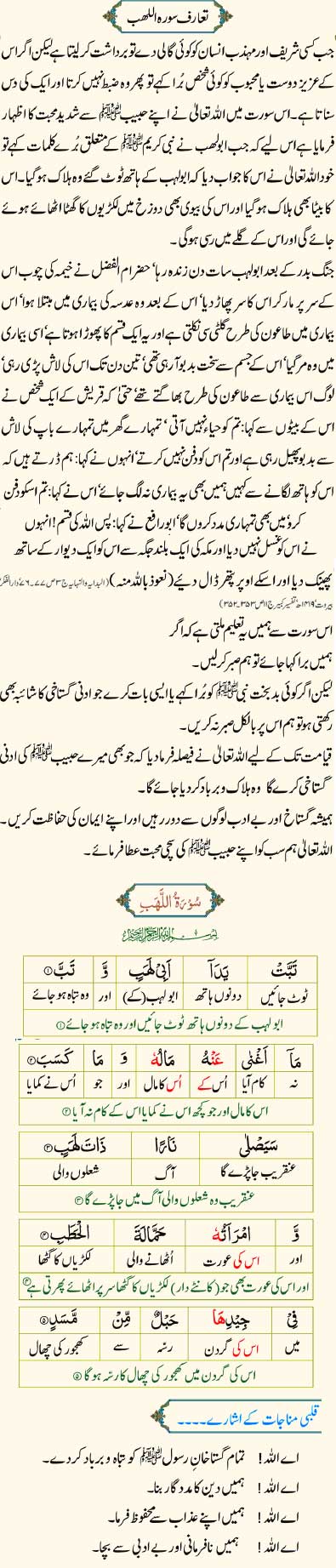
Surah Al-Lahab
Benifits Of Fasting
Ramadan is derived from ramdaa which means ” sun-baked,” perhaps a reference to the pangs of fasting. Almighty Allah says in the Quran “O believers! fasting is prescribed for you as it was prescribed for the people before you so that you may become pious.” {Qur’an chapter 2: verse 183}
Fasting is one of the pillars of Islam. It has been an integral part of all major religions. Its mentioned in (Matthew 4:2) that the prophet Jesus (peace be upon him) fasted for forty days before he was called to prophethood and its mentioned in (exodus 24:18) that prophet Moses (peace be upon him) fasted for forty days and nights before he was given the law.
Fasting in Ramadan is a part of the broader program that Islam prescribes for man to fulfill his moral and spiritual destiny in this world and in the hereafter.
It is the special worship designed to develop in man the ability to exercise self-restraint and patience for the pleasure of Allah, man’s creator, lord, and nourisher.
Its objective is to give man the power to keep in check his unruly desires and tendencies that make him prone to greed, revenge, anger, provocation, and fear; that makes him commit various sins, acts of aggression, cruelty, and oppression.
It seeks to free the human soul and lends it the moral and spiritual strength to promote beauty, harmony, kindness, peace, compassion, and justice. the Quran says: ” we sent our messengers with clear signs and sent down with them the Book and the balance (of right and wrong ), that men may stand forth in justice.” (chapter 57:verse 25)
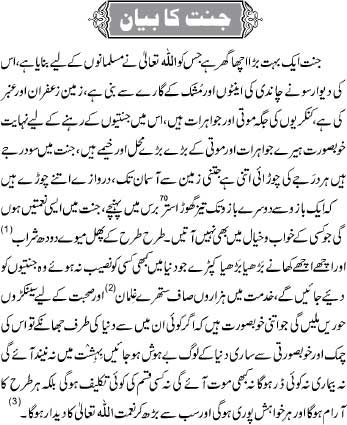
Jannat Kaisi Hai
Fasting For Taqwa
Prescribing fasting the Quran says: “O you who believe, fasting is prescribed to you as it was to those before you, that you may (learn) self-restraint.” (2:183)
The original Arabic word translated here as self-restraint is taqwa, which has a much broader significance. It symbolizes that basic mortal quality that demarcates the line between morality and amorality and distinguishes humans from animals as moral beings.
It represents the love of good with an eagerness to respond to it, and a strong desire to keep away from what is evil and harmful.
Those who are neutral or immune to questions of good and bad, justice and injustice, compassion and cruelty, loyalty and treachery are in the words of the Quran like the blind, deaf, and dumb cattle, whose only concern in life is to fill their stomachs.
“They have hearts wherewith they understand not, eyes wherewith they see not, and ears wherewith they hear not. “