
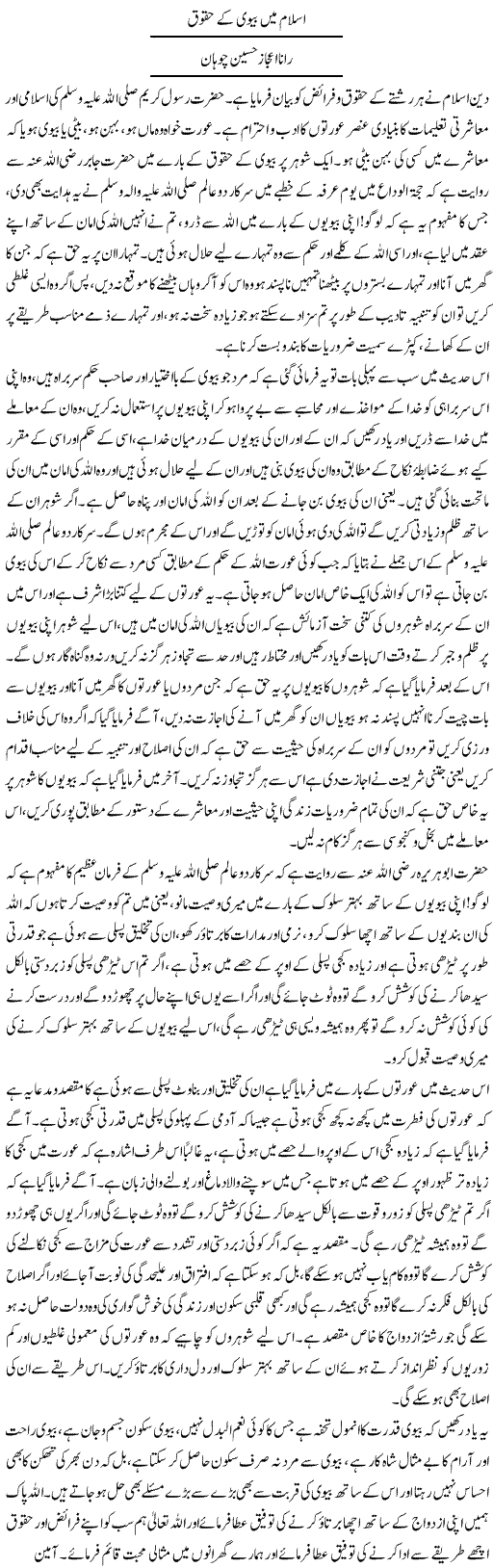
Some Of The Symptoms, Avoidance And Cures Of Sins
Narrated by Abu Huraira, The Prophet (sallallahu alaihe wa-sallam) said “Avoid the seven great destructive sins” the people asked O Allah Messenger ! what are they? He said, “To join others in worship along with Allah, to practice sorcery, to kill the life which Allah has forbidden except for a just cause, to eat up Riba (usury, interest), to eat up an orphan’s wealth, to show one’s back to the enemy and fleeing from the battlefield at the time of fighting and to accuse chaste women, who never even think of anything touching their chastity and are true believers”.[19]
Narrated by Abdullah bin Amr that the Prophet (sallallahu alaihe wa-sallam) said “Whoever has the following four (characteristics) will be a pure hypocrite and whoever has one of the following four characteristics will have one characteristic of hypocrisy unless and until he gives it up.
1. Whenever he is entrusted, he betrays (proves dishonest).
2. Whenever he speaks, he tells a lie.
3. Whenever he makes a covenant, he proves treacherous.
4. Whenever he quarrels, he behaves in a very imprudent, evil, and insulting manner.” [20]
Narrated by ‘Aishah that the Prophet (sallallahu alaihe wa-sallam) said “The most hated person to Allah is the one who is most quarrelsome of the opponents” [21]
Narrated by Abu Huraira that Allah’s Messenger (sallallahu alaihe wa-sallam) said “Part of a man’s good observance of Islam is that he leaves the things which do not concern him” ( i.e. avoiding interference with other’s matters).[22]
Narrated by Ibn Abbas that Allah Messenger (sallallahu alaihe wa-sallam) passed by two graves and said “Both of them are being tortured, and they are not being tortured for a major sin. This one used not to save himself from being soiled with his urine, and the other used to go about with calumnies” [23]
The Qur’an: Narrated by Uthman, The Prophet (sallallahu alaihe wa-sallam) said: “The best among you (Muslims) are those who learn the Qur’an and teach it (to others).” [24]
Ibn Masood reported that the Prophet (sallallahu alaihe wa-sallam) once said: “Whoever reads a single letter from Allah’s Book will receive a blessing and each blessing is worth ten times its value.”[25] Abu Umaamah reported that the Prophet (sallallahu alaihe wa-sallam) said “Recite the Qur’an for verily on the Day of Resurrection it will act as an intercessor for its companions (those who read it often).[26]
Prayer ( Salat ) [27] To offer salat at its appointed time as narrated by Abdullah ibn Masud ‘I asked the Prophet (sallallahu alaihe wa-sallam) Which deed is the dearest to Allah? He said, “To performs-Salat at their early fixed times……. “[28] Bearing in mind salat is to performed as the prophet ordered us to pray “Perform your salat the way you see me performing them” [29]
Fasting (Saum) and Charity (Sadaqah)[30] Mu’adh bin Jabal narrates: “The Prophet (sallallahu alaihe wa-sallam) said to him “May I show you the gates of goodness? (They are) Fasting is a screen from hell, As-Sadaqah extinguishes the sins as the water extinguishes the fire, Standing in prayer by a slave of Allah during the last third part (Tahajjud) of a night” Then the Prophet (sallallahu alaihe wa-sallam) recited (V.32:16) “Their sides forsake their beds”.[31]
Abu Huraira narrates that the Prophet (sallallahu alaihe wa-sallam) said “Every day two angels come down from heaven and one of them says ‘O Allah! Compensate every person who spends in your cause,’ and the other (angel) says, ‘O Allah! Destroy every miser.'” [32]
Seeking Knowledge
Reported by Anas “Seeking knowledge is obligatory on every Muslim” [33]
Reported by Abu ad-Dardaa that he heard the Prophet (sallallahu alaihe wa-sallam) say “If anyone travels on a road in search of knowledge, Allah will cause him to travel on one of the roads of paradise. The angels will lower their wings because of their pleasure with one who seeks knowledge, and forgiveness will be asked for him by the inhabitants of the heavens and earth and the fish in the depth of the oceans…” [34]
Adhering to the Sunnah
Reported by Abu Huraira that the Prophet (sallallahu alaihe wa-sallam) said “I have left with you two things, if you hold on firmly to them, you will never go astray; Allah’s Book and my Sunnah.” [35] Abu Huraira narrates that Allah’s Messenger (sallallahu alaihe wa-sallam) said, “All my Ummah will enter paradise except those who refuse” They asked O Allah’s Messenger! who will refuse? He Said “Whoever obeys me will enter paradise, and whoever disobeys me is the one who refuses (to enter paradise)” [36]
Avoiding Bidah (Innovation)
Abdullah ibn Masoud relates that Allah’s Messenger (Pubh) drew a line for them one day and then Said “This is Allah’s path”, then he drew several lines (branching off) to the right and to the left and said, “These are the paths (of Misguidance) on each of which is a devil inviting people to follow it” and then he recited (the verse) “Verily this is my path, leading straight, so follow it. And do not follow the (other) paths for they will scatter you about from (Allah’s) path. This is His Command to you in order that you may be conscious of Allah.[37]”[38]
Aisha reported that the Prophet (sallallahu alaihe wa-sallam) said “Whoever introduces something new into this religion of ours which does not belong in it will have it rejected” [39] (i.e., it will not be accepted by Allah.
Imitating the Kufaar
The Prophet (sallallahu alaihe wa-sallam) has warned us in regards to imitating the Kufaar, Abu Saeed al-Khudree reported that Allah’s Messenger (sallallahu alaihe wa-sallam) said: “You will follow the practices of your predecessors, inch by inch and yard by yard, so much so that if they were to enter a lizard’s hole you would also follow them.” He then asked if he meant the Jews and the Christians and He replied “Who Else?” [40] The Prophet (sallallahu alaihe wa-sallam) also warned us saying: “Whoever resembles a people, he is one of them” [41] The Prophet (sallallahu alaihe wa-sallam) also cursed men who tried to resemble woman and women who tried to resemble men.[42]
We ask Allah, the Highest, that He turns the misguided of this Ummah back to the guidance, and that he makes us all support one another and aid one another in carrying out good and righteousness until we return to this Ummah its lost glory and honor, Indeed He is fully able and have the power to do that.
Khushamad Aur Chaplusi
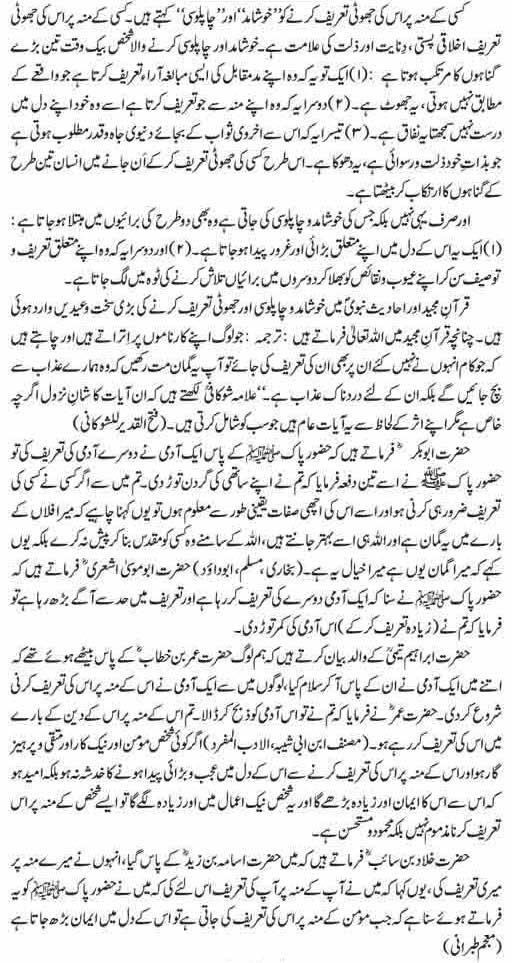
Emotional And Physical Abuse In Marriage
In Islam, the marriage of a man and a woman is not just a financial and physical arrangement of living together but a sacred contract, a gift of Allah, to lead a happy, enjoyable life and continue the lineage. The main goal of marriage in Islam is the realization of tranquility and compassion between the spouses.
The relationship between the spouses should be based on tranquility, love, and mercy. These three summarize the ideals of Islamic marriage. It is the duty of the husband and wife to see that they are a source of comfort and tranquility for each other.
While the meaning of physical abuse is rather obvious, the meaning of emotional abuse might not be, and the abuse itself may be more insidious. Emotional abuse includes name-calling, belittling, using the threat of divorce as a weapon to manipulate the other, threatening with a real weapon (even with no intention to use it). There may be other elements such as not allowing the wife to visit or contact family or friends. Even frequent teasing, though it starts in fun, may become a type of abuse if it takes the form of sarcasm or demeaning remarks.
It is common for some people when they are angry to call others names or belittle them. If one gets angry quickly and easily with one’s spouse, it could lead to emotional abuse. The Prophet (peace and blessings be upon him) advised us to control our anger, not to call each other names, not to use vulgar language, and not to point a weapon at another person. This advice was general for all, but it should be taken even more seriously within a marriage.
These general guidelines are established by the Qur’an in the following verses: “O ye who believe! Let not a folk deride (ridicule) a folk who may be better than they (are), nor let women (deride) women who may be better than they are; neither defame one another nor insult one another by nicknames. Bad is the name of lewdness after faith. And whoso turneth not in repentance, such are evil-doers. O ye who believe! Shun much suspicion; for lo! some suspicion is a crime. And spy not, neither backbite one another. Would one of you love to eat the flesh of his dead brother? Ye abhor that (so abhor the other)! And keep your duty (to Allah). Lo! Allah is Relenting, Merciful.” (Al-Hujurat: 11-12)
Moreover, Prophet Mohammad (SallAllaho Alaihi Wasallam – may the peace and blessings of Allah be upon him) said: ?It is not lawful for a Muslim to scare his fellow Muslim.? (Reported by Ahmad & Abu Dawud)
Abu Hurayrah (may Allah be pleased with him) reported that the Prophet (SallAllaho Alaihi Wasallam) also said: ?None of you should point his weapon at his brother, as Satan may provoke him (to hurt his brother) and as a result, he would fall into a pit of Fire.? (Reported by al-Bukhari) In another version: ?He who (even) points at his brother with a piece of iron is cursed by the angels until he puts it down, even if the other was his blood brother.? (Reported by Muslim)
“Emotional abuse truly damages and hurts as much as physical abuse does. In Islam, there is a special consideration of the relationship between the spouses. Allah says, “And among His Signs is this, that He created for you mates from among yourselves, that you may dwell in tranquility with them, and He has put love and mercy between your (hearts): verily in that are Signs for those who reflect.” (Ar-Rum 21)
It is shown that the basis of the relationship between husband and wife is affection and mercy. In many Hadiths, the Prophet (SallAllaho Alaihi Wasallam) mentioned that if a husband looks at his wife with kindness and mercy, Allah Almighty looks at them with His mercy, and if they shake hands all their sins vanish. So, we have to study very well how the Prophet (peace SallAllaho Alaihi Wasallam) dealt with his wives. In fact, he was very merciful, kind, and loveable, bearing in mind that there were some problems that they faced in their marital life but they dealt with these problems with extreme wisdom and kindness. The Prophet (SallAllaho Alaihi Wasallam) never abused his wives either physically or emotionally.
Therefore, neither of the spouses is allowed to abuse the other emotionally. This is prohibited in Islam. If either does so, Almighty Allah will hold him or her accountable for that, and they should repent to Allah for this. It is clear now that the best guide to us to live a very successful marital life is to follow the Prophet (SallAllaho Alaihi Wasallam).”
Jaheez
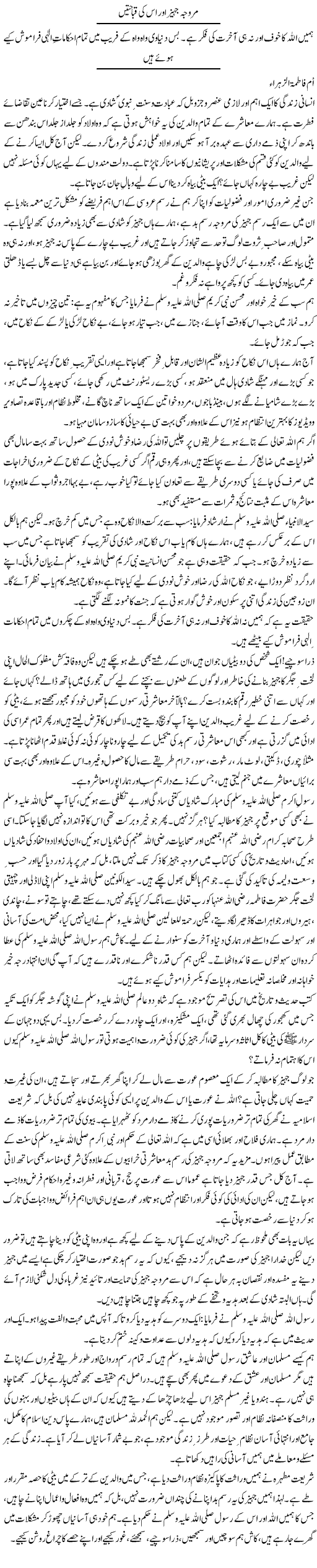
Mualij Ka Maqam Aur Zimmedariyan

When They Take an Oath by Allah, They Are Responded By Allah That It Is Fulfilled
Sahih Bukhari Volume 3, Book 49, Number 866:
Narrated Anas: Ar-Rabi, the daughter of An-Nadr broke the tooth of a girl, and the relatives of Ar-Rabi’ requested the girl’s relatives to accept the Irsh (compensation for wounds etc.) and forgive (the offender), but they refused. So, they went to the Prophet who ordered them to bring about retaliation. Anas bin An-Nadr asked, “O Allah”; Apostle! Will the tooth of Ar-Rabi’ be broken? No, by Him Who has sent you with the Truth, her tooth will not be broken.” The Prophet said, “O Anas! Allah”; law ordains retaliation.” Later the relatives of the girl agreed and forgave her. The Prophet said, “There are some of Allah’s slaves who, if they take an oath by Allah, are responded to by Allah i.e. their oath is fulfilled). Anas added, “The people agreed and accepted the Irsh.”
Sahih Bukhari Volume 3, Book 49, Number 866:
Ar-Rabi, the daughter of An-Nadr who was a young girl had broken a tooth of another girl and the other girl’s relatives had asked for retaliation instead of compensation
Here a few points noting, The Holy Prophet Muhammed Salalaahu Alaihi wasallam took an OATH that the young girl’s tooth will not be broken
“No, by Him Who has sent you with the Truth, her tooth will not be broken”
and later than it so happened that the relatives of the other girl agreed to take money instead of retaliation after the Holy Prophet took the OATH by Allah, so the Holy Prophet Muhammed Salalaahu Alaihi wasallam’s OATH was fulfilled, and then he said
“There are some of Allah’s slaves who, if they take an oath by Allah, are responded to by Allah i.e. their oath is fulfilled)”
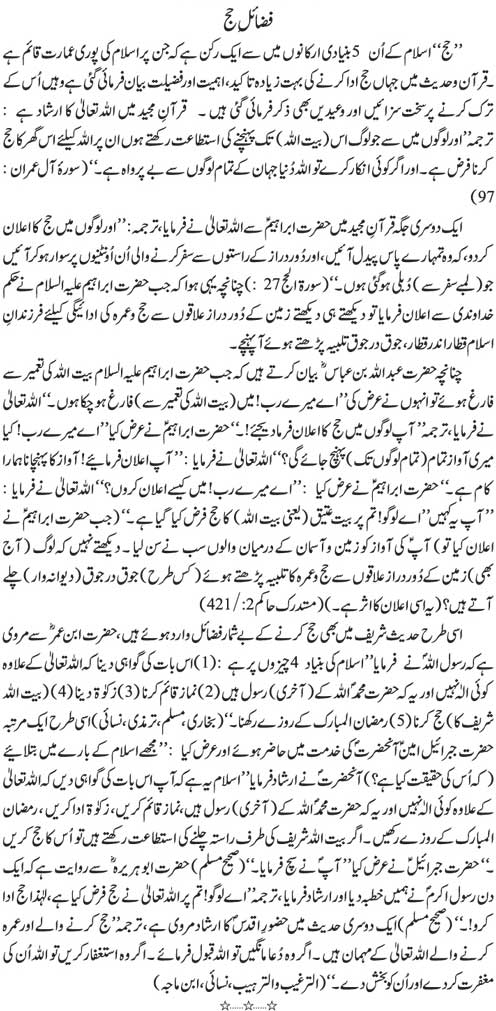
Fazail E Hajj
Friday Prayer
[Transmitted by Abu Dawud]
The Friday prayer in congregation is a necessary duty for every Muslim, with four exceptions; a slave, a woman, a (young) boy, and a sick person.
[Transmitted by Sahih Bukhari]
“When it is a Friday, the angels stand at the gate of the mosque and keep on writing the names of the persons coming to the mosque in succession according to their arrivals. The example of the one who enters the mosque in the earliest hour is that of one offering a camel (in sacrifice). The one coming next is like one offering a cow and then a ram and then a chicken and then an egg respectively. When the Imam comes out (for Jumua prayer) they (i.e. angels) fold their papers and listen to the Khutba.”
[Transmitted by Abu Dawud]
Friday is divided into twelve hours. Amongst them, there is an hour in which a Muslim does not ask Allah for anything but He gives it to him. So seek it in the last hour after the afternoon prayer.
[Transmitted by Abu Dawud]
He who leaves the Friday prayer (continuously) for three Friday on account of slackness, Allah will print a stamp on his heart.
[Transmitted by Sahih Muslim]
He who took a bath and then came for Jumu’ah prayer and then prayed what was fixed for him, then kept silence till the Imam finished the sermon, and then prayed along with him, his sins between that time and the next Friday would be forgiven, and even of three days more.