
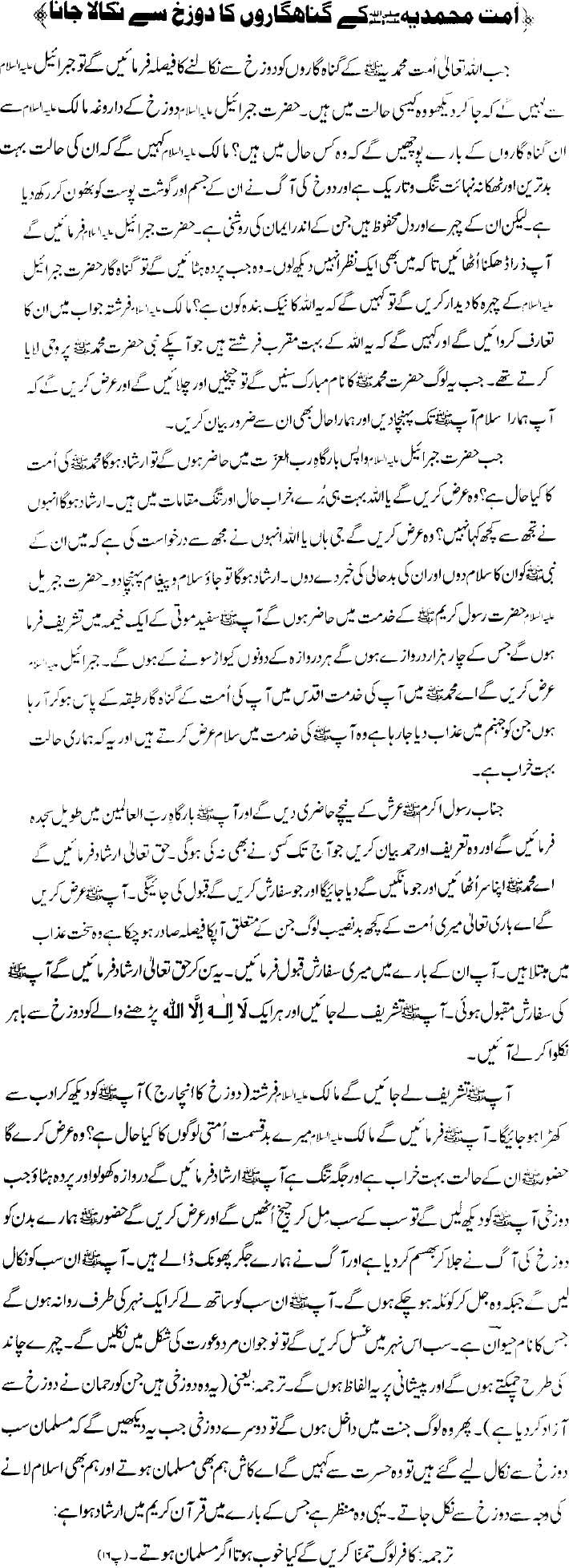
Ummat e Muhammadi (Sallallahu alaihi wasallam) Kay Gunnahgaro Ka Dozakh Say Nikala Jana
What Makes Us Different From Iblis, Shaitan
Iblis. Shaytan. The Devil. Whatever name you call him, everyone knows him. He is the accursed one. The rejected outcast, who was thrown out of Jannah. The one damned to the Fire of Hell forever and doomed until eternity.
Ever wonder how he got there? I mean, really wondered…?
What did he do, or perhaps not do, that condemned him to be the most despicable and humiliated creature in the heavens and the earth?
Yes, sure, we all know the story. We’ve known it since we were babies. We’ve read it in the Qur’an a million times. But, have we ever read the story with the eyes of our hearts? Have we really thought about what happened? Have we ever pondered it? What did Iblis do that was so wrong? Let us look at some of Iblis’ actions.
1. Did Iblis not believe in Allah? Indeed, he did!
Iblis, the accursed, believed in Alah. He knew Allah is the Master, Owner, Sustainer, the Giver of life and death, the Lord of all things. In fact, he calls Him my Rabb, my Lord.
He (Iblis) said, ‘My Lord, reprieve me till the Day they are raised.’ (Surah al-Hijr:36)
Why, Iblis even swore by Allah’s Might, knowing fully well that it is Allah Subhaanahu wa Ta’ala, Who is Almighty and that all Power belongs to Him Alone. Iblis swears: He (Iblis) said, ‘I swear by Your Might, that I will surely mislead them all. (Surah Saad:82)
2. Did he believe that someone else created him? NO, he knew Allah is his Creator!
Shaytan knew very well that Allah is the Creator of the heavens and the earth and whatever is in them, including himself, all jinn and mankind. He admitted it himself.
(Iblis) said: ‘I am better than he (Adam). You created me of fire, and You created him of clay.’ (Surah al-Aaraaf:12)
Agar Niyyat Naik Ho Tu
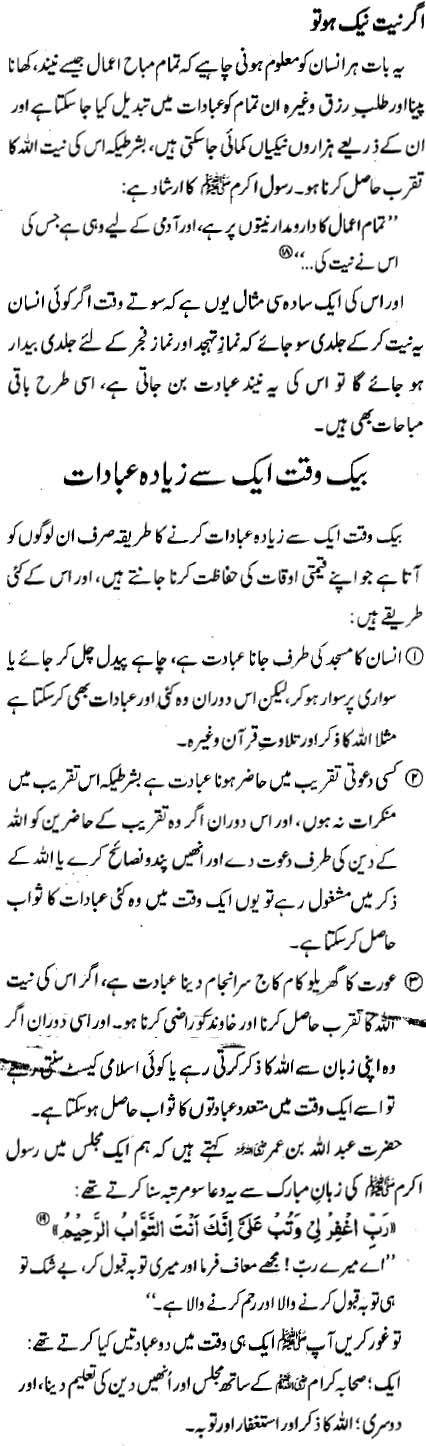
Agar Niyyat Naik Ho Tu
Akhlaq: The Importance Of Islamic Morals
The definition of morals (Akhlaq) in the Arabic language: It is a term derived from the word “Khuluq” meaning the character and the nature; therefore, a man’s character would be his qualities and his morals. The definition of morals in Shari’ah terminology: Morals are the characteristics that Allah (SWT) has ordered Muslims to abide by when performing their actions. They are the commands and prohibitions related to the qualities which the Muslim should demonstrate when performing his actions, be it acts of worship, transactions and others
Since the Shari’ah, or rather restrict the Muslim, his actions are restricted, for Allah (SWT) says: “It is not fitting for a believer, man or woman, when a matter has been decided by Allah and His Messenger, to have any option about their decision. If anyone disobeys Allah and His Messenger, he is indeed on a clearly wrong path” [TMQ 33:36]
And for He (SWT) says: “But no by the Lord, they shall not be believers, until they make you judge in all disputes between them, and find in their souls no resistance against your decisions, but accept them with the fullest conviction.” [TMQ 4:65]
Tib-e-Nabvi: Kalonji
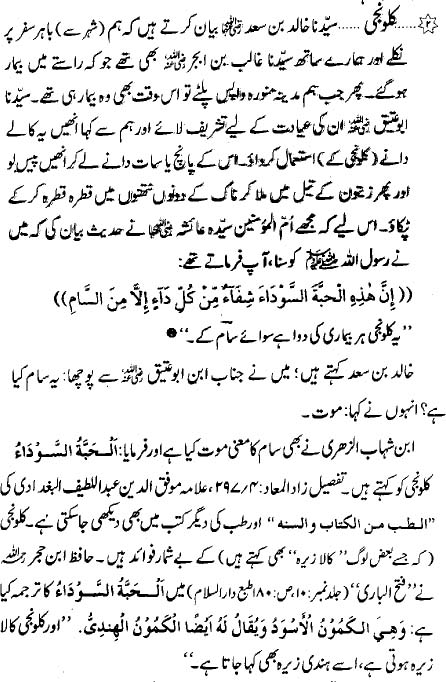
Tib-e-Nabvi: Kalonji
The Negative C’s Of Islamic Parenting
One of the greatest challenges a Muslim will ever face is being a parent. This is one challenge, however, many of us are least prepared for. Allah tells us in the Quran that our children are our trial, and as such, we should take the task of parenting seriously and start learning from each other.
There are many negative C’s, which should also be identified so that we can avoid them or at least be aware of them.
Competition: In an authentic Hadith, the Prophet Muhammad said: “Look up to one who is greater in piety so you strive to be like him and look upon one who is below you in material status so that you may be thankful to Allah’s Grace”. As a Muslim community, we are experiencing the opposite. We are literally killing ourselves to gain bigger and better material goods than others and passing this same competitive spirit to our children. If Br. X’s son is going to Yale, my son must go to Harvard; otherwise, he is a failure, no matter how good a Mumin (believer) he is in comparison to Br. X’s son. We are inadvertently putting so much pressure on our children to compete in Dunya (this world) that we are actually hurting their self-esteem and pushing them away. Remember, if children don’t find acceptance of who they are and what they are capable of at home, they will find it elsewhere.
Majlis Say Uth Kar Jane Ki Sunnat

Majlis Say Uth Kar Jane Ki Sunnat
Receiving Naseeha – Work On Ourselves First
Usually, you’ll find in articles on “The Manners of Naseeha” or “Fiqh of Naseeha” going over how to give Naseeha before mentioning how to accept it. I want to change things up and speak about receiving it first because of the problems many Muslims face with it.
Firstly, you have to humble yourself and break down your walls of arrogance. This lays the foundation for Naseeha to operate on. If every Muslim were to work for this, it would make identifying our mistakes for correction much more streamlined, whether the identification comes from yourself or from your fellow Muslim brother or sister.
Secondly, discard any self-perceived “rank” or “status” in your mind. It doesn’t matter if the person is a different age, or a different nationality, a different Manhaj, a different gender, or different at all. Whether it’s your parent, child, relative, Shaykh, friend, student, a pious person, a sinner, whoever, every Muslim has the right to advise you when you do wrong. Imam Malik (rahimuhullah) once came into a masjid after Asr and was commanded by a boy to pray two rak’ah of Tahayyatul Masjid even though it was clearly contradictory to his Fiqh position. His students saw this and later asked him why he prayed the two rak’ah. Imam Malik replied:
Bura Anjam: Aik Munafiq Ka Ibrat-nak Anjam
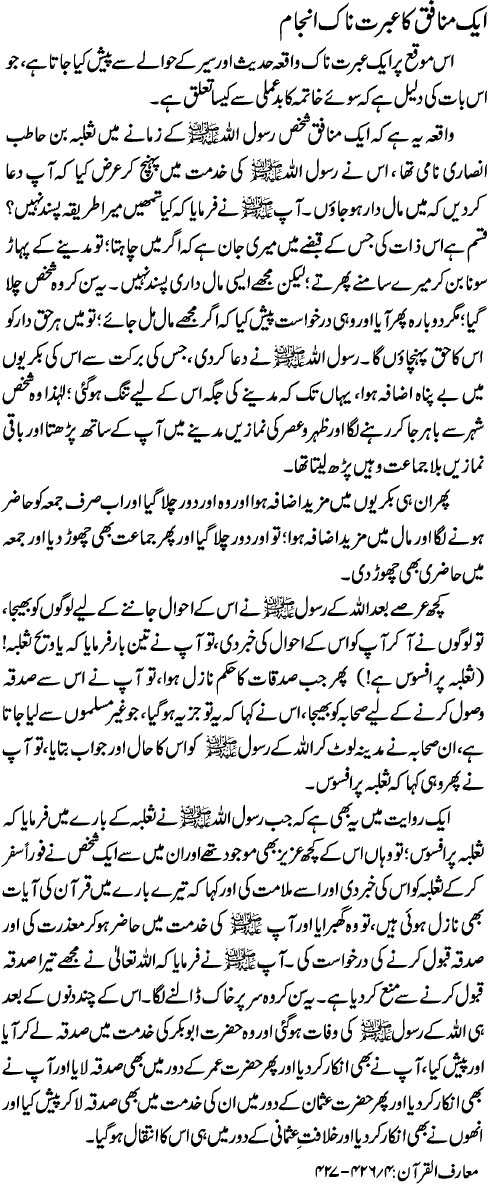
Bura Anjam: Aik Munafiq Ka Ibrat-nak Anjam
Ten Principles Of Success In the Light Of The Seerah
It is a well-known fact that the Prophet of Islam (PBUH) was the supremely successful man in the entire human history. But he was not just a hero, as Thomas Carlyle has called him. According to the Qur’an, he was a good example for all mankind. He has shown us the way to achieve supreme success in this world.
By studying the life of the Prophet, we can derive those important principles that the Prophet followed. In short, the Prophet of Islam was a profoundly positive thinker in every sense of the word. All his activities were result-oriented. He completely refrained from all such steps as may prove counter-productive.
First Principle: To begin from the possible
This principle is well explained in a saying of Aisha RA. She said: “Whenever the Prophet had to choose between two options, he always opted for the easier choice.” (Al-Bukhari) To choose the easiest option means to begin from the possible, and one who begins from the possible will surely reach his goal.
Second Principle: To see advantage in disadvantage
In the early days of Mecca, there were many problems and difficulties. At that time, a guiding verse in the Qur’an was revealed. It said: “With every hardship there is ease, with every hardship there is ease.” (94:5-6). This means that if there are some problems, there are also opportunities at the same time. And the way to success is to ignore the problems and avail the opportunities.