

Dua Ism-e-Azam
Bitterness Is A Killer!
Abu Hurairah (Radi Allahu anhu) said: The Allah’s Messenger (SalAllahu alaihi wasallam) said, “Verily, Allah likes three things for you and disapproves three things for you. He likes that you should worship Him Alone, not to associate anything with Him (in worship) and hold fast the Rope of Allah and not be divided among yourselves; and He disapproves of your irrelevant talk, persistent questioning and the squandering of the wealth.” Muslim (As Taken from Riyad-us-Saliheen)
We tend to think that circumstances cause us to become bitter, but this is not always the case. Bitterness is something that happens to us, it is a characteristic we develop. To swallow a daily dose of poison would be unthinkable. Yet this is what you do if you awaken each morning with bitter thoughts that belong to the past. You are poisoning your system.
Bitterness is a killer. But who does it hurt? Only you – for who else suffers that gnawing pain which twists and turns deep in your being? Certainly not the one who has wronged you! He or she probably is not even aware of it. Bitterness depresses the spirits, stifles creativity, weakens the immune system, obstructs happiness and ruins health. As a carrier you are the only one who reaps its adverse consequences so why submit to it?
A bitter person always seems to find a good reason to be bitter: “After all I did, he or she left me…” “My parents all favor my brother – nothing I do will please them…” “That false rumor ruined my chances of promotion…” and the list goes on… Valid reasons, maybe. Painful, certainly! Even worthy of some human emotion. But it takes only a little –yes just a little time and effort to work through the pain, hurt, disappointment, sadness, or anger. You must process your emotions, regain your balance, change your attitude or seek counsel.
“Wonderful in theory,” a bitter person might say. “But I can’t forget.” You can forget, but whether you choose to is another matter. It takes time and effort to re-pattern negative thoughts into the conscious habit of replacing them with positive ones. When we harbor negative emotions towards others or ourselves, or when we intentionally create pain for others, we poison our own physical and spiritual systems. By far the strongest poison to the human spirit is the inability to forgive oneself or another person. It disables a person’s emotional resources. The challenge is to refine our capacity to love others as well as ourselves and to develop the power of forgiveness.
“Forgiveness is the key that unlocks the door of resentment and the handcuffs of hate. It is a power that breaks the chains of bitterness and the shackles of selfishness.”
ALLAH TA’ALA knows what’s hidden in the deep recesses of our hearts. Those feelings of pain, anguish, resentment, hatred, bitterness, etc., that we so successfully hide from everyone else, including our closest family members and friends. So why not let it all out? Why not let ALLAH TA’ALA be your “therapist”? Let your prayer mat be your “couch” while you reveal and ask the One who is in control, Who knows you better than you know yourself. From the very depth of Allah Ta’ala’s fountain of Mercy, bitterness will be cleansed and you shall blossom amongst the flowers of enjoyment. Subhan-ALLAH!
Beloved Reader! It is better to live in peace than in bitterness and strife. I’ve known people to go through a lot of trials and hardships and maintain a grateful and gracious spirit throughout. I’ve seen others face similar trials only to become angry and embittered souls. In both cases, the hardship revealed the heart more than it formed the heart. If we are filled with sweetness and something jostles us, then sweetness spills out. If we are filled with bitterness, and we get jostled, then battery acid goes everywhere. Overcome the obstacles in your path, and be determined, courageous, and hard-working. Never be faint-hearted. Be resolute, but never bitter… be beautiful inside, and thus you shall become an embodiment of love, joy, and happiness.
How To Deal With Bitterness:
- The most important is to Turn to Allah by means of Dua (Prayer). Raise your hands in supplication, for, Du’a is a weapon of a Believer.
- Every time you think of a past negative situation, replace it instantly with a picture of a positive, happy life.
- When you feel resentful, bless and forgive the person who wronged you, and do not stop praying for the best for those you love.
- Busy yourself with things you enjoy so that you have no time to brood. Plan something to look forward to. Give to someone who is worse off than yourself. In other words, place every negative thought with a positive one until it becomes a habit.
Never allow bitterness to take root, or you’ll become a twisted, sour human being people will shun.
Bitter thoughts are like weeds. Pluck them out of your heart relentlessly…and in their place will sprout the seeds of joyful new life.
O ALLAH TA’ALA! Reform our character and bless us with the cleanliness of the heart. ..Aameen
By Sister S Bemath
Maghfirat Waley Aamaal
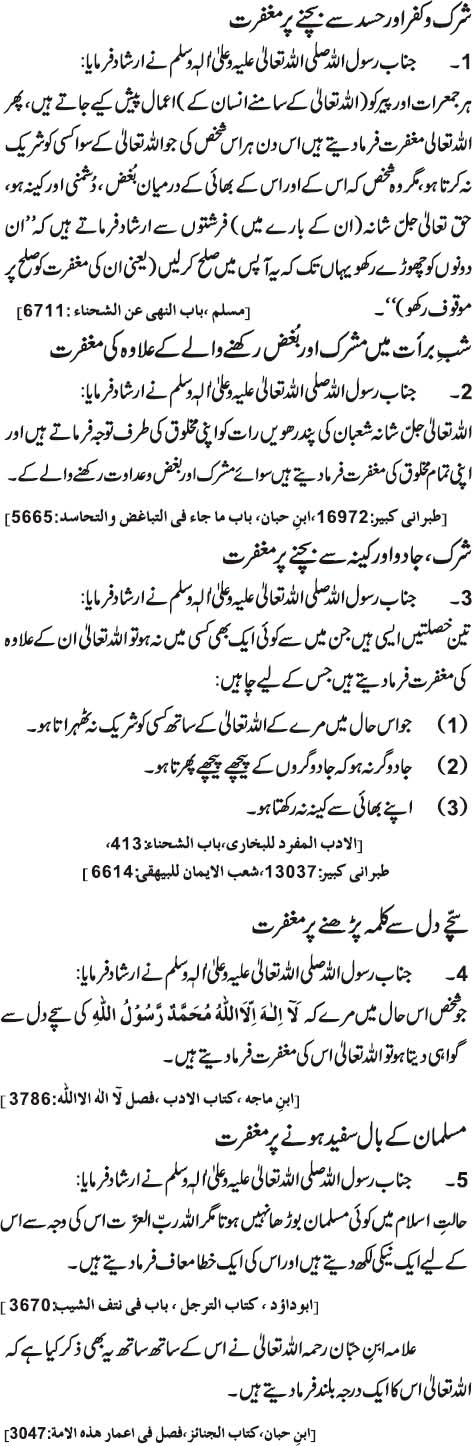
Maghfirat Waley Aamaal
Virtues Of The Day Of Arafah (9th Dhu’l-Hijjah)
Then, which of the favors of your Lord will you deny? (13: Sura e Rehman)
The best of supplications is the supplication on the day of Arafah and the best which I and the Prophets before me have said (is) … `None has the right to be worshiped except Allah, alone, without partner. To Him belongs all praise and sovereignty, and He is over all things omnipotent.’
The Day of ‘Arafah, the 9th of Dhu’l-Hijjah is one of the selected days of Allah. Hence, it has many virtues and blessings. Some of these virtues are ….
Perfection of the Religion: It is the day the religion was perfected and Allah’s favor was completed on the entire humanity. Umar ibn Khattab (ra) reported that a Jewish man said to him, “O Ameer al-Mu’mineen, there is an ayah in your Book which you recite; if it had come to us Jews, we would have taken that day as an Eid (festival).” Umar said, “Which ayah?” He said: “This day I have perfected your religion for you, completed My favor upon you, and have chosen for you Islam as your religion.” (5:3) Umar said, “We know on which day and in which place that was revealed to the Prophet (Sallallahu alaihi wa salam). It was when he was standing in Arafah on a Friday.” (Bukhari, Muslim)
Day of Eid: It is a day of Eid and celebration for all the Muslims, whether they are in the Sacred House or any part of the world. The Prophet (Sallallahu alaihi wa salam) said: “Yawm ‘Arafah (the day of Arafah), Yawm al-Nahr (the Day of Sacrifice) and Ayyaam al-Tashreeq (the 3 days following Yawm al-Nahr) are Eid (festival) for us, the people of Islam. These are days of eating and drinking.” This was narrated by the authors of al-Sunan. It was reported that ‘Umar ibn Khattab said: “It – i.e., the ayah ‘This day I have perfected?’ was revealed on a Friday, the Day of Arafah, both of which – praise be to Allah – are Eid for us.”
Day of Oath: It is a day on which Allah swore an oath. The Almighty Allah cannot swear an oath by anything except that which is mighty. Day of ‘Arafah is the “witnessed day” mentioned in the Qur’an: “By the witnessing day (Friday) and by the witnessed day (the Day of ‘Arafah).” (85:3)
Abu Hurairah (ra) reported that the Prophet (Sallallahu alaihi was salam) said: “The promised day is the Day of Resurrection, the witnessed day is the Day of Arafah, and the witnessing day is Friday.” (Tirmidhi)
It is the “odd” (i.e., odd-numbered, Witr) by which Allah swore in the verse (which means): “And by the even and the odd.” ( 89:3)
Ibn Abbas said: “The even is the Day of Adhaa (10th Dhu’l-Hijjah) and the odd is the Day of Arafah (9th Dhu’l-Hijjah).”
Expiation of sins for two years: It is the day on which, if anyone fasts, his sins are forgiven for two years. Abu Qatadah (ra) reported that the Messenger of Allah (Sallallahu alaihi wa salam) was asked about fasting on the Day of Arafah. He said, “It expiates for the sins of the previous year and of the coming year.” (Muslim)
The fasting is mustahab (recommended) for those who are not on Hajj. In the case of the one who is on Hajj, it is not sunnah for him to fast on the Day of Arafah, because the Prophet (Sallallahu alaihi was salam) did not fast on this day in Arafah. It was narrated that he forbade fasting on the Day of ‘Arafah in ‘Arafah.
Covenant from the Progeny of Adam: It is the day on which Allah took covenant from all the progeny of Adam. Ibn Abbas (ra) reported that the Messenger of Allah (Sallallahu alaihi wa salam) said: “Allah took the covenant from the loins of Adam in Na’man, i.e., ‘Arafah. He brought forth from his loins all his offspring and spread them before Him, then He addressed them, and said: ‘Am I not your Lord? They said, ‘Yes, we testify,’ let you should say on the Day of Resurrection: ‘Verily, we have been unaware of this.’ Or lest you should say: ‘It was only our fathers aforetime who took others as partners in worship along with Allah, and we were (merely their) descendants after them; will You then destroy us because of the deeds of men who practiced Batil (polytheism and committing crimes and sins, invoking and worshiping others besides Allah)?’ (7:172-173) (Ahmad)
There is no greater day than this and no greater covenant than this.
Day of Forgiveness of Sins: This is the day to get forgiveness from sins, freedom from the Fire, and pride in the people who are there: Prophet (Sallallahu alaihi wa salam) said: “There is no day on which Allah frees more people from the Fire than on the Day of Arafah. He comes close and expresses His pride to the angels, saying, ‘What do these people want?'” (Muslim)
Ibn Umar reported that the Prophet (Sallallahu alaihi wa salam) said: “Allah expresses His pride to His angels at the time of Isha’ on the Day of ‘Arafah, about the people of ‘Arafah. He says, ‘Look at My slaves who have come unkempt and dusty.'” (Ahmad)
These are just some of the blessings and merits of the day of ‘Arafah. We all should try our best to avail maximum benefit from this blessed day. Praise be to the One who gave us an opportunity to earn rewards and have our sins removed on this day.
Virtues Of The Day Of Arafah (9th Zil Hijjah)
Aaishah radhiyallahu anhaa reports that Rasulullah sallallahu alayhi wasallam said: ” There is no day in which Allah sets free more souls from the fire of Hell than on the day of Arafah. And on that day, Allah draws near to the earth and by way of exhibiting His pride remarks to the Angels: “What is the desire of these (servants of mine).” Muslim
Talhah radhiyallahu anhu reports that Rasulullah sallallahu alayhi wasallam said: “Apart from the day of the Battle of Badr, there is no day on which the Shaytaan is seen to be more humiliated, more rejected, more depressed and more infuriated than on the day of Arafah, and indeed all this is only because of beholding the abundance of descending mercy (on that day) and Allah’s forgiveness of the great sins of the servants.” Mishkaat
Abu Qataadah Al Ansaari radhiyallahu anhu narrates that Rasulullah sallallahu alayhi wasallam was asked about the fast on the day of Arafah. He said, “It compensates for the (minor) sins of the past and the coming year. ” (Muslim P.368 Vol. 1, Tirmizi P. 157 Vol. 1, Ibne Maajah P.124 Vol. 1)
Fasting On The Day Of Arafah
The ninth day of Zulhijjah is the day of ‘Arafah. It is the day when pilgrims stand on the plain of ‘Arafah to pray. On this day, Muslims all over the world who do not witness the annual Hajj should spend the day in fasting in preparation for the three-day festivity following Eid ul Adha.
Abu Hafasah (ra) said the Prophet (saas) said: “Fasting on the day of ‘Arafah absolves the sins for two years: the previous year and the coming years, and fasting on ‘Ashura, the tenth day of Muharram atones for the sins of previous years.” (Reported by Jama’ah except Bukhari and Tirmidhi)
In another hadith, the Prophet’s wife Hafsah (ra) said: “Four things the Messenger of Allah never neglected: Observing fast on the day of ‘Ashura, (on the tenth of Muharram), three days every month, and offering Fajr sunnah prayers early in the morning.” (Muslim)
These ahadiths are proof that fasting on the tenth of Zulhijjah, the day before Eidul Adha was a lifelong practice of the Prophet (saas) as his wife reported.
There are some reports that fasting is prohibited on the day of ‘Arafah. However, it must be understood that this refers to a person performing Hajj. If a person is on Hajj, there is no fast for him or her on the day of Arafah. That is undoubtedly a blessing for him because of the hardships of the pilgrimage. In a hadith reported by Umm al-Fadl (ra) she said: “The companions doubted whether the Prophet was fasting on Arafah or not. She decided to prove to them that he was not, so she said, ‘I sent to him milk, which he drank while he was delivering the Khutbah on ‘Arafah.'” (Bukhari)
Prohibiting the pilgrim from fasting on these days is a great mercy for him, for fasting will exert undue hardship on the person performing the Hajj, while he is concerned with his pilgrimage. Above all, the pilgrim would not be fasting anyway because he is traveling.
Wo Baatien Jin Say Qabar Kay Sawal Asaan Ho Jaate Hein

Wo Baatien Jin Say Qabar Kay Sawal Asaan Ho Jaate Hein
Sitting Between Two Persons
If you enter a room, do not sit between two persons. Instead, sit on their left or right side. Abu Dawood reported that
the Messenger of Allah (صلى الله عليه وسلم) Said: ‘No one is to sit between two people without their permission.’
Sometimes two persons will be kind enough to favor you by making room for you to sit between them. Acknowledge this kind gesture by accepting their offer. Do not sit cross-legged to crowd them out. A sage said: ‘Two persons are considered immoderate: a person to whom you give advice, and he arrogantly holds it in contempt against you and a person who is favored with a seat in a room, and he sits crossed-legged.’
If you are seated between two people, do not eavesdrop and listen to what they say, lest their conversation be a confidential or private matter. Eavesdropping is a bad habit and a sin. Al-Bukhari reported that the Messenger of Allah (صلى الله عليه وسلم) said: ‘Whoever listens to people’s conversation against their wishes, will be punished by liquid lead being poured down their ears on the day of Judgment.’ You should seek to benefit from the company and wisdom of the elders, who are described as ‘ a fruit at the end of the season.’ I would add, a sun wearing the veil’ since it will leave us and disappear at night.
Be keen to attend the gatherings of the elders whether scholars, pious persons, nobles, or relatives. Soon you may lament their departure and your loss. It is an inappropriate Muslim manner to whisper to someone sitting next to you if you are in a group of three people. The third person will feel deserted and isolated and will think the worst of thoughts. The Messenger (صلى الله عليه وسلم) hated this. Imam Malik and Abu Dawood reported that he said: ‘No two shall exchange whispers in the presence of a third person.’
That the Prophet used ‘No two…’ in an assertive negative form, indicates that such a mistake is not only inappropriate but unimaginable and instinctively despicable. ‘Abdullah Bin Omar was asked, ‘What if they were four?’
‘Then it does not matter,’ he answered, meaning it is not irritating than to whisper or to mutter. If a friend entrusted you with a secret, do not betray him or her. Do not tell it even to your best friend or closest relative.
Namaz Ka Sahee Tariqa


Namaz Ka Sahee Tariqa
Practices That Almighty Allah Dislikes
- Allah does not love the wrongdoers (unjust) [Quran-Surah-3/57]
- Allah does not love the wrongdoers (unjust) [Quran-Surah-42/40]
- Allah does not love the unbelievers (rejecters of Faith) [Quran-Surah-3/32]
- Surely, Allah does not love him who is unthankful and sinful. [Quran-Surah-2/276]
- Indeed, he who associates others with Allah, Allah has forbidden him Paradise, and his refuge is the Fire (Al-Maida 5/72)
- Allah does not love the mischief-makers[Quran-Surah-5/64]
- Allah does not love the mischief [Quran-Surah-2/205]
- Allah does not love the mischief-makers.[Quran-Surah-28/77]
- Surely Allah does not love those who exceed the limits. [Quran-Surah-2/190] and [Quran-Surah-5/87]
- Allah does not love the arrogant (person having proud) [Quran-Surah-16/23]
- He (Allah) does not love the extravagant (wasteful) [Quran-Surah-6/141]+[7/31]
- Surely Allah does not love the treacherous (deceitful, untrustworthy) [Quran-Surah-8/58]
- Allah does not love him who is proud (arrogant), boastful [Quran-Surah-4/36]
- Allah does not love any arrogant boaster. [Quran-Surah-31/18]
- Allah does not love utterance of bad things or sins of other people publicly, except the oppressed. [Quran-Surah-4/148]
- Allah does not love him who is proud, boastful. [Quran-Surah-4/107]
- Surely Allah does not love anyone who is unfaithful, ungrateful [Quran-Surah-22/38]
Naseehat Ki Chand Aham Baatein

Hadees e Nabwi S.A.W: Naseehat Ki Chand Aham Baatein
The Burial Procedure In Islam
Allah (SWT) says: … And Allah grants respite to none when his appointed time (death) comes. And Allah is well-acquainted with what you do.’ (Surah 63, v 11) Abu Hurairah (ra) relates that RasulAllah (saw) stated: read the kalmia ‘La Ilaha Ilallah’ near the dying person (thus by reading the kalmia near them, their thoughts are diverted to the oneness of Allah (SWT) and they pass away from this world in that state inshallah). (Sahih Muslim)
Hazrat Maqir bin Yasaar (ra) relates that RasulAllah (saw) stated: read surah Ya-Sin near the dying person. (Musnad Ahmad, Abu Dawood, Ibn Majah)
Hazrat Jabir bin Zayd (ra) relates that the recitation of Surah R’ad (thunder) also causes the dying person to have some peace and eases the pangs of death. (Ibn Abi Shayba)
Hazrat Abdullah ibn Umar (ra) relates I heard RasulAllah (saw) say: when anyone amongst you dies, then do not hold his body back (from the burial). Take the body quickly to the grave, after the burial read the opening 5 verses of Surah Baqarah towards the head of the grave. And read the last 2 verses of Surah Baqarah towards the foot of the grave. (Abu Dawood, v2, p94)
Due to governmental requirements and procedures, a body may be held back from a burial. However, to delay a body from being buried due to the absence of certain family members is not permissible according to Shariah. This is because, in many ahadith, RasulAllah (saw) has expressly ordered that the body be buried as soon as possible after death.
Umme Salamah (ra) relates that at the time of the death of her husband Abu Salamah (ra) Nabi Karim (saw) came to their house, and the eyes of Abu Salamah (ra) remained open after his death. Nabi Karim (saw) closed them and said: ‘When the soul is taken out of the body, then the faculty of sight is also taken with it.’ Hearing this, the household of Abu Salamah (ra) started crying loudly.
Nabi Karim (saw) stated: O people! Make supplication for good and success, for whatever you are saying now, the angels say ‘Ameen’ to that. Then Nabi Karim (saw) himself made the following dua: ‘O Allah forgive Abu Salamah and raise his rank amongst those whom you have guided of your creation. Sustain his house folk, O Allah forgive Abu Salamah and all of us also and make his grave wide and filled with light!’ (Sahih Muslim)
To take part in the funeral prayer and burial of a Muslim carries a very great reward, indeed Hazrat Abu Hurairah (ra) relates that RasulAllah (saw) stated: whomsoever takes part in the funeral prayer of a Muslim and then stays on until the burial is completed. He will be rewarded the equivalent of 2 qirat. The comparison of 1 qirat is like the Mountain of Uhud.(Sahih Muslim)
Be aware, that this applies to the menfolk and women should refrain from the acts of burial alongside the men. There are also hadith which prohibit women from attending the cemeteries.
Hazrat Abdullah ibn Abaas (ra) stated: the believer who takes part in the funeral prayer of his fellow believers the greatest reward that he attains is, after his death, he (the performer of the funeral prayer of others) has his sins forgiven. (Nawadirul Usool)
From this narration is it encouraged that a believer should, as much as possible, take part in the funeral prayer and burial of the Muslims to attain the great reward that Allah (swt) has kept for these deeds. For today is their turn, and tomorrow it will be ours.
After performing the burial of any believer, RasulAllah (saw) would wait at their grave and would say: supplicate for the steadfastness and forgiveness of your brother, for he is about to be questioned. (Abu Dawood)
The individuals who place the body in the grave should say: ‘Bismillahi Wa Ala Milathi Rasulillah’ (we place you in the name of Allah and the religion of RasulAllah (saw) we hand you over to Allah). Then the body should be placed on its right side facing the qibla.(Duri Mukhtar)
After this, cover the grave with earth, for each person to throw 3 handfuls in the grave is preferred. It is better than on throwing the 1st handful: ‘Minha Khalaqna Kum’ (from this earth we created you), is read. On the 2nd handful: ‘Wa Feha Nu’iydukum’ (and to this we are returning you). And on throwing the 3rd handful read: ‘Wa Minha Nukhrijukum Taratan Ukhra’ (from this again we shall raise you (on Qiyamah). (Duri Mukhtar)
The news of the passing away of Hazrat Jafar ibn Abi Talib (ra) reached RasulAllah (saw). He (saw) said to his household: ‘Prepare food for the family of Jafar (ra), for they are at this time grieving and will not be attentive to food.’ (Jami Tirmidi, Ibn Majah)
It is regretful & shameful that today people frequent the house of the family of the deceased to have food rather than preparing & sending food to their house, which is the way of our Prophet (saw).
May Allah guide us to the straight path and make use of those who live with Iman, die with Iman, and raise us on Qiyamah with the believers Ameen!
Mufti Yusuf Danka Al-Kauthar