
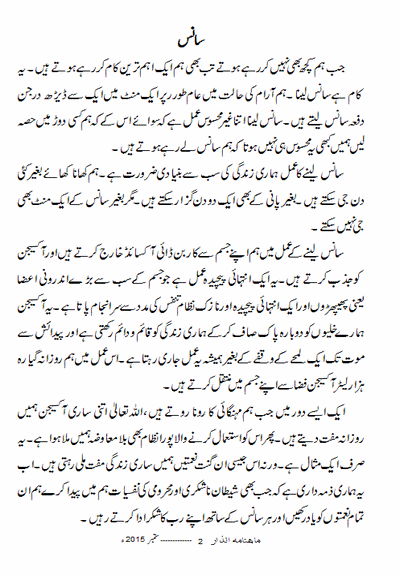
Saans
Learn From History And Fear Allah
Extremism, exceeding proper bounds, corruption, immorality, and subjugating people are the key to death, destruction of kingdoms, and cause for perdition. Pharaoh was arrogant on earth, divided its people, and subjugated some of them. There is only one power in existence and that is the power of Allah. There is one absolute value and that is the value of Iman (faith). Whoever is supported by Allah’s power need not fear even if he is devoid of all the manifestations of strength. Whoever has Allah’s power against him will have no security or peace of mind even if he is supported by all powers.
Read history to learn lessons from their predecessors. Qura’nic parables are among the most effective means of education.
Mousa and Bani Israel’s history teaches us the lessons for the building of nations, their independence, and the prosperity of civilization. It also provides the reasons for the collapse of nations. Make the best use of their time by obeying Allah and doing good deeds and remembering death.
Nights and days are passing swiftly and nights follow days without stopping. There are many people who have not completed the day and others who hoped to see the next day did not live till the next. When the moment of death (Ajal) comes, Allah will not postpone it.
This world is not a place where a human being will live forever. After that, the human being’s abode will be in paradise or hell. The year that has passed will bear witness either in our favor or against us. Get ready with a satisfactory answer — for the Day of Resurrection — and do good deeds, and seek Divine forgiveness for your sins. Make the best use of your remaining time before death takes you by surprise.
Islam: A Complete Way Of Life
Islam is not a religion in the common and distorted sense, for it does not confine its scope to one’s private life. It is a complete way of life and is present in every field of human existence. Islam provides guidance for all aspects of life – individual and social, material and moral, economic and international. The Qur’an enjoins man to embrace Islam without any reservation and to follow Allah’s guidance in all areas of life.
In fact, it was an unfortunate day when the scope of religion was confined to the private life of man and its social and cultural role was reduced to naught, as has happened in this century. No other factor, perhaps, has been more important in causing the decline of religion in the modern age than its retreat into the realm of private life.
In the words of a modern philosopher: “Religion asks us to separate things of God from those of Caesar. Such a judicial separation between the two means the degrading of both the secular and the sacred … That religion is worth little if the conscience of its followers is not disturbed when war clouds are hanging over us all and industrial conflicts are threatening social peace. Religion has weakened man’s social conscience and moral sensitivity by separating the things of God from those of Caesar.”
Islam totally denounces this concept of religion and clearly states that its objectives are the purification of the soul and the reform and reconstruction of society.
Thus even a cursory study of the teachings of Islam shows that it is an all-embracing way of life and does not leave out any field of human existence to become a playground for the forces of evil.
Arrogance: The Barrier To Paradise
Allah’s Messenger (peace be upon him) said: “Whoever has an atom’s worth of kibr (pride and arrogance) in his heart will not enter Paradise.” So a man said: What about a person who loves (i.e. takes pride in) wearing beautiful clothes and beautiful shoes? So he replied: “Indeed Allah is beautiful and loves beauty. Kibr is to reject the truth and to despise the people.” (Sahih Muslim, 1/65)
So Allah informs us that the Hellfire is the abode of those who have kibr (pride and arrogance). And we learn from the (above) hadith that: “Whoever has one atom’s worth of kibr in his heart will not enter Paradise.” So this is proof that kibr necessitates entry into the Hellfire and prevents entry into Paradise. And this comprehensive explanation that the Prophet (peace be upon him) mentioned has clarified the meaning of kibr in the dearest possible manner. So he divided kibr into two types:
1. Kibr against the truth
This is to reject the truth and not accept it. So anyone who rejects the truth is proud and arrogant – in accordance with what he rejects. So it is obligatory upon everyone to humble themselves to the truth that Allah sent His Messenger with, and (the truth) He sent down in His Book.
Those who, out of pride and arrogance, do not comply with the Messengers (i.e. do not believe in them and their message) are disbelievers and they will eternally dwell in the Hellfire. This is because they rejected the truth that the Messengers brought to them with clear signs and proof. They are prevented from accepting it because of the kibr they harbor in their hearts. Allah said:
“Verily, those who dispute about the Signs of Allah, without any authority having come to them, there is nothing else in their breasts except pride.” (Qur’an, 40:56)
Those who, out of kibr, do not comply with parts of the truth, because it opposes their personal opinions or desires, are not disbelievers. But their action necessitates punishment in accordance with what they have of kibr. This is why scholars have agreed that whenever a sunnah of Allah’s Messenger (peace be upon him) has been explained to someone, it is not lawful for him to turn away from it giving preference to the saying of someone else – whoever the someone else may be.
Therefore, it is obligatory for students of knowledge to give complete and absolute precedence to the saying of Allah and the saying of His Messenger (peace be upon him) over and above the saying of anyone else. He should make that the basis to which he returns, and the foundation upon which he builds. He must try his best to follow the guidance of the Prophet (peace be upon him) inwardly and outwardly and strive hard to understand what is intended from it.
Dunya Parasti Aur Khuda Parasti
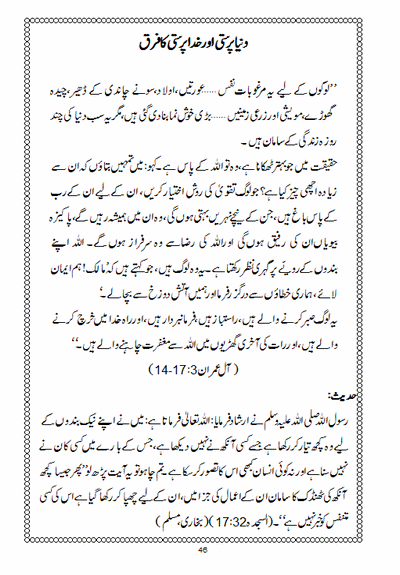
Dunya Parasti Aur Khuda Parasti
Preparing For The Day Of Judgment
Fear Allah and not do anything that earns His displeasure. Allah protects those who fear Him and makes Paradise their abode.
The sun will come nearer to the earth and nobody will escape its scorching heat. On that Day, there will be no tree to provide shade, no water to give some relief, and no rock beside which to take rest. The land will be flat. The Day of Judgment will be equivalent to 50,000 worldly years.
The level of the people’s sweat will be measured by their deeds. The sweat will cover some up to their anklebones, some to their knees, some to their hips, and others to their mouths.
Amidst this suffering, there are some among the believers whom Allah will provide with shade on the Day when there will no shade except that provided by Him. There are seven categories of people whom Allah will provide with shade. These include a just leader (Imam), a youth who grows up in the worship of Allah, a person whose heart is attached to the mosques, two people who like each other for the sake of Allah, a man who, when called by a beautiful woman of high social standing (for immoral acts), says, “I fear Allah”, one who gives alms and does not disclose it to anyone, and the one who remembered Allah privately and tears flowed from his eyes.
The Prophet (peace be upon him) said that deeds are driven by intention and that what a person gets depends upon his intention (niyyah). Allah commands a Muslim to do good deeds and keep away from committing sins and all that He has forbidden at all times. However, there is an emphasis on doing good deeds when a person becomes old especially when approaching the last days of life. The Prophet (peace be upon him) said, “The deeds are judged by the final deeds.” Therefore, whoever Allah grants success to do good deeds in the final days or hours of his life, then Allah has written a good end for him.
Whoever Allah does not grant success and does an evil deed in his final hour Allah’s wrath will be brought against him. Allah has commanded Muslims to seek a good end.
Whoever succeeds in having a good end, will be happy in the Hereafter, but whoever does an evil deed in the last hours of life, is at a loss in this world and in the Hereafter.
Pious believers are always keen to do good deeds prior to the final hour and they also seek to have a good end. They have good faith in Allah but bad faith in themselves.
Whoever has sincere and good faith in Allah, follows the teachings and Sunnah of the Prophet (peace be upon him) and the guidance of the Prophet’s companions is successful in having a good end because good intentions and sincerity are conditions for deeds to be accepted by Allah.
Means of securing a good end are performing the five obligatory prayers in congregation with the Muslims. Other deeds include belief (Iman), being God-conscious in private and in public, obeying Allah and keeping away from all that He has forbidden, keeping away from major and minor sins, following the teachings of the Prophet (peace be upon him), following the path of the Muhajireen and Ansar, keeping away from being unjust to others, being kind toward others and refraining from innovations in religion (bida’).
Food In Quran
[1:1] In the name of GOD, Most Gracious, Most Merciful
[16:115] He only prohibits for you dead animals, blood, the meat of pigs, and food which is dedicated to other than GOD. If one is forced (to eat these), without being deliberate or malicious, then GOD is Forgiver, Most Merciful.
The vegetarian diet is perfectly acceptable in the light of the Quran. Please review the following verses:
[5:4] They consult you concerning what is lawful for them; say, “Lawful for you are all good things, including what trained dogs and falcons catch for you.” You train them according to GOD’s teachings. You may eat what they catch for you, and mention GOD’s name thereupon. You shall observe GOD. GOD is most efficient in reckoning.
[5:5] Today, all good food is made lawful for you. The food of the people of the scripture is lawful for you. Also, you may marry the chaste women among the believers, as well as the chaste women among the followers of previous scripture, provided you pay them their due dowries. You shall maintain chastity, not committing adultery, nor taking secret lovers. Anyone who rejects faith, all his work will be in vain, and in the Hereafter, he will be with the losers.
[5:93] Those who believe and lead a righteous life bear no guilt by eating any food, so long as they observe the commandments, believe and lead a righteous life, then maintain their piety and faith, and continue to observe piety and righteousness. GOD loves the righteous.
[6:145] Say, “I do not find in the revelations given to me any food that is prohibited for any eater except (1) carrion, (2) running blood, (3) the meat of pigs, for it is contaminated, and (4) the meat of animals blasphemously dedicated to other than GOD.” If one is forced (to eat these), without being deliberate or malicious, then your Lord is Forgiver, Most Merciful.
[7:157] “(4) follow the messenger, the gentile prophet (Muhammad), whom they find written in their Torah and Gospel. He exhorts them to be righteous, enjoins them from evil, allows for them all good food, and prohibits that which is bad, and unloads the burdens and the shackles imposed upon them. Those who believe in him, respect him, support him, and follow the light that came with him are the successful ones.”
[10:24] The analogy of this worldly life is like this: we send down water from the sky to produce with it all kinds of plants from the earth and to provide food for the people and the animals. Then, just as the earth is perfectly adorned, and its people think that they are in control thereof, our judgment comes by night or by day, leaving it completely barren, as if nothing existed the previous day. We thus explain the revelations for people who reflect.
[16:115] He only prohibits for you dead animals, blood, the meat of pigs, and food which is dedicated to other than GOD. If one is forced (to eat these), without being deliberate or malicious, then GOD is Forgiver, Most Merciful.
[22:30] Those who reverence the rites decreed by GOD have deserved a good reward at their Lord. All livestock is made lawful for your food, except for those specifically prohibited for you. You shall avoid the abomination of idol worship, and avoid bearing false witness.
[23:18] We send down from the sky water, in exact measure, then we store it in the ground. Certainly, we can let it escape.
[23:19] With it, we produce for you orchards of date palms, grapes, all kinds of fruits, and various foods.
[23:20] Also, a tree native to Sinai produces oil, as well as relish for the eaters.
[23:21] And the livestock should provide you with a lesson. We let you drink (milk) from their bellies, you derive other benefits from them, and some of them you use for food.
Thank you and may God guide us,
M. Irtaza
Assalamu Alaikum, Not Just Words
Narrated Abu Huraira: The Prophet said, “When Allah created Adam, He said to him: `Go and greet that company of angels who are sitting there – and then listen to what they are going to say in reply to your greetings because that will be your greeting and your off-springs.’ Adam said to the angels: `As-Salamu `Alaikum.’ They replied: `As-Salamu `Alaikum wa Rahmatullah.’ Thus adding in reply to him: `wa Rahmatullah (and Mercy of Allah)’ to his greeting.’’ (Al-Bukhari)
All right, mate! What’s up! How are you? Good morning and afternoon are all famous greetings around the world. Different cultures, races, and communities say it in their own way and languages. Muslims, however, no matter from which country, race, or culture, greet each other in the same way all over the world. But have we ever stopped to think about the impact and beauty of what we utter? Hearts and bonds are strengthened every time we exchange this greeting.
This salutation was prescribed from the beginning of time as mentioned in the Hadith. The meaning translates: “May peace, mercy, and blessings of Allah be upon you.” By saying this, we are in fact making Du’a for our brothers and sisters and spreading love and peace simultaneously. Another benefit is that it ends enmity. We may see someone whom we don’t like, but by saying these words, our hearts may Insha Allah open up and allow friendship to sow its seeds.
The importance of this greeting is exemplified in a Hadith collected by Al-Bukhari and Muslims from Abdullah Bin Umar. A man asked the Messenger of Allah (peace be upon him): “What is the best thing in Islam?” He replied, “Feeding others and giving the greeting of Salam to those whom you know and those whom you do not know.”
The Prophet mentioned feeding someone and giving salaams together as the best things in Islam. We often lose sight of the simplest things that have great rewards.
Among the perfect attributes of Imaan – believing in the six articles of faith – is passing on salams.
The Messenger of Allah (peace be upon him) said: “By Him in Whose Hand is my soul, you will not enter Paradise until you believe, and you will not believe until you love one another. Should I not guide you to something which will install love amongst you? ‘Spread Salams amongst you.’” (Abu Dawood, vol. 3, no. 5174)
In today’s scenario, love and a stronger bond between Muslims is more than needed. Several people embrace Islam every day and many face hostility and are sometimes boycotted by their non-Muslim relatives as a result. It is upon us Muslims to welcome them. We are their kinsfolk.
By spreading salams we are obeying the Prophet (peace be upon him) as he told us that we should give salams to people we know and people we do not. Is this what we are doing? I’m afraid we are not. When walking down the street how many of us greet those who pass by?
Here are a few things to keep in mind next time we meet each other:
- Be the first to initiate the Salam.
- Greet Muslims whom you know and you don’t.
- Begin your conversation with the Salam.
- If someone tells us that so-and-so gave their Salaams to us, then reply, “Wa Alaika Wa Alayhis Salam.”
- A person riding a mount should greet the one who is walking; a person on foot should greet the one who is sitting; a smaller group should greet a larger group; and the young should greet their elders. (Al-Bukhari, vol. 8, book 74, no. 250-251)
- Whenever you enter a house, yours or others, enter by saying the Salam. (Qur’an, 24:61)
- Shake hands because it wipes out the (minor) sins. (Al-Tirmidhi)
Qayamat Ki Nishani
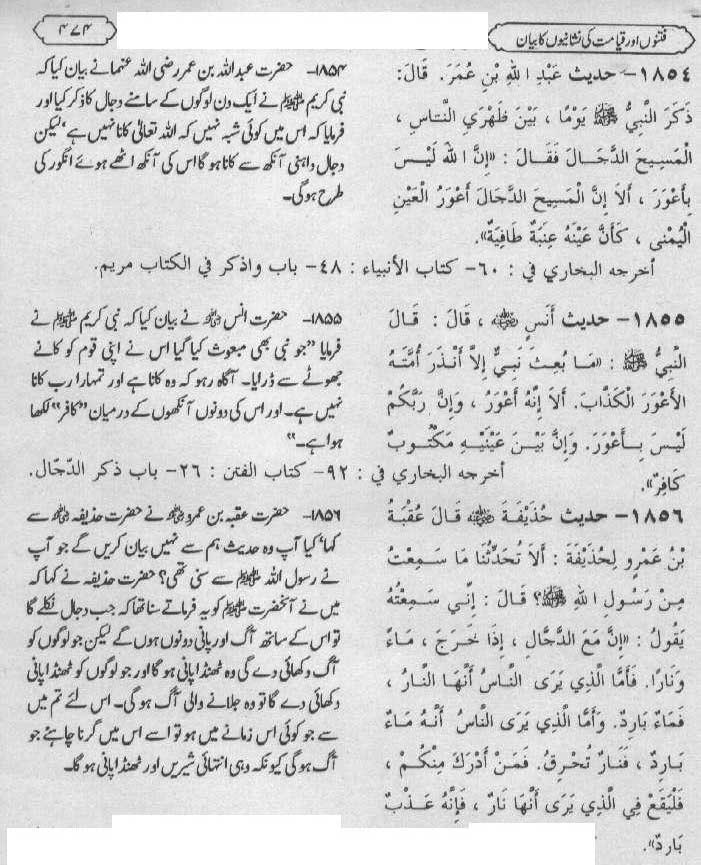
Qayamat Ki Nishani
Love For Prophet: The Sahabah Way
No matter how much we write about the Companions of the Prophet (peace be upon him), we cannot fairly describe their merits, virtues, and excellence.
The best of generations to ever live in this world, they were chosen by Allah to accompany His Last Messenger. They sacrificed their wealth, families, and lives defending and propagating the truth.
Embracing Islam and then being groomed by the Prophet (peace be upon him) transformed a community that came from the ruthless deserts into a fine people with exceptional character and behavior. The men who would bury their daughters alive turned into fathers who rejoiced at the birth of daughters and who took extra care in bringing them up.
The Ahadith that throw light on their lifestyles and virtues are plenty. One such aspect was their unconditional obedience to Allah and His Messenger. Faith was deeply ingrained in their hearts. They knew the Messenger did not instruct them except based on Allah’s revelation.
When Urwa Bin Mas’ud came to negotiate with the Prophet (peace be upon him) during the incident that’s popularly known as the Treaty of Hudaibiyah, he witnessed firsthand the attitude of the Companions towards Muhammad (peace be upon him). He went back to the Quraish and gave that powerful description:
“O, people! By Allah, I have been to the kings and to Caesar, Khosrau (Persian emperor) and An-Najashi, yet I have never seen any of them respected by his courtiers as much as Muhammad is respected by his companions. By Allah, if he spat, the spittle would fall in the hand of one of them (i.e. the Prophet’s companions) who would rub it on his face and skin; if he ordered them, they would carry out his order immediately; if he performed ablution, they would struggle to take the remaining water; and when they spoke, they would lower their voices and would not look at his face constantly out of respect.” (Al-Bukhari, 3/50, no. 891)
The Prophet (peace be upon him) did not establish a relationship between a master and disciples. The term Sahabah is not used without meaning. The Sahabah literally lived as the companions of Muhammad (peace be upon him).
When a stranger would come to Madina, he would not recognize the Prophet as if he was sitting in a group because there were no special seats for him, no elevated chairs that would distinguish him from others, and to be sure no special clothes indicating that he was in fact the ruler of Madina.
Despite this humility, the status of the Prophet (peace be upon him) did not diminish. The Companions gave the Prophet his due right and respect. As preceded, the kings of Romans and Persians were disobeyed and followed as the Prophet (peace be upon him) was.