

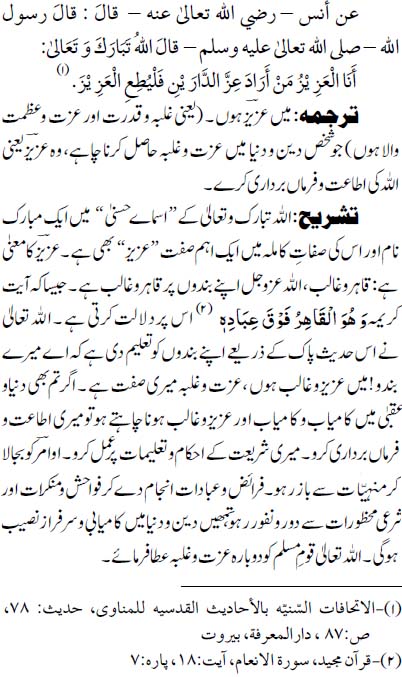
Hadith Qudsi: Allah, Aziz Aur Ghalib
Heroes Of Islam: Imam Shafi’i
Muhammad ibn Idris ibn al-‘Abbas, al-Imam al-Shafi’i, Abu ‘Abd Allah al-Shafi’i al-Hijazi al-Qurashi al-Hashimi al-Muttalibi (d. 204), the offspring of the House of the Prophet (PBUH- peace be upon him), the peerless one of the great mujtahid imams and jurisprudent, the scrupulously pious ascetic and Friend of Allah, he laid down the foundations of fiqh (Islamic Law) in his Risala, which he said he revised and re-read four hundred times, then said: “Only Allah’s Book is perfect and free from error.”
He is the cousin of the Prophet (PBUH) descending from al-Muttalib who is the brother of Hashim, ‘Abd al-Muttalib’s father. Someone praised the Banu Hashim in front of the Prophet (PBUH), whereby he interlaced the fingers of his two hands and said: “We and they are but one and the same thing.”
Al-Nawawi (may Allah be pleased with him) listed some special merits of al-Shafi’i:
1, his sharing the Prophet’s (PBUH) lineage at the level of their common ancestor ‘Abd Manaf;
2, his birth in the Holy Land of Palestine and
3, upbringing in Mecca;
5, and his education at the hands of superlative scholars together with his own intelligence and knowledge of the Arabic language. To this Ibn Hajar (may Allah be pleased with him) added: the hadith (the sayings/doings) of the Prophet (scholars ), “O Allah! Guide Quraysh, for the science of the scholar that comes from them, will encompass the earth. O Allah! You have let the first of them taste bitterness, so let the latter of them taste reward.” Another hadith of the Prophet (scholars ) says: “Truly, Allah shall send forth for this Community, at the onset of every hundred years, someone who will renew their Religion for them.” The scholars agreed, among them Abu Qilaba (d. 276) and Imam Ahmad, that the first narration signified al-Shafi’i, and the second signified ‘Umar ibn ‘Abd al-‘Aziz and then al-Shafi’i.
Imam Shafi’i was born in Ghazza or ‘Asqalan in 150, the year of Abu Hanifa’s (may Allah be pleased with him) death, and moved to Mecca at the age of two, following his father’s death, where he grew up. He was early a skillful archer, then he took to learning language and poetry until he gave himself to fiqh, beginning with hadith. He memorized the Quran at age seven, then Imam Malik’s Muwatta at age ten, at which time his teacher would deputize him to teach in his absence. At age thirteen he went to see Malik, who was impressed by his memory and intelligence.
Malik ibn Anas and Muhammad ibn al-Hasan al-Shaybani were among his most prominent teachers and he took position against both of them in fiqh. Al-Shafi’i said: “From Muhammad ibn al-Hasan I wrote a camel-load.” Al-Hakim narrated from ‘Abd Allah ibn ‘Abd al-Hakam: “Al-Shafi’i never ceased to speak according to Malik’s position and he would say: ‘We do not differ from him other than in the way of his companions,’ until some young men spoke unbecomingly at length behind his back, whereupon al-Shafi’i resolved to put his differences with Malik in writing. Otherwise, his whole life he would say, whenever asked something: ‘This is what the Teacher said’ – h’dha qawl al-ustadh – meaning Malik.”
Al-Muzani said: “I never saw one more handsome of face than al-Shafi’i. If he grasped his beard it would not exceed his fist.” Ibn Rahuyah described him in Mecca as wearing bright white clothes with an intensely black beard. Al-Za’farani said that when he was in Baghdad in the year 195 he dyed his beard with henna.
Abu ‘Ubayd al-Qasim ibn Sallam said: “If the intelligence of an entire nation was brought together he would have encompassed it.” Similarly, al-Muzani said: “I have been looking into al-Shafi’i’s Risala for fifty years, and I do not recall a single time I looked at it without learning some new benefit.”
Al-Sakhawi in the introduction to his al-Jawahir wa al-Durar and others narrates that someone criticized Ahmad ibn Hanbal (may Allah be pleased with him) for attending the fiqh sessions of al-Shafi’i and leaving the hadith sessions of Sufyan ibn ‘Uyayna. Ahmad replied: “Keep quiet! If you miss a hadith with a shorter chain you can find it elsewhere with a longer chain and it will not harm you. But if you do not have the reasoning of this man [al-Shafi’i], I fear you will never be able to find it elsewhere.” Ahmad is also related by his students Abu Talib and Humayd ibn Zanjuyah to say: “I never saw anyone adhere more to hadith than al-Shafi’i. No one preceded him in writing down the hadith in a book.” The meaning of this is that al-Shafi’i possessed the understanding of hadith after which Ahmad sought, as evidenced by the latter’s statement: “How rare is fiqh among the scholars of hadith!” This is a reference to the hadith: “It may be one carries understanding (fiqh) without being a person of understanding (faq’h).” Sufyan himself would defer to al-Shafi’i in matters of tafsir (commentary of the Quran) and fatwa (Islamic verdicts). Yunus ibn Abi Ya’la said: “Whenever al-Shafi’i went into tafsir, it was as if he had witnessed the revelation.” Ahmad ibn Hanbal also said: “Not one of the scholars of hadith touched an inkwell nor a pen except he owed a huge debt to al-Shafi’i.”
Al-Shafi’i was known for his peculiar strength in Arabic language, poetry, and philology. Bayhaqi narrated:
[From Ibn Hisham:] I was al-Shafi’i’s sitting companion for a long time, and I never heard him use except a word which, carefully considered, one would not find (in its context) a better word in the entire Arabic language. . . . Al-Shafi’i’s discourse, in relation to language, is a proof in itself.
[From al-Hasan ibn Muhammad al-Za’farani:] A group of bedouins used to frequent al-Shafi’i’s gathering with us and sit in a corner. One day I asked their leader: “You are not interested in scholarship; why do you keep coming to sit with us?” They said: “We come to hear al-Shafi’i’s language.”
In the introduction of his compendium of Shafi’i fiqh entitled al-Majmu’ al-Nawawi mentions that al-Shafi’i used a walking stick for which he was asked: “Why do you carry a stick when you are neither old nor ailing?” He replied: “To remember I am only a traveler in this world.”
Ibn e Hajash (RA) Aur Ibn e Saad (RA) ki Dua
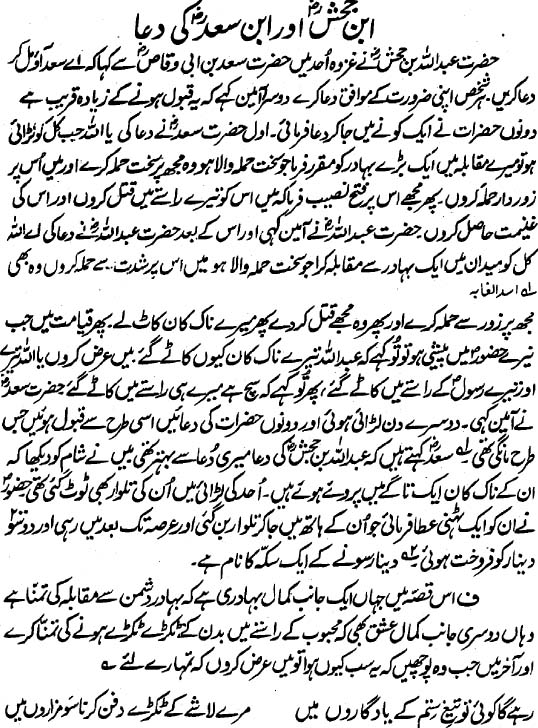
Ibne Hajash (RA) Aur Ibne Saad (RA) ki Dua
Who Are The People Of Regret?
Life as we know it can bring with it all sorts of grief, stress, and regret. At times, such stress is due to financial worries, other times it relates to health concerns, whilst at other times its anxiety is due to an enemy that awaits. The grief of this world is of many types and of varying degrees, however, no matter how serious stress becomes, you are very unlikely to see it causing a mother to “forget her baby”, or a “child to go grey” or for “people behaving as if they are drunk”.These descriptions are exclusive to only one specific day of stress and regret. That is the Day of Judgement.
Allah said, The Day you see it every nursing mother will be distracted from her nursling, and every pregnant woman will abort her pregnancy, and you will see the people appearing intoxicated although they are not intoxicated; but the punishment of Allah is severe.”[1]
A day so intense that it has been described as the day that will make children turn grey.”[2]
On this day of colossal stress and unimaginable fear, people– in their billions – will only be of two categories.
The first category
A group who feel safe, secure, and inexplicably at peace. These people singled out Allah in worship, they tackled every sin of theirs before death and lived a life of preparation for the Day of Allah’smeeting, thus Allah said about them,
أThose will have security…”[3]And He said, “TheGreatest Terror (the Day of Judgement) will not grieve them”[4]
The second category
They are the terrorized and regretful ones, who will be heard screaming out: “.. How great is our regret for not giving it thought!”[5]
A second group will be heard pleading as they lower their heads in shame, “Our Lord, we now see and we hear so return us so that we may do good, we are now certain!”[6]
And a third group will be heard screeching “O I wish that I was dust!”[7]
Regret is an incredibly powerful negative emotion that, at times, can become so extreme that, if not managed with iman, can make a person suicidal. In fact, the Harvard Newsletter tells a story of a man in Liverpool who always chose the same set of lottery numbers. However, one time when he forgot to renew his ticket, his numbers came up. This poor man was so full of self-blame and regret that he committed suicide. Similarly, there will be people who will wish for death on the Day of Judgement as one of its names is ‘Yawmul Hasra’ (The Day of Regret).
Allah said, “And warn them, O Muḥammad, of the Day of Regret…” [8]
The Prophet (sall Allahu ʿalayhi wa sallam) said, “There isn’t any person who enters Jannah except that they are first made to see their potential place in the hellfire had they failed so that they increase ingratitude, and there isn’t a person who enters the hellfire except that they are first made to see their potential place in paradise had they passed so that they are taken by regret.”[9]
What once seemed to be the greatest possible achievement in life will all of a sudden seem on that Day as a regretfully wasted opportunity, for what greater regret can there be in existence than missing out on Allah’s acceptance and the Paradise that it brings.
With this said, it is essential to realize that the Prophet(sall Allahu ʿalayhi wa sallam) has explicitly mentioned several matters that will bring about ‘Hasra’ (regret) on that long day. What follows are a few examples of these matters:
The regret of not giving Surat Al-Baqara due attention
When the rewards are distributed to those who had given this surah the focus it deserves, those who fell short will be in a major state of bitter regret. This is because the Prophet (sall Allahu ʿalayhi Wa Sallam) said, “ReciteSurat Al-Baqara, for taking care of it is a blessing, leaving it will be regret and the magicians are unable to overcome it.”[10]
Urs Mubarak
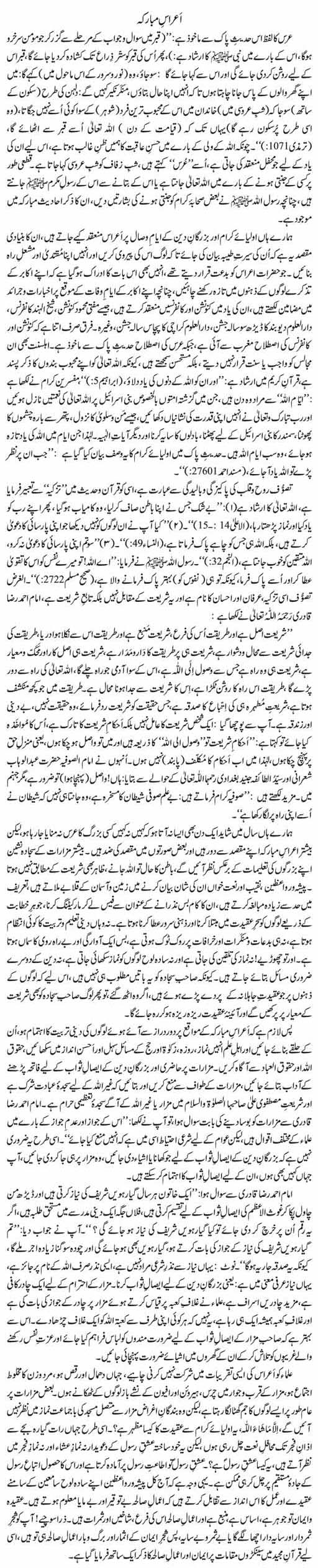
Urs Mubarak by Mufti Muneeb
Prophet Muhammad: A Perfect Management
Prophet Muhammad (peace be upon him) was a human being who was chosen by God to deliver His final message to mankind. As Islam is not merely a religious faith that governs only the relation between man and God, but rather a complete way of life that seeks to regulate all aspects of human life, the Prophet’s role gave him the leadership of the Muslim community in every respect. He was the religious, social, military, and political leader of all Muslims.
In other words, he combined both religious and secular leadership. In doing so, he set the regulation of people’s affairs at a new level, making clear that appropriate religious and moral values must govern all aspects of life.
Today, most people throughout the world suggest that religion should not interfere with politics or economics, or even social relations. When we look at what this means in practice we find that people accept that politicians lie, misrepresent facts and try to deceive others and their own population. Even in the most liberal democracies, people accept much of this as normal. The scandal of members’ expenses in the British Parliament is a clear example that self-interest is an acceptable justification for unethical behavior.
The Prophet laid the foundation of a system of management that showed great insight and looked at the interests of the community and ensured that friendly relations should prevail within it. Wherever a group of people needs to work together, either for themselves or for society, someone should be chosen as the head of the group. This would ensure that they would stick together and that their work would be mutually complementary and without duplication.
How many people should be in the group to need to have someone acting as its chief? The Prophet made this very clear. He said: “When three people travel together, they should appoint one of them as their head.” This will ensure that the group will have someone responsible for keeping them together so that none is left out at some point on the way because the others wanted to move on. If they face a problem on the way, they are in it together. Without someone taking this responsibility, any one of them facing a problem might find himself alone while the others move on.
The Prophet sent out many expeditions, some very small. Indeed one of them consisted of only eight people. Others included several hundred men. In all cases, he appointed a commander. He gave the commander clear instructions with regard to the treatment of his men and the mission they were undertaking. He set very high standards in the treatment of opponents. No plundering was allowed. No one should be fought except an enemy who is out to fight Muslims. Even with enemies, no religious person, elderly man, woman, or child should be killed in any circumstances.
What were the criteria the Prophet applied in choosing such commanders? The two basic criteria were ability and love. No one was given a command by the Prophet unless he had the qualities that make him able to handle the job in hand very efficiently. Moreover, he must be known to love his fellow Muslims, keen to ensure their welfare. He must also be acceptable to them. With regard to the first criterion, the Prophet said: “Whoever appoints someone as head of a group of ten people, knowing that among them there is a better one to lead them, betrays God, His messenger, and the Muslim community.” Even in worship, the leader must be acceptable to the congregation. The Prophet says: “Anyone who leads a congregation when they dislike him, his prayer does not go beyond his ears.” If prayer is unacceptable because the imam is disliked by the congregation, then this applies in an even greater measure to all situations.
– By Adil Salahi
Qayamat Kay Din Aamal Batane Ki Surtain
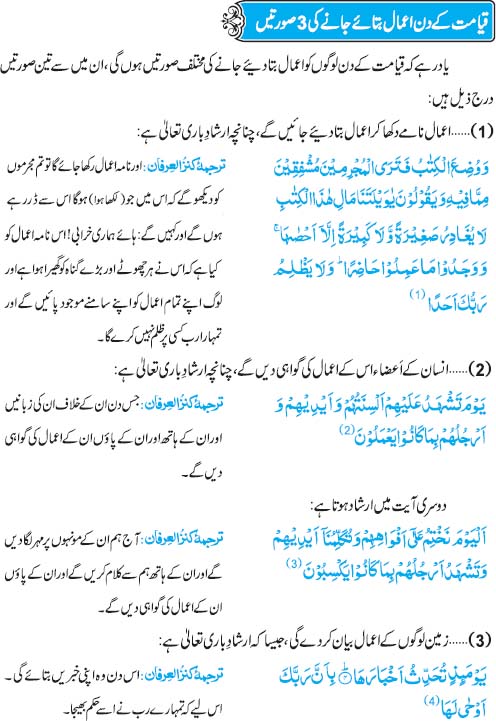
Qayamat Kay Din Aamal Batane Ki Surtain
Women’s Clothing In Salat
Aaisha (RA) has narrated that RasulAllah (SAW) stated: ‘A mature women’s prayer if performed without a large sheet is not accepted.’ (Abu Dawood, Tirmizi)
For the prayer to be correct there are certain conditions:
One such condition is that the face, the portion BELOW both ankles, and the fingers of both hands can be exposed. Apart from this, it is COMPULSORY (FARD) to cover all other parts of the body. Whether the women read in privacy or openly, these conditions are binding in both respects. At the time of RasulAllah (SAW), Muslim women would cover their bodies with a thick cloth whether in prayer or outside of this worship. (Sharee Hijab, p124)
Dear sisters, When you attend the Masjid please make sure that you are wearing the appropriate clothing that covers the body adequately according to the conditions set in Shariah.
- Women must cover their heads and hair completely with a large sheet/ scarf draped over the shoulders.
-
Women must wear a long loose fitting shirt with full-length sleeves (to cover the area over the wrist)
-
Women must wear a loose-fitting full-length lower garment reaching below the ankles. If you choose to wear a skirt, please ensure that it covers the legs and ankles completely to fulfill the conditions of Salat.
-
If sisters choose to wear clothing of their own choice, then, they are advised respectfully to adopt an Abaya or Burka to attend the Masjid and offer their prayers.
Mufti Yusuf Danka Al-Kauthar
Hadith Qudsi: Dua Ki Fazilat Aur Ahmiyat

Hadith Qudsi: Dua Ki Fazilat Aur Ahmiyat
The Importance Of Halal In Islam
Allah (SWT) says in Qur’an: “O you who believe! Eat of the lawful things that we have provided you with, and be grateful to Allah (SWT) If it is He whom you worship” (S2,v172)
“O Messengers! Eat of the Tayiyyibat (Halal foods) which Allah has made lawful (meat of eatable animals, milk products, fats, vegetables, fruits, etc.) and do righteous deeds” (S23,v51)
In both the ayats Allah (SWT) orders the Messengers and all Muslims to abstain from eating Haram food, in the same way, Halal food and pure things are emphasized for consumption while showing thanks (shukr) for this blessing. By eating Haram food bad characteristics are borne in an individual, the desire to perform good deeds disappears and du’aas are not accepted. By eating Halal food, nur (spiritual light) is created. This results in good characteristics and an attraction to do good deeds. A person starts to hate evil deeds. His du’aas are accepted.
- Abu Hurairah (RA) states: ‘For one of you to fill his mouth with the dirt of the earth is better for you than to put a morsel of Haram food in your mouth.’ (Al Kabair, Ahmed)
- Ibn Ka’b bin Ujra (ra) states that Rasulullah (saw) said: ‘That body will not enter Jannah which was nurtured by Haram substances.’ (Tirmidhi)
- Abu Hurairah (RA) states that Rasulullah (SAW) said: ‘A time will come upon the people that they will not care for that which is being taken/earned if it is from Halal or Haram sources.’ (Bukhari)
- Ibn Umar (RA) states that Rasulullah () ) said: ’Four characteristics are such that, if they are within a person, they are enough for him, (1) the care of trust in your possession, (2) to speak the truth, (3) good characteristics, (4) to care for Halal and Haram in eating and drinking. ‘ (Al Targib wal Tarhib)
Many people are such that in matters of eating and drinking they do not think about whether there is a Haram ingredient in the food, or whether the meat has been slaughtered according to Shari’ah or not, i.e. Halal. There are also people who take care of the food being Halal but do not care about the income they use to buy the food. Whether it is Haram or not, in both instances, it is not permissible and the food will be regarded as Haram. Some individuals open bank accounts to use the interest to assist the poor, but after a while, they forget the needy and use the interest for personal gain and enjoyment.
A trustworthy trader’s status in Islam
- Abu Said Al Khudri (ra) states that Rasulullah (SAW) said: ‘The merchant/trader who is completely honest & truthful in his trade will be with the Prophets, the Truthful and Martyrs on the Day of Qiyamah.’ (Tirmidhi)
- Ibn Masood (RA) states that Rasulullah (SAW) said: ‘The worry and striving to earn Halal is Compulsory (Fardh) after the major Fardh acts (salaat, saum, etc.) (Baihaqi)
- Umar (RA) said: ‘Do not give up earning from Halal sources, and do not say that Allah (SWT) provides an earning, for Allah (SWT) does not send gold and silver from the skies, he has the ability to do that, but Allah (SWT) has the habit of using different means to sustain his creation.’(Aksir hidayat)
- Abdullah bin Mubarak (rah) said: ‘ I prefer to return one dirham (silver coin) due to suspicion more than giving 100,000 dirhams in Sadaqah.’ (Al Kabair)
My dearest friends! Everyone has to die and will be placed in their own grave. We should be ashamed that we say ‘The time is such that we can’t differentiate between Halal/Haram’. May Allah (SWT) save us from that. Eating Haram food will cause immodesty, shamelessness, and disregard for the laws of Allah (SWT). If children are nurtured with Haram food, they will be rebellious and have the worst of characteristics. It is plainly evident that from purity comes good and from dirt comes evil.
My Brothers and Sisters! Let us think about whether our earnings are Halal or Haram, and let us ensure that we eat only Halal food. May Allah (SWT) grant us the means to live according to His orders and attain His pleasure. Aameen.
Mufti Yusuf Danka