

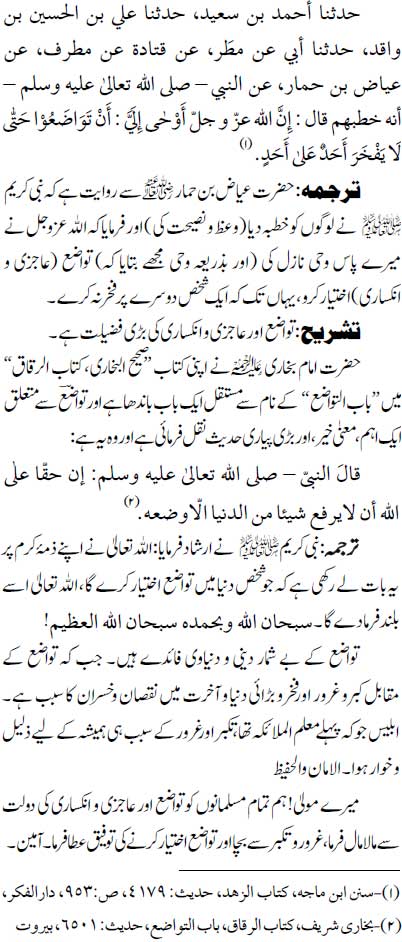
Hadith Qudsi: Tawaza (Aajzi Aur Inkisari)
Gains Pleasure Of Allah By The Anger Of People
You Cannot Please Everyone. A man said to al-Hasan al-Basree (rahimahullaah): ‘The people sit around you so that they may find fault with you!’ So he said, ‘Indeed, I encouraged my soul to aspire for Paradise so it aspired for it. Then I encouraged it to aspire for salvation from Hellfire and so it aspired for it. Then I encouraged it to aspire for salvation from the people, but I didn’t find a way to do that. Indeed the people were not pleased with their Creator although He provides for them, so how can they be pleased with another creation like themselves?’ [1].
Prophet Moosaa (’alayhis salaam) said:- ‘O my Lord, the people say things about me which are not (i.e. not true)! So Allah`(azza wa jall!’) revealed to him:- ‘O Moosaa, I did not make that (privilege) for Myself, so how can I make it the case for you?’ [2]
Maalik bin Dinaar:- ‘Since I have known the reality of people, I have not taken delight in their praise nor have I hated their criticism.’ It was said to him, ‘Why is that?’
He said, ‘The one who praises from amongst them is excessive and the critic from amongst them exaggerates! ” [3]
‘Aisha (radiyallaahu `anha) wrote to Mu’aawiyah (radiyallaahu` anhu): ‘Salamun ‘alayk. Amma ba’d. I have heard the Messenger of Allah (sallallaahu `alayhi wa sallam) say:- ‘Whoever gains the Pleasure of Allah by the anger of the people (i.e. thereby gains their anger)
Allah suffices him of the people’s troubles. ‘ And whoever gains the pleasure of the people by the Anger of Allah (i.e. in the process he gains His Anger), then Allah leaves him to the people.’ Wa-Salaamu ‘alayk.’ [4]
Imam ash-Shaafi’ee: ‘There is nobody except that he has someone who loves him and someone who hates him. So if that’s the case, let a person be with the people who are obedient to Allah `azza wa jall!’ ( – as they love and hate for the Sake of Allah and they are not unjust) [5]
References:-
[1] Al-Bidayah wal-Nihayah (9/318 )
[2] Al-Adaab al-Shar’iyyah by Ibn Muflih (1/38 )
[3] Tarikh Dimishq (59/307)
[4] Reported by al-Tirmidhi in Kitab al-Zuhd (no. 2414), declared Saheeh by al-Albaanee
[5] Hilyat al-Awliyah (9/124)
Shaitan Ka Galba Ki Aik Alamat

Shaitan Ka Galba Ki Aik Alamat
Defining Good Deeds
Good deeds can be described as follows:
1. It should be common knowledge for everyone that our first duty is to Allah, our Creator, Sustainer, and Cherisher. We will not be rendering our duties towards Him in full measure unless we carry out His orders. Thus, it should be a top priority for us to do what Allah has clearly instituted for us as pillars and mandatory duties in our religion, such as Prayer, zakah, fasting, Hajj, and so on.
2. While doing the bidding of Allah, it is equally important for us to stay away from all the things that He has clearly forbidden for us. This includes all the major sins and prohibitions such as shirk, displeasing our parents, murder, adultery, giving or consuming usury, and unlawful business practices.
3. Next comes doing as much good as possible. The Prophet (peace and blessings be upon him) said, “Humans need to do acts of charity or compassion every day that the sun comes up in the sky.” He then added, “It is charity to guide someone who is lost, to give a ride to someone who is stranded; to build something beneficial or help someone who is building.” He also said, “A good word is also an act of charity.” When someone asked, what if a person cannot do any of the good things, he replied, “Then at least he should refrain from harming others; that is a charity he would be rendering towards himself.”
So let us lookout for opportunities for good works; there is no shortage of them if we look around. By doing so, we can rest assured that we will have a good time in our graves as well as in life beyond.
Ikhlaq e Hasna Momin Ka Sarmaya-e-Hayat
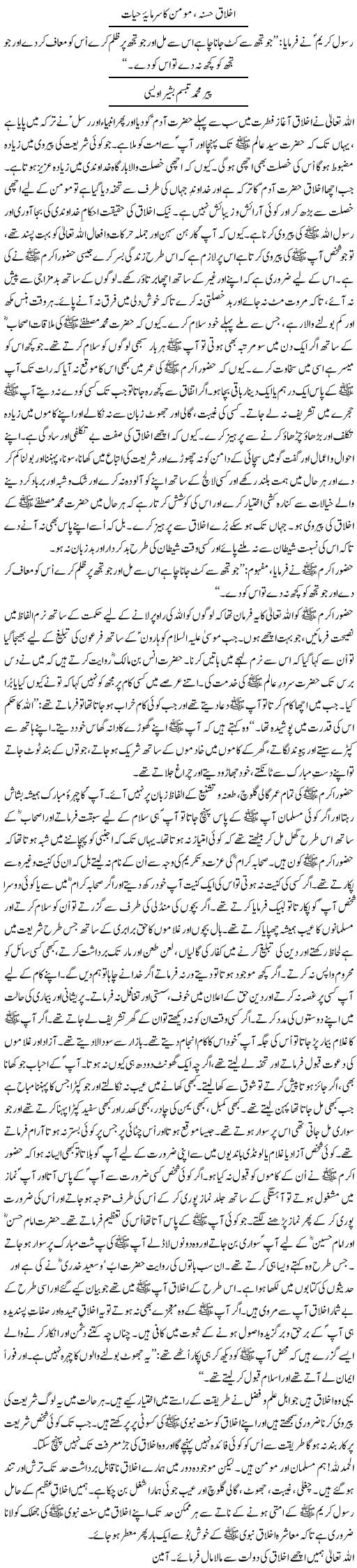
Ikhlaq e Hasna Momin Ka Sarmaya-e-Hayat
Dua And Our Own Good Deeds
[005:041] O Messenger (Muhammad [sal-Allâhu ‘alayhi wa sallam])! Let not those who hurry to fall into disbelief grieve you, of such who say: “We believe” with their mouths but their hearts have no Faith. And of the Jews are men who listen much and eagerly to lies – listen to others who have not come to you. They change the words from their places; they say, “If you are given this, take it, but if you are not given this, then beware!” And whomsoever Allah wants to put in Al-Fitnah (error, because of his rejecting of Faith), you can do nothing for him against Allah. Those are the ones whose hearts Allah does not want to purify (from disbelief and hypocrisy); for them, there is a disgrace in this world, and in the Hereafter a great torment.
Abu Bakrah (May Allah be pleased with him) reported: The Messenger of Allah (PBUH) said, “Shall I not inform you of one of the gravest of the cardinal sins?” We said: “Yes, O Messenger of Allah!” He (PBUH) said, “To join others as partners with Allah in worship and to be undutiful to one’s parents.” The Messenger of Allah (PBUH) sat up from his reclining position (in order to stress the importance of what he was going to say) and added, “I warn you that making a false statement and giving false testimony. I warn you against making a false statement and giving false testimony.” The Messenger of Allah (PBUH) kept on repeating this (warning) till we wished he should stop.[Al-Bukhari and Muslim]
Commentary: The contents of this Hadith make the gravity of making a false statement abundantly clear. How unfortunate indeed it is that, like other major sins, the evil of giving false testimony is very common among present-day Muslims. May Allah prevent us from it.
Narrated Abu Huraira (Radi-Allahu ‘anhu): Allah’s Apostle (Sallallahu ‘Alaihi Wa Sallam) said, “(The performance of) ‘Umra is an expiation for the sins committed (between it and the previous one). And the reward of Hajj Mabrur (the one accepted by Allah) is nothing except Paradise.” Bukhari Vol. 3 : No. 1
Abud-Darda (May Allah be pleased with him) said: The Prophet (PBUH) said, “He who defends the honor of his (Muslim) brother, Allah will secure his face against the Fire on the Day of Resurrection.”[At-Tirmidhi].
Commentary: If someone says something disgraceful against a Muslim, one must defend his Muslim brother (or sister, for that matter) and say that what has been stated about him or she is wrong and that he (or she) is free from the accusation made against him (or her).
Abdullah bin ‘Umar bin Al-Khattab (May Allah be pleased with them) narrated that: He heard the Messenger of Allah (ﷺ) saying: “Three men, amongst those who came before you, set out until night came and they reached a cave, so they entered it. A rock fell down from the mountain and blocked the entrance of the cave. They said: ‘Nothing will save you from this unless you supplicate to Allah by virtue of a righteous deed you have done.’
Thereupon, one of them said: ‘O Allah! I had parents who were old, and I used to offer them milk before any of my children or slaves. One day, I went far away in search of grazing and could not come back until they had slept. When I milked as usual and brought the drink I found them both asleep. I hated to disturb them and also disliked giving milk to my children before them. My children were crying out of hunger at my feet but I awaited with the bowl in my hand for them to wake up. When they awoke at dawn, they drank milk. O Allah! If I did so to seek Your Pleasure, then deliver us from the distress caused by the rock’. The rock moved slightly but they were unable to escape.
The next said: ‘O Allah! I had a cousin whom I loved more than anyone else (in another version he said: as a man can love a woman). I wanted to have sexual intercourse with her but she refused. Hard pressed in a year of famine, she approached me. I gave her one hundred and twenty dinars on condition that she would yield herself to me. She agreed and when we got together (for sexual intercourse), she said: Fear Allah and do not break the seal unlawfully. I moved away from her in spite of the fact that I loved her most passionately, and I let her keep the money I had given her. O Allah! If I did that to seek Your Pleasure, then, remove the distress in which we are.’ The rock moved aside a bit further but they were still unable to get out.
The third one said: ‘O Allah! I hired some labourers and paid them their wages except one of them departed without taking his due. I invested his money in business and the business prospered greatly. After a long time, he came to me and said: O slave of Allah! Pay me my dues. I said: All that you see is yours – camels, cattle, goats, and slaves. He said: O slave of Allah! Do not mock me. I assured him that I was not joking. So he took all the things and went away. He spared nothing. O Allah! If I did so seeking Your Pleasure, then relieve us of our distress.’ The rock slipped aside and they got out walking freely”. [Al-Bukhari and Muslim].
Hadith Qudsi: Gunahon Ko Bakhshne Wala

Hadith Qudsi: Gunahon Ko Bakhshne Wala
Hazrath Uways Al-Qarni (Radiallahu Anhu) And His Mother
The great Saint Uways of Qaran! Was presented the blessed cloak of Rasulullah (Salla’llahu’alaihi wa sallam) on the Holy Prophet (salla’ llaahu’alaihi wa sallam)’s instruction. It is preserved in Istanbul, Turkey. He reached his Spiritual status due to obedience to his mother.
Uways (Radiallahu anhu) was from the village of Qaran, in Yemen. He had asked his mother’s permission to visit Allah’s Messenger, and she said: “You have my permission to go, see him once, and come straight back. If the Messenger is at home, you may meet with him; if not, come straight back here.” Uways made a journey of three months on foot, from Yemen to Madinah the Illuminated. When he reached Rasulullah (Salla’llahu’alaihi wa sallam) ‘s house, he knocked on the door and Hazrath Aisha (Radiallahu anha), wife of the Chosen Prophet and Mother of the Believers opened the door. She told him that Rasulullah (Salla’llahu’alaihi wa sallam) was in the Masjid.
Uways (Radiallahu anhu) remembered his promise to his mother and replied: “Please convey my salaams to my Beloved Rasulullah (Salla’llahu’alaihi wa sallam). Kindly inform him that Uways came from Yemen, did not find him at home, and is returning to Yemen since he does not have permission from his mother to meet him in the mosque.”
When the Rasul (Salla’llahu’alaihi wa sallam) came home from the mosque, he found the radiance of Uways in his house. Hazrath Aisha (Radiallahu anha) told him what had happened, and conveyed Uways’s salutations. His blessed eyes looked towards Yemen and the blessed Prophet said: “The fragrance of our friend is reaching us.” The noble Companions asked: “If Uways is your friend, why did he not stay to see you?” Rasulullah (Salla’llahu’alaihi wa sallam) replied: “He complied with a promise given to his mother and he is serving her.”
The Holy Prophet (salla’ llaahu’alaihi wa sallam) said “Uways will come back to Madinah the Illuminated, to meet me, but we will not meet physically, for I shall then be united with my Lord ”
Rasulullah (Salla’llahu’alaihi wa sallam) said that when Uways (Radiallahu anhu) came back to Madinah he was to be given his cloak, and asked to pray for the Community of Muhammad (Salla’llahu’alaihi wa sallam). He also mentioned that a light was visible on one of Uways’s hands.
During Hazrath Umar (Radiallahu anhu) ‘s Caliphate, a number of Yemenis visited Madinah the Illuminated, and Hazrath Ali and Umar (Radiallahu anhu ajmain) approached them and enquired about the Saint, Uways (Radiallahu anhu), from the village of Qaran. The Yemenis said they knew of no such saint, but they did point out that a camel herd from that village, who seldom mixed with other people, preferred to spend his time in worship, alone among the camels. Hazrath Ali and Umar (Radiallahu anhu ajmain) then approached Hazrath Uways (Radiallahu anhu), greeted him, conveyed the greetings of the Messenger, and presented him with his blessed cloak. But he was reluctant to accept. “Surely there is some mistake!” he exclaimed, in his desire to hide himself. Seeing the light upon his hand, they cried: “You are the saint described to us by Allah’s Messenger, for he told us about the light on your hand.” They also reported to him the wish of the blessed Messenger that he should pray for the Community of Muhammad.
Hazrath Uways (Radiallahu anhu) rubbed the blessed cloak over his face and eyes and kissed it. Then he asked to be left alone. When he was alone he held the cloak and began to pray: “O Allah this cloak is the cloak of Your beloved Messenger. He has presented it to me, but I refuse to wear it unless You pardon the Community of Muhammad (Salla’llahu’alaihi wa sallam) .” He then repeated his prayer in exactly the exact words. As he was about to repeat his prayer a third time, Hazrath Ali and Umar (Radiallahu anhu ajmain) came beside him. He cried: “Oh, you came too soon!
As with people in every age, the Yemenis were unaware of the presence in their midst of such a saint, whose prayers were accepted. They imagined him to be an ordinary camel herd. The Friends of Allah, do not seek fame, and as such hide themselves away from other people.
Those who serve their mothers with love will be resurrected with Hazrath Uways (Radiallahu anhu). Those good to their parents will be happy in this world and the Hereafter.
Ilm Aur Ulma Kay Fazail
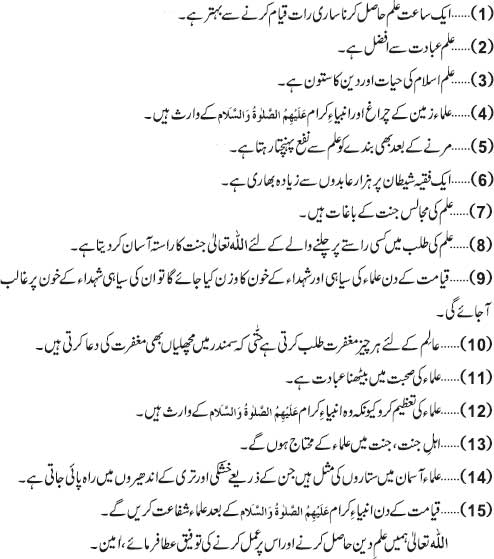
Ilm Aur Ulma Kay Fazail
Importance Of Marriage In Islam
Allah has created men and women as company for one another, and so that they can procreate and live in peace and tranquillity according to the commandments of Allah and the directions of His Messenger. The Quran says: “And among His signs is this that He created for you mates from among yourselves, that you may dwell in tranquillity with them, and He has put love and mercy between your hearts. Undoubtedly in these are signs for those who reflect.” (30:21)
“And Allah has made for you your mates of your own nature, and made for you, out of them, sons and daughters and grandchildren, and provided for you sustenance of the best. “(16:72)
These verses of the Noble Quran clearly show that in contrast to other religions like Christianity, Buddhism, Judaism, etc. which consider celibacy or monasticism as a great virtue and a means of salvation, Islam considers marriage as one of the most virtuous and approved institutions. The Messenger of Allah (peace be upon him) declared, “There is no monasticism in Islam.” He further ordained, “O you young men! Whoever is able to marry should marry, for that will help him to lower his gaze and guard his modesty.” (Al-Bukhari)
The Prophet regarded modesty as a great virtue. He said, “Modesty is part of faith.” (Al-Bukhari) The importance of the institution or marriage receives its greatest emphasis from the following hadith of the Prophet, “Marriage is my Sunnah. Whosoever keeps away from it is not from me.”
With these Quranic injunctions and guidance from the Prophet (peace be upon him) in mind, we shall examine the institution of marriage in the Shari’ah. The word zawaj is used in the Quran to signify a pair or a mate. But in common parlance, it stands for marriage. Since the family is the nucleus of Islamic society, and marriage is the only way to bring families into existence, the Prophet (peace be upon him) insisted upon his followers entering into marriage. The Shari’ah prescribes rules to regulate the functioning of the family so that both spouses can live together in love, security, and tranquillity. Marriage in Islam has aspects of both ‘Ibadah (worship) of Allah and Mu’amalah (transactions between human beings). In its ‘Ibadah aspect, marriage is an act pleasing to Allah because it is in accordance with his commandments that husband and wife love each other and help each other to make efforts to continue the human race and rear and nurse their children to become true servants of Allah.
In its mu’amalah aspect, marriage is a lawful response to the basic biological instinct to have sexual intercourse and to procreate children. The Shari’ah has prescribed detailed rules for translating this response into a living human institution reinforced by a whole framework of legally enforceable rights and duties, not only of the spouses, but also of their offspring. These aspects are beautifully explained in a tradition of the Prophet. It is narrated by Anas that the Messenger of Allah (peace be upon him) said, “When a man marries, he has fulfilled half of his religion, so let him fear Allah regarding the remaining half.”
The Prophet considered marriage for a Muslim as half of his religion because it shields him from promiscuity, adultery, fornication, homosexuality, etc., which ultimately lead to many other evils like slander, quarreling, homicide, loss of property, and disintegration of the family. According to the Prophet (peace be upon him), the remaining half of the faith can be saved by taqwa.
Conditions of Marriage
Careful consideration of the Quranic injunctions and the traditions of the Prophet (peace be upon him) clearly show that marriage is compulsory (wajib) for a man who has the means to easily pay the mahr (dowry) and to support a wife and children and is healthy. Also if he fears that if he does not marry, he may be tempted to commit fornication (zina). It is also compulsory for a woman who has no other means of maintaining herself and fears that her sexual urge may push her into fornication. But even a person who has a strong will to control his sexual desire, who has no wish to have children, and who feels that marriage will keep him away from his devotion to Allah, it is commendable (mandub). However, according to the Maliki school, under certain conditions it is obligatory (fard) for a Muslim to marry even if he is not in a position to earn his living:
If he fears that by not marrying he will commit fornication (zina).
If he is unable to fast to control his passions or his fasting does not help him to refrain from Zina.
Even if he is unable to find a slave girl or a destitute girl to marry.
However, some jurists suggest that if a man cannot procure a lawful livelihood, he must not marry because if he marries without any hope of getting lawful bread, he may commit theft, and in order to avoid one evil (his passions) he may become the victim of another (theft). The Hanafi school considers marriage as obligatory (fard) for a man:
If he is sure that he will commit Zina if he does not marry.
If he cannot fast to control his passion or even if he can fast, his fast does not help him to control his passion.
If he cannot get a slave girl to marry.
If he is able to pay the dowry (mahr) and earn a lawful livelihood.
Marriage is forbidden (haram) to a man, according to the Hanafi School, if he does not possess the means to maintain his wife and children or if he suffers from an illness, serious enough to affect his wife and progeny. It is not desirable (makruh) for a man who possesses no sexual desire at all or who has no love for children or who is sure to be slackened in his religious obligations as a result of marriage. In a beautiful tradition the Prophet (peace be upon him) has given the most important point that should weigh with every Muslim in selecting his bride:
“Whoever marries a woman solely for her power and position, Allah will only increase him in humiliation. Whoever marries a woman solely for her wealth, Allah will only increase in poverty. Whoever marries a woman because of her beauty, Allah will only increase in ugliness. But whoever marries a woman in order that he may restrain his eyes, observe cautiousness, and treat his relations kindly, Allah puts a blessing in her for him and in him for her.”
In order that problems should not arise after marriage the Prophet (peace be upon him) recommended that, in the selection of his bride, a man should see her before betrothal lest blindness of choice or an error of judgment should defeat the very purpose of marriage. But this “seeing” is not to be taken as a substitute for the “courtship” of the West. The man should not gaze passionately at his bride-to-be but only have a critical look at her face and hands to acquaint himself with her personality and beauty. However, if a man so desires, he may appoint a woman to go and interview the proposed bride, so that she may fully describe the type of girl she is. Since believing men and women are referred to in the Quran, a woman also has the right to look at her potential husband. The special permission for men and women to see each other with a view to matrimony does not contravene the code of conduct for believing men and women to lower their gaze and be modest which is laid down in the Holy Quran.
Ijbar: A Safety Valve
The consent of both the man and the woman is an essential element of marriage, and the Quran gives women a substantial role in choosing their own life partners. It lies down: “Do not prevent them from marrying their husbands when they agree between themselves in a lawful manner.” (2: 232)
However, Imam Malik, one of the four great Imams of the Sunni schools of Islamic jurisprudence gives a slightly restrictive interpretation to this verse. He makes the choice of partner by a Muslim girl subject to the over-ruling power or Ijbar of her father or guardian in the interests of the girl herself. It may sometimes happen that in her immaturity or over-zealousness, a girl may want to marry a man about whom she has distorted information or who does not possess good character, or who lacks proper means of livelihood. In such a case, it is better, or rather incumbent upon the girl’s father or guardian, that, in the wider interests of the girl, he restrains her from marrying such a worthless man and finds a suitable person to be her husband. Generally speaking, such marriages arranged by fathers and guardians work better than a marriage brought about through Western courtship.
The case of Abu Juham bin Hudhaifah and Mu’awiyah ibn Abu Sufyan is relevant here. They proposed marriage to Fatimah bint Ghaith. The Prophet (peace be upon him) advised Fatimah not to marry either of them on the grounds that Mu’awiyah was then a pauper and Abu Juham was cruel and harsh. So she married Usamah.
The Free Consent of the Parties
The Quran (4:21) refers to marriage as a mithaq, i.e. a solemn covenant or agreement between husband and wife, and enjoins that it be put down in writing. Since no agreement can be reached between the parties unless they give their consent to it, marriage can be contracted only with the free consent of the two parties. The Prophet (peace be upon him) said, “The widow and the divorced woman shall not be married until their order is obtained, and the virgin shall not be married until her consent is obtained.” (Al-Bukhari)
This aspect is greatly emphasized by Imam Bukhari. He, in fact, gave one of the chapters in his Sahih the significant title: “When a man gives his daughter in marriage and she dislikes it, the marriage shall be annulled.” Once a virgin girl came to the Prophet (peace be upon him) and said that her father had married her to a man against her wishes. The Prophet gave her the right to repudiate the marriage. (Abu Dawud).
Divorced women are also given the freedom to contract a second marriage. The Holy Quran says, “And when you divorce women, and they have come to the end of their waiting period, hinder them not from marrying other men if they have agreed with each other in a fair manner. “(2: 232)
With regard to widows, the Quran says, “And if any of you die and leave behind wives, they bequeath thereby
to their widows (the right to) one year’s maintenance without their being obliged to leave (their husband’s home), but if they leave (the residence) of their own accord, there is no blame on you for what they do with themselves in a lawful manner.” (2:234)
Thus widows are also at liberty to re-marry, even within the period mentioned above; and if they do so they must forgo their claim to traditional maintenance during the remainder of the year. However, it must be remembered that the power of Ijbar given to a father or the guardian by the Maliki school over their selection of life partner obtains in all the situations considered above, namely, whether the daughter or the ward is a virgin or divorcee, or widow.
Prohibited Marriage Partners
Under the Shari’ah, marriages between men and women standing in a certain relationship with one another are prohibited. These prohibited degrees are either of a permanent nature or a temporary one. The permanently prohibited degrees of marriage are laid down in the Holy Quran: “And marry not those women whom your fathers married, except what has already happened (of that nature) in the past. Lo! It was ever lewdness and abomination, and an evil way. Forbidden unto you are your mothers and your daughters, and your sisters and your father’s sisters and your mother’s sisters, and your brother’s daughters and your sister’s daughters, and your foster mothers and your foster sisters, and your mothers-in-law and your step-daughters who are under your mother-in-law and your step-daughters who are under your protection (born) of your women unto whom you have gone into — but if you have not gone into them, then it is no sin for you (to marry their daughters) — and the wives of your sons from your own loins, and that you should have two sisters together, except what has already happened (of that nature) in the past. Allah is ever- Forgiving, Merciful.” (4:22 – 24)
From the above verses, it is clear that a Muslim must never marry the following:
- His mother
- His step-mother (this practice continues in Yoruba land in Nigeria, where in some cases the eldest son inherits the youngest wife of his father)
- His grandmother (including his father’s and mother’s mothers and all preceding mothers e.g. great grandmothers)
- His daughter (including granddaughters and beyond)
- His sister (whether full, consanguine, or uterine)
- His father’s sisters (including paternal grandfather’s sisters)
- His mother’s sisters (including his maternal grandmother’s sisters)
- His brother’s daughters
- His foster mother
- His foster mother’s sister
- His sister’s daughter
- His foster sister
- His wife’s mother
- His step-daughter (i.e. the daughter of a former husband of a woman he has married if the marriage has been consummated. However, if such a marriage was not consummated, there is no prohibition)
- His real son’s wife
A great wisdom lies behind these prohibitions on the grounds of consanguinity, affinity, and fosterage. No social cohesion can exist if people do not keep these prohibitions in their minds while contracting marriages. Temporary prohibitions are those that arise only on account of certain special circumstances in which the parties are placed. If the circumstances change, the prohibition also disappears. They are as follows:
- A man must not have two sisters as wives at the same time nor can he marry a girl and her aunt at the same time.
- A man must not marry a woman who is already married. However, this impediment is removed immediately after the marriage is dissolved either by the death of her former husband or by divorce followed by the completion of the period of ‘iddah (retreat).
- A man must not have more than four wives at one time. This impediment is, of course, removed as soon as one of the wives dies or is divorced.
- A man must not marry a woman during her ‘iddah`.
Regarding this last prohibition, the Quran expects Muslims to act with the utmost propriety and righteousness. It lies down: “…but do not make a secret contract with them except in honorable terms, nor resolve on the tie of marriage till the term prescribed is fulfilled.” (2:235)
This means that a man must not make a specific proposal for marriage to a woman during the time of her ‘Iddah` after the death of her husband or an irrevocable divorce. However, he can send a message saying, for instance, “I wish to find a woman of good character”. But if a woman is in the ‘Iddah` of a divorce which is revocable where raja’ (return) is possible, a man must not send her even an implied invitation to marry her, because she is still considered the lawful wife of the first husband. In fact, this restriction is most beneficial because it prevents a man from becoming an instrument of breaking up a family where there are still chances of reconciliation between the wife and husband even though they are moving away from each other.
Two Suitors Seeking to Marry the Same Girl
The Prophet (peace be upon him) disapproved of two persons competing with one another to secure marriage with the same girl. This is because such a situation is likely to develop bitter enmity between two Muslim brothers. The Prophet said, “A believer is a brother of a believer. Hence it is not lawful for him to bargain upon the bargain of a brother, nor propose for (the hand of a girl) after the marriage proposal of his brother until the latter (voluntarily) withdraws the proposal.”
Imam Abu Hanifa, Imam Shafi’i, and Imam Malik, all hold the view that it is a sin to put a proposal of marriage against the proposal of another Muslim brother. However, if a marriage is contracted in this wrongful way it will be sufficient if the second suitor who was successful seeks the forgiveness of the first suitor and of Allah. But Imam Dhahiri considers such a marriage void. It is respectfully submitted that the former view is more rational and sound.