
Now Before Any Change in Us Can Take Place,
We Need To Reexamine Our Outlook On Prayer.
Ask Yourself:–
Why Do I Pray?
Is it Just Because I Have T?
Is it Just To Get This Daily Duty Out Of The Way And Over With?
Or May Be it is Because Everyone Just Does it So I Do it Too?
It’s Time To Make A Change.
We Need To Start Praying Out Of Sincere Love.
Pray Out Of Longing To Be With The One You Love.
Pray.. For The Peace And Comfort That Comes From Being With The One, You Love.
There Are 3 Reasons Which Make You Love Someone :
1. Either Because That Someone is Beautiful!
2. Or Because Someone Always Deals Kindly With You
3. Or Because That Someone Has Done Many Favors For You…..
Think Of Allah Now.
He is All Of The Above And More,
isn’t He?
Doesn’t He Then Deserve To Be The Most Worthy Of Our Love Over Everything And Anyone Else?
To Truly Love Allah is To Truly Taste The Greatest Love in Existence!
It is To Truly Taste The Beauty Of Faith
TAG: Allah
Inna Lillahi wa inna ilayhi Raji un
The Ayah and its Meaning
Inna Lillahi wa inna ilayhi Raji un
Truly, to Allah, we belong, and truly, to Him, we shall return.
[Noble Quran 2:156]
The translation of the verses mentioned before and after this ayah is:
And certainly, We shall test you with something of fear, hunger, loss of wealth, lives, and fruits, but give glad tidings to As-Sabirin (the patient). [Noble Quran 2:155]
Who, when afflicted with calamity, say: “Truly, to Allah we belong and truly, to Him we shall return.” [Noble Quran 2:156]
They are those on whom are the Salawat (i.e, who are blessed and will be forgiven) from their Lord, and (they are those who) receive His mercy, and it is they who are the guided ones.
[Noble Quran 2:157]
When do we recite this Ayah?
A prevalent perception in our society is that the words Inna Lillahi wa inna ilayhi Raji un are only recited at the time of someone’s death. However, this perception is not correct.
This ayah is to be said in cases where a person has suffered any kind of loss, be it the death of a person (Muslim or non-Muslim) or any living creature, loss of wealth or property, deterioration of health, etc.
There is one Hadith where the Prophet (peace and blessings be upon him) is quoted to have said “Inna Lillahi wa inna ilayhi Raji un” when the lamp went off at night.
Ayesha (May Allah be pleased with her) asked him, “O Messenger of Allah. Is this also a calamity?”
Allahs Messenger replied, “Yes. Whatever hurts or causes difficulty to a Muslim is a calamity and on bearing it patiently, it carries Allah’s promise of reward.”
The Virtues of reciting the Ayah
As mentioned before, Allah asks us to be those who are patient [As-Sabirun] during calamities by reciting the ayah “Inna Lillahi wa inna ilayhi Raji un”.
In the very next ayah Allah tells us of the reward for this practice:
They are those on whom are the Salawat (i.e., who are blessed and will be forgiven) from their Lord, and (they are those who) receive His mercy, and it is they who are the guided ones.
[Noble Quran 2:156]
Muslim narrated in his Sahih that Umm Salamah said:
I heard the Messenger of Allah (peace and blessings be upon him) say: “There is no person who is afflicted with a calamity and says, “Verily to Allah we belong and unto Him is our return. O Allah, reward me for my affliction and compensate me with something better” – but Allah will reward him for his affliction and compensate him with something better.”
She said: When Abu Salamah died, I said: Who is better than Abu Salamah, the companion of the Messenger of Allah? Then Allah caused me to say it and I said it. She said: Then I married the Messenger of Allah (peace and blessings be upon him).
Alhamdulillah (praise be to Allah), who could be a better husband than the Prophet (peace and blessings be upon him)?
Are you jealous of what others have?
Hasad (jealousy and envy) is among the most destructive emotions which a man may develop toward his fellow human being. With Hasad, a person will wish evil for others and will be happy when misfortune befalls them. The Prophet (peace be upon him) warned against envy by comparing it to fire that completely burns the wood. He (peace be upon him) said: “Beware of jealousy, for verily it destroys good deeds the way fire destroys wood.” (Abu Dawood)
The Prophet (peace be upon him) said: “There has come to you the disease of the nations before you, jealousy and hatred. This is the ‘shaver’ (destroyer); I do not say that it shaves hair, but that it shaves (destroys) faith.. (Al-Tirmidhi, No. 2434)
Hasad can take a person into disbelief because he may conclude that Allah has not been fair with him, while Allah is the Most Just. The person may forget all of Allah’s mercy and blessings bestowed upon him. The Messenger of Allah (peace be upon him) said: “They are enemies of Allah’s bounties.” When asked, “Who are they?” , he replied: “Those who envy people for what Allah has given them of Bounty.” (At-Tabarani)
Allah through His Absolute Wisdom gave some people more wealth, intelligence, beauty, strength, and children than others. Discontentment comes from the slave’s ignorance of his Lord. If he recognizes his Lord with the attributes of Perfection, he would not be discontent and as a result would not develop Hasad. A believing Muslim should be content with what Allah has destined for him. Imam Ibn Qayyim said: “It (contentment) opens the door of peace and security for the slave.
“Allah favored some of you over others with wealth and properties- Do they deny the favors of Allah?” (Qur’an, 16:71)
“Do they envy men for what Allah has given them of His Bounty?” (Qur’an, 4:54)
“It is We Who portion out between them their livelihood in this world, and We raised some of them above others in ranks, so that some may employ others in their work. But the mercy of your Lord is better.” (Qur’an, 43:32) This means that the mercy of Allah is better than the convenience of the world. Material things of this life do not make one superior over another. True superiority lies in Taqwa (righteousness and fear of Allah).
Allah said: “Surely, the most noble of you to Allah is the most God-fearing.” (Qur’an, 49:13)
“And the Hereafter with Your Lord is (only) for those who have Taqwa.” (Qur’an, 43:35)
What belongs to the transient world is of no significance at all before Allah. The Prophet (peace be upon him) said: “If this world were worth a mosquito’s wing before Allah, He would not give a disbeliever a drink of water.” (Al-Tirmidhi)
In order to discourage envy, the Prophet (peace be upon him) said: “Do not look to those above you. Look to those below you, as it will more likely remind you of Allah’s favors bestowed on you.” (Al-Bukhari and Muslim)
Zakat-Ul-Fitr
[Sahih Bukhari : Volume 2, Book 25 Zakat ul Fitr, Number 579]
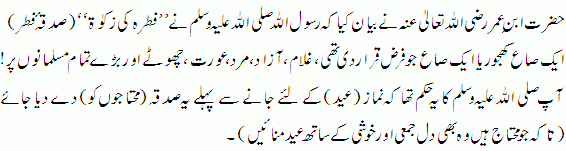
Narrated Ibn Umar ( RadiAllah Anhu) Allah’s Apostle (sal-Allahu-alleihi-wasallam) Enjoined The Payment Of One Sa’ Of Dates Or One Sa’ Of Barley As Zakat-Ul-Fitr On Every Muslim Slave Or Free, Male Or Female, Young Or Old, And He Ordered That it Be Paid Before The People Went Out To Offer The ‘Id Prayer.
[Sahih Muslim : Book 5 Kitab Al-Zakat, Number 2153]
Abdullah bin Umar (Radi Allah Anhu) reported that the Messenger of Allah (sal-Allahu-alleihi-wasallam) Prescribed Zakat-Ul-Fitr Of Ramadan One Sa’ Of Dates Or One Sa’ Of Barley for Every individual Among The Muslims (whether) Free Man Or Slave, Male Or Female, Young Or Old.

[Sahih Bukhari : Volume 2, Book 25 Zakat ul Fitr, Number 588]
Narrated Ibn ‘Umar (Radi Allah Anhu): Allah’s Apostle (sal-Allahu-alleihi-wasallam) has made Sadaqatul-Fitr obligatory, (and it was),
Either One Sa’ Of Barley Or One Sa’ Of Dates (and its payment was obligatory) on young and old people, and on free men as well as on slaves.

[Sahih Muslim : Book 5 Kitab Al-Zakat, Number 2159]
Ibn ‘Umar (Radi Allah Anhu) reported that the Messenger of Allah (sal-Allahu-alleihi-wasallam) ordered that the Sadaqat-ul-Fitr should be paid before the people go out for prayer.

[Sahih Bukhari : Volume 2, Book 25 Zakat ul Fitr, Number 587]
Narrated Nafi’: Ibn ‘Umar (Radi Allah Anhu) said, “The Prophet (sal-Allahu-alleihi-wasallam) made incumbent on every male or female, free man or slave, the payment of One Sa’ Of Dates Or Barley As Sadaqat-Ul-Fitr (or said Sadaqa-Ramadan) .”
The People then substituted half Sa’ of wheat for that. Ibn ‘Umar used to give dates (as Sadaqat-ulFitr) . Once there was scarcity of dates in Medina and Ibn ‘Umar gave barley. ‘ And Ibn ‘Umar used to give Sadaqat-ul-Fitr for every young and old person. He even used to give on behalf of my children. Ibn ‘Umar used to give Sadaqatul-Fitr to those who had been officially appointed for its collection. People used to give Sadaqat-ul-Fitr (even) a day or two before the ‘Eid.

Never Forget To Pray To ALLAH
[Quran – 2:45] “And seek assistance through patience and prayer, and most surely it is a hard thing except for the humble ones,”
The Prophet (Peace Be Upon Him) has said:
[Bukhari, Book #21, Hadith #263] “O Allah! I ask guidance from Your Knowledge, And Power from Your Might and I ask for Your great blessings. You are capable and I am not. You Know and I do not and You Know the unseen. O Allah! If You Know that This job is good for my religion and my subsistence and in my Hereafter–(or said: If it is better for my present and later needs)–Then You ordain it for me and make it easy for me to get, And then bless me in it, and if You Know that This job is harmful tome In my religion and subsistence and in the Hereafter–(or said: If it is worse for my present and later needs)–Then keep it away from me and let me be away from it. And ordain for me whatever is good for me, And make me satisfied with it). The Prophet added that then the person should name (mention) his need.”
Allah’s Command- Be Just
[ALLAH’S Quran – 4:58] “…And exercise justice when you sit in judgement upon people, and be consonant with the principles of moral right and in accordance with reason and fact. Allah enjoins only what is right and sound; how morally excellent is what He exhorts you to do; Allah has always been Sami’un with (unlimited audition), and Bassirun, (He sees all that you do).”
The Prophet (Peace Be Upon Him) has said :
[Muslim, Book #020, Hadith #4493] “It has been narrated on the authority of ‘Abdullah b. ‘Umar that the Messenger of Allah (may peace be upon him) said: Behold! the Dispensers of justice will be seated on the pulpits of light beside God, on the right side of the Merciful, Exalted and Glorious. Either side of the Being is the right side both being equally meritorious. (The Dispensers of justice are) those who do justice in their rules, in matters relating to their families and in all that they undertake to do.”
[Sunan Abudawud, Book #24, Hadith #3568] “Narrated Abu Hurayrah: The Prophet (peace_be_upon_him) said: If anyone seeks the office of judge among Muslims till he gets it and his justice prevails over his tyranny, he will go to Paradise; but the man whose tyranny prevails over his justice will go to Hell.”
How important is Ikhlaas-Sincerity
Islam teaches sincerity and persuades to live with it. Acceptance of deeds depends on sincerity (Ikhlaas). Ikhlaas means man’s deeds and actions to be done for the sake of Allah alone and not to show to the people. Moreover, sincere words and actions are felt in heart and triggers confidence of everyone around you. We must be always sincere in all matters, whether it is religious duty, or family matters, public/ business dealings, office works etc. With regard to family one has to be natural and sincere with spouse and other family members and relatives.
One must be sincere in prayer with pure and sincere devotion. Make sincere repentance (tawba), by making sincere promise not to repeat the same sin again. In the given below Quranic verses translations you would know how Al-Mighty Allah Commands the prophet (Sallallaho A’laihi Wa Sallam) and people to be sincere.
1) Worship Allah and associate nothing with Him, and to parents do good, and to relatives, orphans, the needy, the near neighbor, the neighbor farther away, the companion at your side, the traveler, and those whom your right hands possess. Indeed, Allah does not like those who are self-deluding and boastful (arrogant and proud)(Quran Surah An-Nisa4/36)
2) Say, [O Muhammad], “Indeed, I have been commanded to worship Allah, [being] sincere to Him in religion. (Surah Az-Zumar 39/11)
3) Indeed, We have sent down to you the Book, [O Muhammad], in truth. So worship Allah, [being] sincere to Him in religion (Surah Az-Zumar 39/2)
4) Say, “Allah [alone] do I worship, sincere to Him in my religion (Surah Az-Zumar 39/14)
5) He is the Ever-Living; there is no deity except Him, so call upon Him, [being] sincere to Him in religion. [All] praise is [due] to Allah, Lord of the worlds (Surah Ghafir 40/65)
6) O you who have believed, repent to Allah with sincere repentance. Perhaps your Lord will remove from you your misdeeds and admit you into gardens beneath which rivers flow [on] the Day when Allah will not disgrace the Prophet and those who believed with him. (Surah Al-Tahreem 66/8)
7) Say, “Indeed, my prayer, my rites of sacrifice, my living and my dying are for Allah, Lord of the worlds (Surah Al-Anaam 6/162)
8) And whoever obeys Allah and the Messenger – those will be with the ones upon whom Allah has bestowed favor, of the prophets, the steadfast affirmers of truth, the martyrs and the righteous. And excellent are those as companions (Surah An-Nisa 4/69)
9) And perform properly (and complete) the Hajj and Umrah for Allah. ( Al-Baqarah 2/196)
Good Character
Good conduct and noble character are the most valuable and precious assets of any human society. They are the treasures of pride for any individual. Courtesy is a virtue, because a refined mind cultivates good habits, performs good deeds, and avoids all that is bad and corrupt.
Prophet Mohammed’s (Sallallahu-A’layhi-Wasallam’s) Character
1) Allah, the Exalted, says:”And verily, you (O Muhammad (PBUH)) are on an exalted (standard of) character.” (Quran Surah 68/4)
2) The Holy Quraan states: “Surely there is for you the best example in the Messenger of Allah (Muhammad Sallallahu-Alayhi-Wasallam), for whoever seeks the pleasure of Allah and the Last Day, and remembers Allah often (much).” (Surah Al-Ahzaab 33/21)
3) Anas (May Allah be pleased with him) reported: The Messenger of Allah (PBUH) was the best of all the people in behavior.
[Al-Bukhari volume 8/221 book 73 and Muslim]
4) Anas (May Allah be pleased with him) reported: I never felt any piece of velvet or silk softer than the palm of the Messenger of Allah (PBUH), nor did I smell any fragrance more pleasant than the smell of Messenger of Allah (PBUH). I served him for ten years, and he never said ‘Uff’ (an expression of disgust) to me. He never said ‘why did you do that?’ for something I had done, nor did he ever say ‘why did you not do such and such’ for something I had not done.
[Al-Bukhari volume 8/64 book 73 and Muslim Chapter 13-Book 030 #5720].
Which Type of Conduct Is Desired From Human Beings
1) “The Jannah is prepared for those who spend during ease and hardship, who repress anger, and who pardon the people.” (3/133-134)
2) Abdullah bin ‘Amr mentioned Allah’s Apostle saying that he was neither a Fahish nor a Mutafahish. Abdullah bin ‘Amr added, Allah’s Apostle said, ‘The best among you are those who have the best manners and character.’ (Bukhari 8/56 Book 73)
3) Narrated Jarir bin ‘Abdullah: The Prophet said, “He who is not merciful to others, will not be treated mercifully. (Bukhari 8/42 Book 73)
4) Narrated Anas bin Malik: Allah’s Apostle said, “Do not hate one another, and do not be jealous of one another, and do not desert each other, and O, Allah’s worshipers! Be brothers. Lo! It is not permissible for any Muslim to desert (not talk to) his brother (Muslim) for more than three days.” (Bukhari 8/73 Book 73)
5) Narrated ‘Aisha: The Prophet said “Gabriel continued to recommend me about treating the neighbors kindly and politely so much so that I thought he would order me to make them as my heirs. (Bukhari 8/43 Book 73)
6) Nawwas bin Sam’an (May Allah be pleased with him) reported: I asked Messenger of Allah (PBUH) about virtue and sin, and he said, “Virtue is noble behavior, and sin is that which creates doubt and you do not like people to know about it.”[Muslim Bk 032 #6195].

10 Ways of developing love for Allah
Shaykh Ibn al-Qayyim (rah)
says: “The reasons which cause mahabbah (love) of Allaah Ta’ala to develop, are ten:
First: Reciting
the Qur’aan, reflecting and understanding its meaning and its intent.
Second: Drawing closer
to Allaah – the Most High – through optional deeds, after fulfilling the obligatory duties.
Third: Being
continuous in the dhikr (remembrance) of Allaah, with the tongue, the heart and the limbs – under all circumstances. The more continuant the dhikr, the more muhabbah develops and intensifies.
Fourth: Giving
precedence to what Allaah loves over personal loves, when being overcome by desires.
Fifth: Contemplating and deliberating over the
Names and Attributes of Allaah.
Sixth: Recognizing and remembering the favors
and bounties of Allaah – both manifest and hidden.
Seventh: To be humble and submissive before
Allaah – and this is the greatest matter.
Eighth: To be in seclusion reciting the
Qur’aan, during that time in which Allaah descends to the lowest heaven (which is the last third of every night), finishing this recitation with seeking Allaah’s forgiveness and repenting to Him.
Ninth: To sit in the gatherings of the true
and sincere lovers of Allaah, reaping the fruits of their speech, and not to speak except if there is benefit in it and that you know that such talk will increase you in goodness and that it will benefit others as well.
Tenth: To stay clear of all those causes which
distances the heart from Allaah – the Mighty and Majestic.
So these are the ten reasons which cause the person to develop true love for Allaah and to reach the rank of al-muhabbah, by which he reaches his Beloved.
Adapted from Shaykh Ibn
Qayyim’s (rah) Madarij-us-Saalikeen

Umm al-Mo’mineen Hadrat Maimoona Bint al-Harith (Radi Allahu Anha)
Hadrat Sayyida Maimoona was the last wife of the Holy Prophet (Sallallaho Alaihi wa Aalihi wa Sallam). She belonged to the tribe of Banu-Hilala. The Holy Prophet (Sallallaho Alaihi wa Aalihi wa Sallam) had another wife from the same tribe. The other wife’s name was Zainab, commonly known as Ummul-Masakeen (Mother of the needy and poor). Maimoona was her second adopted name. Her first name Barra was changed by the Holy Prophet (Sallallaho Alaihi wa Aalihi wa Sallam) and the new name Maimoona was given. Her father Harith bin Hazam was one of the respected chiefs of the tribe Banu-Hilala and he had sixteen daughters. One of his daughters namely Umm-ul-Fazal was the wife of Hadrat Abbas, who was the Holy Prophet’s uncle. His other daughter namely Umm-e-Salma was married to Hadrat Hamza, another uncle of the Holy Prophet (Sallallaho Alaihi wa Aalihi wa Sallam). Another daughter Lubaba was the mother of Hadrat Khalid bin Walid (A renowned General of Muslims who fought against Iranians and was given the title of “Sword of Allah” by the Holy Prophet (Sallallaho Alaihi wa Aalihi wa Sallam). Harith’s some other daughters were later married to Hadrat Umar, the second Caliph, and Hadrat Ali, the fourth Caliph. Another daughter Asma was married to Hadrat Jafar. Thus most of Hadrat Maimoona’s sisters were married to the pioneering revolutionary leaders of Islam.
Hadrat Maimoona was the last wife of the Holy Prophet (Sallallaho Alaihi wa Aalihi wa Sallam) and he did not marry afterward. The Prophet (Sallallaho Alaihi wa Aalihi wa Sallam) was about sixty years old at the time of his marriage with Hadrat Maimoona. She lived three years married life with the Holy Prophet (Sallallaho Alaihi wa Aalihi wa Sallam). Prior to her marriage twice. Her first marriage took place with Masood bin Amr. Masood divorced her and then she was married to Abu Rahim bin Abdul Aza. Abu Rahim died in the seventh year of Hijra. After Abu Rahim’s death the Holy Prophet’s Uncle Hadrat Abbas persuaded the Holy Prophet Mohammad (Sallallaho Alaihi wa Aalihi wa Sallam) to marry Maimoona.
Hadrat Maymuna or Hadrat Barra as she was then called, yearned to marry the Prophet. She went to her sister, Umm al Fadl to talk to her about that and she, in turn, spoke to her husband, al-Abbas. Al-Abbas immediately went to the Messenger (peace and blessings of Allah be upon him) with Maymuna’s offer of marriage to him and her proposal was accepted. When the good news reached her, she was on a camel, and she immediately got off the camel and said, “The camel and what is on it is for the Messenger of Allah (peace and blessings of Allah be upon him).” They were married in the month of Shawwal in 7 AH just after the Muslims of Medina were permitted to visit Mecca under the terms of the treaty of Hudaybiyya to perform Umra.
The Holy Prophet (Sallallaho Alaihi wa Aalihi wa Sallam) was wearing an Ihram (Ihram is the dress for performing Hajj or Umrah comprised of two sheets of cloth, one wrapped around the waist and the other around the shoulder. After putting on Ihram, one can not trim his hair, cut his nails, abuse or have sex, etc.). In the same condition, he sent five hundred Dirhams as Mehr to Hadrat Maimoona and the Nikah ceremony was Performed While on return after Umra from Makkah to Madina, he stayed at a place called Saraf. This place is ten miles away from Makkah on way to Madina. At Saraf, the feast of Walima ( The feast, i.e. lunch, or dinner offered to friends and guests on the next day of the marriage) was held.