
TAG: Prophet Muhammad (peace be upon him)
Tajdar-E-Risalat Ki Gareeb Parwari

Surah Kausar
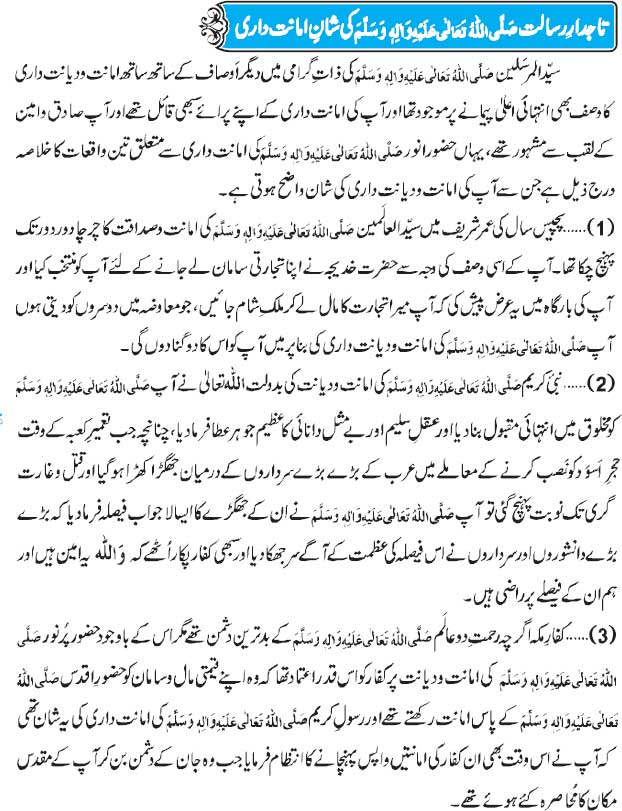
Tajdar-e-Risalat Ki Shan e Amanat Dari
Those Who Will Enter Paradise Without Being Called To Account
The first group of this ummah who will enter Paradise will be those who were pre-eminent in their Imaan, taqwaa, righteous deeds and adherence to the true religion. They will enter Paradise in one rank: the first of them will not enter until the last of them enters, and they will be as beautiful as the full moon.
Al-Bukhaari reports from Abu Hurayrah (ra) that the Messenger of Allah (saw) said:
“The first group to enter Paradise will be as beautiful as the full moon. They will not spit, blow their noses or excrete. Their vessels will be fo gold, their combs of gold and silver, their incense o aloe, and their sweat of musk. Each of them will have two wives, the marrow of whose leg-bones will be visible through their flesh because of their extreme beauty. There will be no differences or hatred among them (the people of Paradise); their hearts will be as one, and they will glorify Allah (swt) morning and evening”. (Kitaab Bid’ al-Khalq, Baab Ma Jaa’ fi Sifaat al-Jannah, Fath al-Baari, 6/318; Muslim, at-Tirmidhi)
al-Bukhaari reports from Sahl ibn Sa’d (ra) that the Messenger of Allah (saw) said: “Seventy thousand – or seven hundred thousand – of my ummah will enter Paradise; the first of them will not enter until the last of them does so, and their faces will look like the full moon”. (Fath al-Baari, 6/319)
It is true that with each one of these seventy, Allah (swt) will give His Prophet seventy thousand. Ahmad reports with a saheeh isnaad from Abu Bakr (ra) that the Messenger of Allah (saw) said:
“I have been given seventy thousand of my ummah, who will enter Paradise without being called to account. Their faces will be like the full moon, and their hearts will be as one. I asked my Rabb, may He be glorified, for more, and He gave me, along with each of them, seventy thousand more”. (Saheeh al-Jaami’, 1/350, no. 1068)
Ahmad, at-Tirmidhi, and Ibn Hibbaan report with a saheeh isnaad from Abu Umaamah that the Messenger of Allah (saw) said, “My Rabb promised me that seventy thousand of my ummah would enter Paradise without being called to account and without being punished, and with each one will be seventy thousand, and three handfuls of people picked up by my Rabb [ i.e. it will be a great number]”. (Saheeh al-Jaami’ 6/108, no. 2988).
The Prophet (saw) described the characteristics of these seventy thousand.
al-Bukhaari reports from Ibn ‘Abbaas that the Prophet (saw) said, “I was shown the nations, and I saw a Prophet pass by with a group of his people, and another with a band of his people, another with only ten, another with five, and another on his own (with no followers). Then I looked and saw a large crowd of people. I asked, “O Jibreel, are these my ummah?” He said, “No, but look at the horizon.” So I looked and saw a huge multitude of people. Jibreel said, “These are your ummah, and those seventy thousand in front will not be called to account or punished.” I asked, “Why?” He said, “They did not treat themselves with branding (cauterization) or with ruqyaa (charms) and they did not see evil omens in things ( i.e they were not superstitious): they put their trust only in their Rabb””. ‘Ukaasha ibn Mihsan stood up and said, “Pray to Allah (swt) to make me one of them”. The Prophet (saw) said, “O Allah (swt) make him one of them”. Then another man stood up and said, “Ask Allah (swt) to make me one of them”. The Prophet (saw) said, ‘Ukaasha has preceded you”. (Saheeh al-Bukhaari, Kitaab ar-Riqaaq, Baab Yadhkul al-Jannah Sab’un Alfan bi Ghayri Hisaab, Fath al-Baari, 11/405)
These may be the ones whom Allah (swt) has called al-Muqarraboon (those nearest to Allah swt):
“And those foremost [in faith] will be foremost [in the Hereafter]. These will be those nearest to Allah [al-Muqarraboon], in the Gardens of Bliss”. (56:10-12)
More of them will come from the early generations than from the later generations:
“A multitude of those [foremost] will be from the first generations [who embraced Islaam], and a few of those [foremost] will be from the later generations”. (56:13-14)
The Modern Muslim State Of Madina
PROPHET MUHAMMAD (peace be upon him) stayed in Makkah calling the people of his hometown to the message of Allah for 13 years and the number of people who embraced Islam did not exceed 70. The Prophet (peace be upon him) suffered a lot at the hands of his people who rejected the new religion, in spite of its noble and uplifting values. During that initial phase of Islam, Prophet Muhammad (peace be upon him) was fully occupied with instilling the idea of monotheism or the Oneness of God in his people’s minds.
When the Prophet (peace be upon him) migrated to Madina where he (peace be upon him) spent 10 years of his life, that are truly considered the most profitable and fruitful ones in the history of Islam. As soon as he settled in Madina, the Prophet (peace be upon him) started to work for establishing the Muslim state. If we deeply study the foundations upon which Prophet Muhammad (peace be upon him) established this state, we will discover that it was a modern state in the full sense of the word:
• When the Prophet (peace be upon him) arrived in Madina, he started building a mosque first to serve as the parliament for the nascent Muslim state. In other words, it was not only a place of worship but a place for discussing and reviewing all the matters related to the general good of Muslims and Islam.
• The second step taken by Prophet Muhammad (peace be upon him) was to effect a reconciliation between Aws and Khazraj, the two most powerful tribes of Madina. This is what is called nowadays in political circles as establishing social peace and political stability.
• The third step was to sign non-aggression treaties with the Jews which in the present terminology is called establishing and fostering good neighborliness. But, unfortunately, the Jews, as usual, violated the treaty which made Prophet Muhammad (peace be upon him) expel them from Madina to keep their mischief away from the new-born Muslim state and this is what is called today political shrewdness.
• The Prophet (peace be upon him) established the principle of Shoura (Consultation). He (peace be upon him) used to consult his Companions to seek their views on all matters of importance, giving everybody the chance to present his or her point of view. He never hesitated to accept and act on any reasonable point of view, in spite of the fact that it might be contrary to his own view. This is what we call today the democratic spirit and public opinion polls.
• The Noble Prophet (peace be upon him) was deeply concerned about equality. He emphasized on many occasions that all Muslims regardless of their color, race, wealth and social status are equal and this accomplished what we call today as human rights.
• The Prophet (peace be upon him) always emphasized the positive role of women in building the Muslim society and always stressed that her role is as important as that of man, and this is what we have come to call today women’s rights or women’s empowerment.
Why Was The Holy Qur’an Revealed Over 23 Years?
It is important to note that if the Qur’an had been revealed all at once, people would ask, “Why was it sent down all at once and not in stages?” The ultimate answer to such questions lies with Allah, the All-Wise and All-Knowing. Our decisions are based on a very limited viewpoint, as we are limited creatures.
The Divine decree, on the other hand, considers everything – our moral and spiritual well-being, worldly happiness, and both the present and future – and weaves the whole into a single pattern that is coherent with grace and wisdom. Thus, the benefit we derive from the Divine commandments is immeasurable, and the blessing that flows from obeying them is beyond our imagination. And so it is with the method that Allah chose to reveal the Qur’an.
The Revelation began when it was time for humanity to reach maturity. The Prophet’s mission and that of his community was to become the most complete, progressive, and dynamic exemplars for humanity, and to achieve such a level of advancement that they would be the masters and guides for all subsequent people.
But these reformers first had to be reformed. Their qualities and characters had been conditioned by the surrounding non-Islamic environment, where their ancestors had been living for centuries. Islam was to turn their good qualities into qualities of unsurpassed excellence and to purge their bad qualities and habits in such a way that they would never reappear.
If the Qur’an had been revealed all at once, how would they have reacted to its prohibitions and commandments? Certainly they would have been unable to understand, let alone accept and apply them in the ideal manner. This lack of gradualism would have been self-defeating, as proven by history. Wherever Islam was taken, it spread gradually but steadily, and so became firmly established.
We see people all around us who cannot free themselves from their bad habits and addictions. If you confined such people, even if you convinced them to abandon their habits for their own benefit, they would not be happy with you. On the contrary, they would feel angry, bored, and irritated. They would complain and try to escape from your program of reform so that they could revert to their habits as soon as possible. All the arguments and documented evidence put forth by specialists and experts would not persuade them to change. Even those who are cured occasionally suffer a relapse. Indeed, some of those who campaign against harmful habits, such as smoking and consuming alcohol, still indulge in them!
Remember that the Qur’an came to change not one or two habits; it came to change everything zways of living and dying, marrying, buying and selling, settling disputes, and how to perceive one’s relation with the Creator, and more. Given the scope of the change envisioned, we can begin to grasp why it was revealed in stages.
The gradual revelation of the Qur’an prepared the people to accept and then live the virtues, excellent manners, and lofty aspirations it demanded. That so much was achieved in only 23 years is a miracle. As Said Nursi said, “I wonder if the scholars of today were to go to the Arabian peninsula, could they accomplish in 100 years even one percent of what the Prophet accomplished in one year?”
Current campaigns to eradicate a peripheral vice, such as smoking, employ famous scholars, individuals, institutions, and the whole network of mass media, yet they still result in overall failure. If 20 fewer people die on the road per year after a campaign against alcohol, it is considered a great success. What the Prophet accomplished, at God’s bidding, over 23 years far surpasses what all of humanity has managed to achieve since that time.
The Qur’an was revealed in stages so that its audience could understand, internalize, and apply its prohibitions, commands, and reforms. Revelation came when the need for guidance arose, without discouraging or grinding down morale, warning and condemnation preceded prohibition and appeal and exhortation preceded command. For instance, alcohol and other intoxicating drinks were prohibited in three or four stages; female infanticide in two stages; uniting warring tribes and building up a close-knit society based on brotherhood, thus raising the collective consciousness, in several stages. These difficult reforms were not gestured at or expressed in slogans, they were actually achieved.
Today, we design our projects according to past experience and future possibilities. Taking possible social and economic fluctuations into account, we make our plans flexible in order to leave room for any necessary modifications. Just like a young tree, the early Muslims grew slowly, adapting gradually to new conditions and thus developing naturally. Every day new people were coming into Islam.
New Muslims had to learn many things, they had to reach an Islamic consciousness, train themselves to act upon Islam, and thus become members of a society rather than separate individuals or mutually hostile clans. Their characters, personalities, and their whole lives, were reshaped and reordered in accordance with Islamic precepts and the Qur’anic guidance.
Such was the magnitude of their spiritual, moral, intellectual, and even physical regeneration. This transformation was achieved through a balanced synthesis of worldly life and spiritual advancement, and it happened gradually, slowly yet continuously, and harmoniously.
Prophet Muhammad (peace be upon him): A Keen Sense Of Fairness
When a family of high status experiences hard times and loses much of its wealth, it either works hard to maintain its social standing through observing fine values and moral standards, or it may be unscrupulous in attempting to regain its material losses. Prophet Muhammad’s (peace be upon him) family was of the first type. It continued to attach much importance to all the fine qualities all human societies approve, such as sincerity, truthfulness, fidelity, courage, kindness to others, readiness to help in any good cause. Prophet Muhammad (peace be upon him) followed this line from his early years and developed a keen sense of upright behavior. Hence, his community gave him the nickname Al-Amin, which means ‘the trustworthy’. They always declared that they never experienced him telling a lie in any situation, for any reason.
This quality enhanced Prophet Muhammad’s (peace be upon him) standing with all those who were close to him. His paternal aunts loved him dearly. They always tried to help him achieve the best in life. His uncles recognized in him a young man of great potential. None more so than Abu Talib, his uncle who took him into his own home after Abd Al-Muttalib’s death. Hence, we see Abu Talib taking his teenager nephew on a trip to Syria. A few years later, he arranges for him to work as a shepherd, then as he approaches adulthood, he encourages him to work as a trade agent, traveling with a trade caravan.
The upright attitude and moral code of behavior that Prophet Muhammad (peace be upon him) adopted from an early age endeared him to all around him, and earned him a high standing among his people. Hence, when they had a dispute concerning the replacement of the Black Stone at the corner of the Kaabah, after it had been renovated, they could find no way of preventing the dispute from developing into a bloody fight other than arbitration. They agreed to put their dispute to the first person entering the Sacred Mosque. When it was Prophet Muhammad (peace be upon him) that came forward, they were delighted and readily declared their acceptance of his judgment. His ruling showed maturity and recognition of the considerations that led people to take extreme measures. Hence, he was keen to ensure that no hard feelings remained and everyone was satisfied. He gave them a method of replacing the Black Stone in which they all shared that honor, and none could feel left out. He told them to bring a sheet of cloth and place the Black Stone on it. Then a man from each clan held the edge of the sheet and they all lifted it at the same time, bringing the Black Stone close to its position. He then helped them to put it in place.
Although this incident took place several years before Prophet Muhammad (peace be upon him) started to receive divine revelations, his ruling shows a keen sense of justice. The people in dispute placed no condition on the process of arbitration. They declared their acceptance of his ruling in advance. Had he wished, he could have argued that since the exercise of putting the Black Stone back in place was an exercise of honor, it belonged to the most honorable family or clan in Makkah. That would have given it to his own family. He, however, did not wish to exploit the situation in order to give his own people some advantage. Instead, he was keen to keep the whole community happy. Hence, he ruled that they all should share in the honor and he provided the way to ensure that.
Needless to say, when Prophet Muhammad (peace be upon him) started to receive his revelations, and became a Prophet and a messenger of God, his sense of justice was placed on a much higher level.
Prophet Muhammad (pbuh) – Fine Social Habits
Many of the Prophet’s (peace be upon him) companions belonged to the poorest and weakest strata in society. In Makkah, some of them were slaves or individuals attaching themselves to tribes to which they did not belong. As such, they had no privileges. In Madinah, his companions included people of all social ranks, but the Muslim community was in the process of establishing its foundation in the midst of a very hostile environment. Armies were raised to crush it, and economic siege was imposed on it. Yet the Muslim community was a close-knit community, with a bond of brotherhood in faith uniting all its members. The Prophet was keen to nurture this bond and help it to replace old tribal and family loyalties.
The Prophet was fully aware that ideas should be translated into practical action, and ties based on faith should have practical manifestations. Hence, it is not enough for people to speak of the new bond of Islamic brotherhood without the practical manifestations that cement this bond so as it would be felt as a reality. Therefore, the new Muslim society must be exemplary in its manners and social values and traditions. None other than the Prophet could establish these. God states that the Prophet provided guidance in all matters. In matters of religion, his example must be followed. In the areas that pertain to ordinary human life, the Prophet’s practice is always good to follow.
The Prophet was exemplary in his politeness and social habits. At the time, people mostly sat on the ground. When he sat with his companions, or with others, in the mosque or anywhere else, he never put his legs forward. He turned with his full face towards anyone who spoke to him, so as to make the speaker feel that the Prophet was fully attentive to what he said. He was the first to greet anyone who met him on the road. If he passed by a group of boys playing in the street, he would greet them and may stop to speak to them.
We see in our world that despite all the refinements that human society has developed, when a leader or a ruler is with his people, his manner is that of the one who is always in command, always holding the initiative. If he is attending a function, he decides when he leaves, paying little attention to what might have been prepared or might have remained. If he is visiting others, he rises to signal the end of the visit. The Prophet never did this. He would not rise until he has taken leave of his host.
He took meticulous care of his cleanliness and hygiene, so as not to cause any offense. He never blew air over any food or drink. If it was too hot, he would wait a little until it has cooled down. If he needed to sneeze, he would cover his mouth. He always used perfume, and stated that the two things of the human world that he loved were perfume and women. This was in a society that had long abused women. By saying this, he stressed that women must be well treated by Muslims. He frequently used a toothbrush to keep his teeth clean and to ensure that his mouth smell was always pleasant. He recommended his companions to use a toothbrush after meals and on waking up. If he woke up during the night, the first thing he did was brush his teeth. Urging his companions to maintain cleanliness, he told them to have a bath at least once a week, preferably on Fridays before going to the mosque for their prayers. He said: “Take a bath on Friday, even if you have to buy the water at a dinar for a cup.”
– by Adil Salahi
The Prophet As A Man
No material thing was too attractive for the Prophet (peace be upon him). He never coveted anything of the comforts or adornments of this life. His approach was that whatever served the purpose was good enough. People may like to surround themselves with things that give pleasure or add beauty to living conditions, but the Prophet did not attach much importance to these. He would welcome them when they were available, but would not miss them if they were scarce. To him this life is too short to attach much importance to its luxuries.
We see this in the articles the Prophet used in his daily life. People like to have fine articles for their food and drink when they can afford them. They use a collection of plates, cups and glasses for their daily meals, keep a beautiful dinner set for their guests and surround themselves with articles that add beauty to their homes. They may replace these with better or more beautiful ones when they have the means to do so. There is nothing wrong with that. God says in the Qur’an: “Say, ‘Who is there to forbid the beauty which God has produced for His servants, and the wholesome means of sustenance?’ Say, ‘They are (lawful) in the life of this world, to all who believe – to be theirs alone on the Day of Resurrection.'” (7: 32) However, when people compete in stocking what they do not use, only because they want to be on the same level as their friends or neighbours, then such luxuries are given too much importance. The Prophet has taught us, by practical example, that such an approach is wrong. He showed us that life can be just as comfortable without material luxury.
If we look at what the Prophet used for his food and drink, we find that he was satisfied with what was simple, inexpensive and served the purpose. We must always remember that this was a matter of choice, not imposed by his poverty. He could have whatever he wished, if he only showed a desire for it. Asim ibn Al-Ahwal, who belonged to the Tabieen generation that followed the Prophet’s companions, says : “I saw the Prophet’s cup at Anas ibn Malik’s house. It had a crack and Anas pulled it together with a chain of silver. It was a good, wide cup made of fine, thin wood. Anas said to us: ‘I gave the Prophet to drink out of this cup so many times.’ Ibn Seereen says: ‘The cup had a ring of iron and Anas wanted to replace it with one made of gold or silver, but Abu Talhah, (Anas’ stepfather), told him not to change anything the Prophet had or did. Therefore, Anas left it as it was.'” (Related by Ahmad and Al-Bukhari.)
We may find it strange that wooden articles were used for such a frequent purpose as drinking. Yet in our homes we may use some wooden articles that are finely made. It is rare, however, that a wooden cup is used for drinking. However, when the Prophet had something better, he used it. Ibn Abbas reports : “The governor of Alexandria sent a cup made of glass to the Prophet and he used it to drink.” (Related by Ibn Saad and Abu al-Shaykh.) This was part of the gift the ruler of Egypt sent to the Prophet in reply to his message calling on him to believe in Islam. The Egyptian ruler recognized the Prophet but decided to remain Christian and hoped to have friendly relations with the Prophet. Therefore, he sent him a gift to demonstrate his good will.
The Prophet also used other articles for his drink. Jabir reports : “The Prophet’s drink was left for him to ferment in a large water skin. If none is found, they would put the drink in a stoneware beaker to ferment.” (Related by Al-Shafie, Muslim and Al-Darimi.) We mentioned that the Prophet did not allow his drink to ferment for long. He would leave it over night and drink of it the following day, so that it would have some sweetness, but no trace of alcohol.
If the Prophet’s household had an article, it was used until it no longer served the purpose for which it was made. Lady Sawdah, the Prophet’s wife, reported : “We had a sheep, but she died. We dyed its skin and used it for fermenting drinks, until it became too dry.” (Related by Ahmad, Al-Bukhari and Al-Tirmidhi.) This Hadith makes it clear that when an animal dies of natural causes, it is not permissible to eat. However, its skin could be used after it is dyed. When it is dyed it is considered to be free of impurity. In this case, when the sheep died, its skin was put to good use, until it was too dry and became unsuitable for use.
All this gives us a picture of very simple life. The Prophet was keen that this remained the main characteristic of his life, so that people would look up to him for practical guidance in all respects. We can still do so when we study his life pattern very closely. We may add here a few Hadiths that confirm this picture. They hardly need any comment from us.
Lady Ayesha reports : “The Prophet and I used to bathe, drawing water from the same vessel, using a large one called Al-Faraq.” (Related by Al-Bukhari and Muslim.) This is a large container that held enough water for two people to wash all their bodies, without being excessive. Ayesha reports: “We had this vessel of water which was filled for us. We both drew water out of it.” (Related by Al-Bukhari and Al-Nassaie.)
Abdullah ibn Zayd reports: “The Prophet once came to us and we brought him water in a beaker made of brass. He performed ablutions, washing his face three times and his hands twice. He then wiped his head from front to back and back to front, then he washed his feet.” (Related by Al-Shafie, Al-Bukhari and Al-Nassaie.)