
TAG: Prophet Muhammad (peace be upon him)

Love For Our Children
Prophet Muhammad (peace be upon him) instructed us to show our love to our children: He is not one of us who does not have mercy for children and respect for our seniors.
(At-Tirmidhi)
It is reported that Al-Aqra’ ibn Habis saw Allah’s Messenger kissing his grandchild and said to the Prophet, “I have ten children, but I have never kissed any one of them.” The Prophet said, “He who does not show mercy (toward his children), no mercy would be shown to him.”
(Al-Bukhari)
a Bedouin asked the Prophet, “Do you kiss your sons?” The Prophet replied, “Yes.” The Bedouin said, “We do not.” The Prophet said to him, “What can I do for you if Allah has removed mercy from your heart?”
(Al-Bukhari)
Abu Huraira (A Companion Of The Prophet Muhammad)
Through this phrase millions of Muslims from early history of Islam to the present have come to be familiar with the name Abu Huraira (RA – May Allah be pleased with him), who you expect to find his name in most Hadith (sayings or doings of the Prophet Mohammed), Sirah (biography of the Prophet Mohammed) or Fiqh (Islamic jurispudence) books.
Abu Huraira (RA) enjoyed a great talent, he was gifted with an extraordinary long term memory to the extent that he would hear a discussion or a speech and be able to reproduce the identical discussion or speech years later without changing or deleting one single word from it.
This great gift that Abu-Huraira (RA) enjoyed could have been the worst thing that could have happened to him as some people used his well known and authentic name to make up false hadith about our beloved Prophet (SAW – may the peace and blessings of Allah be upon him), and link these false hadith to Abu Huraira. However, through hard and sincere efforts put in by some of the pious scholars who sacrificed their lives to preserve and save our beloved Prophet’s (SAW) hadith and save them from any harm by the enemies of Islam who tried to mislead Muslims by adding to them thing that were never said by the Prophet of Allah (SAW), Abu Huraira’s reputation was saved from their wrong doing until our present day.
Abu Huraira became a Muslim at the hands of At-Tufayl Ibn Amr who as the chief of the tribe to which he belonged. When he submitted to the truthfulness of this religion, he accompanied At-Tufayl to Makkah and had the privilege of meeting the noble Prophet (SAW). The Prophet (SAW) asked Abu Huraira (RA) what his name was, “Abdu-Shams” (the servant of the sun), Abu Huraira (RA) replied. So he was told by the holy Prophet (SAW) to change his name to “Abdur-Rahman” (the servant of the Beneficent). However, he continued to be known among people as “Abu Hurrah” (the kitten’s father) because of his love for a cat he looked after and fed, and which used to follow him wherever he went.
Abu Huraira (RA) lived with his mother who was still a Mushrik (pagan). He prayed for her and tried hard to convince her to join Islam, but she adamantly refused. One day when he was telling her about Islam she uttered some words about the Prophet (SAW) which saddened Abu Huraira greatly. He went to the Prophet (SAW), his eyes full of tears and told him about what had happened between him and his mother. He also asked the Prophet (SAW) to make supplication (pray) to Allah (s.w.t) for her to make her heart respond to Islam. The Prophet (SAW) responded to Abu Huraira’s (RA) request and prayed for his mother. When Abu Huraira (RA) returned home he was delighted to hear his mother, who had just taken a shower, testifying that there is no God but Allah and that Muhammad is His Servant and His Messenger. So he rushed back to the Prophet (SAW) with his eyes glowing with joy, and informed him that Allah had answered his prayers, and guided his mother to Islam. He then said: “O Allah’s Messenger (SAW), Ask Allah to make me and my mother lovable to the believing men and women” . So he (SAW) said: “O Allah, make this servant of yours and his mother lovable to every believing man and woman” .
With his great gift and talent, Abu Huraira (RA) realized that he was able to serve this religion a great deal. He realized that, because many of the early companions (of the Prophet Mohammed) who had the most knowledge died in the battles in Allah’s cause, this religion needed people to preserve it, as in those days the companions used to write only the Qur’an fearing it might get mixed with the Hadith of the Messenger (SAW), if the latter was to be documented too. Even among those who had a great deal of knowledge, many of them were occupied by their trades and didn’t have as much free time as Abu Huraira (RA) to spend with the Prophet (SAW). Also the fact that he had an extraordinary long term memory meant that he could hear the Prophet’s (SAW) teachings and be able to ask a writer to write them later knowing that he will not forget any of them.
Therefore, during the four years Abu Huraira (RA) stayed with the Prophet (SAW) in Madinah, he set himself to accompany the holy Prophet (SAW) to gain knowledge and memorize his sayings and teachings in order to preserve the word of Allah (s.w.t) and the teachings of his beloved Prophet (SAW). The Prophet (SAW) himself directed Abu Huraira (RA) to an effective way to memorise his Hadiths, Abu Hurrah (RA) said: Allah’s Prophet (SAW) one day said to us: “whoever spreads his garment until I finish my talk, and then takes hold of it, will not forget anything from what he heard from me” .
The fact that Abu Huraira (RA) set himself to preserve the teachings of the noble Prophet (SAW), meant that he was always close to the Prophet (SAW) in his stay in Madinah, as he had free time at his disposal, unlike the Muhajirin (those who had migrated) he did not work in trade and unlike the Ansar (the helpers) he did not have a land to look after. This enabled Abu Huraira (RA) to stay with the noble Prophet (SAW) at Madinah and to go with him on journeys and expeditions.
He loved the Prophet (SAW) a great deal, he was never tired of looking at the Prophet (SAW) nor was he tired of listening to him. Often he would praise Allah for his good fortune and say “Praise be to Allah who has guided Abu Huraira (RA) to Islam, Praise be to Allah who taught Abu Huraira (RA) the Qur’an, Praise be to Allah who has bestowed on Abu Huraira (RA) the companionship of Muhammad (SAW)” .
Abu Huraira (RA) underwent much hardship and difficulties as a result of devoting his life to knowledge and companionship of the holy Prophet (SAW), Abu Huraira (RA) said: “One day, my hunger became so severe that I placed a stone on my stomach. I then sat down in the path of the companions. Abu Bakr (RA) passed by and I asked him about an Ayah (verse) of the book of God (Quran). I only asked him so that he would invite me but he didn’t”.
Despite the fact that Abu Huraira (RA) set himself to preserving the word of Allah and the teachings of his Prophet (SAW), he by no means neglected his other duties as much of his time was spend in prayers and devotion to God. He often rotated staying up at night with his wife and his daughter, as he would stay up for a third of the night, his wife for another third and his daughter for a third, this way in the house of Abu Huraira no hour of the night would pass without Ibadah (worship) and Salat (prayer). Abu Huraira’s (RA) presence was also felt in the battlefield when needed to protect and establish the religion of Islam by the sword, as he lived all his life, since becoming a Muslim, as a soldier of Islam not missing a single battle with the holy Prophet (SAW).
After the death of the holy Prophet (SAW), Abu Huraira continued his duties in conveying the teachings of the Prophet (SAW). He went on preaching a great number of hadith, which made some of his friends curious of the large amount of Ahadith that he memorised in such a short time. Although the fact that he was able to memorise so many hadith was justified by the fact that he was dedicated to staying with the Prophet (SAW) and due to the extraordinary ability to memorise speeches from the first time.
Abu Huraira (RA) continued to live a righteous life, devoting himself to serve the religion of Islam and being kind to his mother as well as encouraging others to be kind to their parents. One day when Abu Huraira’s (RA) health was deteriorating quickly and his friends were praying for him to recover, he looked to the heavens and said “O Allah I love meeting you and ask you to love meeting me” . He then died in the year 59 after Hijra (migration) when he was seventy eight years old.
He died after having accomplished his duty and his desire to preserve and transmit the teachings of the Holy Prophet (SAW), leaving Muslims a great debt of gratitude for helping to preserve the teachings of the noble Prophet (SAW) and setting them a perfect example and platform to follow in preaching and conveying to the humanity what he and others had worked relentlessly, facing all sorts of hardships, in order to preserve. We ask Allah (s.w.t) to reward Abu Huraira (RA) and grant him the companionship of the holy Prophet (SAW) in the hereafter just as he was granted his companionship in this world.
Hamzah Qassem
From Nida’ul Magazine
The Wrath of Allah On Those Who Disrespected The Holy Prophet Muhammed Sallalaahu Alaihi wasallam
Sahih Bukhari Volume 4, Book 56, Number 814:
Narrated Anas: There was a Christian who embraced Islam and read Surat-al-Baqara and Al-Imran, and he used to write (the revelations) for the Prophet. Later on he returned to Christianity again and he used to say: “Muhammad knows nothing but what I have written for him.”
Then Allah caused him to die, and the people buried him, but in the morning they saw that the earth had thrown his body out. They said, “This is the act of Muhammad and his companions. They dug the grave of our companion and took his body out of it because he had run away from them.”
They again dug the grave deeply for him, but in the morning they again saw that the earth had thrown his body out. They said, “This is an act of Muhammad and his companions. They dug the grave of our companion and threw his body outside it, for he had run away from them.”
They dug the grave for him as deep as they could, but in the morning they again saw that the earth had thrown his body out. So they believed that what had befallen him was not done by human beings and had to leave him thrown (on the ground).
Sahih Bukhari Volume 4, Book 56, Number 814:
Those who disrespected the Holy Prophet Muhammed Salalaahu Alaihi wasallam faced the Divine wrath of Allah
The Gate Of Iman- Hazrat Abu Bakr Siddique radiallahu taala anhu
Sahih Bukhari Volume 1, Book 8, Number 455
Narrated by Abu Said Al-Khudri
The Prophet delivered a sermon and said, “Allah gave a choice to one of (His) slaves either to choose this world or what is with Him in the Hereafter. He chose the latter.” Abu Bakr wept. I said lo myself, “Why is this Sheikh weeping, if Allah gave choice to one (of His) slaves either to choose this world or what is with Him in the Here after and he chose the latter?” And that slave was Allah’s Apostle himself. Abu Bakr knew more than us. The Prophet said, “O Abu Bakr! Don’t weep. The Prophet added: Abu- Bakr has favored me much with his property and company. If I were to take a Khalil from mankind I would certainly have taken Abu Bakr but the Islamic brotherhood and friendship is sufficient. Close all the gates in the mosque except that of Abu Bakr.
The way of Love , Ishq E Rasool is the gate of the way to Allah , All who achieved communion with Allah , came through the way of love , this is way of Abu Bakr Siddique radi allahu taala anhu and the way of Success ,
He was among the first person to endorse and accept the Apostleship of the Holy Prophet Muhammed Salalaahu Alaihi wasallam.
His deep love and reverence for the Holy Prophet Muhamed Salalaahu Alaihi wasallam earned him some of the highest honors
He Always led the prayer in the absence of The Holy Prophet Muhammed Salalaahu Alaihis wasallam
Sahih Bukhari Volume 1, Book 11, Number 633 :
Narrated by Al-Aswad
“We were with ‘Aisha discussing the regularity of offering the prayer and dignifying it. She said, ‘When Allah’s Apostle fell sick with the fatal illness and when the time of prayer became due and Adhan was pronounced, he said, ‘Tell Abu Bakr to lead the people in prayer.’ He was told that Abu Bakr was a soft-hearted man and would not be able to lead the prayer in his place. The Prophet gave the same order again but he was given the same reply. He gave the order for the third time and said, ‘You (women) are the companions of Joseph. Tell Abu Bakr to lead the prayer.’ So Abu Bakr came out to lead the prayer. In the meantime the condition of the Prophet improved a bit and he came out with the help of two men one on each side. As if I was observing his legs dragging on the ground owing to the disease. Abu Bakr wanted to retreat but the Prophet beckoned him to remain at his place and the Prophet was brought till he sat beside Abu Bakr.” Al-A’mash was asked, “Was the Prophet praying and Abu Bakr following him, and were the people following Abu Bakr in that prayer?” Al-A’mash replied in the affirmative with a nod of his head. Abu Muawiya said, “The Prophet was sitting on the left side of Abu Bakr who was praying while standing.”
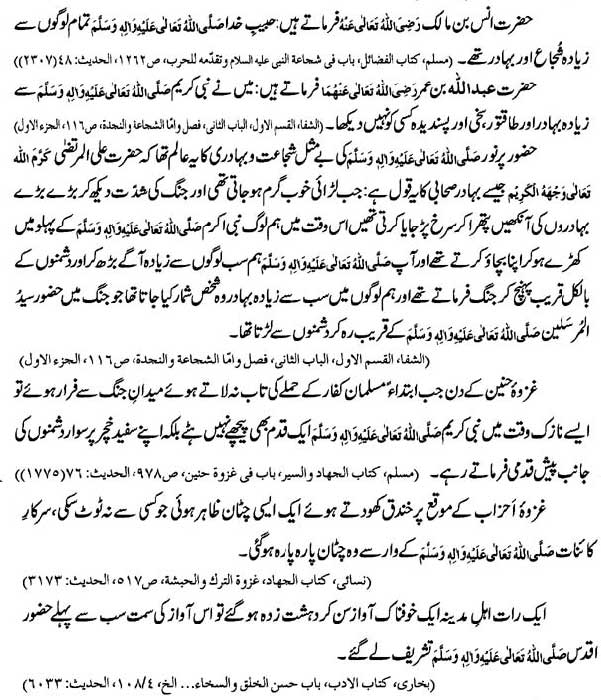
Syed-ul-Mursaleen Ki Shujaat
The Virtues And Blessings of Reciting Durood Upon Nabi (Sallallahu Alaihi Wasallam)
All praise is due to Allah Ta’ala. May the choicest durood (salutations) and salaam (peace) descend upon the noblest of Ambiyaa and Rasuls, our master and leader Hadhrat Muhammad (Sallallahu Alaihi Wasallam) and upon his blessed household and all his illustrious companions.
It is the belief of every believer that those who enjoy the highest rank after Allah Ta’ala are the Ambiyaa (may Allah Ta’ala’s choicest blessings rain upon them), and from among the galaxy of Ambiyaa, the highest in rank and status is Hadhrat Rasulullah (Sallallahu Alaihi Wasallam). Not only was Rasulullah (Sallallahu Alaihi Wasallam) sent to this ummah as the final messenger of Allah Ta’ala and the seal of prophethood, but he was also the leader of all the Ambiyaa and Rasuls of the past. The nubuwwat of every Rasul and Nabi of the past was subject to accepting Muhammad (Sallallahu Alaihi Wasallam) as his leader and pledging to support his cause if Rasulullah (Sallallahu Alaihi Wasallam) appeared in his era.
The love that Allah Ta’ala expressed for Rasulullah (Sallallahu Alaihi Wasallam), which can be easily gauged from the style of address in the Holy Qur’an , is unique and exclusive to Rasulullah (Sallallahu Alaihi Wasallam). The honor conferred to Rasulullah (Sallallahu Alaihi Wasallam) by Allah Ta’ala on the occasion of Me’raj was an honour not enjoyed by any other Messenger of the past. Furthermore, when Rasulullah (Sallallahu Alaihi Wasallam) will be ushered into the court of Allah Ta’ala on the day of Qiyaamah to the esteemed pedestal of maqaam mahmood to intercede for the entire humanity, his distinct position will be envied by all the Ambiyaa and Rasuls and their nations.
Rasulullah (Sallallahu Alaihi Wasallam)’s blessings and virtues are so immense and incredible that it is impossible for anyone to enumerate. Suffice to say that he will be the leader of the entire creation of Allah Ta’ala on the day of Qiyamah .
Hadhrat Ibn Abbas (Radhiallahu Anhu) reports that a group of Sahaabah were once sitting (in Musjid Nabawi) when Rasulullah (Sallallahu Alaihi Wasallam) emerged (from his home) and came towards them. As he drew closer, he heard them discussing amongst themselves. One of them said, “Indeed Allah Ta’ala chose Hadhrat Ebrahim (Alaihi Salaam) as his khaleel (special friend).” Another said, “Hadhrat Moosa (Alaihi Salaam) had the honor of conversing directly with Allah Ta’ala. A third said, “Hadhrat Isa (Alaihi Salaam) is the kalima and rooh of Allah Ta’ala (i.e. he was born with the command of Allah Ta’ala and the rooh was directly inserted into the womb without the medium of a father.) A fourth said, “Allah Ta’ala had divinely selected and chosen Hadhrat Aadam (Alaihi Salaam) (to be the father of mankind).
Nabi (Sallallahu Alaihi Wasallam) then entered their gathering and addressed them saying, “I have overheard your discussion and (I have noticed) your surprise with regard to the esteemed status and lofty positions of the past Ambiyaa. Certainly, Hadhrat Ebrahim (Alaihi Salaam) is the khaleel of Allah Ta’ala, and there is no doubt in that. Hadhrat Moosa (Alaihi Salaam) had the honor of conversing directly with Allah Ta’ala- this is an established fact. Hadhrat Isa (Alaihi Salaam) is the kalima and rooh of Allah Ta’ala, and this is certainly true. And Hadhrat Aadam (Alaihi Salaam) has been divinely selected by Allah Ta’ala, and undoubtedly he was such. Behold, I am the habeeb (beloved) of Allah Ta’ala and I proclaim it without pride. I will be the bearer of the banner of praise on the day of Qiyaamah, behind which will be Hadhrat Aadam and all those who came after him. I proclaim this without any pride. I will be the first to intercede and the first whose intercession will be accepted on the day of Qiyaamah, and I proclaim this without pride. I will be the first to shake the chain of the door of Jannah. Thereafter Allah Ta’ala will command that the door be opened for me and I be made to enter, while with me will be the poor believers, and I proclaim this without pride. I am the noblest of all the former and latter to Allah Ta’ala, and I say this without pride.
Undoubtedly, Rasulullah (Sallallahu Alaihi Wasallam) is the greatest and pinnacle of Allah Ta’ala’s creation. It is the greatest honour for every ummati of Rasulullah (Sallallahu Alaihi Wasallam) to be linked to Rasulullah (Sallallahu Alaihi Wasallam), the Imaam of all the Ambiyaa of Allah Ta’ala. Rasulullah (Sallallahu Alaihi Wasallam) is the source of hidaayat (guidance) for humanity at large, for it was none other than Rasulullah (Sallallahu Alaihi Wasallam) who was chosen to show us the path of guidance, through which we can earn eternal bliss and salvation. The ability of worshipping and recognizing Allah Ta’ala correctly, and simultaneously fulfilling the rights of fellow humans, also depend entirely upon emulating the teachings of Rasulullah (Sallallahu Alaihi Wasallam).
Apart from this, when we study the mubaarak life of Rasulullah (Sallallahu Alaihi Wasallam), we realize the intense love that Rasulullah (Sallallahu Alaihi Wasallam) possessed, not only for his family and Sahaabah, but for every ummati till the day of Qiyaamah. The perpetual concern and overwhelming anxiety that Nabi (Sallallahu Alaihi Wasallam) had for every ummati is inconceivable and unimaginable. In short, his deep love, unwaning concern and unabating worry for every ummati propelled him to patiently bear the manifold atrocities and immense difficulties that had befallen him in the path of propagating Deen which even the most caring and loving mother would not undergo for her one and only child. The three years of boycott in the valley of Abu Taalib, his mubaarak shoes being filled with blood at Ta’if, the blood oozing from his mubaarak face at Uhud etc., is only a glimpse of what he sacrificed for the Ummah, to such an extent that Allah Ta’ala pitied him and addressed him in the Holy Quran:
Perhaps, [O Muhammad], you would kill yourself with grief that they will not be believers.
Certainly a Messenger from amongst yourselves has come to you. It grieves him that you should face difficulty and hardship: ardently anxious is he over your hidaayat, to the Believers is he most compassionate and merciful.
Thus, when Nabi (Sallallahu Alaihi Wasallam) is essentially the source of all good in this world, and the ticket to enter Paradise, one can well imagine that being his followers what rights he has over us and how much we are indebted to him.
Amongst the rights that Rasulullah (Sallallahu Alaihi Wasallam) possesses over us, is that we obey him in all that he has commanded, we lead a life in conformity to his mubaarak lifestyle, and we continuously recite durood and salaam upon him as we are instructed by Allah Ta’ala in the Holy Qur’an:
Allah and His angels send blessings upon the Nabi (Sallallahu Alaihi Wasallam). O you who believe! Send durood and salaam upon him.
However, on account of our busy schedules and being so preoccupied with commitments and the mundane activities, we have drifted far away from Rasulullah (Sallallahu Alaihi Wasallam) and lost track of our main objectives and priorities in life. In view of the present situation, the need was felt to once again rekindle the love of Rasulullah (Sallallahu Alaihi Wasallam) within our hearts, thereby being able to understand the way to follow his mubaarak sunnah and reach Allah Ta’ala.
We make Duaa to Allah Ta’ala that he accept this humble effort and makes it a means of us being blessed with the intercession of Nabi (Sallallahu Alaihi Wasallam) on the day of Qiyaamah, and being in his mubaarak company.
The Awakening Of Umar Bin Al-Khattab
Umar was 27 when the Prophet (peace be upon him) began his mission. Young Omar was one of those who did not care to listen to the message of Islam. He was leading the old way of life. As years went by, Islam made slow headway. This made Omar angry. He wondered how people who once went over to Islam never went back to their old faith. One of Omar’s own maid-servants became a Muslim. He beat her as much as he could, but she would not give up the new faith.
At last in the sixth year of the Prophet’s mission, a number of Muslims left for Abyssinia. This made Umar boil with rage. “Here is a man,” he thought to himself “who has split the people. People lived smoothly enough. He appeared on the scene. He has torn son from father and brother from brother. Now his followers are running away to another land. Surely Muhammad is the cause of all trouble. I must slay him and put an end to the trouble.”
With this resolve, Omar drew his sword and set out to kill the Prophet (peace be upon him). On the way, he met a friend who asked him why he looked so upset. Omar told him what he was going to do. “You better take care of your own kin first,” said the friend, “Your sister and her husband have gone over to Islam.”
These words changed the direction of Omar’s anger. He went straight to the house of his sister, Fatima. He knocked at the door. Someone was reciting the Qur’an inside. Fatima was terrified when she heard Omar’s voice. She hid the portion of the Qur’an she was reading and opened the door.
“What was it that you were reciting just now?” Omar demanded.
“Oh nothing,” said the sister.
“Why nothing?” he shouted in rage. “I have heard it. I know you both have accepted Muhammad’s faith.” Saying this, he began to beat his brother-in-law, Saeed. Fatima ran to his help and got a blow to the head. The head began to bleed. This made the couple gather courage. “Yes, we have become Muslims,” they shouted at Omar. “Do what you will.” The sight of the bleeding sister deeply moved Omar. Fatima was such a loving sister! Surely there must be some great truth in the Qur’an which had won her innocent heart. “Would you let me have a look at the Qur’an?” said Omar.
Fatima handed him the few pages of the book she had.
Omar sat down to study the pages. Soon his face changed. His anger cooled down. The fear of Allah gripped his heart. He wept and declared, “Surely this is the word of Allah.”
Omar was again on his way to the place of the Prophet (peace be upon him). But he was a changed man. He was not going to slay him but to embrace his faith.
The Noble Prophet was sitting in the company of some men. He saw Omar coming and asked, “Omar , what brings you here?”
“O Prophet of Allah!” replied Omar, “I have come to embrace Islam.” Great was the joy of the Noble Prophet (peace be upon him) and his followers. Loud shouts of “Allah is the Greatest” rented the air of Makkah.
Soon everyone knew that Omar was no longer an enemy of Islam. It was a great day for Islam because one of its bitterest enemies had become its staunch follower.
Description of the Last Prophet
Physically speaking, the Prophet Muhammad (peace be upon him) was the most handsome of people. He was of medium height, not too tall and not too short, of medium build, of white going slightly red-brown skin color, with a completely full head of shiny black slightly curly hair that would reach to his shoulders at its longest, hair which was sometimes dyed slightly red and/or yellow, a taut neck, an extended black thick beard with a few white hairs, firm un-raised cheeks, a fine slender nose, wide white eyes with a slight reddish tinge with strikingly black pupils, a flat chest and stomach, well-statured, thick heavy hands with slightly long fingers, very soft palms, smooth large feet, no excess fat or flesh on the heels, and a gait of one leaning slightly forward when he walked. May Allah bless and bestow peace upon him.
He had a large back, broad shoulders, in between which slightly to the left one could see the Seal of Prophethood – a slightly raised piece of skin with a small grouping of hair. May Allah bless and bestow peace upon him.
When he met people, he would turn his whole body to meet them. He was the first to greet people, having a wide smile, with a face that was immersed in blessed light that shone and radiated like a bright moon.
He had a firm handshake which he would not let go of until the other person let go yet at the same time was so gentle that if a small girl was to take his hand and lead him around the town, he would follow in tow.
It was difficult for people to compose themselves in his presence due to the sheer awe of his countenance and the shock of how handsome he was. His gravitas and presence was such that despite his medium height, he seemed taller than those surrounding him. May Allah bless and bestow peace upon him.
He would love to wear cotton shirts, some similar to a thawb, short and long but never below the ankles, sometimes short-sleeved so that one could see his white clean arm-pits and sometimes long to his wrists. He disliked woollen garments except for the occasional use of a woolen over-garment, mostly white yet sometimes colorful garments particularly striped, sometimes red-striped, but never wore anything saffron in color. He would wear a turban, sometimes a two-piece outfit with a sarong type lower garment, and would accept and wear the clothes of foreigners given to him as a gift. May Allah bless and bestow peace upon him.
– Based on authentic narrations. Please see the “Commentary to the Shama’il Al-Muhammadiyyah”