TAG: Quran
Quran Is The Greatest Gift From Allah
Why do they not study the Quran carefully? Do they have locks on their minds?
QURAN IS THE GREATEST GIFT FROM ALLAH (SWT) BECAUSE:
- A book that is full of answers
- A book that makes you cry
- A book that makes you notice how much harder you can try
- A book that makes you realize what true love really is
- A book that gives you direction for all of life’s tough biz
- A book that gives you hope that someone somewhere is watching over you
- A book that was revealed to our beloved prophet over a period of 23 years
- once you put faith into this book you can handle worldly fears
- A gift sent down from heaven
- A treasure from above
- Written proof that shows us how blessed we are with Allah’s love.
- A BOOK IN WHICH THE MASTER OF WORLDS AND HEAVENS PROMISED/CLARIFIED IN THE FOLLOWING COMMAND……
(17:41) We have explained (things) in various (ways) in the Qur’an, in order that they may receive admonition, but it only increases their flight from the truth.
(17:89) And We have explained to mankind, in this Qur’an, every kind of similitude, yet the greater part of mankind refuse (to receive it) except with ingratitude […]
(39:27) And verily We have coined for mankind in this Qur’an all kinds of similitudes, that perhaps they might reflect […]
(18:54) We have explained in detail in this Qur’an, for the benefit of mankind, every kind of similitude, but man is in most things contentious.
(30:58) Verily, We have propounded for mankind in this Qur’an, every kind of parable […]
(6: 65) Behold how many facets We give to these signs, so that they might understand the truth […]
(7:52) […] For indeed We did convey unto them a Book which We expounded with knowledge (ilm) — a guidance (huda) and a grace (rahmat) for people who believe.
(6:114) Shall I seek other than Allah for judge when it is He who has revealed unto you (this) Book, fully explained [..?]
(2:219) […] Thus Allah makes plain to you (His) revelations, that perhaps you may reflect.
(3:103) […] Thus Allah makes clear His revelations unto you that perhaps you may be guided.
(6:97) […] clearly, indeed, have We spelled out these signs unto people of knowledge.
(6:98) […] clearly, indeed, have We spelled out these signs unto people who can grasp the truth.
(6:99) […] Verily in all this are signs (ayats) for people who will be convinced.
4:95. Not equal are those of the believers who sit (at home), except those who are disabled (by injury or are blind or lame, etc.), and those who strive hard and fight in the Cause of Allah with their wealth and their lives. Allah has preferred in grades those who strive hard and fight with their wealth and their lives above those who sit (at home). Unto each, Allah has promised good (Paradise), but Allah has preferred those who strive hard and fight, above those who sit (at home) by a huge reward;
18:29 And proclaim, “This is the truth from your Lord. Whoever accepts it let him accept it, and whoever rejects it, let him reject it.”
[39:29] GOD cites the example of a man who deals with disputing partners (Hadith), compared to a man who deals with only one consistent source (Quran). Are they the same? Praise be to GOD; most of them do not know.
[16:89] The day will come when we will raise from every community a witness from among them, and bring you as the witness of these people. We have revealed to you this book to provide explanations for everything, and guidance, and mercy, and good news for the submitters.
31:6 But among people, there are those who invest their time in Hadith which is unfounded, so as to lead those without knowledge away from the path of God, making mockery of it (the Qur’an). For such there is a humiliating punishment in store.
(6:164) […]every nafs shall bear the consequences of its actions and no one can help him in any capacity
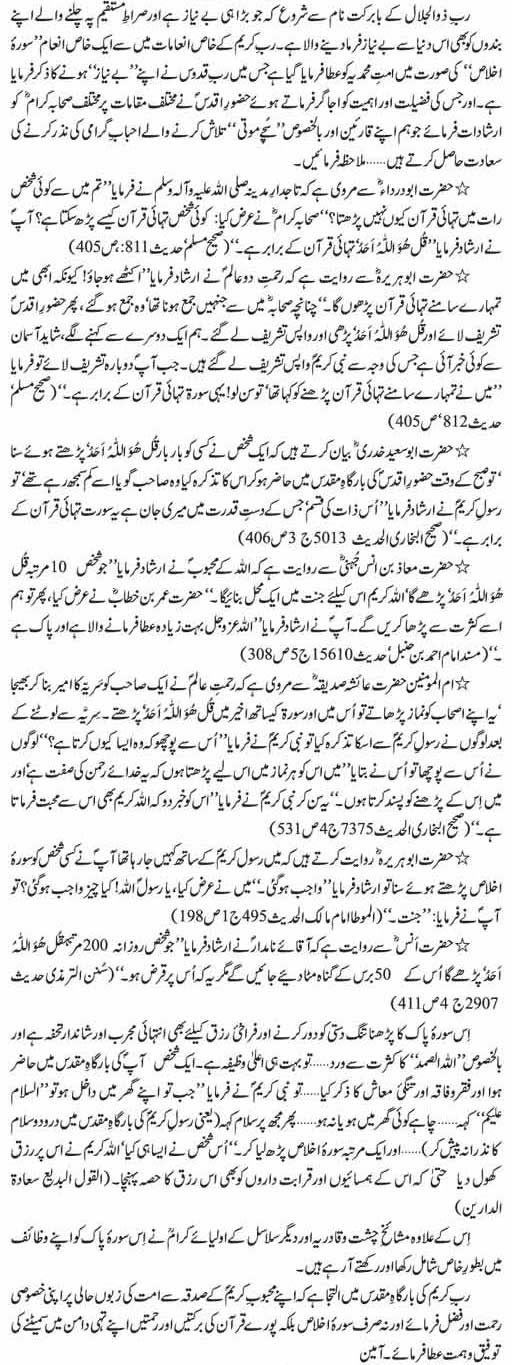
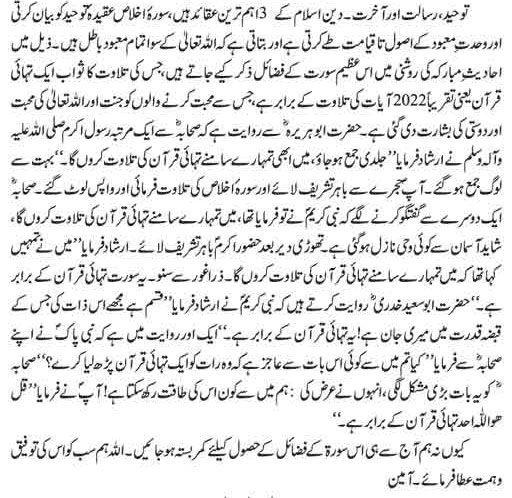
Surah Ikhlas Kay Fazail

Imbibe Spirit Of Ramadan
We Muslims must compete with one another in righteous deeds and work to alleviate the pain and suffering of the poor and needy, inspired by the spirit of the holy month of Ramadan.
This blessed month has taught us many lessons. We have to contemplate them to learn how people should be compassionate to their fellow beings, how the rich feel the suffering of the poor, and how Muslims compete with one another to win the pleasure of God. We Muslims must imbibe the true spirit of Islam, which is a religion of love, mercy and tolerance and promotes goodness, reform and dialogue.
We Muslims should participate actively in the creation of a human civilization.
The significance of Ramadan is that in this month the first verses of the Holy Qur’an were revealed to Prophet Muhammad (peace be upon him) as guidance to mankind and a criterion to differentiate between right and wrong. “Whoever fasts during Ramadan with faith and seeking reward from God will have his past sins forgiven.” a saying of the Prophet.
The role of Ramadan in deepening the qualities of kindness, forgiveness, mercy and showing sympathy to those who are less well off. It revitalizes the high values that our religion has taught us. It’s a month when the doors of the Heaven will be kept open and of Hell remain locked.
Why Is Ramadan The Month Of Qur’an?
MAY you have a happy and blessed Ramadan! It is the month of the Qur’an as well as the month of all good deeds. A Muslim is recommended to read the Qur’an and do good deeds in this blessed month as much as he can. In this context, we recall the Prophetic Hadith addressed by the Prophet (peace be upon him) to his Companions on the last day of Sha’ban: “O people! A great month has come; a blessed month in which is a night better than a thousand months; a month in which Allah has made it compulsory upon you to fast by day, and voluntary to pray by night. Whoever draws nearer (to Allah) by performing any of the (optional) good deeds in (this month), shall receive the same reward as performing an obligatory deed at any other time; and whoever performs an obligatory deed in (this month), shall receive the reward of performing 70 obligatory deeds at any other time. It is the month of patience, and the reward of patience is Paradise. It is the month of charity and a month in which a believer’s sustenance is increased. Whoever gives food to a fasting person to break his fast, shall have his sins forgiven, and he will be saved from the Hell-Fire, and he shall have the same reward as the fasting person, without his reward being diminished at all.” (Reported by Ibn Khuzaymah)
Ramadan is the month in which the Qur’an was revealed. Allah says: The month of Ramadan in which was revealed the Qur’an, a guidance for mankind, and clear proofs of the guidance, and the Criterion (between right and wrong). So whoever of you sights (the crescent on the first night of) the month of Ramadan, he must observe Saum that month . . .” (Al-Baqarah 2:185)
This verse establishes the link between Ramadan and the Qur’an. We know that the Prophet (peace be upon him) was in the habit of retreating to Mount Hira during Ramadan and it was during one of these periods of contemplation that the Archangel Gabriel appeared to him with the first revelation. So Ramadan marks the beginning of the call to Islam and the prophetic mission of Prophet Muhammad (peace be upon him).
Secondly, when Ramadan Fasting became obligatory, the Prophet (peace be upon him) used to recite the Qur’an with Gabriel. Gabriel used to descend from the heavens every night to read everything that had so far been revealed to the Prophet (peace be upon him).
Thirdly, when we offer our Taraweeh prayers, it is recommended that over the course of the month recitation of the whole Qur’an be completed. This presents a great opportunity for those who haven’t read the whole Qur’an to hear it.
Lessons And Moralities Of Fasting
RAMADAN is a month of discipline, self-control, patience, and good behavior. In Ramadan, Muslims are expected to gain the fruits of fasting, namely, piety and consciousness of Allah. In this context, Allah, Most High, says in the Glorious Qur’an : “O you who believe! Observing As-Saum (the fasting) is prescribed for you as it was prescribed for those before you, that you may become Al-Muttaqun (the pious).” (Al-Baqarah 2:183)
Also, He says: “And He it is Who has put the night and the day in succession, for such who desires to remember or desires to show his gratitude.” (Al-Furqan 25:62)
Life and death and the succession of nights and days have a purpose and that is to test us and to give us an opportunity to express our thanks and gratitude to our Creator and Sustainer. The month of Ramadan comes and goes. We must examine ourselves now and see what we have learned and achieved during this month. The test of success of this month lies in the effects it has left upon us as follows:
Discipline
We learn in this month how to discipline ourselves for the sake of Allah. We follow a strict schedule of eating and drinking. We are constantly aware that even in our such mundane activities as eating and drinking, we must follow divine injunctions. We change our habits in our daily routines because we learn that we are not the servants and slaves to our habits, but always the servants of Allah. Then after Ramadan, we have to keep this spirit of discipline in other modes of our life and must continue with our submission to the commands of Allah.
Renewal of devotional life
Ramadan renews our enthusiasm for worship and devotion to Allah. In this month we are more careful of our daily prayers and have special prayers at night. There is no religion without prayer and Muslims learn in this month how to strengthen and deepen their religious life.
Renewal of contact with the Qur’an
Ramadan and the Qur’an are linked together from the beginning. It was in this month that this divine message was revealed to Prophet Muhammad (peace be upon him). We are told that the Prophet (peace be upon him) was fasting when he received the first revelation. Fasting prepares the believers’ hearts to learn the Word of Allah. It is the most suitable condition for our spiritual and mental communication with the Qur’an. The Muslim Ummah pays more attention to the Qur’an in this month. This renewed contact with the Qur’an must help us in following its message.
Renewal of identity with the Ummah
Ramadan is not an individual experience only, but it is an experience in community. The whole Muslim Ummah fasts together in one and the same month. We identify with one another in our obedience to Allah. This gives us a new sense of togetherness and association. Ramadan teaches us that the Muslim Ummah is the community of piety and devotion to Allah and its members derive their strength from each other in deeds of piety and virtue. The bonds that are based on piety and virtue are the strongest and these bonds prove good for mankind. The strength of the Muslim community lies in its commitment to the values of goodness, morality and piety. Ramadan leaves an imprint of all these values upon the Muslim Ummah.
A fresh sense of care and sympathy
Fasting in the month of Ramadan helps us to understand the suffering and the pains of the poor and needy. By our voluntary hunger and thirst we realize what it means to be deprived of basic necessities of life. Ramadan is called the month of charity and sympathy. We learn how to be more kind and generous in this month. Many Muslims also pay their Zakah in the month of Ramadan.
Jihad or struggle
Fasting in Ramadan and Jihad both of them were prescribed in the same year, that is, the second year of Hijra in Madina. Fasting prepares for hardships and sacrifices. These are two important things without which Jihad is not possible. Muslims learn in Ramadan how to struggle against the forces of evil in their own selves, in the society around them, and in the world at large.
Taqwa
To summarize all the moral and spiritual gifts of Ramadan, we can say that Ramadan gives us the great gift of Taqwa (piety). Taqwa is the sum total of Islamic life. It is the highest of all virtues in the Islamic scheme of things. It means, God-consciousness, piety, fear and awe of Allah and it signifies submission to Allah and total commitment to all that is good and rejection of all that is evil and bad.
Ten Things About Ramadan
1 – Fasting this month is a pillar of Islam
The Prophet (peace be upon him) said: “Islam is built on five (pillars): The testimony that there is no god worthy of worship except Allah and that Muhammad is the Messenger of Allah. Establishing prayer. Paying Zakah. Fasting in Ramadan. Haj to the House (the Ka’bah).” – Bukhari and Muslim
2 – Revelation of Qur’an
“The month of Ramadan in which was revealed the Qur’an, a guidance for mankind and clear proofs for the guidance and the criterion (between right and wrong)…” (Qur’an, 2:185)
“Verily, We have sent it (this Qur’an) down in the Night of Al-Qadr (Decree).” (Qur’an, 97:1)
3 – Laylat-al-Qadr (Night of Decree) is in this month
The Night of Al-Qadr (Decree) is better than a thousand months (i.e. worshiping Allah in that night is better than worshiping Him a thousand months, i.e. 83 years and 4 months).
“Therein descend the angels and the Rooh [Jibreel (Gabriel)] by Allah’s Permission with all Decrees, (all that night), there is peace (and goodness from Allah to His believing slaves) until the appearance of dawn” (Qur’an, 97:1-5)
4 – Forgiveness of sins
The Prophet (peace be upon him) said: “Whoever fasts Ramadan out of faith and in the hope of reward, his previous sins will be forgiven.” – Bukhari and Muslim
The Prophet (peace be upon him) said: “Whoever spends the nights of Ramadan in prayer out of faith and in the hope of reward, his previous sins will be forgiven.” – Bukhari and Muslim
5 – Paradise opens and Hell closes
The Messenger of Allah (peace be upon him) said: “When Ramadan comes, the gates of Paradise are opened and the gates of Hell are closed, and the devils are chained up.” – Bukhari and Muslim
6 – Every night people are saved from Hell
The Prophet (peace be upon him) said, “At every breaking of the fast, Allah has people whom He redeems.” – Musnad Ahmad – classed as saheeh by Al-Albani
7 – Equivalent to fasting 10 months
The Prophet (peace be upon him) said: “Whoever fasts Ramadan then follows it with six days of Shawwaal, it will be like fasting for a lifetime.” – Saheeh Muslim
The Prophet (peace be upon him) said: “Whoever fasts Ramadan, a month is like ten months, and fasting six days after al-Fitr will complete the year.” – Musnad Ahmad
8 – Taraweeh equivalent to praying all night
The Messenger of Allah (peace be upon him) said, “Whoever prays qiyaam with the imam until he finishes, it will be recorded for him that he spent the whole night in prayer.” – Abu Dawood – Classed as saheeh by Al-Albaani in Salaat Al-Taraaweeh, p. 15
9 – Umrah equivalent to Hajj
The Messenger of Allah (peace be upon him) said, “When Ramadan comes, go for ‘Umrah, for ‘Umrah in Ramadan is equivalent to Haj.” (Bukhari) According to a report narrated by Muslim, “… is equivalent to doing Haj with me.”
10 – Offering Iftar
The Messenger of Allah (peace be upon him) said, “Whoever gives iftaar to one who is fasting will have a reward like the fasting person, without detracting from the fasting person’s reward in the slightest.” – Tirmidhi and Ibn Maajah – classed as saheeh by Al-Albani
A Test Too Hard
They came upon you from above and from below you. Your eyes rolled (with fear) and your hearts leapt up to your throats, and confused thoughts about God passed through your minds. That was a situation when the believers were sorely tested and severely shaken.
The hypocrites and the sick at heart said: “God and His Messenger promised us nothing but delusions.” Some of them said: “People of Yathrib! You cannot withstand (the attack) here, so go back.” And a group of them asked the Prophet’s permission to leave, saying: “Our houses are exposed,” while they were not exposed. They only wanted to run away. (The Confederates Al-Ahzab: 33: 10-13)
The Qur’an is not merely a book to be read and understood: it is a motivating force. Its texts are ready for implementation at every point. It only needs a heart that warms to it in circumstances that enable its resources to be fully tapped. We may read a particular Qur’anic text tens or hundreds of times, then we look at it again when we are facing a particular situation only to discover that it gives us what it had not given before. It provides a straight answer to our complex problem, shows a way that we overlooked, clears our doubts and replaces these with firm and perfect reassurance. Nothing else, old or new, gives us what the Qur’an gives.
The surah begins its discussion of the encounter with the confederate forces by reminding the believers of God’s favors when He repelled the armies that were intent on exterminating them. The first verse in the passage sums up the nature of the event, its beginning and end, before giving any details or explaining any attitudes. Thus, God’s favor is brought into focus so that the Muslims will always remember it. It also makes it clear that as God commands the believers to follow His revelations, place their trust in Him and not yield to the unbelievers or the hypocrites, it is also He who protects those advocating His message and code for human life against aggression: “Believers! Remember the blessings God bestowed on you when hosts came down upon you. We let loose against them a windstorm and hosts that you could not see. Yet God sees all that you do.” (Verse 9)
In this short opening verse we have a picture of the beginning and end of the battle, along with the decisive factors that combine to produce its result: the arrival of the enemy forces; God’s sending strong winds and other troops unseen by the believers; and His support which is dependent on their attitude and action as God is fully aware of all that they do.
The surah then gives details of the situation: “They came upon you from above and from below you. Your eyes rolled (with fear) and your hearts leapt up to your throats, and confused thoughts about God passed through your minds. That was a situation when the believers were sorely tested and severely shaken. The hypocrites and the sick at heart said: ‘God and His Messenger promised us nothing but delusions.’ Some of them said: ‘People of Yathrib! You cannot withstand (the attack) here, so go back.’ And a group of them asked the Prophet’s permission to leave, saying: ‘Our houses are exposed,’ while they were not exposed. They only wanted to run away.”
The verses paint an image of the whole of Madinah in the grip of great alarm and distress, with the idolaters of the Quraysh and Ghatafan allied with the Jews of Qurayzah moving in from all sides. These feelings of alarm and distress affected all of the people, but their reactions and responses differed. Needless to say, people’s thoughts about God, their behavior, and their evaluation of causes and results were much at variance. Therefore, the test was extremely difficult and the distinction between believers and hypocrites was decisive.
We can see today the whole situation: its elements, feelings, actions and reactions as if it were happening before our eyes. We see it though from the outside: “They came upon you from above and from below you.” We also see people’s reactions to what was unfolding: “Your eyes rolled (with fear) and your hearts leapt up to your throats.” This is a picture of profound fear, anxiety and distress, imparted through people’s expressions and feelings. “Confused thoughts about God passed through your minds.” The surah does not tell us about these thoughts in detail. In fact the adjective “confused” is implied rather than stated in the Arabic text. This gives a more vivid picture of the confusion in people’s feelings and ideas, leaving minds bewildered and perplexed. Such a state of fear and confusion is then further heightened: “That was a situation when the believers were sorely tested and severely shaken.”
A test that left the believers severely shaken must have been truly fearful. Muhammad ibn Maslamah and others said: “During the Moat Encounter our nights were days. The unbelievers took it in turns to confront us, with Abu Sufyan showing up at the head of his troops one day, Khalid ibn Al-Walid with his forces the next day, Amr ibn Al-As the next, Hubayrah ibn Wahb the next, followed by Ikrimah ibn Abi Jahl, and lastly by Dirar ibn Al-Khattab. This was very hard for us, and people were really in fear.”
A further description of the state in which the Muslims found themselves is given by Al-Maqrizi in Imta Al-Asma: “The idolaters appeared at dawn, and the Prophet (peace be upon him) mobilized his companions and the two sides engaged in fighting throughout the day and part of the night. Neither the Prophet nor any Muslim could move out of position. The Prophet could not offer any of the Dhuhr, Asr, Maghrib and Isha’ prayers. His companions said to him: ‘Messenger of God! We have not prayed.’ He said: ‘Nor have I.’ Then the idolaters withdrew and each side went back to their encampments. On another day, Usayd ibn Hudayr stood guard on the edge of the moat, at the head of 200 Muslims. Mounted forces of idolaters, commanded by Khalid ibn Al-Walid tried to take them unawares, but the two sides were engaged in fighting for sometime. Wahshi, who had killed Hamzah, the Prophet’s uncle, during the Battle of Uhud, stabbed Al-Tufayl ibn Al-Nu’man Al-Ansari with a spear and killed him. On that day, the Prophet said: ‘The idolaters have kept us from our middle prayer of Asr. May God fill their bellies and hearts with fire.'”
Relationship With The Qur’an: Basic Prerequisites
CERTAIN basic states and attitudes of the heart and mind are necessary prerequisites to any fruitful relationship with the Qur’an. Develop them as much as you can. Make them part of your consciousness, keep them ever-alive and active. Integrate them in your actions. Let them penetrate the depth of your being. Without the help of these inner resources you will not receive your full measure of the Qur’an’s blessings. They will be your indispensable companions too, throughout your journey.
1. Faith: The Word Of God
Come to the Qur’an with a strong and deep faith that it is the word of Allah, your Creator and Lord.
Why should such a faith be a necessary prerequisite? No doubt such is the power and charm of the Qur’an that even if a man takes it up and starts reading it as he would an ordinary book, he will still benefit from it, should he read it with an open mind. But this book is no ordinary book, it opens with the emphatic statement : (This is the Book (the Qur’an), whereof there is no doubt . . . ) (Al-Baqarah, 2:2). Your purpose in reading and studying it is no ordinary purpose. You seek from it the guidance that will transform your whole being, bring you and keep you on the Straight Path: (Guide us to the Straight Way) (Al-Fatihah, 1:5) is the cry of your heart to which the Qur’an is the response.
You may admire the Qur’an, even be informed by it, but you cannot be transformed by it unless its words soak in to awaken you, to grip you, to heal, and to change you. This cannot happen unless you take them for what they truly are, the words of God.
That is why the Qur’an reminds you of this important truth again and again: in the very beginning, in the opening verses of many surahs, and frequently in between.
That is why even the Messenger (peace and blessings be on him) is instructed to proclaim his own faith, and all believers must join him: (The Messenger (Muhammad, peace be upon him) believes in what has been sent down to him from His Lord, and (so do) the believers.) (Al-Baqarah, 2:285).
You must, therefore, always remain conscious that each word that you are reading, reciting, hearing, or trying to understand has been sent for you by Allah.
2. Purity Of Intention
Read the Qur’an with no purpose other than to receive guidance from your Lord, to come nearer to Him, and to seek His good pleasure.
What you get from the Qur’an depends on what you come to it for. Your niyyah (intention and purpose) is crucial. Certainly the Qur’an has come to guide you, but you may also go astray by reading it should you approach it for impure purposes and wrong motives. (Al-Baqarah 2:26).
The Qur’an is the word of Allah, it therefore requires as much exclusiveness of intention and purity of purpose as does worshiping (in prayer) and serving Him.
Do not read it merely for intellectual pursuit and pleasure, even though you must apply your intellect to its fullest for the task of understanding the Qur’an. So many people spend a lifetime in studying the language, style, history, geography, law, and ethics of the Qur’an, and yet their lives remain untouched by its message. The Qur’an frequently refers to people who have knowledge but do not derive benefit from it.
You may also derive other lesser benefits from the words of the Qur’an, such as the healing of bodily afflictions, psychological peace, and deliverance from poverty. There is no bar to having these, but again, they should not become the be-all and end-all that you seek from the Qur’an nor the goal of your niyyah. For in achieving these you may lose a whole ocean that could have been yours.
Finally, your niyyah should be directed to seeking only your Lord‚s pleasure, by devoting your heart, mind, and time to the guidance that He has sent to you. That is what you barter when you surrender yourself to Allah : (And of mankind is he who would sell himself, seeking the Pleasure of Allah . . .) (Al-Baqarah 2:207).
Purpose and intentions are like the soul of a body, the inner capability of a seed. Many seeds look alike, but as they begin to grow and bear fruits, their differences become manifest. The purer and higher the motive, the greater the value and yield of your efforts.
So always ask yourself: Why am I reading the Qur’an? Tell yourself constantly why you should. This may be the best way to ensure the purity and exclusiveness of purpose and intention.
Miscellaneous Hadiths
On the Day of Resurrection, there will be no money to compensate
Narrated by Abu Huraira(Radhiallaho anho):
Allah’s Messenger (sallallaahu ‘alaihi wasallam) said, “Whoever has oppressed another person concerning his reputation or anything else, he should beg him to forgive him before the Day of Resurrection when there will be no money (to compensate for wrong deeds), but if he has good deeds, those good deeds will be taken from him according to his oppression which he has done, and if he has no good deeds, the sins of the oppressed person will be loaded on him.”
Sahih Al-Bukhari Vol. 3 : No. 629
The recitation of the Qur’an at dawn
Narrated by Ibn Al Musaiyab(Radhiallah o anho):
Abu Huraira said, “Allah’s Messenger (sallallaahu ‘alaihi wasallam) said,’A prayer performed in congregation is twenty-five times more superior in reward to a prayer performed by a single person. The angels of the night and the angels of the day are assembled at the time of the Fajr (Morning) prayer.”
Abu Huraira added, “If you wish, you can recite: ‘Verily! The recitation of the Qur’an in the early dawn (Morning prayer) is ever witnessed (attended by the angels of the day and the night).’ ” (17.78)
Sahih Al-Bukhari Vol. 6 : No. 241
After listening to the Adhan
Narrated by Jabir bin Abdullah(Radhiallah o anho):
Allah’s Messenger (sallallaahu ‘alaihi wasallam) said, “Whoever, after listening to the Adhan (for the prayer) says, ‘O Allah, the Lord of this complete call and of this prayer, which is going to be established! Give Muhammad Al-Wasila and Al-Fadila and raise him to Al-Maqam-al- Mahmud which You have promised him,’ will be granted my intercession for him on the Day of Resurrection. ”
Sahih Al-Bukhari Vol. 6 : No. 243
Milking an animal without permission
Narrated by Ibn Umar(Radhiallaho anho):
Allah’s Messenger (sallallaahu ‘alaihi wasallam) said, “An animal should not be milked without the permission of its owner. Does any of you like that somebody comes to his store and breaks his container and takes away his food? The udders of the animals are the stores of their owners where their provision is kept, so nobody should milk the animals of somebody else, without the permission of its owner.”
Sahih Al-Bukhari Vol. 3 : No. 614
O Allah! I seek refuge with You from miserliness
Narrated by Anas bin Malik(Radhiallaho anho):
Allah’s Messenger (sallallaahu ‘alaihi wasallam) used to invoke thus: “O Allah! I seek refuge with You from miserliness; laziness; from old geriatric age; the punishment in the grave; from the affliction of Ad-Dajjal; and from the afflictions of life and death. ”
Sahih Al-Bukhari Vol. 6 : No. 230
one-hundred bad deeds will be wiped off
Narrated by Abu Huraira(Radhiallaho anho):
Allah’s Messenger (sallallaahu ‘alaihi wasallam) said, “If one says one-hundred times in one day: “None has the right to be worshipped but Allah, the Alone Who has no partners, to Him belongs Dominion and to Him belong all the Praises, and He has power over all things (i.e. Omnipotent)” , one will get the reward of manumitting ten
slaves, and one-hundred good deeds will be written in his account, and one-hundred bad deeds will be wiped off or erased from his account, and on that day he will be protected from the morning till evening from Satan, and nobody will be superior to him except one who has done more than that which he has done.”
Sahih Al-Bukhari Vol. 4 : No. 514