TAG: Quran
Modern Stress And Its Cure From Qur’an
Stress is the most common aliment of the modern age. It has been implicated in the causation of peptic ulcer disease, coronary heart disease, depression, autoimmune disease, hypertension, diabetes, and even cancer. In a milder form, it manifests in the form of unrest, violence, at work, school, and home. Common medical problems like tension headache, insomnia, and obesity are also attributed to unusual stress. None of us are free from stress but some deal with it better than others.
Stress results from the following factors:
a. Fear of the unknown and trying to see through and control destiny.
b. Losses in our life of people and things dear to us and our inability to recover those losses.
c. Inner conflict between our heart and mind between what is known to be the truth and our failure to accept it as truth. Acceptance of truth may require changing our habits and way of life which we may adhere to for some reason like pleasure, joys, taste, pride in race or heritage, etc.
Let us examine how the Quran deals with such situations.
Our losses are a trial for us:
“Be sure we will test you with something of fear and hunger, some loss in goods or lives, but give glad tidings to those who are steadfast, who say when afflicted with calamity: To God we belong and to Him is our return. They are those on who (DESCEND) blessings from God and mercy and they are the once that receive guidance .” 2:155
Thus in Islam, we do not have the concept of the ownership of goods and life. Everything belongs to God and returns to him. So if we don’t own that thing why mourn our loss?
a. Our destiny is predetermined. We do not have control over that part. What we have control over is a limited free will, that is our actions, our choice to do good or bad, to believe in God or not to believe in Him, but we have no control over tomorrow’s event not related to our actions i.e. whether my wife will have a son or daughter, whether his/her eyes will be brown or black, or whether I will have an accident or not tomorrow. worrying over such things is of no use.
b. Rejection of faith in the Quran is called a disease. This denial of truth is due to arrogance.
“In their heart, there is a disease and God has increased their disease and grievous is their penalty because they lie to themselves.” 2:10
Therefore after lying to ourselves, we set up an inner conflict – between heart and mind. In order to contain that conflict, the mind sends signals to glands for secretion of hormones like adrenaline which leads to rapid heart rate, perspiration, tremor, the basis of lie detector test.
This lying conflict could be due to “SMALL” crimes like theft or adultery, or big crimes like the rejection of God.
Three stages of spiritual development of soul age:
a. Nafsul Ammara: – The Passionate soul “I do not absolve myself Lo the (human) soul is prone to evil, save that whenever my Lord has mercy. Lo, Lord is forgiving; merciful.” 12:53 (Surah Yusuf)
This soul inclines toward sensual Pleasure, passion and self-gratification, anger, envy, greed, and conceit. Its concerns are the pleasure of body, the gratification of physical appetite, and ego.
Hadith “your most-ardent-enemy is your evil self which resides within your body” (Bukhaii).
If this evil soul is not checked will leads to unusual stress and its resultant effects.
b. Nafsul Lawanunah (The Reproaching Soul). “Nay, I swear by the reproaching soul” 75:1
This soul is conscious or aware of Evil, resists it, asks for God’s grace, and pardon, repents and tries to amend and hopes to achieve salvation.
“And (There are) others who have acknowledged their faults. They mix a righteous action with another that was bad. It may be that Allah will relent toward them. Lo! Allah is relenting, merciful.” 9:102
Hadith “These are two impulses within us. One spirit which calls towards good and confirms the truth. He who feels this impulse should know that it comes from Allah. Another impulse comes from our enemy (Devil) which leads to doubt and holds untruth and encourages evil. He who feels this should seek refuge in Allah from the accursed devil.”
This soul warns people of their vain desire, guides, and opens the door to virtue and righteousness. It is a positive step in spiritual growth.
c. The satisfied soul (Nafsul Mutmainnah). “O (you) soul in (complete) rest and satisfaction. Come back to your Lord, will pleased (yourself) and will pleasing unto him. Enter you then among my devotees, enter you in my heaven.” 89:27-30
This is the highest state of spiritual development. the satisfied soul is the state of bliss, content, and peace. The soul is at peace because it knows that in spite of its failures in this world, It will return to God. Purified of tension, it emerges from the struggle with obstacles blocking the peace of mind and heart.
What should we do in panic and despair? In a panic, non-believers behave differently than believers. They have no one to return to, to ask for mercy and forgiveness, their life is this life, which they cannot control, thus get more depressed and increase in their state of wrongdoing. Then we will see that if they are used to casual drinking will start drinking more and become alcoholic, or a barbital criminal.
On the other hand, a believer should do the following:
a. Increase dhikr (Remembrance of God)
“who have believed and whose heart have Rest in the remembrance of God. Verify-in the remembrance of God, do hearts find rest.” 13:28
b. Increase their prayer.
“O you who believe, seek help with steadfastness and prayer. For God is with those who are steadfast.” 2:153
c. Ask forgiveness
“And I have said: seek forgiveness from your Lord. Lo He was ever forgiving.” 71:10
In addition to above, we are also asked to continue to struggle to up-grade ourselves.
” Surely God does not change the condition in which a people are in until they change that which is in themselves.” 13:11
In summary, stress results from a lack of inner peace due to conflicts within us and leads to external disturbances in our behavior and health. Inner peace can only be achieved by believing in God, the All-Mighty, and remembering him frequently and asking for his help and forgiveness in times of difficulties.
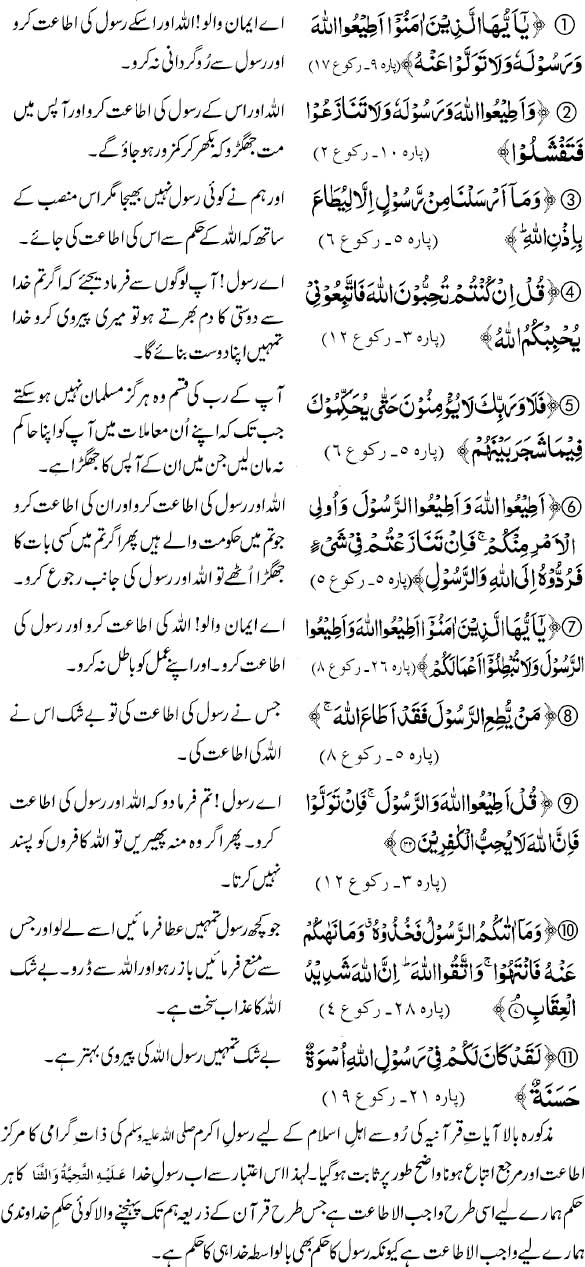
Itaat-e-Rasool Quran Ki Roshni Main

Islam’s Accent On Justice
DOING justice is one of the key features of the Qur’anic teachings. It has been specifically termed as akin to piety (5:8). Its importance and practice have been emphasized in several ways. One is when the Qur’an directly enjoins the believers to do justice and refrain from doing injustice (16:90).
The other is when the Qur’an says that Allah loves those who do justice (5:42) and warns those who carry the burden of the sins of inequities (injustices) (20:111) with a categorical declaration that for unjust there will be no helpers. The third is when the Qur’an enjoins the believers to be firm and foremost in doing justice for the sake of Allah (4:135). Normally whatever a person does, he does it for his own sake. But through this verse, the Qur’an enjoins the believers to do justice for the sake of Allah which shows how important doing justice is.
There are three factors that invariably take one away from the path of justice. One is lust, the other is affiliation or relationships and the third is enmity. The Qur’an expressly exhorts believers not to be influenced by these factors.(38:26).
The Qur’an enjoins the believers to do justice even if it may be harmful to themselves, or to their parents or to their relatives and irrespective of the fact that the party concerned is rich or poor (4:135). It means that they have to do justice uninfluenced by self-interest or any other affiliation or motive. The Qur’an further exhorts the believers to be so steadfast in doing justice that their enmity with some people should not turn them away from the path of justice (5:8). In other words, they have to be just even to enemies.
The Qur’an not only highlights the importance of justice but also tells us how to do justice when it says: “Indeed We have sent Our Messengers with clear proofs, and revealed with them the Scripture and the Balance (justice) that mankind may keep up justice.” (57:25).
The verse, in fact, tells us that Allah sent His Messengers and with them the Books to enlighten the people, among other things, on the importance of balance so that they learn how to do justice.
The word “Balance” implies the maintenance of equilibrium. In the sphere of human activities when the norms of balance are applied in the exercise of discretion, whether in relation to one’s self or in relation to others or in the exercise of authority or in the delivery of judgment or decision in regard to others in general and their rights and obligations in particular, it is called justice.
Dispensation of justice assumes particular significance when it is in regard to the determination of the rights or obligations, or the guilt or innocence of others. The modern jurisprudence has identified three principles commonly known as the principles of natural justice the observance of which could be sine qua non to the doing of justice. One is that no one shall be condemned without being given a hearing. The other is that justice shall not only be done but shall manifestly be seen to be done. The third is that no one shall be a judge in his own case. All these principles are in the observance of the norms of balance as enjoined by the Qur’an.
The first and foremost requirement of observing the norms of balance could be that every allegation must be made by an appropriate explanation. The person alleged to have done something wrong, or to have failed to discharge an obligation, must have an opportunity to explain his position in respect of the allegation. Without such an opportunity it will not be possible to observe the norms of balance. The decision of Prophet Dawud (David) in the dispute between the two brothers over the ownership of a ewe (38:22,23) could be the best example.
Although the decision of Dawud was manifestly right in spite of that he fell down prostrate and sought Allah’s forgiveness after giving the decision, the only plausible explanation of which could be that it occurred to him that he gave his decision without hearing the other party. The principle that could be deduced from this story would be that no one shall be condemned without a hearing even if he is manifestly wrong.
The other requirement of observing the norms of balance could be that the person giving decision in the dispute between the parties gives equal opportunities to the parties to present, plead and defend their claims and positions, as the case may be, weighs the evidence adduced and the arguments and counter-arguments put forward on even scales, gives due consideration to the contentions raised and pleas by the parties and delivers judgment on merit, uninfluenced by any extraneous consideration. This, in other words, implies that justice shall not only be done but shall manifestly be seen to be done.
The third requirement of observing the norms of balance could be that the person giving the decision in a dispute involving the rights and obligations of others is unbiased and has no personal interest in the case. Balance is disturbed when the person giving the decision is biased or becomes a judge in his own cause. This is the third principle of natural justice deducible from the observance of the norms of balance as enjoined by the Qur’an.
An excellent example of the observance of the norms of balance cited by the Qur’an could be when the standing crop in the farm of a person was destroyed by the sheep of another person. The matter came up for decision before Dawud who ruled that all of the sheep should be given to the owner of the farm. Prophet Sulaiman (Solomon) came to know about the decision who said if he were to decide the matter he would have given a different decision.
When Dawud heard about it, he called his son Sulaiman and asked him what decision would he have given in the matter. Sulaiman said his decision would have been to give the sheep in the charge of the owner of the farm so that he could make use of them and the owner of the sheep would have been asked to sow seed in the farm and raise another crop. When the crop reached the same stage, in which it was when destroyed, the farm was to be given to its owner and the sheep returned to their owner. Dawud agreed and pronounced the same decision.
The doing of justice, whether in matters involving the rights and obligations of parties or the liability of persons, civil or criminal, largely depends on evidence. It is because of this reason that the Qur’an lays special emphasis on the production of proper and relevant evidence. As it says: “And mix not truth with falsehood, nor conceal the truth while you know.” (2:42). It says again: “And conceal not the evidence, for he who hides it, surely, his heart is sinful . . .” (2:283) and to be staunch and firm in giving evidence (4:135).
Some Of The Symptoms, Avoidance And Cures Of Sins
Narrated by Abu Huraira, The Prophet (sallallahu alaihe wa-sallam) said “Avoid the seven great destructive sins” the people asked O Allah Messenger ! what are they? He said, “To join others in worship along with Allah, to practice sorcery, to kill the life which Allah has forbidden except for a just cause, to eat up Riba (usury, interest), to eat up an orphan’s wealth, to show one’s back to the enemy and fleeing from the battlefield at the time of fighting and to accuse chaste women, who never even think of anything touching their chastity and are true believers”.[19]
Narrated by Abdullah bin Amr that the Prophet (sallallahu alaihe wa-sallam) said “Whoever has the following four (characteristics) will be a pure hypocrite and whoever has one of the following four characteristics will have one characteristic of hypocrisy unless and until he gives it up.
1. Whenever he is entrusted, he betrays (proves dishonest).
2. Whenever he speaks, he tells a lie.
3. Whenever he makes a covenant, he proves treacherous.
4. Whenever he quarrels, he behaves in a very imprudent, evil, and insulting manner.” [20]
Narrated by ‘Aishah that the Prophet (sallallahu alaihe wa-sallam) said “The most hated person to Allah is the one who is most quarrelsome of the opponents” [21]
Narrated by Abu Huraira that Allah’s Messenger (sallallahu alaihe wa-sallam) said “Part of a man’s good observance of Islam is that he leaves the things which do not concern him” ( i.e. avoiding interference with other’s matters).[22]
Narrated by Ibn Abbas that Allah Messenger (sallallahu alaihe wa-sallam) passed by two graves and said “Both of them are being tortured, and they are not being tortured for a major sin. This one used not to save himself from being soiled with his urine, and the other used to go about with calumnies” [23]
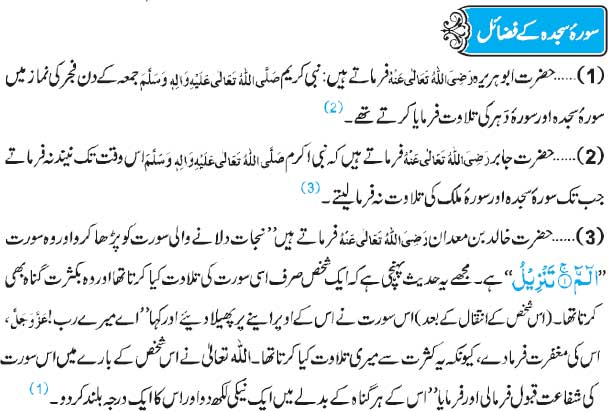
The Qur’an: Narrated by Uthman, The Prophet (sallallahu alaihe wa-sallam) said: “The best among you (Muslims) are those who learn the Qur’an and teach it (to others).” [24]
Ibn Masood reported that the Prophet (sallallahu alaihe wa-sallam) once said: “Whoever reads a single letter from Allah’s Book will receive a blessing and each blessing is worth ten times its value.”[25] Abu Umaamah reported that the Prophet (sallallahu alaihe wa-sallam) said “Recite the Qur’an for verily on the Day of Resurrection it will act as an intercessor for its companions (those who read it often).[26]
Prayer ( Salat ) [27] To offer salat at its appointed time as narrated by Abdullah ibn Masud ‘I asked the Prophet (sallallahu alaihe wa-sallam) Which deed is the dearest to Allah? He said, “To performs-Salat at their early fixed times……. “[28] Bearing in mind salat is to performed as the prophet ordered us to pray “Perform your salat the way you see me performing them” [29]
Fasting (Saum) and Charity (Sadaqah)[30] Mu’adh bin Jabal narrates: “The Prophet (sallallahu alaihe wa-sallam) said to him “May I show you the gates of goodness? (They are) Fasting is a screen from hell, As-Sadaqah extinguishes the sins as the water extinguishes the fire, Standing in prayer by a slave of Allah during the last third part (Tahajjud) of a night” Then the Prophet (sallallahu alaihe wa-sallam) recited (V.32:16) “Their sides forsake their beds”.[31]
Abu Huraira narrates that the Prophet (sallallahu alaihe wa-sallam) said “Every day two angels come down from heaven and one of them says ‘O Allah! Compensate every person who spends in your cause,’ and the other (angel) says, ‘O Allah! Destroy every miser.'” [32]
Seeking Knowledge
Reported by Anas “Seeking knowledge is obligatory on every Muslim” [33]
Reported by Abu ad-Dardaa that he heard the Prophet (sallallahu alaihe wa-sallam) say “If anyone travels on a road in search of knowledge, Allah will cause him to travel on one of the roads of paradise. The angels will lower their wings because of their pleasure with one who seeks knowledge, and forgiveness will be asked for him by the inhabitants of the heavens and earth and the fish in the depth of the oceans…” [34]
Adhering to the Sunnah
Reported by Abu Huraira that the Prophet (sallallahu alaihe wa-sallam) said “I have left with you two things, if you hold on firmly to them, you will never go astray; Allah’s Book and my Sunnah.” [35] Abu Huraira narrates that Allah’s Messenger (sallallahu alaihe wa-sallam) said, “All my Ummah will enter paradise except those who refuse” They asked O Allah’s Messenger! who will refuse? He Said “Whoever obeys me will enter paradise, and whoever disobeys me is the one who refuses (to enter paradise)” [36]
Avoiding Bidah (Innovation)
Abdullah ibn Masoud relates that Allah’s Messenger (Pubh) drew a line for them one day and then Said “This is Allah’s path”, then he drew several lines (branching off) to the right and to the left and said, “These are the paths (of Misguidance) on each of which is a devil inviting people to follow it” and then he recited (the verse) “Verily this is my path, leading straight, so follow it. And do not follow the (other) paths for they will scatter you about from (Allah’s) path. This is His Command to you in order that you may be conscious of Allah.[37]”[38]
Aisha reported that the Prophet (sallallahu alaihe wa-sallam) said “Whoever introduces something new into this religion of ours which does not belong in it will have it rejected” [39] (i.e., it will not be accepted by Allah.
Imitating the Kufaar
The Prophet (sallallahu alaihe wa-sallam) has warned us in regards to imitating the Kufaar, Abu Saeed al-Khudree reported that Allah’s Messenger (sallallahu alaihe wa-sallam) said: “You will follow the practices of your predecessors, inch by inch and yard by yard, so much so that if they were to enter a lizard’s hole you would also follow them.” He then asked if he meant the Jews and the Christians and He replied “Who Else?” [40] The Prophet (sallallahu alaihe wa-sallam) also warned us saying: “Whoever resembles a people, he is one of them” [41] The Prophet (sallallahu alaihe wa-sallam) also cursed men who tried to resemble woman and women who tried to resemble men.[42]
We ask Allah, the Highest, that He turns the misguided of this Ummah back to the guidance, and that he makes us all support one another and aid one another in carrying out good and righteousness until we return to this Ummah its lost glory and honor, Indeed He is fully able and have the power to do that.
Taqwa: Valuable Fruit Of Fasting
THE Islamic fast is unique and different from other types of fasting observed in other religions. It is obligatory, for a specific period of time from dawn to dusk, and in a specific lunar month called Ramadan.
It involves a voluntary renunciation of all appetites and desires of the flesh during that month for defined hours, with cheerful and willing acceptance of this beneficial divine mandate.
Sunset signifies the achievement of one s victory over himself during the day.
This blessed month of Ramadan inculcates a spirit of fortitude and gratitude. The atmosphere of the month is such that positive thoughts are automatically invoked on a 24-hour basis. Such thoughts, which wish the welfare of one and all, Muslims as well as non-Muslims, including those who have wronged us!
A stable monotonous environment of eating three times daily tends to produce stereotyped reactionary patterns. Fasting gives a variable environment with rigid strategies and sufficient degrees of freedom to cope with the changing conditions.
Some of us may be habituated to a particular type of vice or wrong-doing – e.g. gambling, smoking, drinking, backbiting, fraud, hot temper, domestic violence, etc.
Whatever foul we are habituated to, becomes our routine and it becomes difficult to resist. Fasting helps to overcome such habits either gradually for some of us or immediately for those with stronger will power, especially if supported by constant supplications seeking Allah s assistance. The usual antidote is to put an entirely opposite thought in the mind to displace the negative trend.
This act of self-restraint in Ramadan strengthens the will and hence, the will power. This extra will power helps to overcome obsessions and addictions. In fact, fasting also reduces a criminal’s urge to commit dangerous crimes.
During the Islamic fast, every organ in the body that has been given to us as a trust by Allah is put to a critical test.
A hunger strike is not an Islamic fast. We must not see evil, hear evil, utter evil nor act evil. This is a training session for us to develop Taqwa (God-consciousness) and piety, as well as to show gratitude for the great favor of the revelation of the Holy Qur’an during the month of Ramadan in the night called Lailatul-Qadr.
Taqwa is the most valuable fruit of fasting. Just as plants have their own season of flowering, so is Ramadan the season of the year for blossoming of goodness, virtue and piety in the Muslim ummah (nation). Not one, but millions of people jointly water the garden of virtue in the same lunar month, all over the world.
The purpose of the Islamic fast is to obey Allah’s command. Through this exercise, Muslims can develop a balanced personality and a strong sense of a community of believers. It trains all those who volunteer for service to Allah, before allowing them to take on the job of His vicegerency and establish Allah’s message of mercy on Earth.
The fasting Muslim is continuously tied with rules and regulations for one full month and then released for 11 months to see whether the training has been adequate and effective and if not, any deficiency found in the personality and will power could be corrected and made up in the following year s refresher course, in the Ramadan program. This is because Allah wants us to make the choice and behave well when left alone and unattended. The personality develops when a person is free to do any wrong as he would like, but does not do it under unrestricted conditions; e.g. during the 11 months following the Ramadan fast.
If we have passed this first part of the examination, then as Muslims who adhered to the five pillars of Islam and fasted, we are entitled to celebrate Eid Al-Fitr (Feast of breaking the fast), also called Eid Al-Saghir (the Minor Feast).
Then Allah gives us two months and 10 days to prepare for Eid Al-Adha (Feast of Sacrifice), also called Eid Al-Kabir (the Major Feast).
The Minor Feast will entitle us to climb up the ladder one step toward becoming mu’mineen (believers), because we must now learn to sacrifice our time, money, leisure, pleasure, skill, along with other talents, God-given gifts, and bounties, then be prepared to share them with our fellow human beings.
As believers adhering to the seven branches of iman (faith and belief) we must not only think of but actually perform good deeds.
This, in turn, will now prepare us for the second examination of higher spiritual achievement. And, if successful, we will be entitled to celebrate the Major Feast as believing men and believing women then go up one more rung on the ladder up Sirat Al-Mustaqim (the Straight Path).
During Ramadan, we get up for suhoor before dawn, then stop eating and drinking at the break of dawn, abstain from such and such actions during the day and take Futoor (break the fast) in the evening, at the exact time of sunset. This is precise timing. The month of fasting teaches us to respect the time and be precise in our dealings and timings and to be punctual at all times.
The exact timing of initiating of the fast at the break of dawn and breaking it at sunset with the right countdown to the last minute, teaches us the limits between right and wrong, between halal (permitted) and haram (prohibited), which is so essential for the elevation of the soul to a higher level on the spiritual scale.
A person who can rule his/her desires and make them function as he likes, has attained true moral excellence! A 425-hour of intensive study in any particular subject of one’s choice in any university would qualify one in that particular subject.
Similarly, 425 hours of intense devotion in Ramadan should certainly uplift a practicing Muslim to a state of higher spiritual achievement and earn him a reward from Allah.
During Ramadan, we also learn to inculcate in ourselves the art of patience. This, together with lessons and reminders to forgive all those who wronged us, add their own quota of enhancing our personality and outlook on life, with multiple benefits, not only in this life but also in the Hereafter.
Ramadan: The Month of the Qur’an
THE Noble Qur’an was revealed in the month of Ramadan (Al-Qur’an, 97:1-3.). Because of this strong relationship between the Qur’an and the month of Ramadan, Prophet Muhammad (peace be upon him) used to read the Qur’an to Archangel Jibreel every Ramadan. I think this is the right place to discuss the purpose and objective of the revelation of the Qur’an, its importance, the campaigns against it, and the dos and don’ts of the Qur’an.
The Qur’an represents the culmination of all other earlier Revealed Books. The Qur’an is the last of the Revealed Books. The Qur’an is the first religious book in the world, which requires the belief in other revelations, a part of its Faith. This Sacred Book was revealed to the last Messenger, Prophet Muhammad (peace be upon him) in the month of Ramadan. Allah Himself said in the Qur’an: “Ramadan is the (month) in which was sent down the Qur’an, as a guide to mankind, also clear (Signs) for guidance and judgment (between right and wrong).” (2:185). Allah the Most High has especially mentioned the exact date and month of the revelation: “We have indeed revealed This (Message) in the Night of Power.” (97:1) So the purpose of the revelation of the Qur’an was for guidance of Mankind.
Its originality and authenticity have been guaranteed by no other than Allah the Almighty himself. The world is challenged to produce a Book like it. It is the only Revealed Book whose text stands pure and uncorrupted even after 14 centuries. Allah says, “Say: “if the whole of mankind and jinns were to gather together to produce the like of this Qur’an, they could not produce the like thereof, even if they backed up each other with help and support.” (17:88)
Since the revelation of the Qur’an, the enemies of Islam have been trying to distort it. Firstly, they said, it is not revelation, it is written by Prophet Muhammad (peace be upon him). Then they started attacking its authenticity and originality. In spite of their conspiracy, the teachings of Islam have been preserved in its original form.
The Qur’an is the only Book in the world that would remain so till the Last Day as Allah has guaranteed its purity.
The purity, preservation, and propagation of the Qur’an were maintained by two methods: memorization of Qur’an in Qur’anic schools and the recitation of the complete Qur’an in Ramadan.
In the month of Ramadan every year, the Noble Prophet (peace be upon him) was asked by Archangel Jibreel to recite the whole of it twice. It was a Muzakira between the two. Abu Huraira reported that Jibreel used to repeat the recitation of the Qur’an with the Prophet once a year, but he repeated it twice with him in the year the Prophet (peace be upon him) demised. The Qur’an was recited in the Taraweeh for the first time during the era of Caliph Omar.
So far as the memorization of the Qur’an in Qur’anic schools is concerned, many Huffaz and Islamic scholars have been killed in different parts of the world at different times. But still, there is no dearth of Islamic scholars who can recite the complete Qur’an from memory. Severe campaigns have been launched against the Qur’anic schools, which teach the study, recitation, and memorization of the Qur’an. The Qur’an is the main Book of the Muslims; it is the duty of the Muslims to learn the Qur’an, which contains their code of life and ethical values whose benefits have been experienced by mankind throughout the ages.
The Qur’an is the basis of the religion of Islam, and on the preservation and propagation of the Qur’an depends the very existence of this Faith. Hence the virtue of learning and teaching the Qur’an is self-evident and does not need further elucidation. The Prophet (peace be upon him) said, “The best amongst you is he who learns the Qur’an and teaches it.” (Bukhari, Daud, and Tirmidhi).
Surah Kausar

A Message To Those Drowning In Sin
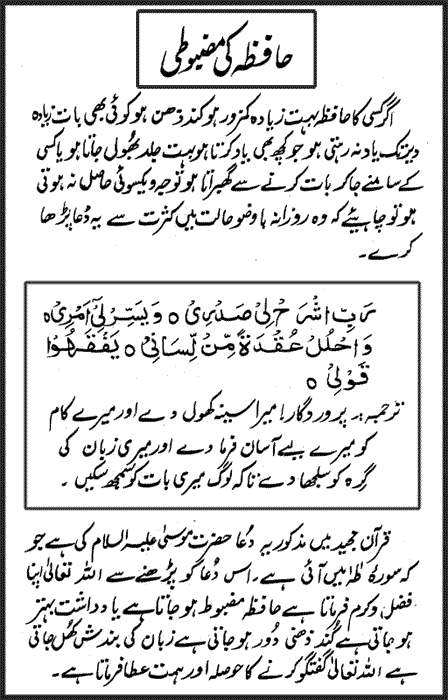
Q: I would like to let you know that I have committed the most major sins and I am not saying this in order to take pride in my sins – I used to feel this before but not any longer. I have defeated Satan in many rounds, but he defeated me in more battles. Is it possible for me to return to Allah once again and how?
A: In the name of Allah, Most Gracious, Most Merciful. All praise be to Allah and prayers and salutations to our Prophet Muhammad and his family and companions.
The Prophet (PBUH) said Allah will forgive whoever repents before the sun rises from the west [reported by Muslim from the Hadith of Abu Hurairah].
Nothing prevents you from repenting, even if your sins reach the sky or fill the whole earth. As long as the human being is in this life, the door of repentance is open. You are in the midst of a battle between the call of faith in your heart, and the call of desire that is guided by Satan in your heart.
The heart is not immunized from Satan except with the Zikr (remembrance) of Allah, the Exalted, and it does not have the strength to want good except by doing good deeds. Satan does not defeat the heart unless it is inattentive of the Zikr of Allah, the Exalted and unless it is weak because of vice and sins committed. Take it and maintain it as its results are guaranteed, Allah willing, if you persevere it honestly:
- Keep up the five prayers in congregation, especially the Fajr prayer and never miss it. Allah, the Exalted says “and the fajr reading of the Qur’an , verily the fajr recitation of Qur’an is witnessed,” i.e. the Fajr prayer is witnessed by angels.
- After the Fajr prayer remain in the mosque to read the Qur’an until sunrise, and then offer two Rakahs (prayer units) 10 minutes after sunrise.
- Say Subhan Allah wa bi Hamdihi (may Allah be glorified and praised) one hundred times a day at any time in the mosque or house, whether walking, sitting, in the car, etc. This Zikr wipes out sins.
- Ask forgiveness of Allah one hundred times each day, saying Astaghfirullah wa atoobu ilayh (I ask forgiveness of Allah and I repent to Him), once again at any time you wish and in whatever condition you are in.
- Say this zikr: la ilaha illa Allahu wahdahu la sharika lah, lahul mulk wa lahul hamd wa howa ala kul shayin qadeer (there is no god but Allah; He has no partner; He is the dominion and praise, and He is capable of everything) one hundred times each day at any time you wish and in whatever condition you are.
- Between Maghrib (sunset prayer) and Isha (evening prayer) remain in the mosque and do not leave it, and recite as much as you can of the Qur’an, with full concentration.
- Continue this program for at least a month: living with the Qur’an, reciting it with consideration, and acting upon what is in it; spending time alone for long hours for the Zikr of Allah, the Exalted.
- If the environment in which you live does not support you in applying this program, then change the environment – abandon bad friends, and avoid places that encourage you to commit sins.
- Donate part of your money as a form of repentance to Allah, the Exalted, as charities given in secret are seen only by Allah, the Exalted.
In an authentic Hadith, “Secret charities extinguish the anger of the Lord.” [Narrated by ibn Hibban from the Hadith of Anas] - Try to perform Umrah with the intention of renewing your faith and cleansing your past with the water of this blessed trip.
11. If you owe anything to others, return that and do not retain anything you will be accounted for, as a form of repentance to Allah.
How Prayer Accelerates Treatment Of The Sick
And Your Lord said: “Invoke Me, I will respond to your (invocation). Verily, those who scorn My worship, they will surely enter Hell in humiliation!” (Ghafir 40:60)
According to the Qur’an, prayer, meaning “calling, requesting, seeking help,” is a person’s turning sincerely to Allah, and seeking help from Him, the Almighty, the Compassionate and Merciful, in the knowledge that he is a dependent being. Illness is one of those instances when a person feels this dependence most and draws closer to Allah. Furthermore, sickness is a test, devised in His wisdom, that takes place by His will, and is a warning to remind people of the transience and imperfection of this life, and is also a source of recompense in the hereafter for the patient and submissive.
Those without faith, on the other hand, imagine that the way to recovery is through doctors, medicines or the advanced technological capabilities of modern science. They never pause to think that it is Allah Who causes their physical systems to function when they are in good health, or Who creates the healing medicines and doctors when they are ill. Many turn only to Allah when they arrive at the opinion that doctors and medicines are inadequate. People in such situations seek help only from Allah, realizing that only He can free them from their difficulty. Allah has revealed this mindset in a verse:
And when harm touches man, he invokes Us, lying on his side, or sitting down or standing. But when We removed his harm from him he passes on as if he had never invoked Us for a harm that touched him! Thus it is made fair-seeming to be Musrifun that which they used to do. (Yunus 10:12)
The fact is, however, that even in good health, or without tribulations or other difficulties, a person must pray and give thanks to Allah for the comforts, good health and all the other blessings He has imparted.
One very important aspect of prayer is this: In addition to praying out loud, it is also important for a person to make every effort to pray through his or her deeds. Prayer by action means doing everything possible to attain a certain wish. For example, in addition to praying, a sick person may also have to visit an expert doctor, use medicines that will be of benefit, and receive hospital treatment if necessary or some other form of special care. Because Allah has linked everything that happens in this world to specific causes, everything in the world and in the universe happens in accordance with these causes. Therefore, the individual must take the requisite measures in accordance with these causes, and yet await the outcome from Allah, with humility, submission, and patience, in the knowledge that it is He Who brings about their results.
The positive effect of faith and prayer on the sick and the way this accelerates treatment is a matter that has attracted the attention of and is recommended by doctors. Under the heading “God and Health: Is Religion Good Medicine? Why Science Is Starting to Believe,” Newsweek took the curative effect of religion as its cover story. It reported that faith in God raised people’s morale and helped them recover more easily, and that science had also begun to believe that people with religious faith recover more easily and quickly. According to a Newsweek survey, 72 percent of Americans say they believe that praying can cure someone and that prayer facilitates recovery. Research in Great Britain and the USA has also concluded that prayer reduces patients’ symptoms and accelerates the recovery process.
According to research conducted at Michigan University, depression and stress are observed to a lesser extent in the devout. And, according to findings at Rush University in Chicago, the early death rate among people who worship and pray regularly is some 25 percent lower than in those with no religious convictions. Another study conducted on 750 people, who underwent angio-cardiography, proved scientifically the “curative power of prayer.” It was established that the death rate among heart patients who prayed decreased by 30 percent within a year after their operations.
Examples of the prayers mentioned in the Qur’an are these:
And (remember) Ayyub (Job), when he cried to his Lord: “Verily, distress has seized me, and You are the Most Merciful of the merciful of all those who show mercy.” (Al-Anbiya’ 21:83)
And (remember) Zakariya (Zachariah), when he cried to his Lord: ” O My Lord! Leave me not single (childless), though You are the Best of Inheritors.” (Al-Anbiya’ 21:89)
And indeed Nuh (Noah) invoked Us, and We are the Best of those who answer (the request). (As-Saffat 37:75)
As has already been stated, prayer must not only be for alleviation of sickness or other mundane problems. A sincere believer must always pray to Allah and accept whatever comes from Him. The fact that the benefits of prayer revealed in many verses of the Qur’an are now being recognized scientifically once again reveals the miraculous nature of the Qur’an.
And when My slaves ask you (O Muhammad, peace be upon him) concerning Me, then (answer them) I am indeed near (to them by my knowledge). I respond to the invocations of the supplicant when he calls on Me. So let them obey Me and believe in Me, so that they may be led aright. (Al-Baqarah 2:186)