TAG: Quran
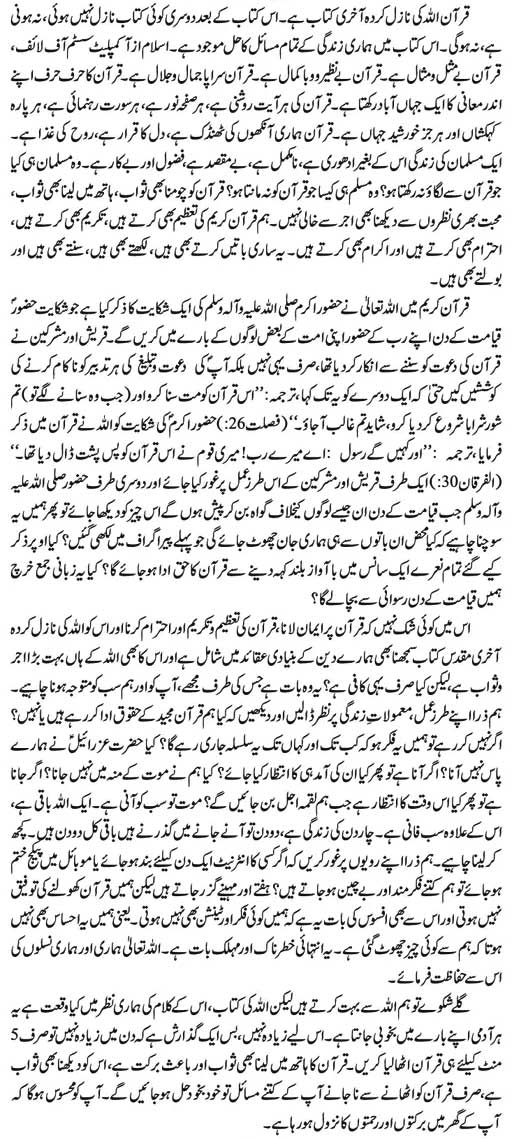
Why Don’t We Open Quran?
The Noble Qur’an is the focal point of our lives, or so it deserves to be. The way we approach it, or lack thereof, on the other hand, falls miserably short of ideals. I’m currently teaching a self-help class entitled “Empower Yourself – Approaching and Understanding the Qur’an”, designed to reorient ourselves to the Book of Allah in a proper manner and providing useful tools and resources to developing a life-long relationship with it. It is my intention here, in a series of posts, to raise a number of significant issues that arise with respect to the Qur’an and our approach to it.
Broadly speaking, there are two approaches to a study of the Qur’an. The conservative, cautious approach predominates among Muslims and warns against misinterpreting the Qur’an. This approach is epitomized by the statement of Abu Bakr: What sky will shelter me and what earth will hold me, if I were to interpret one word of the Qur’an without proper knowledge? In other words, not for laymen is the task to understand or interpret the Qur’an. For that, one must refer to scholars-specialist s-jurists- muftis, and not just that, but those from approved institutions or madhhabs (legal schools). What exactly those are depends upon the one making the argument.
The other approach is a more liberal one, based upon the premise that the Qur’an was revealed to everyone and not just an elite group of specialists who hold the exclusive keys to it. Historically, it came down from the heavens to speak to the Bedouins and shepherds, the shopkeepers and merchants, children and adults, women and men, the illiterate and educated-in short, every type of common man. And so it must speak to us today.
There are points and counter-points, replies and counter-replies, between these two camps that can go on endlessly. That is not our purpose here. Nor are these two groups distinct entities, but two broad ranges of approaching the Qur’an, with all the spectrum of variation in between.
In my mind, at least, the approach that is most consistent with the spirit of the Qur’an is clear. But whatever your view happens to be, one thing should be unanimous: it’s high time we open our Qur’ans again. By Allah, we need it. And the world needs it. As Khurram Murad says in his classic work on the topic: “As you come to the Qur’an, you come to a new world. It is a journey that will take you through the endless joys and riches of the words that your Creator and Lord has sent to you and all mankind. Here you will find a world of untold treasures of knowledge and wisdom to guide you on the pathways of life, and to mould your thoughts and actions.”
Let’s spread the word. Facilitate the study of the Qur’an in our circles and communities. An “Open Your Qur’an” national day. A Qur’an literacy movement. Anything you can think of. But for Allah’s sake, let us open our Qur’ans.
Who Are Your Real Friends?
It is very important for every Muslim to make sure that his choice of friends and the company he keeps is correct. It has been proven through experience that habits and behavior of friends and associates slowly manifest in an individual.
Without realizing, a person begins to adopt the style and behavior of his friends. We are all witness to this fact. Sadly, I can recall many incidents where those who were pious, religious and of good character lost all their good qualities because they kept company and associated with an inappropriate circle of friends.
I have also seen others who were drowning in sin and evil, who underwent a complete revolution in their lives after adopting the company of a pious person of huge moral standards.
Rasullullah May Allah’s peace and blessings be upon him has advised, “A person is on the way of his life friend. Therefore, he should think very carefully whom he is making a friend with.” (Tirmidhi, Abu Dawood)
We need friends who are sincere, genuine and true and also true in their friendship. Those who care for our well-being from every aspect are true friends.
Whereas on the other hand, worldly friends are not only a waste of time, but also on the day of Qiyamah, they will be a means of destruction.
The Quran says:
“All friends on the day of Qiyamah will be enemies of one another except the God fearing.”
(Mutaqeen) (43:67)
Here, the Quran is not saying that friends will not help or benefit each other on that day, it is saying something much stronger, that friends who were not God-fearing will be the enemies of each other on the day of Qiyamah.
The Amazing Description Of Iron In Qur’an
The Qur’an disclosing some facts about iron unknown in the 7th century said: “And We sent down iron, in which is mighty power, as well as many benefits for mankind.” (Qur’an, 57:25) Literal translation. Arabic ‘Anzala’ means to send down. (Al-Mawrid, A. Yusuf Ali)
It is said that iron is extracted from the depths of the earth then how is it that the Qur’an mentions it as having been ‘sent down.’
The answer is as the Qur’an says that ‘the heaven and earth were joined together as one united piece, then We parted them.’ (Qur’an, 2l:30). In other verse the Qur’an said: “Then He rose over towards the heaven when it was smoke and said to it and to the earth: come both of you willingly or unwillingly. (Qur’an, 41:ll).
However, this Qur’anic statement was confirmed only in 19th century The scholars admitted that the earth was a gaseous mass, and had in it burning hot magma, after its separation it cooled down and condensed till it was enveloped in a hard layer of 10 to 15 miles of solid crust.
The original gaseous mass had in it all types of metals, like iron, gold, silver, copper and lead etc. Therefore, when the Qur’an spoke of Allah sending down the iron, it referred to the original nebula that contained all the materials.
When the earth cooled and condensed, these metals took their specific shapes along with other matters present in the gaseous mass. That is why these metals can be turned into liquid magma. The earth still contains in it burning hot liquid magma which comes out in an eruption of a volcano. The iron is most important among the metals. The Prophet (peace be upon him) said in an anthentic Hadith “Verily Allah has sent down four blessings from the sky: the iron, the fire, the water and the salt.”
No doubt, all these things were the part of the gaseous mass when the heaven and the earth were joined together. Later, after its separation the earth with all its treasures came down, hence all these matters descended from the sky.
The Qur’an speaks of the benefits the man derives from the iron. Use of iron has all along been an inseparable part of our life. In houses, buildings, industrial machinery and in governing a country we use weapons made of iron. Only one thing remained undefined of which the Qur’an spoke: “We sent down iron in which is mighty or violent power.”
During the period of the revelation of the Qur’an in the 7th century, weapons mainly consisted of swords, spears, arrows and armors. The people in those times could not comprehend the violent power of iron. In the 12th century when the cannon was invented the people became aware of its mighty power. But after the development of blast furnaces in the 19th century the use of iron shot up many fold. Machines, automobiles, ships, trains, rails, engines, industrial plants, pistols, revolvers, rifles, guns, cannons of very long range, armored cars, tanks, bombs, missiles, rockets and atomic reactors – all the dangerous weapons did prove the violent power of iron.
No doubt the Qur’an is the Book of Allah, which contains His Omniscient Knowledge. Whatever development the world may achieve, it shall never go beyond the Qur’anic knowledge as Allah said: “And We have sent down to you the Book (the Qur’an) as an exposition of everything.” (Qur’an, 16:89)
The Same Old Battle
None but the unbelievers dispute God’s revelations. Let it not deceive you that they seem to be able to do as they please on earth. Before their time the people of Noah rejected the truth, as did other groups and communities after them. Each of these communities schemed against the messenger sent to them, aiming to lay their hands on him. With false argument they strove to refute the truth, but then I took them to task. How awesome was My punishment! Thus your Lord’s word shall come true against the unbelievers: they will be the dwellers in the fire of hell.
(The Forgiving, Ghafir; 40: 4-6)
The opening of the surah established the truth of God’s oneness and His divine attributes. The surah now makes clear that this truth is accepted by all creatures. It is, in fact, firmly rooted in their nature and directly related to the nature of the universe. Only the unbelievers dispute these signs and argue about God’s revelations. Thus they are a class apart, choosing to be at odds with the universe and all other creatures within it.
“None but the unbelievers dispute God’s revelations.”
Throughout the entire expanse of the universe, only the unbelievers stand apart, deviating from the true path. In relation to the whole universe, they are weaker and less significant than an ant in relation to planet earth. When they stand on their own disputing God’s revelations and denying His signs, the rest of the universe declares its acceptance of Him and recognizes His oneness, deriving its strength from Him. With their odd attitude, the unbelievers’ fate is sealed, no matter how powerful, affluent and mighty they may appear to be: “Let it not deceive you that they seem to be able to do as they please on earth.”
They may be able to move about, gather wealth, enjoy their power and revel in easy living. However, they are ultimately doomed. The battle, if there could ever be a battle between them and the Creator of the universe, will lead to its inevitable end.
There were in former times communities that followed the same path. Their fate should make clear to the unbelievers what happens in the end to anyone who tries to stand against the power of the Almighty: “Before their time the people of Noah rejected the truth, as did other groups and communities after them. Each of these communities schemed against the messenger sent to them, aiming to lay their hands on him. With false argument they strove to refute the truth, but then I took them to task. How awesome was My punishment!”
The Islamic Wife In The Light Of Holy Qur’an And Ahadees
The Holy Prophet (S.A.W.) said, “A thankful tongue, a soft-hearted wife is a friend of yours in religion.” These are the qualities that Islam desires in a woman who shall nurture the future generations of mankind towards an Islamic society.
Sociologists all over the world are laying more and more stress on the importance of family life, as opposed to what goes on in the West, where 5 out of 10 marriages end in divorce, where 60% of divorced women are prone to suicide, and almost every separated family has a history of a delinquent child.
As a maintainer of woman, the man has been deemed responsible for managing the day-to-day affairs outside the house, striving to earn, a livelihood. Woman has been given complete charge of the house, responsible for rearing the children and managing the home. This division of management is not in any way derogatory to the honor of woman; she is not the man’s slave, but his equal. In all its wisdom, Islam has allotted different sets of duties to men and women because of their different physical and mental attributes. Man is physically better suited to rough it out in the harsh world, and, due to her physical and emotional make up, woman is more suitable to manage the house.
A woman is more self-sufficient in household affairs and better shoulders the responsibility of rearing the children. This arrangement guarantees the continuation and the formation of a society complementing religion. This is a great trial and test for man and woman. Very rarely do we find a family like that of Imam Ali (A.S.), which contains a Fatima Zahra (S.A.), Hassan (A.S.), Hussain (A.S.), Zainab (S.A.) and Kulsum (S.A.).
The Holy Qur’an states: “They (wives) are an apparel for you, and you are an apparel for them.” (2:187)
What the Qur’an is stating is clear – besides covering the body, apparel protects the body from the vagaries of nature, enhancing one’s personal beauty. Man and wife should complement each other, and as Imam Ali (A.S.) has said, “Like a dress, a worthy wife will conceal one’s fault.”
How To Increase One’s Iman?
If a sick person doesn’t realize that they are sick, the doctor will never be able to cure her. So realizing that there is a spiritual sickness is a sign that your faith is strong. I have the following words of advice for you:
Al-Haakim reported in al-Mustadrak, and al-Tabaraani reported in al-Mu jam, that the Prophet (peace and blessings of Allah be upon him) said: Faith wears out in the heart of any one of you just as clothes wear out, so ask Allah to renew the faith in your hearts. (Reported by al-Haakim in al-Mustadrak, 1/4;. Al-Haythami said in Majma al-Zawaa id, 1/52, It was reported by al-Tabaraani in al-Kabeer and its isnaad is saheeh. ) This Hadith tells us that our faith will become weak but we will have to strengthen it with various actions and different good deeds. If we try to implement the following, In Sha Allah it will help us all.
On a weekly basis, try to attend some Halaqah or an Islamic gathering. That is a great way of keeping the battery of Iman and actions charged.
A good suggestion would be that you join some weekend or evening Islamic course or something of that sort. You will find good company there which will be a means of strengthening your faith and Iman. And when you feel like you are all burnt out , there will be others there who will guide you and help you out and get you back up on your feet again.
Try to read some portion of the Quran everyday and make Zikr of Allah. It will not be a bad idea to start off the day by reciting Surah Yaseen.
Try to have a daily Halaqah of reading from a Hadith book at home. The most widely used Hadith book in English is probably Riyadh us Salihin. Set aside a time at home, and try to sit down with other family members. It does not have to be long. Even five minutes or ten minutes will suffice. A daily dose of the words of Allah and his beloved Prophet Sallallahu Alaihe Wasallam goes a long way in keeping us attached to our faith.
After prayers or whenever, try to recite as many times as possible the words which are mentioned in the following Hadith: The Messenger of Allah (peace and blessings of Allah be upon him) said: Do not forget to say in every prayer, Rabbi a inni ala dhikrika wa shukrika wa husni ibaadatika (O Allah, help me to remember You, thank You and worship You properly.). (al-Nasaa i, 1303)
10 Ways To Be Firm Upon Islam
1. Seek Allah’s help for guidance and steadfastness. Allah has praised the Du’a of the scholars in the Qur’an:
“Our Lord! Let not our hearts deviate (from the truth) after You have guided us, and grant us mercy from You. Truly, You are the Bestower.”
2. Sit with righteous people and attend circles of remembrance of Allah like Islamic lectures enthusiastically. Visit pious people.
3. Study the lives of righteous people by reading books or listening to tapes about them. Give more emphasis on studying the biographies of the Companions of the Prophet (peace be upon him).
4. Frequently listen to Khutbahs and lectures that soften the heart and are emotional.
5. Observe the obligatory deeds, like performing the five daily prayers and making up the missed fasts of Ramadan, with care, due to the great good that obligatory deeds carry.
6. Do voluntary deeds, even if they are few, that are easy and loved by the heart. Surely the most beloved deeds to Allah are the consistent ones even if they are few, as the Prophet (peace be upon him) informed us.
7. Start memorizing the Qur’an. Recite it constantly and as much as possible. Recite what you memorized in the voluntary prayers.
8. Remember Allah and seek His forgiveness, i.e. do Dhikr and Istighfar. Surely these are easy deeds but their benefit is immense. They increase the Iman (faith) and strengthen the heart.
9. Stay as far away as possible from ‘the corrupter of the heart’, like bad friends, television, satellite channels, music, obscene magazines, etc.
10. Repent as quickly as possible. With sincere repentance, by the will of Allah, there will be no turning back. Indeed Allah becomes very happy when His servant repents.
– Al-Madina Magazine
Signs Are Everywhere
In the Name of God, the Lord of Grace, the Ever Merciful
Ha. Mim. This book is bestowed from on high by God, the Almighty, the Wise. Surely, in the heavens and the earth there are signs for those who believe. And in your own creation, and in the animals God scatters on earth there are signs for people of sure faith. And in the alternation of night and day, and in the means of subsistence God sends down from the skies, reviving with it the earth after it had been lifeless, and in the shifting of the winds there are signs for those who use their reason. (Kneeling Down; Al-Jathiyah: 45: 1-5)
The surah begins by mentioning the revelation of this book, the Qur’an, by God, the Almighty, the Wise after having introduced the two separate Arabic letters Ha, Mim, to point to this book’s source. In speaking about the separate letters introduced at the beginning of a number of surahs, we mentioned in the past that they highlight the fact that the Qur’an is composed of the letters forming the Arab’s own language, yet they cannot produce even a very small portion like it. This, then, constitutes permanent evidence that the Qur’an is bestowed from on high by God, the Almighty who can do whatever He wishes, the Wise who creates everything according to a certain measure and to serve a particular purpose. This is an apt comment that fits the ambience of the surah and its discussion of different types of people.
Before speaking about the unbelievers and their attitude toward the Qur’an, the surah refers to signs pointing to the Creator that are available everywhere in the world around them. Alone, these signs should have been enough to direct them to believe in God. Now, the surah turns their minds to such signs so that they may open their hearts to them and realize that it is God who has bestowed this book from on high and that it is He who has created this great universe: “Surely, in the heavens and the earth there are signs for those who believe.” The signs scattered everywhere in the heavens and the earth are not limited to any area or situation. Wherever we look around us we find signs. Is there anything in this wonderful universe that is not a sign pointing to its great Maker?
Zawal-e-Ummat