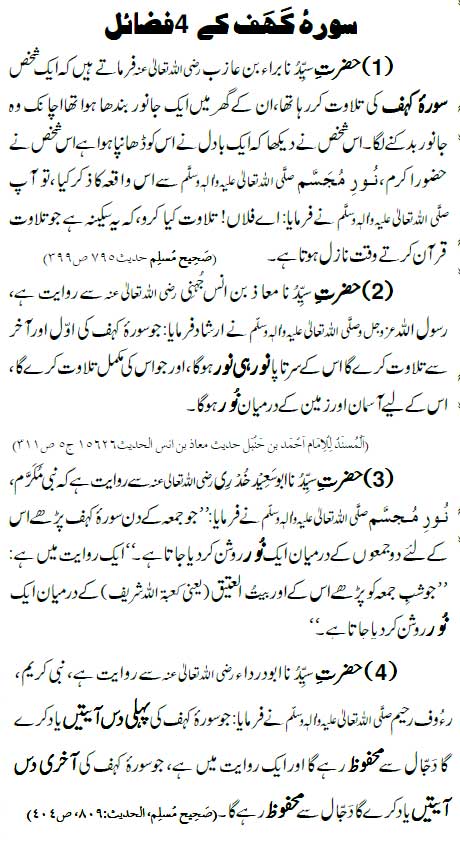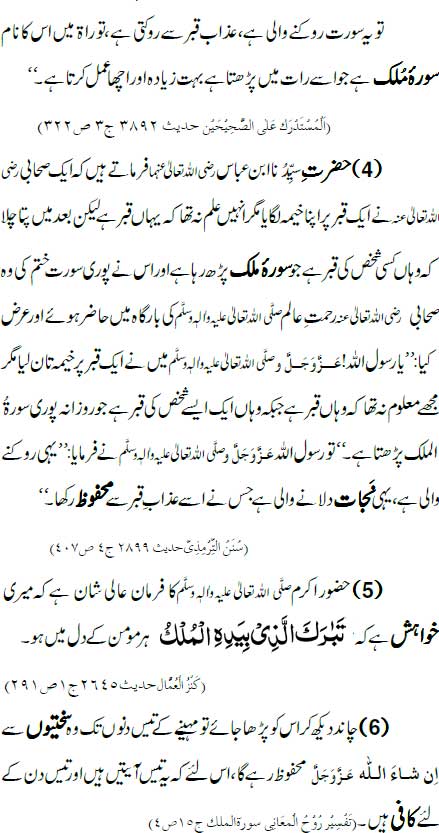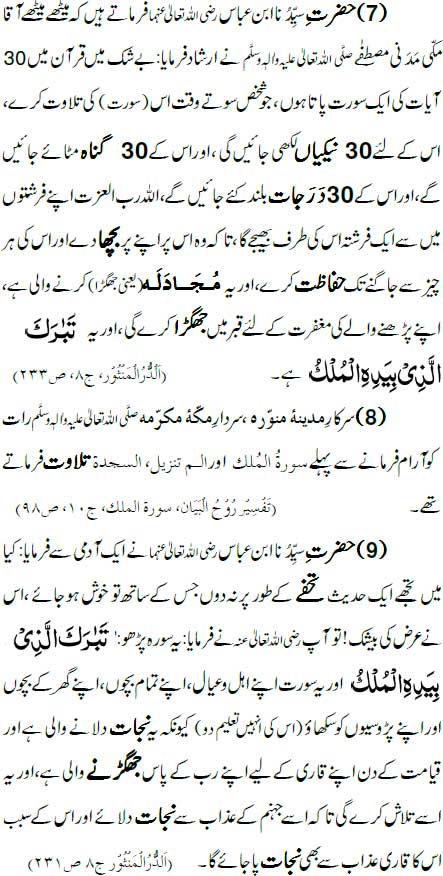


Surah Al-Mulk Ke Fawaid
TAG: Quran
Allah Guides Whom He Wills
[ALLAH’S Quran – 28:56] “You Muhammad shall not be able to guide to Allah’s path whom you like or to whom you have special affection* but Allah guides to His path of righteousness whom He will and He knows best those who are willing to lift to Him their inward sight.”
The Prophet (Peace Be Upon Him) has said:
[Bukhari, Book #58, Hadith #223] “ Narrated Al-Musaiyab: When Abu Talib was on his deathbed, the Prophet went to him while Abu Jahl was sitting beside him. The Prophet said, “O my uncle! Say: None has the right to be worshipped except Allah, an expression I will defend your case with, before Allah.” Abu Jahl and ‘Abdullah bin Umaya said, “O Abu Talib! Will you leave the religion of ‘Abdul Muttalib?” So they kept on saying this to him so that the last statement he said to them (before he died) was: “I am on the religion of ‘Abdul Muttalib.” Then the Prophet said, ” I will keep on asking for Allah’s Forgiveness for you unless I am forbidden to do so.” Then the following Verse was revealed:– “It is not fitting for the Prophet and the believers to ask Allah’s Forgiveness for the pagans, even if they were their near relatives after it has become clear to them that they are the dwellers of the (Hell) Fire.” (9.113) The other Verse was also revealed:– “(O Prophet!) Verily, you guide not whom you like, but Allah guides whom He will …….” (28.56)”
Seal Their Hearts
Abdullah B.Umar and Abu Hurairah said that they heard Allah’s Messenger (Way Peace Be Upon Him) say on the planks of his pulpit:
People most cease to neglect the Friday prayer or Allah will seal their hearts and then they will be among the negligent.
[Book 004, Number 1882: Muslims Shareef]
Jabir B.Samura reported :
I used to pray with the Messenger Of Allah (May Peace Be Upon Him) and both his prayer and sermon were of moderate length.
[Book 004, Number 1883: Muslims Shareef]
Treatment Of Wives
In light of the Verses of the Qur’an, we see that Allah, the Exalted, ordered excellent treatment towards the wife, generosity towards her, and the best cohabitation with her, even if there is no love from the heart. Allah, the All-Wise said: “And live with them in the best way. If you dislike them, it may be that you dislike a thing and Allah brings through it a great deal of good.” (Surah An-Nisa’, 4:19)
The Prophet (Peace be upon him) said:
“A believer man must not hate (his wife) believing woman; if he dislikes one of her characteristics he will be pleased with another.” (Reported by Muslim)
Also, Allah clarifies that the woman has rights toward her husband, just as the husband has towards her. Allah, the Exalted says:
“And they (women) have rights (over their husbands), similar (to those of their husbands) over them, to what is reasonable.” (Surah Al-Baqarah, 2:228)
And the Prophet’s (Peace be upon him) last will before he dies was that men should take care of their wives and honor them, and never treat them unfairly or swallow their rights. The Prophet (Peace be upon him) said:
“Treat the women in the best way.”
And the Prophet (Peace be upon him) ordered us to behave well to our wives, and be generous with them, and he also clarified that the best of men is he who treats his wife best. The Prophet (Peace be upon him) said:
“The most complete in faith is the best in character. And the best of you is the one who is best to his wife.” (Reported by At-Tirmidhi)
The Prophet (Peace be upon him) also said:
“The best of you is the one who is best to his wife, and I am the best of you to my wives.” (Reported by Ibn Majah)
Also, the Prophet (Peace be upon him) ordered his Companions to endure the mistakes of their women, clarifying the nature of the woman, in which Allah created her. The Prophet (Peace be upon him) said:
“Treat the women in the best way. Verily, the woman was created from a rib and the most crooked portion of the rib is its upper part; if you try to straighten it, it will break, and if you leave it, it will remain crooked, so treat the women in the best way.” (Reported by Al-Bukhari)
The Messenger of Allah (Peace be upon him) also said:
“Verily, the woman was created from a rib. It shall not be straightened to you in any way (i.e. she shall not behave exactly as you wish her to). Thus, if you enjoy her, you will enjoy her bent. And if you tried to straighten her, you would break her. And to break her means a divorce.” (Reported by Mustakhrag Abi ‘Awana)
- February, 23
- 5566
- Human Rights
- More
Five Pillars Of Islam
What Are the Five Pillars of Islam?
1) The Testimony of Faith
2) Prayer
3) Giving Zakat (Support of the Needy)
4) Fasting during the Month of Ramadan
5) The Pilgrimage to Makkah
The Five Pillars of Islam are the framework of Muslim life. They are the testimony of faith, prayer, giving zakat (support of the needy), fasting during the month of Ramadan, and the pilgrimage to Makkah once in a lifetime for those who are able.
1) The Testimony of Faith:
The testimony of faith is saying with conviction, “La ilaha illa Allah, Muhammadur rasoolu Allah.” This saying means “There is no true god (deity) but ALLAH, and Muhammad is the Messenger (Prophet) of ALLAH.” The first part, “There is no true god but ALLAH,” means that none has the right to be worshiped but ALLAH alone and that ALLAH has neither partner nor son. This testimony of faith is called the Shahada, a simple formula that should be said with conviction in order to convert to Islam. The testimony of faith is the most important pillar of Islam.
2) Prayer:
Muslims perform five prayers a day. Each prayer does not take more than a few minutes to perform. Prayer in Islam is a direct link between the worshiper and ALLAH. There are no intermediaries between ALLAH and the worshiper.
In prayer, a person feels inner happiness, peace, and comfort, and that ALLAH is pleased with him or her. The Prophet Muhammad (S.A.W.W) said: {Bilal, call (the people) to prayer, let us be comforted by it.} Bilal was one of Muhammad’s (S.A.W.W) companions who was charged to call the people to prayers.
Prayers are performed at dawn, noon, mid-afternoon, sunset, and night. A Muslim may pray almost anywhere, such as in fields, offices, factories, or universities.
3) Giving Zakat (Support of the Needy):
All things belong to ALLAH, and wealth is therefore held by human beings in trust. The original meaning of the word zakat is both ‘purification’ and ‘growth.’ Giving zakat means ‘giving a specified percentage on certain properties to certain classes of needy people.’ The percentage which is due on gold, silver, and cash funds that have reached the amount of about 85 grams of gold and held in possession for one lunar year is two and a half percent. Our possessions are purified by setting aside a small portion for those in need, and, like the pruning of plants, this cutting back balances and encourages new growth.
A person may also give as much as he or she pleases as voluntary alms or charity.
4) Fasting the Month of Ramadan:
Every year in the month of Ramadan, all Muslims fast from dawn until sundown, abstaining from food, drink, and sexual relations.
Although the fast is beneficial to health, it is regarded principally as a method of spiritual self-purification. By cutting oneself off from worldly comforts, even for a short time, a fasting person gains true sympathy with those who go hungry, as well as growth in his or her spiritual life.
5) The Pilgrimage to Makkah:
The annual pilgrimage (Hajj) to Makkah is an obligation once in a lifetime for those who are physically and financially able to perform it. About two million people go to Makkah each year from every corner of the globe. Although Makkah is always filled with visitors, the annual Hajj is performed in the twelfth month of the Islamic calendar. Male pilgrims wear special simple clothes which strip away distinctions of class and culture so that all stand equal before ALLAH.
Pilgrims praying at the Haram mosque in Makkah
Pilgrims praying at the Haram mosque in Makkah. In this mosque is the Kaaba (the black building in the picture) which Muslims turn toward when praying. The Kaaba is the place of worship that ALLAH commanded the Prophets Abraham and his son, Ishmael, to build.
Qurani Mustajab Dua’een


The Minor Signs Of The Last Day
Qiyamah will come when…
Hadhrat Abu Musa Ash’ari (R.A.) narrates that Rasulallah (Sallallahu Alayhi Wassallam) said, “Qiyamah will come…
When it will be regarded as a shame to act on Quranic injunctions.
When untrustworthy people will be regarded as trustworthy and the trustworthy will be regarded as untrustworthy.
When it will be hot in winter.
When the length of days is stretched, i.e. a journey of a few days is covered in a matter of hours.
When orators and lecturers lie openly.
When people dispute petty issues.
When women with children come displeased on account of them bearing offspring, barren women remain happy on account of having no responsibility for offspring.
When oppression, jealousy, and greed become the order of the day.
When people blatantly follow their passions and whims.
When lies prevail over the truth.
When violence, bloodshed, and anarchy become common.
When immorality overtakes shamelessness and is perpetrated publicly.
When legislation matters pertaining to Deen is handed over to the worst elements of the Ummat, and if people accept them and are satisfied with their findings, then such persons will not smell the fragrance of Jannat.
When the offspring become a cause of grief and anger (for their parents).
The following is part of a lengthy Hadith narrated by Hadhrat Abdullah Ibn Mas’ood (R.A.) when he inquired from Rasulallah (Sallallahu Alayhi Wassallam) about the Signs of Qiyamah.
Music and musical instruments will be found in every home.
People will indulge in homosexuality.
There will be an abundance of illegitimate children.
There will be an abundance of critics, tale carriers, back-biters, and taunters in society.
People will establish ties with strangers and sever relations with their near and dear ones.
Hypocrites will be in control of the affairs of the community and evil, immoral people will be at the helm of business establishments.
The Masjid will be decorated, but the hearts of the people will be devoid of guidance.
The courtyards of Masjids will be built beautifully and high mimbars (pulpits) will be erected.
Gangsters and evil people will prevail.
Various wines will be consumed excessively.
Auf bin Malik (R.A.) says: I came to Rasulullah (Sallallahu Alayhi Wasallam) while he was in his skin tent during the Tabuk expedition. He said to me, “Count six things before the advent of Qiyamah:
1 My death
2 The conquest of Jerusalem
3 Mass deaths amongst you people, just as when sheep die in large numbers during an epidemic
4 Abundance of wealth to such an extent that if a person were to be given a hundred Dinars he will still not be satisfied
5 General anarchy and bloodshed, that no Arab household will be spared from it
6 Then a life of peace as a result of a peace agreement between you and the Banil Asfaar
(Romans) which they will break and attack you with a force consisting of eighty flags and under each flag will be an army of twelve thousand men.” (Hadith: Sahih Bukhari).
IRAQ and SYRIA
Abu Nadhrah says: “We were sitting in the company of Jabir bin Abdullah (R.A.) when he said: ‘Soon the people of IRAQ will neither receive any food (grain) nor any money.'” We asked, “Why would such a thing happen?” He replied, “Because of the non-Arabs.” (i.e they will prevent food from going into Iraq, in the form of “sanctions” to this day.) He then said: “Soon the people of Shaam (SYRIA) will neither receive any money nor grain.” We asked why this would happen. He replied: “Because of the Romans (christians).”
CONCEITED PEOPLE:
Hadhrat Abbas (R.A) narrates that Rasulallah (Sallallahu Alayhi Wassallam) has said, “Islam will spread far and wide, across the seas. Horses will cross the land and seas in the cause of Jihaad. Then a time will come wherein a group of people will emerge which recites the Quraan. They will claim,
‘We have recited the Quraan and is there anyone who understands the Quraan better than us? There is NO ONE more proficient than us in the study of the Quraan.’
Then Rasulallah (Sallallahu Alayhi Wassallam) asked the Sahaba, “Do you see any good in their claims?” The Sahaba replied, “No”. Rasulallah (Sallallahu Alayhi Wassallam) said, “But these conceited claimants will be from my Ummah and will be the fuel of the Fire.”
from “Signs of Qiyamah” (excerpts)
by Mohammed Ali Ibn Zubair Ali
Benefits Of As-Salaam Alaikum
1.”As-Salaamu Alaikum” is a means of immense reward
A man passed by the Messenger of Allaah (Sal Allaahu Alaihi wa Sallam) while he was sitting with others, and said “As-salaamu ‘alaykum.”
The Prophet (Sal Allaahu Alaihi wa Sallam) said, “[He will have] ten hasanaat.”
Another man passed by and said “As-Salaamu Alaikum wa Rahmatullaah (peace be upon you and the mercy of Allaah).”
The Prophet (Sal Allaahu Alaihi wa Sallam) said, “[He will have] twenty hasanaat.”
Another man passed by and said “As-Salaamu Alaikum wa Rahmatullaahi wa Barakaatuh (peace be upon you and the mercy of Allaah and His blessings).”
The Prophet (Sal Allaahu Alaihi wa Sallam) said, “[He will have] thirty hasanaat.”
2.”As-Salaamu Alaikum” is an aspect of Imaan
Once a man asked the Prophet (Sal Allaahu Alaihi wa Sallam) about which aspect of Islam was best. The Prophet (Sal Allaahu Alaihi wa Sallam) replied: “Feeding the hungry, and saying salaam to those you know and those you don’t know.” (Bukhaari and Muslim)
3. “As-Salaamu Alaikum” is a means of entering Jannah
The Prophet (Sal Allaahu Alaihi wa Sallam) said: “You will not enter Paradise until you believe, and you will not believe until you love one another. Shall I not tell you about something which, if you do it, you will love one another? Spread salaam (the greeting of peace) among you.” (Muslim)
4. “As-Salaamu Alaikum” gets rid of sins
The Prophet (Sal Allaahu Alaihi wa Sallam) also said, “When two Muslims meet (give salaam), and shake hands, they are forgiven their sins before they part (with each other).” (Abu Dawud)
5. “As-Salaamu Alaikum” is the greeting of the people of Jannah
“Then, those that feared their Lord shall be driven in companies into Paradise. When they draw near its gates will be opened, and its keepers will say to them: “Salaamun ‘Alaikum” (Peace be upon you), you have done well. Enter and live in it forever.” (Surah Zumar:73)
Muharram – One Of The Four Sacred Months
Muharram’ is the first {1st} month of the Hijri calendar and is one of the Four [4] sacred months concerning which Allah {Aza wa Jall } says in the Quran:- ‘Surely the number of months with Allah is twelve {12} months in Allah’s ordinance since the day when He created the heavens and the earth, of these four being sacred; that is the right reckoning; therefore be not unjust to yourselves regarding them. [Source:-Quran ~Surah 9 At-Taubah, Verse # 36]
‘Muharram’ is one of the four{4} sacred Months out of twelve. The others are… Zul-Qa’dah, Zul-Hijjah, and Rajab. These four { 4 }months have been sacred since the creation of the universe.
Allah {Aza wa Jall } says in the Quran:- Muharram is a sacred month because Allah made it sacred along with three{3} other months and told us about it in the Quran. Prophet Muhammad {may peace be upon him} informed us about the Four {4}sacred months in the following narration:-
‘The year is of twelve {12}months, out of which four{4} months are sacred:
Three{3} are in succession …
#1/ ~Dhul-Qa’ da.
#2/~ Dhul-Hijja.
#3/~Muharram.
#4/ ~ Rajab.
[Source:- Bukhari Vol 004, Book 054, Hadith # 419]
‘Ashura’~ [meaning tenth [10th ] in Arabic] {The 10th of Muharram}
Fasting on the 10th of Muharram Ashura was obligatory for Muslims before the fasts of Ramadan were obligatory.
Narrated by the Mother of the Believers Aisha (Allah be pleased with her):- The people used to fast on ‘Ashura’ {the tenth (10th)day of the month of Muharram} before the fasting of Ramadan was made obligatory. And on that day the Kaaba used to be covered with a cover. When Allah made the fasting of the month of Ramadan compulsory…
Allah’s Apostle {may peace be upon him} said:- ‘Whoever wishes to fast (on the day of Ashura) may do so, and whoever wishes to leave it can do so. [Source:-‘Bukhari’ Vol 02, Book 026, Hadith # 662]
The Fast of Ashura expiates the sins of the previous year and the coming year.
Abu Qatada al-Ansari (Allah be pleased with him) reported that….. The Messenger of Allah {may peace be upon him} was asked about fasting on the day of Ashura {10th of Muharram} at which point he said:- It expiates the sins of the preceding year. {Source:-Muslim: Book 06: Hadith # 2603}
Importance Of Prayer
The importance of prayer in Islam cannot be understated. It is the first pillar of Islam that the Prophet, may Allah praise him, mentioned after mentioning the Testimony of Faith, by which one becomes a Muslim. It was made obligatory upon all the prophets and for all peoples. Allah has declared its obligatory status under majestic circumstances. For example, when Allah spoke directly to Prophet Moses, He said,
“And I have chosen you, so listen to that which is inspired to you. Verily, I am God! There is none worthy of worship but I, so worship Me and offer prayer perfectly for My remembrance.” (Quran 20:13-14)
Similarly, the prayers were made obligatory upon the Prophet Muhammad during his ascension to heaven. Furthermore, when Allah praises the believers, such as at the beginning of the chapter entitled ‘al-Muminoon’ (The Believers), one of the first descriptions He states is their adherence to the prayers.
Once a man asked the Prophet about the most virtuous deed. The Prophet stated that the most virtuous deed is prayer. The man asked again and again and for the first three times, the Prophet answered, “The prayer,” then on the fourth occasion he stated, “Jihad in the way of Allah.”
The importance of prayer is demonstrated in many of the Prophet’s statements. For example, the Prophet (peace be upon him) said,
“The first matter that the slave will be brought to account for on the Day of Judgment is the prayer. If it is sound, then the rest of his deeds will be sound. And if it is incomplete, then the rest of his deeds will be incomplete.”
The importance of the prayers lies in the fact that no matter what actions one performs in his life, the most important aspect is one’s relationship to Allah, that is, one’s faith (Imaan), Allah-consciousness (taqwa), sincerity (ikhlas) and worship of Allah (ibaadah). This relationship with Allah is both demonstrated and put into practice, as well as improved and increased, by prayer. Therefore, if the prayers are sound and proper, the rest of the deeds will be sound and proper; and if the prayers are not sound and proper, then the rest of the deeds will not be sound and proper, as the Prophet himself stated.