TAG: Ummahaat al-Muminin
Have You Ever Know Such An Honoured Person
ABDUR – RAHMAN IBN AWF (ra – may the peace & blessings of Allah be upon him)
He was one of the first eight persons to accept Islam. He was one of the ten persons (al-asharatu-al-mubashshirin) who were assured of entering Paradise. He was one of the six persons chosen by Umar (ra – may Allah be pleased with him) to form the council of shura (consultation) to choose the Khalifah (caliph) after his death. His name in Jahiliyyah (ignorance i.e. before the coming of Islam) days was Abu Amr. But when he accepted Islam the noble Prophet (saw – may the peace & blessings of Allah be upon him) called him Abdur-Rahman – the servant of the Beneficent God.
Abdur-Rahman (ra) became a Muslim before the Prophet entered the house of al-Arqam. In fact it is said that he accepted Islam only two days after Abu Bakr as-Siddiq (ra) did so. Abdur-Rahman (ra) did not escape the punishment which the early Muslims suffered at the hands of the Quraysh. He bore this punishment with steadfastness as they did. He remained firm as they did. And when they were compelled to leave Makkah for Abyssinia because of the continuous and unbearable persecution, Abdur-Rahman (ra) also went. He returned to Makkah when it was rumored that conditions for the Muslims had improved but, when these rumors proved to be false, he left again for Abyssinia on a second hijrah (migration). From Makkah once again he made the hijrah to Madeenah.
Soon after arriving in Madeenah, the Prophet (saw) in his unique manner began pairing off the Muhajirin (those who migrated) and the Ansar (the helpers). This established a firm bond of brotherhood and was meant to strengthen social cohesion and ease the destitution of the Muhajirin. Abdur-Rahman (ra) was linked by the Prophet (saw) with Sa’d ibn ar-Rabi’ah (ra). Sa’d (ra) in the spirit of generosity and magnanimity with which the Ansar greeted the Muhajirin, said to Abdur-Rahman (ra): “My brother! Among the people of Madeenah, I have the most wealth. I have two orchards and I have two wives. See which of the two orchards you like and I shall vacate it for you and which of my two wives is pleasing to you and I will divorce her for you.”
Abdur-Rahman (ra) must have been embarrassed and said in reply: “May God bless you in your family and your wealth. But just show me where the sooq (market place) is..”Abdur-Rahman (ra) went to the market-place and began trading with whatever little resources he had. He bought and sold and his profits grew rapidly. Soon he was sufficiently well off and was able to get married. He went to the noble Prophet (saw) with the scent of perfume lingering over him.
“Mahyarn, O Abdur-Rahman (ra)!” exclaimed the Prophet (saw) – “mahyam” being a word of Yemeni origin which indicates pleasant surprise.
“I have got married,” replied Abdur-Rahman (ra). “And what did you give your wife as mahr (dowry)?” “The weight of a nuwat in gold.”
“You must have a walimah (wedding feast) even if it is with a single sheep. And may Allah bless you in your wealth,” said the Prophet (saw) with obvious pleasure and encouragement.
Thereafter Abdur-Rahman (ra) grew so accustomed to business success that he said if he lifted a stone he expected to find gold or silver under it! Abdur-Rahman (ra) distinguished himself in both the battles of Badr and Uhud. At Uhud he remained firm throughout and suffered more than twenty wounds some of them deep and severe. Even so, his physical jihad was matched by his jihad with his wealth.
Once the Prophet, may God bless him and grant him peace, was preparing to despatch an expeditionary force. He summoned his companions and said:
“Contribute sadaqah (charity) for I want to despatch an expedition.” Abdur-Rahman (ra) went to his house and quickly returned. “O Messenger of God (saw),” he said, “I have four thousand (dinars). I give two thousand as a qard to my Lord and two thousand I leave for my family. “
When the Prophet (saw) decided to send an expedition to distant Tabuk – this was the last ghazwah (battle) of his life that he mounted – his need for finance and material was not greater than his need for men for the Byzantine forces were a numerous and well-equipped foe. That year in Madinah was one of drought and hardship. The journey to Tabuk was long, more than a thousand kilometers. Provisions were in short supply. Transport was at a premium so much so that a group of Muslims came to the Prophet (saw) pleading to go with him but he had to turn them away because he could find no transport for them.
These men were sad and dejected and came to be known as the Bakka’in or the Weepers and the army itself was called the Army of Hardship (‘Usrah). Thereupon the Prophet (saw) called upon his companions to give generously for the war effort in the path of God and assured them they would be rewarded. The Muslims’ response to the Prophet’s (saw) call was immediate and generous. In the forefront of those who responded was Abdur-Rahman ibn Awl (ra). He donated two hundred awqiyyah of gold whereupon Umar ibn al-Khattab (ra) said to the Prophet (saw):
“I have (now) seen Abdur-Rahman (ra) committing a wrong. He has not left anything for his family.”
“Have you left anything for your family, Abdur-Rahman (ra)?” asked the Prophet (saw).
“Yes,” replied Abdur-Rahman (ra). “I have left for them more than what I could ever give and better.” “How much?” enquired the Prophet (saw).
“What God and His Messenger (saw) have promised of sustenance, goodness and reward i.e. Allah and His messenger (Islam),” replied Abdur-Rahman (ra).
The Muslim army eventually left for Tabuk. There Abdur-Rahman (ra) was blessed with an honor which was not conferred on anyone till then. The time of Salat (prayer) came and the Prophet, peace be on him, was not there at the time. The Muslims chose Abdur-Rahman (ra) as their imam. The first rakat (unit of prayer) of the Salat was almost completed when the Prophet, may God bless him and grant him peace, joined the worshippers and performed the Salat behind Abdur-Rahman ibn Awl (ra). Could there be a greater honor conferred on anyone than to have been the imam of the most honored of God’s creation, the imam of the Prophets, the imam of Muhammad, the Messenger of God!
When the Prophet, peace be on him, passed away, Abdur-Rahman (ra) took on the responsibility of looking after the needs of his family, the Ummahaat al-Muminin (the Mothers of the believers). He would go with them wherever they wanted to and he even performed Hajj with them to ensure that all their needs were met. This is a sign of the trust and confidence which he enjoyed on the part of the Prophet’s (saw) family.
Abdur-Rahman’s (ra) support for the Muslims and the Prophet’s wives (ra – may Allah be pleased with them all) in particular was well-known. Once he sold a piece of land for forty thousand dinars and he distributed the entire amount among the Banu Zahrah (the relatives of the Prophet’s (saw) mother Aminah), the poor among the Muslims and the Prophet’s wives (saw). When Aishah, may God be pleased with her, received some of this money she asked:
“Who has sent this money?” and was told it was Abdur-Rahman (ra), whereupon she said:”The Messenger of God, may God bless him and grant him peace, said: No one will feel compassion towards you after I die except the sabirin (those who are patient and resolute).”
The prayer of the noble Prophet (saw) that Allah should bestow barakah (blessings) on the wealth of Abdur-Rahman (ra) appeared to be with Abdur-Rahman (ra) throughout his life. He became the richest man among the companions of the Prophet (saw). His business transactions invariably met with success and his wealth continued to grow. His trading caravans to and from Madinah grew larger and larger bringing to the people of Madinah wheat, flour, butter, cloths, utensils, perfume and whatever else was needed and exporting whatever surplus produce they had.
One day, a loud rumbling sound was heard coming from beyond the boundaries of Madinah normally a calm and peaceful city. The rumbling sound gradually increased in volume. In addition, clouds of dust and sand were stirred up and blown in the wind.
The people of Madinah soon realized that a mighty caravan was entering the city. They stood in amazement as seven hundred camels laden with goods moved into the city and crowded the streets. There was much shouting and excitement as people called to one another to come out and witness the sight and see what goods and sustenance the camel caravan had brought.
Aishah, may God be pleased with her, heard the commotion and asked: “What is this that’s happening in Madinah?” and she was told: “It is the caravan of Abdur-Rahman ibn Awl (ra) which has come from Syria bearing his merchandise.”
“A caravan making all this commotion?” she asked in disbelief.”
“Yes, O Umm al-Muminin (mother of the believers). There are several hundred camels.”
Aishah (ra – may Allah be pleased with her) shook her head and gazed in the distance as if she was trying to recall some scene or utterance of the past and then she said: “I have heard the Messenger of God (saw), may God bless him and grant him peace, say: I have seen Abdur-Rahman ibn Awl (ra) entering Paradise creeping.”
Why creeping? Why should he not enter Paradise leaping and at a quick pace with the early companions (ra – may Allah be pleased with them all) of the Prophet (saw)?
Some friends of his related to Abdur-Rahman (ra) the hadith which Aishah (ra) had mentioned. He remembered that he had heard the hadith more than once from the Prophet (saw) and he hurried to the house of Aishah (ra) and said to her: “Yaa Ammah! Have you heard that from the Messenger of God, may God bless him and grant him peace?”
“Yes,” she replied.
“You have reminded me of a hadith which I have never forgotten,” he is also reported to have said. He was so over-joyed and added: “If I could I would certainly like to enter Paradise standing. I swear to you, yaa Ammah, that this entire caravan with all its merchandise, I will giver sabilillah (in the path of God).”
And so he did. In a great festival of charity and righteousness, he distributed all that the massive caravan had brought to the people of Madinah and surrounding areas.
This is just one incident which showed what type of man Abdur-Rahman (ra) was. He earned much wealth but he never remained attached to it for its own sake and he did not allow it to corrupt him.
Abdur-Rahman’s (ra) generosity did not stop there. He continued giving with both his hands, secretly and openly. Some of the figures mentioned are truly astounding: forty thousand dirhams of silver, forty thousand dinars of gold, two hundred awqiyyah of gold, five hundred horses to mujahidin setting out in the path of God and one thousand five hundred camels to another group of mujahidin, four hundred dinars of gold to the survivors of Badr and a large legacy to the Ummahaat al Muminin and the catalogue goes on. On account of this fabulous generosity, Aishah (ra) said:
“May God give him to drink from the water of Salsabil (a spring in Paradise).” All this wealth did not corrupt Abdur-Rahman (ra) and did not change him. When he was among his workers and assistants, people could not distinguish him from them. One day food was brought to him with which to end a fast. He looked at the food and said: “Musab ibn Umayr (ra) has been killed. He was better than me. We did not find anything of his to shroud him with except what covered his head but left his legs uncovered. Then God endowed us with the (bounties of) the world… I really fear that our reward has been bestowed on us early (in this world).” He began to cry and sob and could not eat. May Abdur-Rahman ibn Awl be (ra) granted felicity among:-
“those who spend their substance in the cause of God and follow up not their gifts with reminders of their generosity or with injury. For them their reward is with their Lord, on them shall be no fear nor shall they grieve”. (The Qur’?n, Surah al-Baqarah, 2: 262)
Sawdah Bint Zam’ah (Radi allahu anha)
Prophet Muhammad (peace be upon him) married Sawdah bint Zam’ah (radi allahu anha) a short while after the death of his first and most beloved wife, Khadijah (radi allahu anha) , with whom he shared a very happy 25 years of his blessed life. Sawdah (radi allahu anha) was a mature woman, around 40 years of age, and a mother of five children. This marriage gave Sawdah (radi allahu anha) uplift in her life, for she had been mourning her husband, Al-Sakran ibn Amr, who died soon after the couple had returned from Abyssinia, where a number of the Prophet’s companions had gone a few years earlier to establish a second base for Islam, away from the persecution in Makkah. She was now married to God’s messenger, who was renowned for his fine character and compassion, in addition to the great qualities that fitted him to be the recipient of God’s final message to mankind.
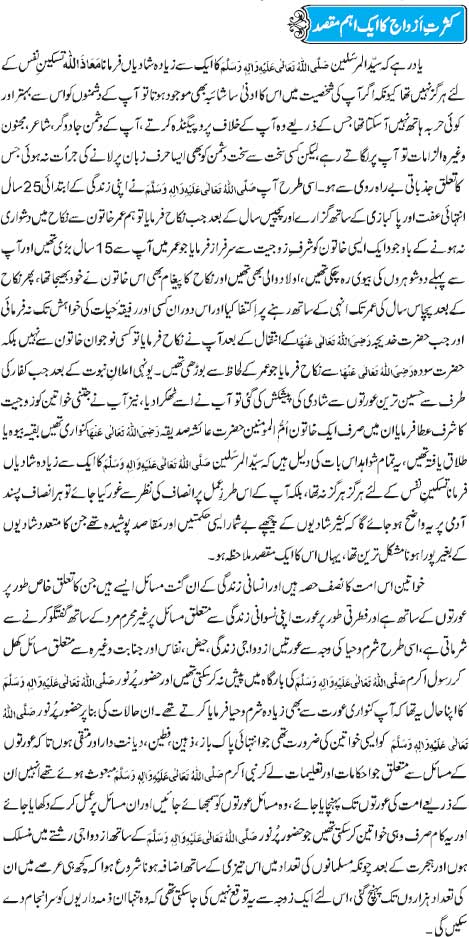
Scholars and writers about the Prophet and his character often explain his marriages in terms of different needs: Some political, others social, and some even legislative. While such reasons were certainly present in many of his marriages, they are not the overriding reasons for any. Each of his marriages expressed a desire to be united with the lady in question. In Sawdah’s case, we read explanations that he wanted to compensate her for the loss of her husband. The fact is that the Prophet needed a new wife after Khadijah (radi allahu anha) had passed away, and the qualities he needed in his new wife were maturity, kindness, and being a believer in his message. Sawdah (radi allahu anha) answered all these. She was the one to take care of his two unmarried daughters, Umm Kulthoom (radi allahu anha) and Fatimah (radi allahu anha) .
We see some aspects of Sawdah’s (radi allahu anha) maturity in the fact that when other wives came into the Prophet’s home and jealousies surfaced between them, leading to the emergence of two camps, Sawdah (radi allahu anha) did not join either group. She remained loyal to her husband, giving him all that he needed love and care. Nor did she ever express, in word or gesture, any feeling of jealousy when she realized that the Prophet’s heart leaned toward a particular one of his wives. On the contrary, we see her rising to the sublime as she realized that the Prophet’s heart favored Aishah (radi allahu anha) above all others, but he had to maintain fairness between all his wives. He would not allow himself to give Aishah (radi allahu anha) an hour more than he would give every one of his other wives. Therefore, in her eagerness to please the Prophet, Sawdah (radi allahu anha) made a gift of her nights to Aishah (radi allahu anha) . This was a voluntary gift, motivated only by her desire to please her husband. Thus, every time it was Sawdah’s (radi allahu anha) turn, the Prophet would visit her in the evening before going to spend the rest of the night at Aishah’s (radi allahu anha) place.
Sawdah’s (radi allahu anha) action speaks much about her character. She was a woman who loved to be kind to others and enjoyed giving them what pleases them.
She wished to remain married to the Prophet and be always remembered by Muslims throughout the world as a ‘mother of all believers’ as his wives earned this title. At the same time, she wanted to give greater pleasure to her husband and the one whom he loved most among his wives. Hence, her gift became a model for any woman who wishes to forego some of her rights in order to please her husband.
Sawdah (radi allahu anha) died toward the end of Umar’s reign, about ten years after the Prophet had passed away.
Umm al-Mo’mineen Hadrat Maimoona Bint al-Harith (Radi Allahu Anha)
Hadrat Sayyida Maimoona was the last wife of the Holy Prophet (Sallallaho Alaihi wa Aalihi wa Sallam). She belonged to the tribe of Banu-Hilala. The Holy Prophet (Sallallaho Alaihi wa Aalihi wa Sallam) had another wife from the same tribe. The other wife’s name was Zainab, commonly known as Ummul-Masakeen (Mother of the needy and poor). Maimoona was her second adopted name. Her first name Barra was changed by the Holy Prophet (Sallallaho Alaihi wa Aalihi wa Sallam) and the new name Maimoona was given. Her father Harith bin Hazam was one of the respected chiefs of the tribe Banu-Hilala and he had sixteen daughters. One of his daughters namely Umm-ul-Fazal was the wife of Hadrat Abbas, who was the Holy Prophet’s uncle. His other daughter namely Umm-e-Salma was married to Hadrat Hamza, another uncle of the Holy Prophet (Sallallaho Alaihi wa Aalihi wa Sallam). Another daughter Lubaba was the mother of Hadrat Khalid bin Walid (A renowned General of Muslims who fought against Iranians and was given the title of “Sword of Allah” by the Holy Prophet (Sallallaho Alaihi wa Aalihi wa Sallam). Harith’s some other daughters were later married to Hadrat Umar, the second Caliph, and Hadrat Ali, the fourth Caliph. Another daughter Asma was married to Hadrat Jafar. Thus most of Hadrat Maimoona’s sisters were married to the pioneering revolutionary leaders of Islam.
Hadrat Maimoona was the last wife of the Holy Prophet (Sallallaho Alaihi wa Aalihi wa Sallam) and he did not marry afterward. The Prophet (Sallallaho Alaihi wa Aalihi wa Sallam) was about sixty years old at the time of his marriage with Hadrat Maimoona. She lived three years married life with the Holy Prophet (Sallallaho Alaihi wa Aalihi wa Sallam). Prior to her marriage twice. Her first marriage took place with Masood bin Amr. Masood divorced her and then she was married to Abu Rahim bin Abdul Aza. Abu Rahim died in the seventh year of Hijra. After Abu Rahim’s death the Holy Prophet’s Uncle Hadrat Abbas persuaded the Holy Prophet Mohammad (Sallallaho Alaihi wa Aalihi wa Sallam) to marry Maimoona.
Hadrat Maymuna or Hadrat Barra as she was then called, yearned to marry the Prophet. She went to her sister, Umm al Fadl to talk to her about that and she, in turn, spoke to her husband, al-Abbas. Al-Abbas immediately went to the Messenger (peace and blessings of Allah be upon him) with Maymuna’s offer of marriage to him and her proposal was accepted. When the good news reached her, she was on a camel, and she immediately got off the camel and said, “The camel and what is on it is for the Messenger of Allah (peace and blessings of Allah be upon him).” They were married in the month of Shawwal in 7 AH just after the Muslims of Medina were permitted to visit Mecca under the terms of the treaty of Hudaybiyya to perform Umra.
The Holy Prophet (Sallallaho Alaihi wa Aalihi wa Sallam) was wearing an Ihram (Ihram is the dress for performing Hajj or Umrah comprised of two sheets of cloth, one wrapped around the waist and the other around the shoulder. After putting on Ihram, one can not trim his hair, cut his nails, abuse or have sex, etc.). In the same condition, he sent five hundred Dirhams as Mehr to Hadrat Maimoona and the Nikah ceremony was Performed While on return after Umra from Makkah to Madina, he stayed at a place called Saraf. This place is ten miles away from Makkah on way to Madina. At Saraf, the feast of Walima ( The feast, i.e. lunch, or dinner offered to friends and guests on the next day of the marriage) was held.
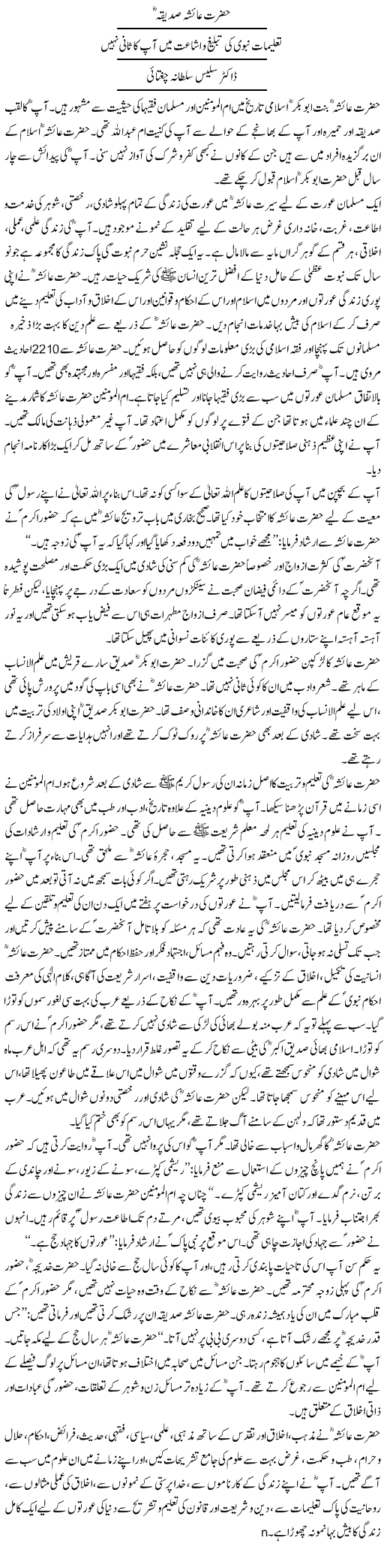
Hazrat Ayesha Siddiqa

The Honorable Wife Of Prophet PBUH Juwairiyah Bint Al-Harith R.A
She Is Barrah Bint Al-Harith Bin Abu Dirar Bin Judhaimah Al-Khuzaiyyah. She Was One Of the Captives Taken On the Day Of The Battle Of Banu Al-Mustaliq, Which Took Place in The Year 5A.H. She Was The Wife of Musafih Bin Safwan.
The Blessed Marriage
Among The Captives Taken When The Muslim Defeated Banu Al-Mustaliq Was A Woman So Beautiful That Any Man Who Saw Her Could Not Help Being Struk By Her Beauty. When The War Booty Was Divided Up, Barrah Who Was Twenty Five (25) Year Old Fell To the Lot Of Thabit Bin Qais Bin Ash-Shammas. She Attempted To Save Herself From The Humiliation Of Captivity And The Shame Of Slavery. For She Was The Daughter Of The Leader Of Her People. By making An Agreement To Buy Her Freedom From Thabit Bin Qais. Then She Went To The Messenger Of Allah S.A.W And Sought An Audience With Him And Upon Entering His Presence, She Said To Him O Messenger Of Allah! I Am Barrah Bint Al-Harith Bin Abu Dirar, Who Is the Leader Of His People And I Have Been Seized By The Calamity Of Which You Are Aware. I Have Made An Agreement To Purchase My freedom, So please Help Me To Meet The Terms Of the Agreement. The Messenger Of Allah Sallalahu Alaihe Wassalam Said: Shall I Tell You Of A Better Plan Than This? She Said: What Is It? The Messenger Of Allah S.A.W Replied: I Will Pay The Price Of Your Freedom And I Will Marry You She Said: Yes The Messenger Of Allah S.A.W It is Done “
The Blessed Marriage Was Completed And Barrah Became One Of The Mothers Of The Believers.
After Consummating The Marriage The Prophet S.A.W Named Her Juwairiyah
Strength Of Her Faith
Juwairiyah R.A Was A Sincere Believer Who Fasted Much And Frequently Spent Her Nights In Prayers She Was A Pious Worshipper Who devoted Herself To Pleasing Allah, The Highest And His Messenger Sallalahu Alaihe Wassalam
Her Death
Juwairiyah R.A Died In The Year 56 A.H, Aged 65 years, And She Was Buried In Al-Baqee Cemetery, Along With The Other Mother Of The Believers.

The Honorable Wife Of Prophet SAW – Umm Salamah
She Is Umm Salmah Bint Abu Umayyah Bin Al-Mughreerah Bin Abdullah Bin Umar Bin Makhzum Al-Qurashiyyah. Her Agnomen Was Umah Salmah Because He Had A Son Named Salamah. As For Her Mother, Har Name Was Atika Bint Amir Bin Rabee’ah Bin Malik Al-Kinaniyyah Before Her Marriage To The Prophet S.A.W Umm Salmah R.A Was Married To Abu Salamah Bin Abdul-Asad
Umm Salamah As We Have Said Married To Abu Salamah Whose Name Was Abdullah From The Time When The Obligation Of Jihad Was Imposed Abdullah Showed Himself To Be One Of The Fiercest Fighters And One Of the Bravest. He Would No Sooner return From A Battel Than He Was Preparing For The Next. He Took Part In The Battle Of Badr And in The Battle Of Uhad, In Which He Was Serious Injured, But Allah Ordained That He Would Survive Umm Salamah Wa Widowed. She Was A Beautiful Woman And So No Sooner Had She Completed Her Waiting Period Then She Receive a Proposal Of Marriage From the Leaders And Distinguished Men Of Al-Madinah, Who Proposed To her Were Abu Bakr And Umar R.A But She Did Not Marry tHen The Prophet S.A.W Sent a Proposal To Her But She Said To The Bearer Of The Prophet Proposal Inform The messenger Of Allah S.A.W That I Am A Very Jealous Women And I Am A Women With Children And None Of My Guardians is Present. The Messenger Came To the Prophet S.A.W And informed Him Of What Umm Salamah R.A Had Said And He S.A.W Said: Say To Her: As For Your Saying That You Are A Very Jealous Woman,I Will Supplicate Allah And Your Jealousy Will Depart, As For Your Saying That You Are A Women With Children, You Will Find Who Is Willing And Able To Support Them And Take Care Of Them, As For Your Saying That None Of Your Guardians Is Present, No one Among Them Whether Present Or Absent Will Dislike That ( This Marriage Should take Place).
So Prophet S.A.W Marriage Umm Salamah R.A And She became Of The Mother Of The Believers. She Was A Women Of Exceeding Beauty,
Possessing A Superior Intellect And Sound Opinion. She Was Also Known For Her God-Fearing Nature,
Her Death
After A Life Filled With Faith And Righteous Deeds, The Mother Of the Believers, Umm Salamah Died In The Year 61 A.H Aged 84And The Venerable Companion, Abu Hurairah R.A Led The People In her Funeral Prayer, After Which She Was Buried In AL-Baqee Cemetery.