TAG: Wudu
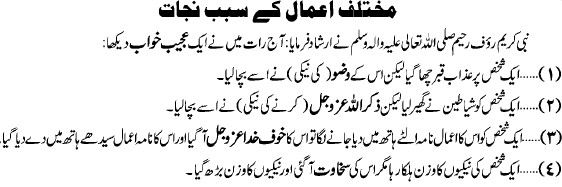
Mukhtalif Aamaal Kay Sabab Nijaat

Cleanliness And Beautification
The attention to hygiene is another aspect of a Civilized Manner (Suluk Al-Hadari) which is an unknown concern in any other religion or philosophy before Islam. Cleanliness became an essential part of the rites and worship to such an extent that it is an inseparable part of the Muslim’s life.
Wudhu :
The five daily Prayers are obligatory upon every Muslim, man, and woman. This Prayer is actually a pledge to meet Allah, the Exalted, from the rising of the dawn until the disappearance of the twilight in the evening.
It is, in fact, a spiritual shower washing away sins five times a day. In this respect, Allah says: “And establish regular Prayers at the two ends of the day and when the night approaches, surely the good deeds blot out the evil deeds.” (11:114)
This Islamic Prayer has a uniqueness unlike the Prayer in other religions in that physical purification is a necessary condition. If Prayer is the key to Paradise then, likewise purification is the key to Prayer.
The Prophet (Peace be upon him) said: “Allah does not accept Prayers without purification. ”
[Note: Reported by Muslim and Ibn Majah on the authority of Ibn `Umar, also by Ibn Majah on the authority of Anas and Abi Bakrah and also Abu Dawud, Al-Nasa’i and Ibn Majah on the authority of the father of Abi Al Malih, Sahih Al- Jami’ Al-Saghir, No.7746]
This purification and cleanliness are of two kinds: purification from impurities and purification from the excretions from the private parts.
Purification from impurities purifies the body, the clothes, and the place in which one prays from any impurities such as the stains of the blood, dead animals and pigs, and the vomiting, urine, or excrement of human beings and animals.
The other kind of purification does not mean cleanliness from something palpable. But rather purifying the inner of oneself because it is an order from Allah.
A Muslim is obliged to make ablution if exposed to minor impurities. This means he must wash the areas of the body which are ordinarily exposed to dust and dirt and he should have a body-washing (Ghusl) after menstruation and sexual intercourse. Moreover, these acts of purification are connected to recurrent natural stimuli which one must blot out through purification. It is also preferable, in Islam, for the Muslim to be eager to clean his body regularly, particularly when he meets his fellow Muslims in the congregational Prayers.
Bath:
Ghusl is also an act in which it is preferable to be performed before the Friday congregational Prayer as stated in the noble hadith.
In other versions, the hadith goes to the extent of ordering one to perform (Ghusl) as part of the overall cleanliness and hygiene of the Muslim Society: “Ghusl on Friday is obligatory (Wajib) on every adult!”
[Note: Reported by Malik, Ahmad, Abu Dawud, Al-Nasa’i, and Ibn Majah on the authority of Sa’id, Sahih Al-Jami’ Al-Saghir, (3690)]
Another hadith obliges the Muslim to perform (Ghusl) at least once a week saying: “Every Muslim should bathe once every seven days where he should wash his head and all of his body.”
[Note: Agreed upon on the authority of Abu Hurairan, Al-Lu `Lu’ Wal Marjan, (No.442)]
Mouth:
The Sunnah has directed attention in taking care of certain parts of the human body such as the mouth. The means of cleaning it was the Swak which is easily found and used in the Arab Peninsula.
In this respect, the Prophet (Peace be upon him) said: “The Swak is a purifying agent for the mouth and it is a way of seeking Allah’s Pleasure.”
[Note: Reported by Ahmad on the authority Abi Bakr; also by Al-Shafi’i, Ahmad, Nasa’i, Ibn Khaizamah, Ibn Hibban, Al-hakim and Al-Baihaqi on the authority of `Aishah, and by Ibn Majah on the authority of Abi Umaman, Sahih Al-Jami Al-Saghir, (3695)]
Hair:
Concerning the hair, Abu Hurairah reported that the Prophet (Peace be upon him) said: “Whoever has hair should care about it.”
[Note: Reported by Abu Dawud on the authority of Abu Rurairah, (No. 4163), Sahih Al-Jami’ Al-Saghir, (No.6497)]
Ata Ibn Yasser reported that: “A man came to the Prophet (Peace be upon him): When he was in the mosque with uncombed hair and an untidy beard. The Prophet pointed to him as if ordering him to fix his hair and beard. He did so and returned. Thereupon the Prophet (Peace be upon him): When he was in the mosque observed, “Isn’t this better than one of you coming with his hair uncombed, as if he was a devil ?”
[Note: Reported by Malik, Al-Mawatta’, vol.2, p.949]
Thus the Prophet as the instructor taught the Muslims the importance of having a pleasant appearance which comes second in importance after the excellence of the inner self.
Furthermore, he taught Muslims to wash their hands thrice on waking up before putting them in the water, saying, “For no one knows where his bands were during sleep.”
[Note: Reported by Al-Bukhari, Muslim, Ibn Majab, Al-Nasa’i, Abu Dawud, and Al-Tirmidhi on the authority of Abu Hurairah, Sahih Al-Jam’i Al Saghir, No.332]
Arabs used to clean their private parts with stones due to scarcity of water and many of them weren’t in the habit of wearing pants, so perhaps they might have touched their private parts (where the impurity was) while they were asleep.
He also taught them to wash their hands after eating and particularly after eating meat. He went so far as to warn them against neglecting to wash their hands before sleep saying: “Whoever goes to sleep without washing his hands from the traces of fatty foods, exposes himself to illness and should blame no one but himself.”
[Note: Reported by Abu Dawud (No.3852), Al-Tirmidhi (No.1861), Ibn Majah (No.3267), and Ibn Hibban as mentioned in Al-Mawarid (No. 1354), all of them reported it on the authority of Abu Hurairah except Ibn Majah who reported it after Fatimah, (May Allah be pleased with both of them), No.3296]
Home:
The Sunnah stressed the importance of cleanliness in the house saying: “You must clean your houses and do not follow in the footsteps of Jews”.
[Note: Reported by Al-Tirmidhi]
Road:
Moreover, the Sunnah instructed Muslims to maintain the cleanliness of the roads by lifting any harmful objects found on it. This is considered a Sadaqa and as a means to ridding the streets of impurities and filth.
Some Bedouin Arabs used to urinate on the roads or in the shade.
The Prophet (Peace be upon him) strictly warned them against it and considered it one of the reasons to provoke Allah’s curse and the people’s curse saying:
“Beware of those acts which cause others to curse. They asked, “What are those acts?” The Prophet (Peace be upon him) said: “Relieving oneself in the people’s walkways or in their shade”.
[Note: Reported by Ahmad, Muslim and Abu Dawud on the authority of Abu Hurairah, the previous reference (no. 110)]
“Beware of the three acts that cause others to curse you: relieving yourselves in a watering-place, on footpaths or shaded places.”
[Note: Reported by Abu Dawud, Ibn Majah, Al-Hakim and Al-Baihaqi on the authority of Mu’adh, Sahij’ Al- Jaini’ Al-Saghir (no. 112)]
This instruction in conjunction with the others were the first attempts, known in the history of mankind, to link human beings with the protection of the environment from harm in the name of religion.
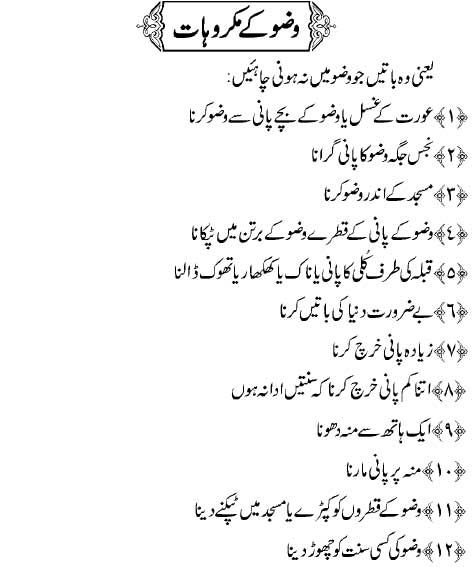
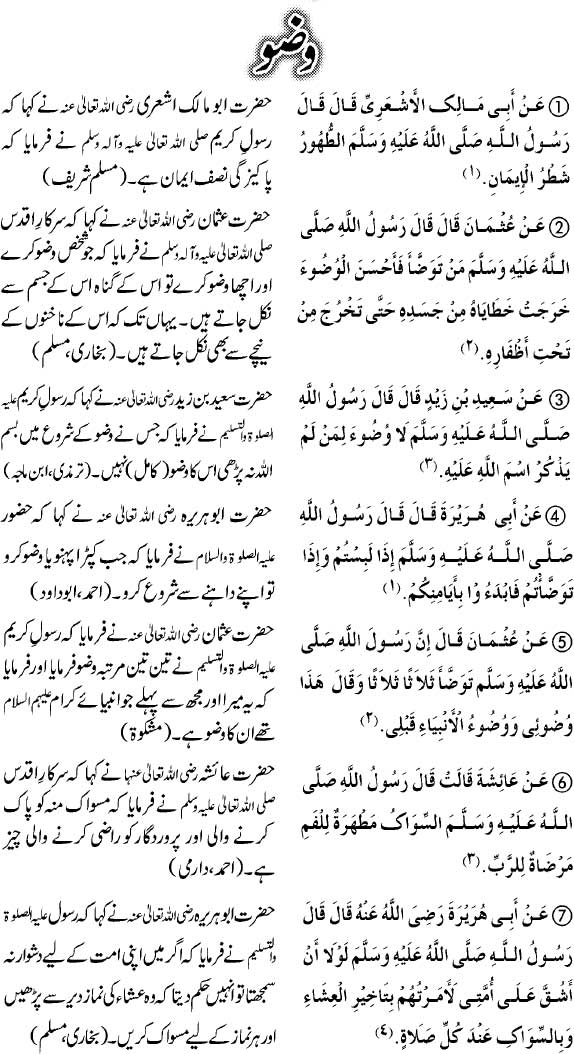
Wudu

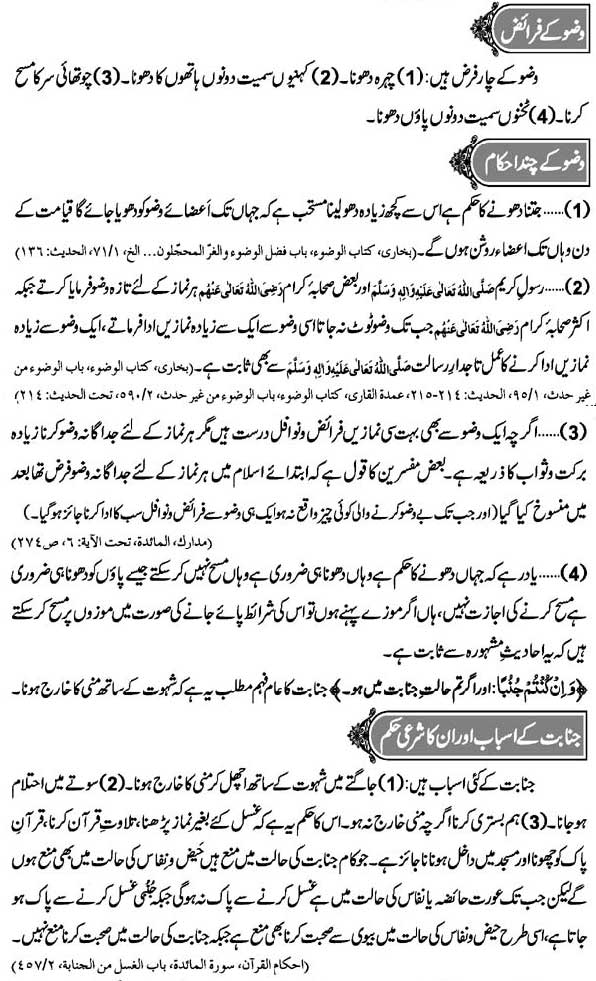
Wudu: Faraiz, Ahkam Aur Janabat Ka Sharai Hukam

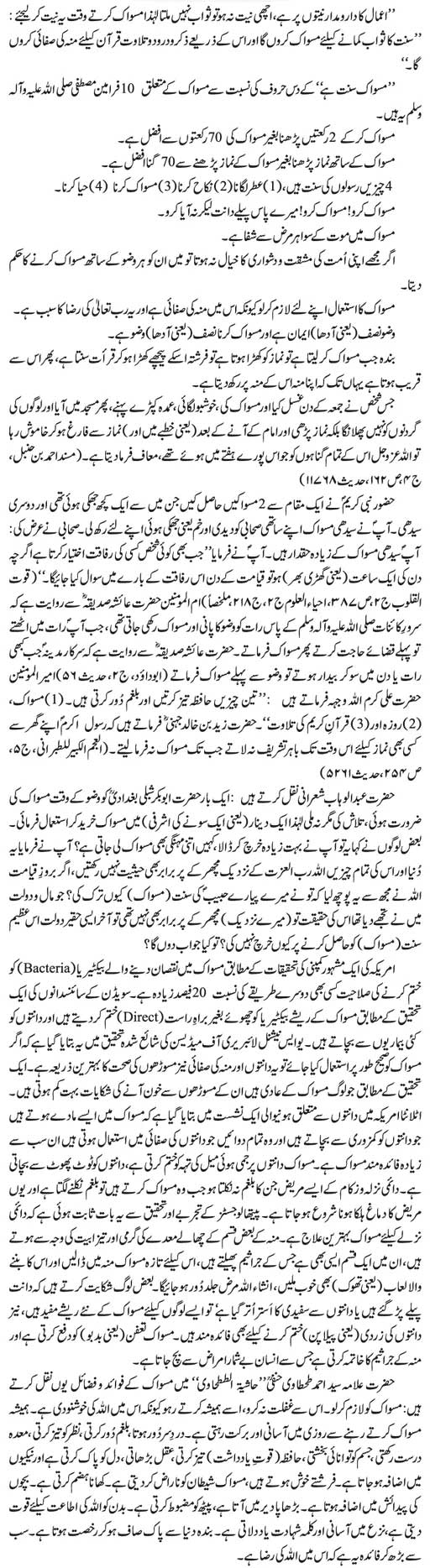
Miswak Ki Fazeelat

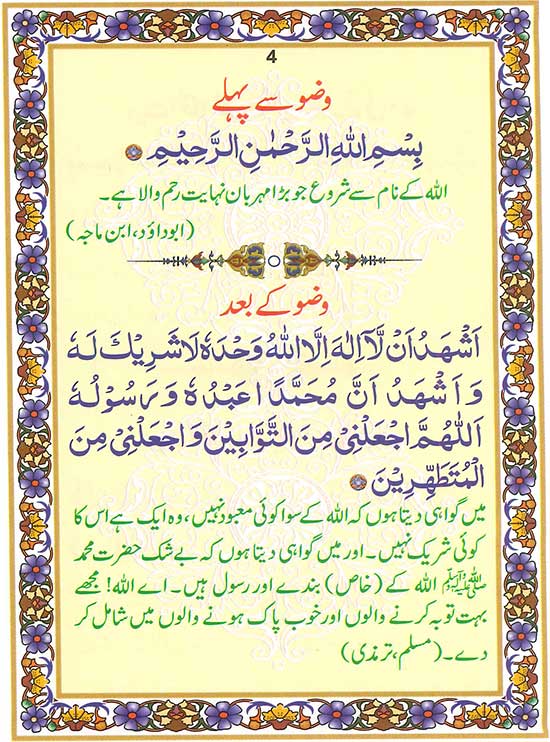
Wudu Ki Dua

Al-Hadith al-Nabawi (s.a.w)
Hadith:Haj for another
Yahya related to me from Malik from Ibn Shihab from Sulayman ibn Yasar that Abdullah ibn Abbas said, “Al-Fadl ibn Abbas was riding behind the Messenger of Allah, may Allah bless him and grant him peace, when a woman from the Khathama tribe came to him to ask him for a fatwa. Al-Fadl began to look at her, and she at him, and the Messenger of Allah, may Allah bless him and grant him peace, turned Fadl’s face away to the other side. The woman said, ‘Messenger of Allah, Allah’s making the hajj obligatory finds my father a very old man, unable to stay firm on his riding-beast. Can I do hajj for him?’, and he said, ‘Yes.’ This was during the farewell hajj.”
(Malik’s Muwatta, Book 20, Number 20.28.98)
Hadith: Love of the Sunnah
Narrated Anas ibn Malik
Allah’s Messenger (peace be upon him) said to me: My son, if you are in a position to pass your morning and evening keeping your heart free from malice against anyone, then act according to it (this high ideal). He then said: My son, and that is my Sunnah and he who loves my Sunnah, in fact loves me and he who loves me, will be with me in Paradise.
Transmitted by Tirmidhi.
Hadith: Charity
Abu Hurairah, may Allah be pleased with him, narrated:
There came a person to the Messenger of Allah (may peace be upon him) and asked: Messenger of Allah, which charity is the best? Upon this he said: That you should give charity (in a state when you are) healthy, closefisted, haunted by the fear of poverty and hoping to become rich (charity in such a state of health and mind is the best). And you must not defer (charity to such a length) that you are about to die and would be saying: This is for so and so, and this is for so and so. Lo, it has already come into (the possession of so and so).
(Hadith number in Sahih Muslim [Arabic only]: 1713 )
Hadith :Friendship
Narrated Abu Said Al Khudri
The Prophet delivered a sermon and said, “Allah gave a choice to one of (His) slaves either to choose this world or what is with Him in the Hereafter. He chose the latter.” Abu Bakr wept. I said to myself, “Why is this Sheikh weeping, if Allah gave choice to one (of His) slaves either to choose this world or what is with Him in the Hereafter and he chose the latter?” And that slave was Allah’s Apostle himself. Abu Bakr knew more than us. The Prophet said,”O Abu Bakr! Don’t weep. The Prophet added: Abu Bakr has favored me much with his property and company. If I were to take a Khalil from mankind I would certainly have taken Abu Bakr but the Islamic brotherhood and friendship is sufficient. Close all the gates in the mosque except that of Abu Bakr.
(Bukhari Vol 1 Number 455)
Wudu Kay Fazail Aur Adaab

Avoiding Nightmares And Sleep Disturbances
Most nightmares have their basis in our waking lives. They can stem from something we have seen or from what had been preoccupying our minds during the day. They can be the consequence of stressful or frightening experiences.
Nightmares are most common among small children. Their frequency generally decreases with age up to the time of puberty.
Someone who has a nightmare should not become worried. A major cause of nightmares is eating late at night right before going to sleep.
Apart from that, it is recommended for a Muslim to sleep in a state of ritual purity. This mean it is best to perform wudu (ablution) before going to bed.
It is also recommended to lie on the right side when going to sleep. The Prophet (peace be upon him) used to sleep on his right side and instructed his followers to do so.
He said (Sahih al-Bukhari (247) and Sahih Muslim (2710)):
If you come to your sleeping place, perform your ablutions as you would for prayer, then lay down on your right side, then say:
“O Allah, I have submitted myself to You and have entrusted to You my affairs, and I have taken refuge in You, in both hope and fear of You. There is no refuge or sanctuary from You except with You. O Allah! I believe in Your Book that You have revealed and Your Prophet whom You have sent.”
If you die in on this night of yours, then you will be on the natural faith. Make these words the last thing that you utter.