

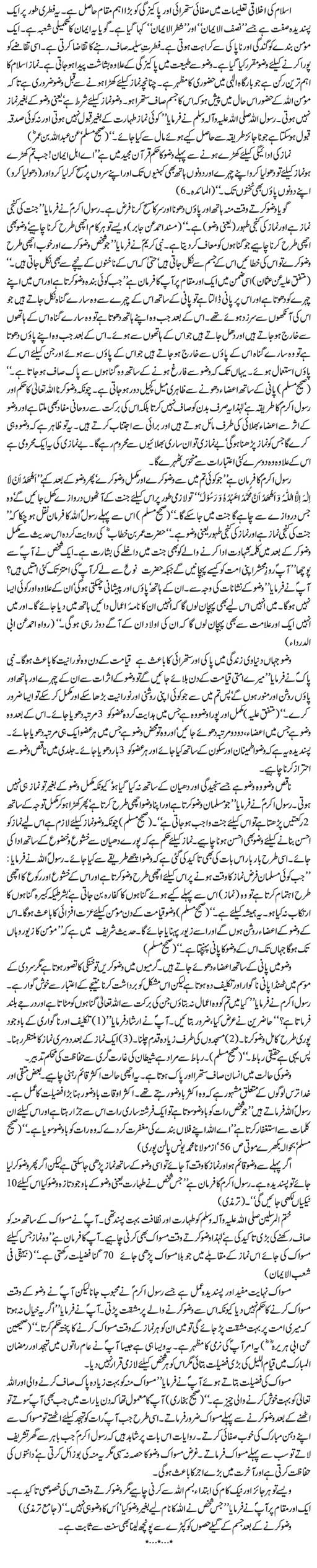
TAG: Wudu
Avoiding Nightmares And Sleep Disturbances
Most nightmares have their basis in our waking lives. They can stem from something we have seen or from what had been preoccupying our minds during the day. They can be the consequence of stressful or frightening experiences.
Nightmares are most common among small children. Their frequency generally decreases with age up to the time of puberty.
Someone who has a nightmare should not become worried. A major cause of nightmares is eating late at night right before going to sleep.
Apart from that, it is recommended for a Muslim to sleep in a state of ritual purity. This mean it is best to perform wudu (ablution) before going to bed.
It is also recommended to lie on the right side when going to sleep. The Prophet (peace be upon him) used to sleep on his right side and instructed his followers to do so.
He said (Sahih al-Bukhari (247) and Sahih Muslim (2710)):
If you come to your sleeping place, perform your ablutions as you would for prayer, then lay down on your right side, then say:
“O Allah, I have submitted myself to You and have entrusted to You my affairs, and I have taken refuge in You, in both hope and fear of You. There is no refuge or sanctuary from You except with You. O Allah! I believe in Your Book that You have revealed and Your Prophet whom You have sent.”
If you die in on this night of yours, then you will be on the natural faith. Make these words the last thing that you utter.
What Was So Special About Him
Anas (may Allah be pleased with him) said: We were sitting in the presence of Allah’s Messenger (peace be upon him) one day, and he said, “A person is about to arrive from this mountain path who is from the people of Paradise.”
So a person from the Ansar arrived, his beard dripping with water from wudhu and his left hand carrying his sandals. He greeted us with salaams.
The second and the third day too the Prophet (peace be upon him) said similar words and the
same man appeared in the same condition.
Abdullah Bin Amr Bin Al-Aas followed the man sought his permission to stay with him for three days .
So Abdullah spent three nights with this person. But he did not see him stand up for the night prayer at all! All he did was, mention Allah and make takbeer when he turned sides on his bed. He would do this till he stood up for the Fajr prayer.
However, Abdullah said, “I never heard him speak anything except good.”
So when the three days were over, Abdullah told the man, “O, servant of Allah! I heard Allah’s Messenger (peace be upon him) saying on three occasions, ‘A person is about to arrive who is from the people of Paradise,’ and you arrived on those three occasions.
But I have not seen you perform a great deal of deeds, so what is it that made the Prophet (peace be upon him) say that about you?” He replied, “I do not harbor disloyalty to any of the Muslims within me, and neither do I feel jealous for the wealth that Allah has bestowed upon them.”
Abdullah said, “This is what has (made you special) and it’s something we cannot endure.” (Musnad Ahmad – Hasan)
Wudu Namaz Ki Kunji
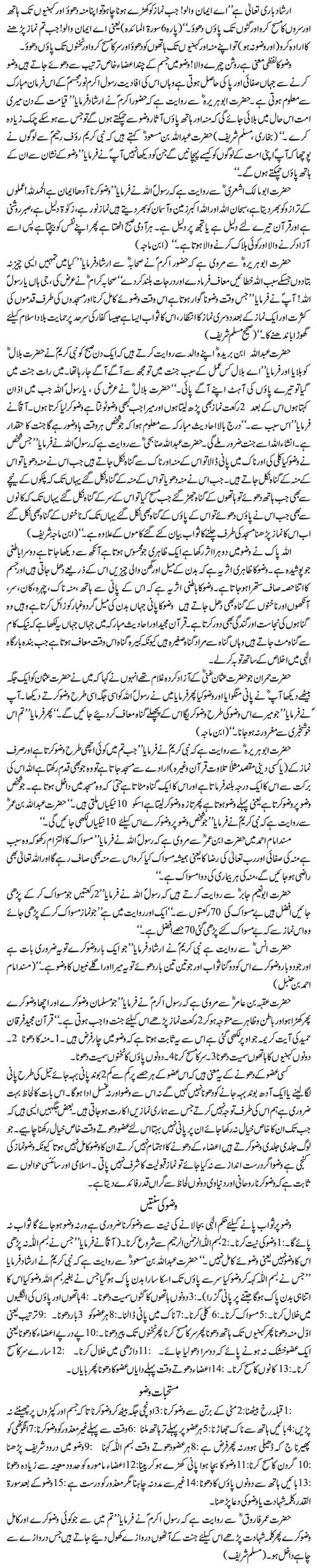
Wudu Namaz Ki Kunji
Personal Hygiene In Islam
Muslims enjoy the highest standard of personal hygiene of all the people in the world. In Islam, cleanliness and purification are not only requirements for the performance of worship, or when embracing Islam, but are part of a Muslim’s very faith. Allah says in the Qur’an: “Truly, Allah loves those who turn unto Him in repentance and loves those who purify themselves (by taking a bath and cleaning and washing thoroughly their private parts, bodies, for their prayers, etc.).” (Al Baqarah: 222)
Cleanliness in Islam is of three kinds:
1- Purification from impurity (i.e. to attain purity or cleanliness, by taking a bath ghusl or performing ablution wudu’ in states in which a bath or ablution is necessary or desirable according to Islamic Law.
2- Cleansing one’s body, dress, or place from an impurity of filth.
3- Removing the dirt or grime that collects in various parts of the body, such as cleaning the teeth and nostrils, trimming nails, and removing armpit and pubic hair.
Ghusl
This is when all parts of the body are thoroughly washed. Ghusl is required of every Muslim after sexual intercourse, after wet dreams, after child-birth, and after post-partum bleeding (40-days flow of blood, and final yellowish discharge has completely stopped), and each month after menstruation and final yellowish discharge have stopped.
Wudu
1- after urinating or defecating
2- if one breaks the wind
3- if one falls asleep lying down
4- if one loses consciousness
The above cases also nullify one’s ablution, requiring a fresh one. Allah says in the Qur’an: “O you who believe! When you intend to offer prayer, wash your faces and your hands (forearms) up to the elbows, rub (by passing wet hands over) your heads, and (wash) your feet up to ankles. If you are in a state of Janaba, purify yourself (bathe your whole body)….” (Al-Ma’idah: 6)
Also on this issue, Abu Hurairah (may Allah be pleased with him) quoted Allah’s Messenger (peace and blessings be upon him) as saying, “The prayer of a person who does hadath (passes, urine, stool or wind) is not accepted until he performs (repeats) the ablution.” A person from Hadaramout asked Abu Hurairah, “What is ‘hadath’?” Abu Hurairah replied, “‘Hadath’ means the passing of wind from the anus.” (Sahih Al-Bukhari, Volume 1, Book 4, Number 137)
Merits of ablution:
Part of the merits of ablution is that it earns Muslims a special name by which they will be called on the Day of Judgment; the name is Al-Ghurr-ul-Muhajjalun (People of shinning bodily parts), due to performing ablution in proper way. Nu’aim Al-Mujmir reported: “Once I went up the roof of the mosque along with Abu Hurairah (may Allah be pleased with him). He performed ablution and said, ‘I heard the Prophet (peace and blessings be upon him) saying: On the Day of Resurrection, my followers will be called Al-Ghurr-ul-Muhajjalun from the traces of ablution and whoever can increase the area of his radiance should do so (by performing ablution in the most perfect manner.'” (Sahih Al-Bukhari, vol. 1, hadith No. 138)
Tayamum (Dry Ablution)
This is performed by putting or striking lightly the hands over clean earth and then pass the palm of each on the back of the other, blow off the dust then pass them on the face. It is performed instead of wudu and ghusl (in case of ritual impurity, etc.). Allah says in the Qur’an: “… But if you are ill or on a journey or any of you comes from answering the call of nature, or you have been in contact with women (i.e., sexual intercourse) and you find no water, then perform tayammum with clean earth and rub therewith your faces and hands. Allah does not want to place you in difficulty, but He wants to purify you, and to complete His Favor on you that you may be thankful.” (Al-Ma’idah: 6)
To illustrate the importance of Muslims maintaining their high level of personal hygiene, the following points are specifically mentioned by Prophet Muhammad (peace and blessings be upon him) on answering the call of nature.
`A’ishah, the Mother of the Faithful (may Allah be pleased with her): “The Prophet (peace and blessings be upon him) used his right hand for getting water for ablution and taking food, and his left hand for his evacuation and for anything repugnant.” (Sunan Abu Dawud)
Abu Hurairah (may Allah be pleased with him) reported: “The Messenger of Allah (peace and blessings be upon him) said: ‘Be on your guard against two things which provoke cursing.’ They (the Companions present there) said: ‘Messenger of Allah, what are those things which provoke cursing?’ He said: ‘Easing on the thoroughfares or under the shades (where people take shelter and rest).'” (Reported by Muslim)
Performing Wudu For Your Daily Prayers
- Niyyat – Make an intention to perform Wudu in one’s mind for the purpose of worshipping Allah Subhanahu wa ta’ala.
- Bismillah – Invoking Allah at the start of Wudu by saying Bismillah (in the Name of Allah)
- Hands – Wash the hands 3 times up to the wrists with water, allowing water to run between the fingers.
- Mouth – Rinsing the mouth with water three times. The mouth must be empty of food.
- Nose – Cleaning one’s nostrils by sniffing water in and then out 3 times.
- Face – Clean the face 3 times from the top of the forehead down to the chin and from ear to ear.
- Arms – Wash the arms three times, from the elbows. Right arm first, then left.
- Head – Moisten the hands and pass them over the head from the forehead to the back of the neck (over the head), and from there back to the forehead. Never wet the neck. Then wipe the earlobes with the fore-fingers cleaning the inside of the ears and the thumbs cleaning the external side.
- Feet – Finally wash both feet beginning with the right first, up to the ankles. The feet should be rubbed while washed and water must run between the toes. No part of the foot remains dry.
Tahiyatul-Wudu Ki Fazeelat
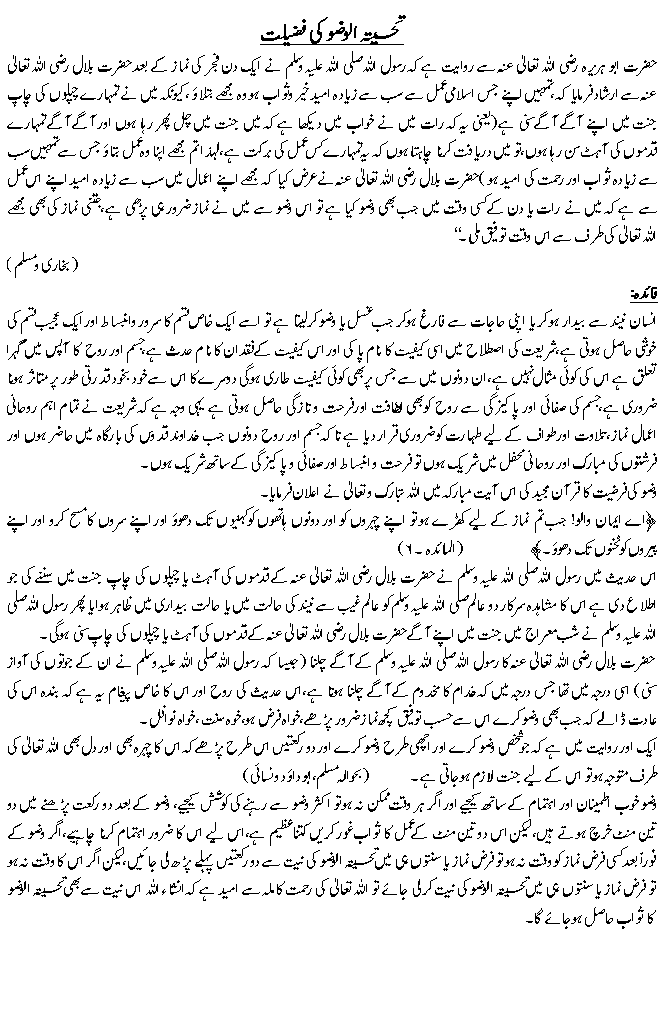
Tahiyatul-Wudu Ki Fazeelat
Improve Your Relationship With The Quran
7 Tips for Improving your Relationship with the Quran….!!!
1. Before you touch it, check your heart.
The key to really benefiting from the Quran is to check your heart first before you even touch Allah’s book. Ask yourself, honestly, why you are reading it. Is it to just get some information and to let it drift away from you later? Remember that the Prophet Muhammad (peace and blessings be upon him) was described by his wife as a “walking Quran”: in other words, he didn’t just read and recite the Quran, he lived it.
2. Do your Wudu (ablution).
Doing your Wudu is good physical and mental preparation to remind you you’re not reading just another book. You are about to interact with ALLAH, so being clean should be a priority when communicating with Him.
3. Start with reading for only 5 minutes every day.
Too often, we think we should read Quran for at least one whole hour. If you aren’t in the habit of reading regularly, this is too much. Start off with just five minutes daily. If you took care of step one, Insha Allah (ALLAH willing), you will notice that those five minutes will become ten, then half an hour, then an hour, and maybe even more!
4. Make sure you understand what you’ve read.
Five minutes of reading the Quran in Arabic is good, but you need to understand what you’re reading. Make sure you have a good translation of the Quran in the language you understand best. Always try to read the translation of what you’ve read that day.
Anmol Khazana – Dua’s For Wudu
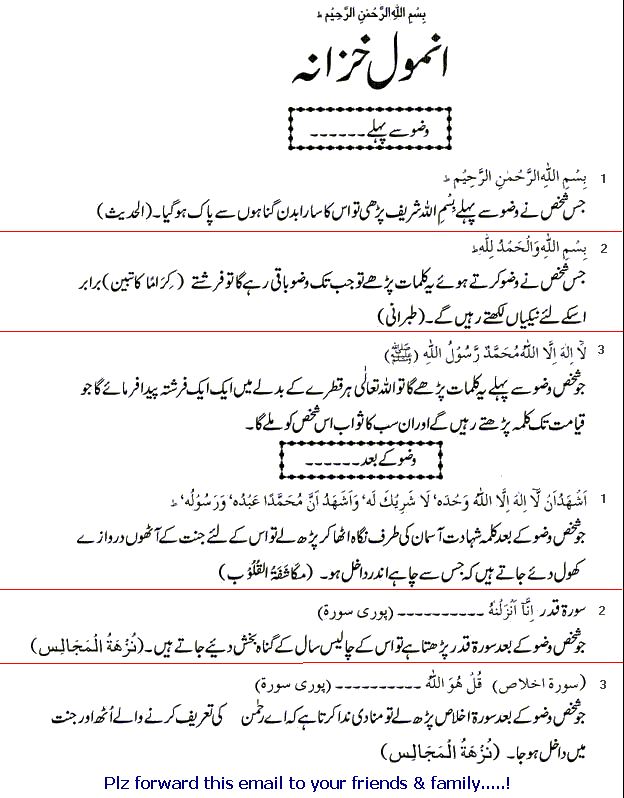
Anmol Khazana