

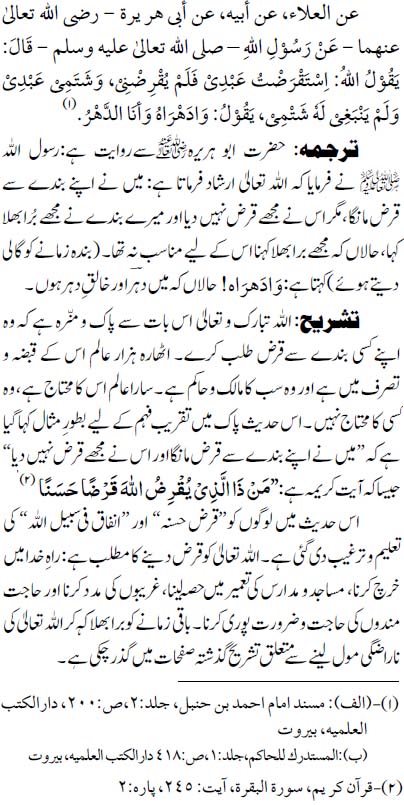
Hadith Qudsi: Dehar
Badshaguni: Zamana e Jahiliyat Ki Riwayat
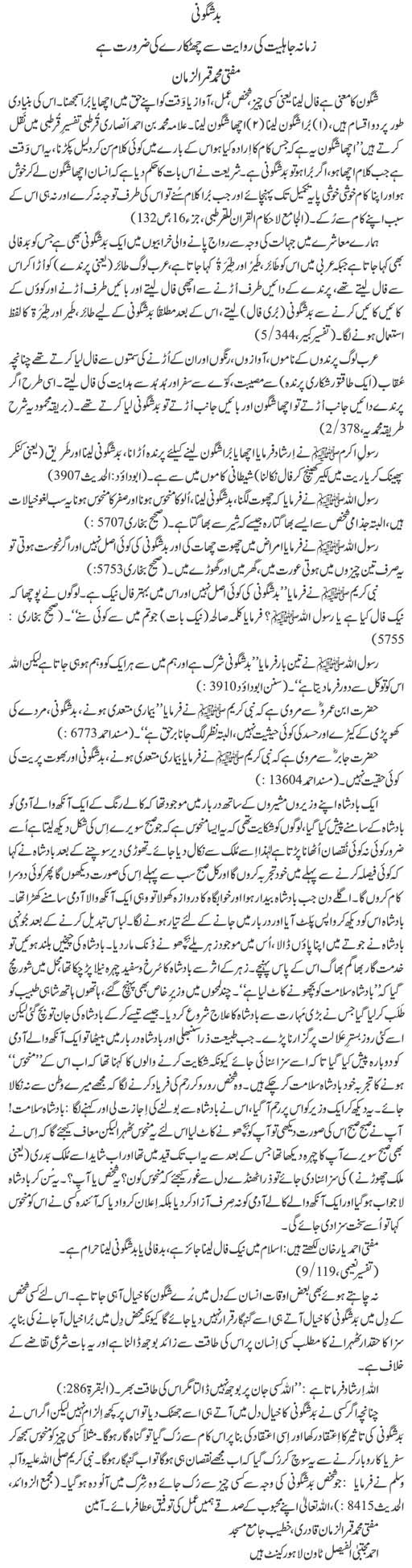
Badshaguni: Zamana e Jahiliyat Ki Riwayat
Misconception: Muslims Worship Muhammad (PBUH)
According to Islamic belief, the Prophet Muhammad was the last Messenger of God. He, like all of God’s prophets and messengers – such as Noah, Abraham, Moses, and Jesus — was only a human being. Christians came to the mistaken assumption that Muslims worship Muhammad by formulating an incorrect analogy – they worship Jesus so they assumed Muslims worship Muhammad. This is one of the reasons that they called Muslims by the incorrect name “Mohammedans” for so many years! Muhammad, like Jesus, never claimed divine status. He called people to worship only Almighty God, and he continually emphasized his humanity so that people would not fall into the same errors as Christians did in regard to Jesus. In order to prevent his deification, the Prophet Muhammad always said to refer to him as “the Messenger of God and His slave”. Muhammad was chosen to be God’s final messenger — to communicate the message not only in words but to be a living example of the message. Muslims love and respect him because he was of the highest moral character and he brought the Truth from God – which is the Pure Monotheism of Islam. Even when Islam was in its very early stages, God revealed that Muhammad “was sent as a mercy to all of mankind” – thus informing us that the message of Islam would become very widespread. Muslims strive to follow the great example of Muhammad, peace be upon him, but they do not worship him in any way. Additionally, Islam teaches Muslims to respect all of God’s prophets and messengers – but respecting and loving them does not mean worshipping them. All true Muslims realize that all worship and prayer must be directed to Almighty Allah alone. Suffice it to say that worshipping Muhammad — or anyone else — along with Almighty Allah is considered to be the worst sin in Islam. Even if a person claims to be Muslim, but they worship and pray to other than Almighty Allah, this cancels and nullifies their Islam. The Declaration of Faith of Islam makes it clear that Muslims are taught only to worship God. This declaration is as follows: “There is nothing divine or worthy of being worshipped except for Almighty Allah, and Muhammad is the Messenger and Servant of God”.
Ghar Mein Iddat Guzarne Kay Sharai Masail
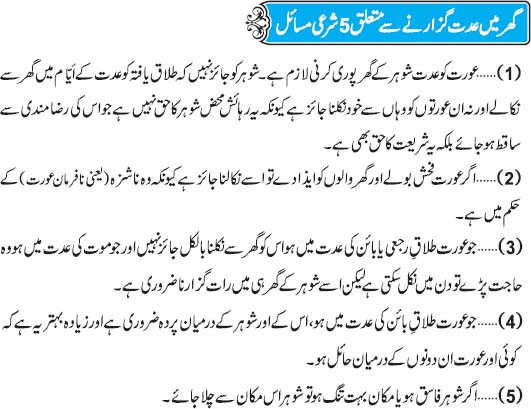
Ghar Mein Iddat Guzarne Kay Sharai Masail
Misconception: Muslims Worship A Different God
First of all, there is only One God who created the Universe and all of mankind. Throughout history, people have created false gods in their minds and come up with false ideas about Almighty God, but regardless of this there is still only One True God – and He alone is worthy of worship. Unfortunately, some non-Muslims have come to incorrectly believe that Muslims worship a different God than Jews and Christians. This might be due to the fact that Muslims sometimes refer to God as “Allah”, but also because over the centuries there have been many lies and distortions spread by the enemies of Islam. In actuality, Muslims worship the God of Noah, Abraham, Moses, and Jesus — the same God as Christians and Jews. The word “Allah” is simply the Arabic word for Almighty God and it is the same word that Arabic-speaking Christians and Jews use to refer to God. If you pick up an Arabic translation of the Christian Bible, you will see the word “Allah” where “God” is used in English. For more information on the word “Allah”, please read: Who is Allah? But even though Muslims, Jews, and Christians believe in the same God, their concepts about Him differ quite a bit. For example, Muslims reject the idea of the Trinity or that God has become “incarnate” in the world. Also, the teachings of Islam do not rely on or appeal to “mystery” or “paradox” — they are straightforward and clear. Islam teaches that God is Merciful, Loving, and Compassionate and that He has no need to become man (nor do humans need for Him to). One of the unique aspects of Islam is that it teaches that man can have a personal and fulfilling relationship with Almighty God without compromising the transcendence of God. In Islam there is no ambiguity in Divinity — God is God and man is man. Muslims believe that God is the “Most Merciful”, and that he deals directly with human-beings without the need of any intermediary. Actually, the phrase “In the Name of God, the Compassionate, the Merciful” is one of the most repeated verses in the Holy Qur’an. Additionally, the pure and straightforward teachings of Islam demand that Almighty God be approached directly and without intermediaries. This is because Muslims believe that God is completely in control of everything and that He can bestow His Grace and Mercy on His creatures as He pleases – no Atonement, Incarnation or blood sacrifice is necessary. In summary, Islam calls people to submit to the One True God and to worship Him alone.
Hadith Qudsi: Sadqaat Aur Khairat
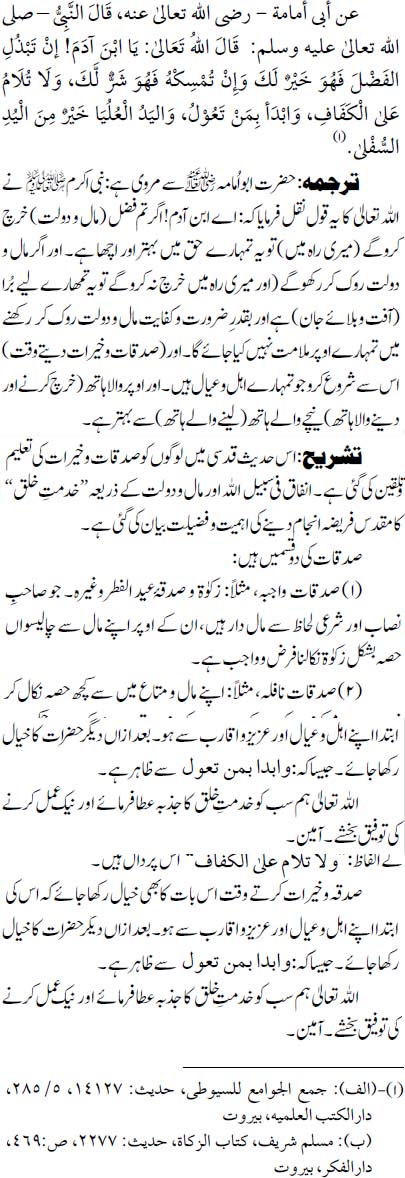
Hadith Qudsi: Sadqaat Aur Khairat (Infaq Fi Sabilillah)
Who Is Allah?
It is a known fact that every language has one or more terms that are used in reference to God and sometimes to lesser deities. This is not the case with Allah. Allah is the personal name of the One true God. Nothing else can be called Allah. The term has no plural or gender. This shows its uniqueness when compared with the word god which can be made plural, gods, or feminine, goddess. It is interesting to notice that Allah is the personal name of God in Aramaic, the language of Jesus and a sister language of Arabic.
The One True God is a reflection of the unique concept that Islam associates with God. To a Muslim, Allah is the Almighty, Creator, and Sustainer of the universe, Who is similar to nothing and nothing is comparable to Him. The Prophet Muhammad was asked by his contemporaries about Allah; the answer came directly from God Himself in the form of a short chapter of the Quran, which is considered the essence of unity or the motto of monotheism. This is chapter 112 which reads:
“In the name of God, the Merciful, the Compassionate. Say (O Muhammad) He is God the One God, the Everlasting Refuge, who has not begotten, nor has been begotten, and equal to Him is not anyone.”
Some non-Muslims allege that God in Islam is a stern and cruel God who demands to be obeyed fully. He is not loving and kind. Nothing can be farther from the truth than this allegation. It is enough to know that, with the exception of one, each of the 114 chapters of the Quran begins with the verse: “In the name of God, the Merciful, the Compassionate.” In one of the sayings of Prophet Muhammad (PBUH), we are told that “God is more loving and kinder than a mother to her dear child.”
But God is also Just. Hence evildoers and sinners must have their share of punishment and the virtuous, His bounties and favors. Actually, God’s attribute of Mercy has full manifestation in His attribute of Justice. People suffer throughout their lives for His sake and people oppressing and exploiting other people all their lives should not receive similar treatment from their Lord. Expecting similar treatment for them will amount to negating the very belief in the accountability of man in the Hereafter and thereby negating all the incentives for a moral and virtuous life in this world. The following Quranic verses are very clear and straightforward in this respect:
“Verily, for the Righteous, are gardens of Delight, in the Presence of their Lord. Shall We then treat the people of Faith like the people of Sin? What is the matter with you? How judge you?” (68:34-36)
Islam rejects characterizing God in any human form or depicting Him as favoring certain individuals or nations on the basis of wealth, power, or race. He created the human beings as equals. They may distinguish themselves and get His favor through virtue and piety only.
The concept that God rested on the seventh day of creation, that God wrestled with one of His soldiers, that God is an envious plotter against mankind, or that God is incarnate in any human being are considered blasphemy from the Islamic point of view.
The unique usage of Allah as a personal name of God is a reflection of Islam’s emphasis on the purity of the belief in God which is the essence of the message of all God’s messengers. Because of this, Islam considers associating any deity or personality with God as a deadly sin that God will never forgive, despite the fact He may forgive all other sins.
[Note that what is meant above applies ONLY to those people who die in a state wherein they are associating others with God. The repentance of those who yet live is acceptable to God if He wills. – MSA of USC]
The Creator must be of a different nature from the things created because if he is of the same nature as they are, he will be temporal and will therefore need a maker. It follows that nothing is like Him. If the maker is not temporal, then he must be eternal. But if he is eternal, he cannot be caused, and if nothing outside him causes him to continue to exist, which means that he must be self-sufficient. And if he does not depend on anything for the continuance of his own existence, then this existence can have no end. The Creator is therefore eternal and everlasting: “He is the First and the Last.”
He is Self-Sufficient or Self-Subsistent or, to use a Quranic term, Al-Qayyum. The Creator does not create only in the sense of bringing things into being, He also preserves them and takes them out of existence and is the ultimate cause of whatever happens to them.
“God is the Creator of everything. He is the guardian over everything. Unto Him belong the keys of the heavens and the earth.” (39:62, 63)
“No creature is there crawling on the earth, but its provision rests on God. He knows its lodging place and its repository.” (11:6)
God’s Attributes
If the Creator is Eternal and Everlasting, then His attributes must also be eternal and everlasting. He should not lose any of His attributes nor acquire new ones. If this is so, then His attributes are absolute. Can there be more than one Creator with such absolute attributes? Can there be, for example, two absolutely powerful Creators? A moment’s thought shows that this is not feasible. The Quran summarizes this argument in the following verses:
“God has not taken to Himself any son, nor is there any god with Him: For then each god would have taken of that which he created and some of them would have risen up over others.” (23:91)
And Why, were there gods in earth and heaven other than God, they (heaven and earth) would surely go to ruin.” (21:22)
The Oneness of God
The Quran reminds us of the falsity of all alleged gods. To the worshippers of man-made objects, it asks: “Do you worship what you have carved yourself?” (37:95)
“Or have you taken unto you others beside Him to be your protectors, even such as have no power either for good or for harm to themselves?” (13:16)
To the worshippers of heavenly bodies, it cites the story of Abraham: “When night outspread over him he saw a star and said, ‘This is my Lord.’ But when it set he said, ‘I love not the setters.’ When he saw the moon rising, he said, ‘This is my Lord.’ But when it set he said, ‘If my Lord does not guide me I shall surely be of the people gone astray.’ When he saw the sun rising, he said, ‘This is my Lord; this is greater.’ But when it set he said, ‘O my people, surely I quit that which you associate, I have turned my face to Him Who originated the heavens and the earth; a man of pure faith, I am not of the idolaters.'” (6:76-79)
The Believer’s Attitude
In order to be a Muslim, i.e., to surrender oneself to God, it is necessary to believe in the oneness of God, in the sense of His being the only Creator, Preserver, Nourisher, etc. But this belief – later on called “Tawhid Ar-Rububiyyah” – is not enough. Many of the idolaters knew and believed that only the Supreme God could do all this, but that was not enough to make them Muslims. To tawhid ar-rububiyyah one must add tawhid al’uluhiyyah, i.e., one acknowledges the fact that is God alone Who deserves to be worshipped, and thus abstains from worshipping any other thing or being. Having achieved this knowledge of the one true God, man should constantly have faith in Him, and should allow nothing to induce him to deny truth.
When faith enters a person’s heart, it causes certain mental states which result in certain actions. Taken together these mental states and actions are the proof of true faith. The Prophet said, “Faith is that which resides firmly in the heart and which is proved by deeds.” Foremost among those mental states is the feeling of gratitude towards God which could be said to be the essence of ‘ibada’ (worship).
The feeling of gratitude is so important that a non-believer is called ‘kafir’ which means ‘one who denies a truth’ and also ‘one who is ungrateful.’
A believer loves and is grateful to God for the bounties He bestowed upon him, but being aware of the fact that his good deeds, whether mental or physical, are far from being commensurate with Divine favors, he is always anxious lest God should punish him, here or in the Hereafter. He, therefore, fears Him surrenders himself to Him, and serves Him with great humility. One cannot be in such a mental state without being almost all the time mindful of God. Remembering God is thus the life force of faith, without which it fades and withers away.
The Quran tries to promote this feeling of gratitude by repeating the attributes of God very frequently. We find most of these attributes mentioned together in the following verses of the Quran:
“He is God; there is no god but He, He is the Knower of the unseen and the visible; He is the All-Merciful, the All-Compassionate. He is God, there is no God but He. He is the King, the All-Holy, the All-Peace, the Guardian of Faith, the All-Preserver, the All-Mighty, the All-Compeller, the All-Sublime. Glory be to God, above that they associate! He is God the Creator, the Maker, the Shaper. To Him belong the Names Most Beautiful. All that is in the heavens and the earth magnifies Him; He is the All-Mighty, the All-Wise.” (59:22-24)
“There is no god but He, the Living, the Everlasting. Slumber seizes Him not, neither sleep; to Him belongs all that is in the heavens and the earth. Who is there that shall intercede with Him save by His leave? He knows what lies before them and what is after them, and they comprehend not anything of His knowledge save such as He wills. His throne comprises the heavens and earth; the preserving of them oppresses Him not; He is the All-High, the All-Glorious.” (2:255)
“People of the Book, go not beyond the bounds in your religion, and say not as to God but the truth. The Messiah, Jesus son of Mary, was only the Messenger of God, and His Word that He committed to Mary, and a Spirit from Him. So believe in God and His Messengers, and say not, ‘Three.’ Refrain; better is it for you. God is only one God. Glory be to Him – (He is) above having a son.” (4:171)
Nabi-e-Kareem (PBUH) Ki Sahaba Karam Par Rehmat Aur Shafqat

Nabi-e-Kareem (PBUH) Ki Sahaba Karam Par Rehmat Aur Shafqat by Molana Muhammad Tariq Noman Garangi
Sayyiduna Muawiyah (RA)
Unlike most of Sayyiduna ‘Uthman (radi Allahu anhu’s) governors, Sayyiduna Muawiyah (radi Allahu anhu) displayed great administrative ability and was very popular. He was a God-fearing man and was especially known for his mercy. Sayyiduna Ali (radi Allahu anhu) was very strict in piety and straightforward. Sayyiduna Muaawiyah (radi Allahu anhu) declared his disobedience to him because he felt that he was better qualified to lead the Muslim world.
Battle Of The Camel
Another serious development took place. Sayyadah Aishah (radi Allahu anha) and two leading Sahaba, Sayyiduna Talha and Sayyiduna Zubair (radi Allahu anhuma) declared their opposition to the Khilaafat of Sayyiduna Ali (radi Allahu anhu). They left Madinatul Munawwarah for Makkatul Mukarramah and from there travelled to Basrah where they rallied men and new supporters.
Sayyiduna Ali (radi Allahu anhu) had to crush all opposition. A bloody battle took place near Basrah on the 9th of December 656 A.C. This battle was sparked off by a third force who were the real troublemakers. Just before the battle, both parties had already reached an agreement to settle the dispute. But this third force, the real assassinators of Sayyiduna ‘Uthman (radi Allahu anhu), launched an overnight attack on both camps simultaneously. Each side was under the impression that the other had attacked. The battle began. Several thousand men were lost including the two Sahaba. Sayyadah Aishah (radi Allahu anha) was safe. She was riding a camel during the battle-hence the name “Battle of the Camel.” Sayyiduna Ali (radi Allahu anhu) treated her in a most noble and dignified manner and respectfully sent her back to Madinatul Munawwarah. She praised him and deeply regretted opposing Sayyiduna Ali (radi Allahu anhu). Kufa was now made the capital of the Islamic world.
Battle Of Siffin
Sayyiduna Muaawiyah (radi Allahu anhu) rallied an army to face Sayyiduna Ali (radi Allahu anhu). A battle took place at Siffin on the Syrian border in the July of 567 A.C. Sayyiduna Muaawiyah (radi Allahu anhu) was no match for Sayyiduna Ali (radi Allahu anhu) and began to retreat. By the clever proposal of Sayyiduna Amr bin Al As (radi Allahu anhu), the retreating army raised pieces of the Holy Quran on their spears demanding judgment between the two parties. Many pious Muslims on the side of Sayyiduna Ali (radi Allahu anhu) refused to fight seeing the Holy Quran displayed in the air.
Judgment
Two men, one from each side, were appointed to settle the dispute. Sayyiduna Abu Musa (radi Allahu anhu), a pious Sahaba from Sayyiduna Ali’s (radi Allahu anhu’s) side, and the skilled Sayyiduna Amr (radi Allahu anhu) from Sayyiduna Muaawiyah (radi Allahu anhu’s) side. Sayyiduna Musa (radi Allahu anhu) declared in front of the Muslims that it was decided to recommend the removal of both Sayyiduna Ali and Sayyiduna Muaawiyah (radi Allahu anhuma) and that the Muslims should select another man for the Khilaafat. Sayyiduna Amr (radi Allahu anhu) replied that: “He has declared the removal of his leader, while I would conform Muaawiyah as the Caliph.” Chaos followed.
Khaarijees
Sayyiduna Ali (radi Allahu anhu) prepared to meet Sayyiduna Muaawiyah (radi Allahu anhu) again in battle, but he was moved from his task by a serious conflict that occurred among his men. Some narrow-minded people accused Sayyiduna Ali (radi Allahu anhu) of accepting a man-made judgment. Their slogan was: “There is no judgment but with Allah.” They declared that Sayyiduna Ali, Sayyiduna Muaawiyah, and Sayyiduna ‘Uthman (radi Allahu anhumul ajma’in) were unbelievers and that Jihad should be declared against them. Ever since this event, they have been known as the “Khaarijees”, which means, “those who left the fold.” They maintained that the Khilaafat should be given to the most eligible Muslim, regardless of his origin. The Kharijees are not regarded as Muslims.