
Rules: Sunnah In Ablution(Wudu)
Q. How is it to perform ablution (Wudu) without its intention?
A. If without the intention of ablution, one falls in the river, or one keeps standing in the rain so that water passes over all the parts which are necessary for the ablution, it will be considered that the ablution is done for saying prayers. But there will be no blessings for the ablution.
Q. How to make intention (Niyyah) for ablution (Wudu)?
A. Intention implies the making-up of one’s mind at the start of ablution; having the intention of removing impurity, and becoming clean for saying the prayers properly. Such thoughts mean ‘intention’ i.e. ‘Niyyah’ for the ablution.
Q. Is it necessary to express the intention (Niyyah) in words?
A. No, it is not necessary. However, if said in words, that too will be correct.
Q. With ablution intact, if fresh ablution is performed, what should be the ‘intention’ (Niyyah) for that?
A. The sole intention of performing ablution-over-ablution should be to enhance the blessings of Allah and to earn more benefits.
Q. Must one say the complete Tasmiah in ablution?
A. It is equally permissible to recite:
BISMIL LAHIR RAHMAN NIR RAHIM (or)
BISMIL LAHIL ‘ALIYIL ‘AZIM VAL HAMDU LIL LAHI ‘ALA DINIL ISLAM (or)
BISMIL LAHI WAL HAMDU LIL LAHI i.e., in any of the above three ways
Q. How is it to use a tooth-stick (Miswak) and what is its method?
A. Brushing the teeth with a tooth-stick (Miswak) is ‘Sunnah Mu’akkadah’ i.e. Emphasized Sunnah. It has many blessings and very many benefits. It may be had from the root of a bitter tree, or its twig e.g., Peelo’s root, or a stick from the Neem tree, not more than 8 inches in length. It should be rinsed before and after use. First brush the teeth from the right side, followed by those on the left. The teeth should be brushed thrice, using fresh water each time.
Q. What is the opinion about gargling?
A. Gargling is an act of Sunnah, both during bath and ablution It should not be done if one is Fasting. During Fasting, only rinse the mouth with a handful of water using the right hand.
Q. How to put water into the nostrils?
A. Hold water in the scooped right hand close to the nose. After this, sniff water into the nostrils (taking care not to let it reach the brain). If one is Fasting, the water should not be sniffed. Instead, it should be put into the nostrils with the hand. Gargling and sniffing water into the nostrils are both Sunnah-mu’akkadah of the Holy Prophet (Peace be upon him).
Q. Which part of the beard should be combed (to do Khalal) according to the Sunnah?
A. It is Sunnah to comb (to do Khalal with fingers) the lower and middle (part) of the beard. And it is obligatory (Fard) to wash hair on the face adjoining the skin.
Q. How to comb the fingers i.e., to do Khalal of the fingers?
A. Khalal of the fingers means that the fingers of both hands should be rubbed against each other and shaken in a manner that they are interwoven. The Khalal of the toe is done by the little finger of the left hand beginning from the little toe of the right foot and ending with the little toe of the left foot.
Q. How to perform the Massah of the whole head?
A. Wet both hands, and place them on both sides of the hair at the forehead. Move both palms and fingers, to the back of the head, up to the nape. Then return hands, ensuring that the whole head is covered.
Q. Must fresh water be used for the Massah of the ears?
A. No, the water taken for the Massah of the head would do. use index finger for Massah inside the ears. The thumb should be used for the outside of the ear.
Q. Is it Sunnah or Mustahab (desirable) to start the ablution from the right side?
A. Some religious scholars hold it as Sunnah, while others regard it as desirable (Mustahab).
Q. How to perform Massah on the back of the neck (nape)?
A.The neck should be wiped with the back of fingers of both the hands. It is an innovation (Bi’dah) to do Massah on the throat.
Q. What are the other procedures in ablution?
A. There are many procedures for ablution. For example, the following are desirable:
- Putting the wet tip of the small finger into the ear holes.
- Performing ablution before the time of prayer.
- Rubbing parts of the body while washing them.
- Moving the ring on the finger.
- Refraining from gossiping about worldly affairs.
- Avoid splashing water on the face (with force).
- Not using too much water for ablution.
- Reciting Tasmiah while washing each part of the body.
- Sending Darud on the Holy Prophet (Peace be upon him) after ablution.
- Reciting Kalima of Shahadah, and reciting the following Dua after ablution:
ALLA HUMMAJ ‘ALNI MINAT-TAW-WABINA WAJ ‘ALNI MINAL MUTATAHIRIN - Drinking the left-over water of ablution while standing.
- Offering two Rakahs of prayer after ablution, known as TAHI YAT UL WUDU (Thanksgiving for the ablution), etc.
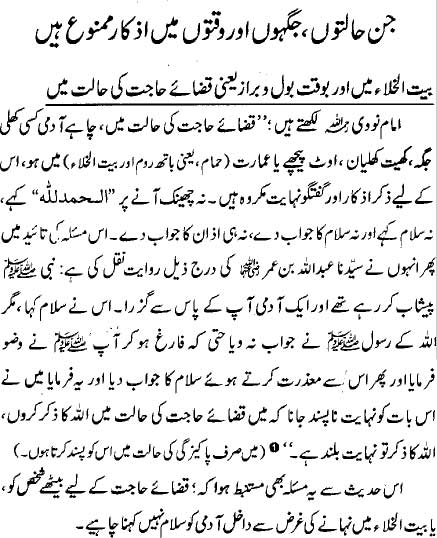
Jin Halatoon, Jaghoon Aur waqtoon Mein Azkar Mamnu Hein
Compulsory Actions For Ablution
Q. How is it to say the prayer, without ablution?
A. It is a big sin. Some religious scholars hold the person Kafir, who intentionally offers the prayer, without ablution.
Q. What is the proof of ablution being a necessity for saying the prayer?
A. The following verse of the Holy Qur’an stipulates that ablution is an essential pre-requisite for prayer.
(O Believers when you rise up for prayer, wash your face, and your hands up to the elbows. And lightly rub your heads. And wash your feet up to the ankles).
And Hadrat Muhammad (Peace be upon him) has said: MIFTAHUS SALATIT TUHUR (Cleanliness is the key to prayer)
Q. What is the minimum that may be called washing?
A. To pour water on a limb, sufficient enough to wet it, permitting one or two drops to fall down. This is washing in its lowest term Wetting to a lesser degree, is not ‘washing’. For example, if one moves wet hands over the face, using so little water that all of it is absorbed and no drops fall down, it will not be considered that one has ‘washed’ the face. Ablution (Wudu) therefore, will not be complete.
Q. How many times, parts be washed, and whose washing is obligatory for ablution?
A. Washing them once, is obligatory (Fard) Washing them up to three times, is the Sunnah of the Holy Prophet (Peace be upon him). And to wash more than three times is undesirable (Makruh) and not permissible.
Q. What portion of the face must be washed?
A. The face must be washed from the hair of the forehead to down under the chin, and from the tip of one ear to the tip of the second ear.
Q. Is ablution valid if a small area of the limb, washing of which is obligatory, is left dry?
A. Even if a tiny spot, as small as one hair, is left dry, the ablution will not be valid.
Q. If one has six fingers, is it obligatory to wash also the sixth finger?
A. Yes. It is obligatory to wash the sixth finger also. Similarly, any additional growth within a part of a limb, whose washing is obligatory, must also be washed.
Q. What is the meaning of performing Massah?
A. To move wet hands over a part of the body is known as Massah
Q. Must a person wet the hands afresh, for performing Massah of the head, or would the moisture still left on them (while washing other parts of the body), suffice for the purpose?
A. It is better to take fresh water, but if hands are wet after washing,
Massah is allowed with them. But Massah is not allowed with hands with which Massah has been performed once before. Similarly, Massah is not allowed with hands: a) soaked from some other wet part, b) or hands moistened by another such part on which Massah has already been done.
Q. If there are drops of rain on the bare head, and such water drops are spread by a dry hand all over the head, would that serve the purpose of Massah?
A. Yes, the Massah is performed.
Q. Is it necessary, in ablution, to wash the inside of the eyes?
A. No, it is not necessary to wash the inside of the eyes, the nose, or the mouth.
Q. If after ablution one shaves the head, or cuts fingernails, will it be necessary to do fresh Massah of the head, or wash the fingernails again?
A. No, it is not required to be done.
Q. If one’s hand is amputated (cut) below the elbow, is it necessary to wash that limb (hand)?
A. Yes, as long as the elbow or some other portion below it is intact, it must be washed.
Momin Aur Kafir Ki Zindagi Aik Jesi Nahi

Masah On Jabirah (Splint): Wiping A Splint, Bandage, Plaster, etc.
What is Jabirah?
Jabirah is a piece of wood (Splint) used to keep in place a broken (fractured) part of the body. But here it also means plaster; a bandage that covers a wound, or ointment, etc., on any part of the body.
Q. What are the instructions for the Masah on: a splint (wood), bandage, or a wound’s covering?
A. Masa’h is allowed over wood (splint), bandage, or the wound’s covering, if their removal is harmful, or causes much pain.
Q. On how much of the covering should Masa’h be performed?
A. On the entire covering, whether or not the wound is beneath all of it.
Q. What are the injunctions if the removal of the bandage does no harm, and causes no pain?
A. If washing the wound is not harmful, nor painful, then it must be washed. If water is harmful, then performing the Masa’h is obligatory (Wajib). But if Masa’h is also harmful then it is permissible to do Masa’h on the bandage, covering, etc.
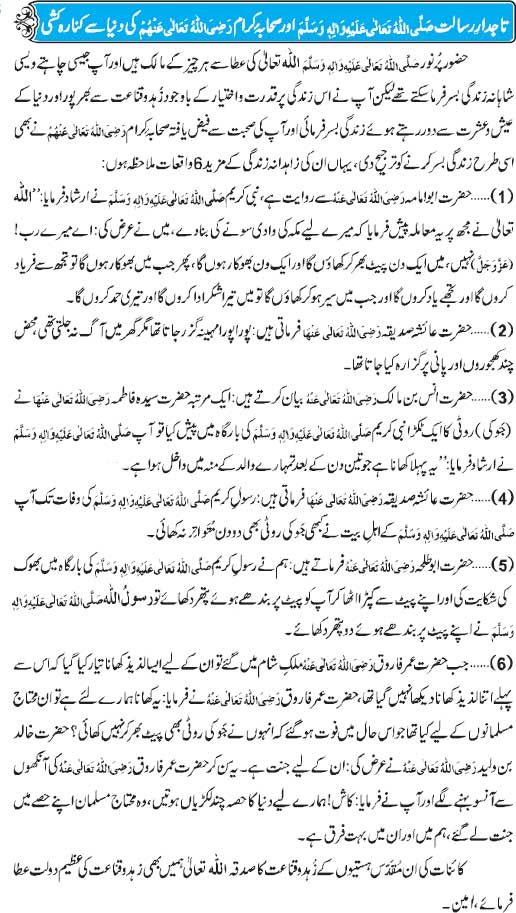
Tajdar e Risalat (PBUH) Aur Sahaba Karam (RA) Ki Dunya Say Kinara Kashi
O People! Verily Allah has Prescribed Upon You Hajj So Perform Hajj
Allah (Subhanahu wa ta’ala) revealed in the Qur’an:- “And proclaim the Hajj among mankind. They will come to thee on foot and (mounted) on every camel, lean on account of journeys through deep and distant mountain highways”(Source – Quran ~Surah Al-Hajj~ Ayah #28).
When Ibrahim (Alaihis salaam) completed the structure of the Kabah, Allah (Subhanahu wa ta’ala) commanded him to call the people to Hajj. Ibrahim (Alaihis salaam) pleaded…”O, Allah! How shall my voice reach all of those people?” Allah (Subhanahu wa ta’ala) told him that his duty was only to give the call….. and it was up to Allah to make it reach the people. Ibrahim (Alaihis salaam) then climbed Mount Arafat and called out in his loudest voice… “O, People! Verily Allah has prescribed upon you Hajj, so perform Hajj.”
‘Amr ibn Al-‘Aas narrates:- “When Islam entered my heart, I went to the Messenger of Allah and said:- ‘Give me your hand so that I may pledge allegiance to you.’ The Prophet (Sallallahu Alaihi Wasallam) spread his hand, but I withdrew mine. He (Sallallahu Alaihi Wasallam) said:- ‘What is wrong ‘Amr?’ I said, ‘I want to make a condition.’ ‘And what is that?’ he (Sallallahu Alaihi Wasallam) said. I said, ‘That Allah will forgive me.’ Then the Messenger of Allah (Sallallahu Alaihi Wasallam) said, ‘Did you not know that Islam wipes out what came before it, and that Hijrah wipes out what came before it and that Hajj wipes out what came before it!”
(Source:-Sahih Muslim).
Hajj is the fifth pillar upon which Islam stands. Allah (Subhanahu wa ta’ala) made it compulsory …. for every able Muslim male and female to perform it, at least once in a lifetime.
Allah (Subhanuhu Wa-Ta’ala) revealed: Hajj thereto is a duty mankind owes to Allah, those who can afford the journey, but if any deny faith, Allah stands not in need of any of His creatures”.
(Source:- ‘Quran’ ~Surah Ali Imran, Ayah # 97).
Performance of the Hajj washes away all sins. Abu Hurairah narrates:- I heard the Prophet (Sallallahu Alaihi Wasallam) say… “Whoever performs Hajj and does not commit any Rafath (obscenity) or Fusooq (transgression),
he returns (free from sin) as the day his mother bore him”.
( Source ~Sahih Bukhari).
Hajj is one of the greatest deeds one can accomplish in his or her lifetime.
Abu Hurairah narrates:- The Prophet (Sallallahu Alaihi Wasallam) was asked… “What deed is the best?” He (Sallallahu Alaihi Wasallam) said… “Iman in Allah and His Messenger.” “Then what?” “Jihad for the sake of Allah.” “Then what?” “Hajj Mabroor”!!!
{a Hajj accepted by Allah (Subhanahu wa ta’ala) }
Abu Sha’thaa’ said:- “I contemplated the good deeds that a person does. I found that salaah, as well as fasting, are a jihad of the body. And that sadaqah is a jihad of someone’s wealth. But Hajj is a jihad of both body and wealth.”
Hajj is the greatest Jihad. Aishah (Radiallahu anha) asked the Prophet (Sallallahu alaihi wa sallam)… “We find that jihad is the best deed, shouldn’t we (women) do jihad?” The Prophet (Sallallahu Alaihi Wasallam) replied… “Rather the best jihad is a Hajj Mabroor!” Aishah (R.A.) later said… “I’ll never cease performing Hajj after I heard that from Rasul Allah”
(Agreed Upon).
The dua of the one in Hajj shall be accepted. The Prophet (Sallallahu alaihi wa sallam) said, “The soldier in the path of Allah and the one who performs Hajj and the one who performs ‘Umra, all are the delegation of Allah!
He (Subhanuhu wa-ta’ala) called them and they answered. And they asked Him, and He shall grant them (what they ask for)!”
(Source:-Authentic hadith, narrated by Ibn Majah and Ibn Hibban).
In the Islamic history books, it was narrated that on the day of Arafat, a man from Turkmenistan stood on the plains of Arafat in Hajj. To his left, all he could see were Muslims crying and praying to Allah (Subhanahu wa ta’ala). To his right, all he could see were Muslims crying and praying to Allah (Subhanahu wa ta’ala). Because of his native tongue, he could not imitate the lengthy prayers of the others. At this realization, everything blurred in front of him. His face reddened, and his eyes poured tears as he raised his hands, “O Allah! Grant me everything that they are asking for! Grant me everything that they are asking for!” And Allah (Subhanahu wa ta’ala) accepted his dua!!!
There is not a single day that the sun has come up on more beloved to Allah (Subhanahu wa ta’ala) than the Day of Arafat. The Prophet (Sallallahu alaihi wa sallam) said:- “There is no day on which Allah frees more of His slaves from Fire than the Day of Arafat, and He verily draws near, then boasts of them before the angels, saying:- ‘What do they seek?’
(Source:-Sahih Muslim).
And in another hadith:- “Verily Allah boasts of the people of Arafat before the people of Heaven (angels) saying: ‘Look to my servants who have come to Me disheveled and dusty.'”
Abdullah ibn Al-Mubaarak narrates:- I went to Sufyaan ibn al-Uyaynah as the day of Arafat was setting. He sat on his knees, his hands raised to the Heavens, and tears moistened his cheeks and beard. He turned and looked at me, so I asked him, “Amongst the people who have gathered here for Hajj, who is in the worst state?” Sufyaan ibn al-Uyaynah said… “He who thinks that Allah will not forgive him.”
A Mabroor Hajj is one in which Allah (Subhanahu wa ta’ala) is not disobeyed during or after. Others have said that a Hajj Mabroor is one that is accepted, and the sign of its acceptance is that a person will go back in a better state than when he came, and that he will discontinue the sins that were between him and Allah (Subhanahu wa ta’ala).
when Ibn Umar was on his deathbed and his son reminded him of all the good deeds that he did with the Prophet (Sallallahu alaihi wa sallam) and the companions. He told him,:- “Quiet! Don’t you know whom Allah accepts from… Verily Allah only accepts from the God-Fearing
(Al-Muttaqoon).”
Indeed, the Prophet (Sallallahu Alaihi Wasallam) said:- “And there is no reward for an accepted Hajj- except …*Jannah*
Tears in my Eyes!
‘Insha Allah’!
‘ Son of Adam! You are nothing but a number of days, whenever each day passes then part of you has Gone.
{Al-Hasan Al-Basree}
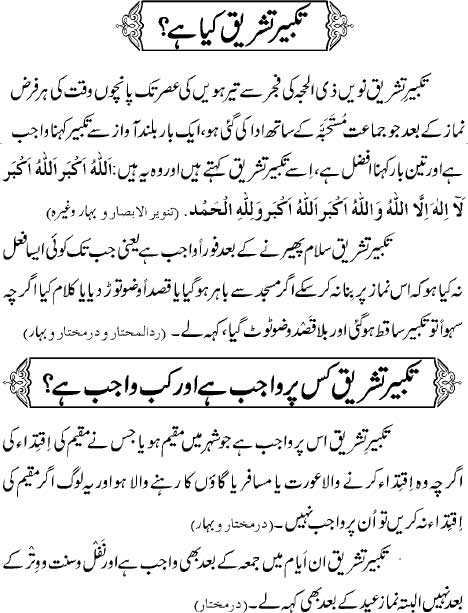
Takbeer Tashreeq Kya Ha?
Mahram For the Purposes Of Hajj
A Mahram of a woman is her husband or that pious male with whom Niqah can ‘never’ be permissible from direct family relation or sharing (suckling) foster mothers.
For example: (all the following relations are from the paternal side)
1. True brothers from one mother, true nephews (brothers sons), father/mothers elder/younger brother, sons son and daughters son, grandfathers…
2. Sharing (suckling) foster mothers, drinking milk in infancy from the same woman However for the milk relations (foster brother/sisters) extra caution should be taken and Hajj not be performed with such persons due to fitnah(threatening) conditions manifest today. (Fatawa Shami vol 2 p199)
Relations formed ‘in-law’
3. Father-in-law, son-in-law. (In this day and age of fitnah, it is recommended not to take up any journey ) : Fatawa Shami vol2 p199:
A Mahram must be of mature age (passed puberty) have mental understanding and be a practicing Muslim.
All women whether old or young have to be accompanied by a Mahram, without a suitable Mahram the requirement of Hajj will be fulfilled yet she will be sinning greatly.
Abu Said Al Kudri (RA) narrates RasulAllah (saw) said: ‘It is not Halal for a woman who believes in Allah (SWT) and the Last Day that she travel for 3 days or more without a Mahram.’(Muslim)
It should be understood, that in today’s terms, this translates to a journey of 48 miles one way. As in the time of Nabi (saw) journeys were undertaken by foot. For a woman to travel 48 miles or more alone is Haram.
If a woman does not have a Mahram or If there is a Mahram yet they are not able to travel with them during their lifetime, in this instance a woman must bequest(wasiyat) her Hajj to another to perform it on her behalf.
Note: Today people use the excuse of family relations that do not qualify as Mahram to travel, including to Hajj, this is not permissible. For example brothers-in-law, husbands nephews, cousins brothers, and servants.
May Allah (SWT) grant our woman a Hajj according to Shariah and accept our efforts and Duas. Aameen.
Mufti Yusuf Danka Al-Kauthar