

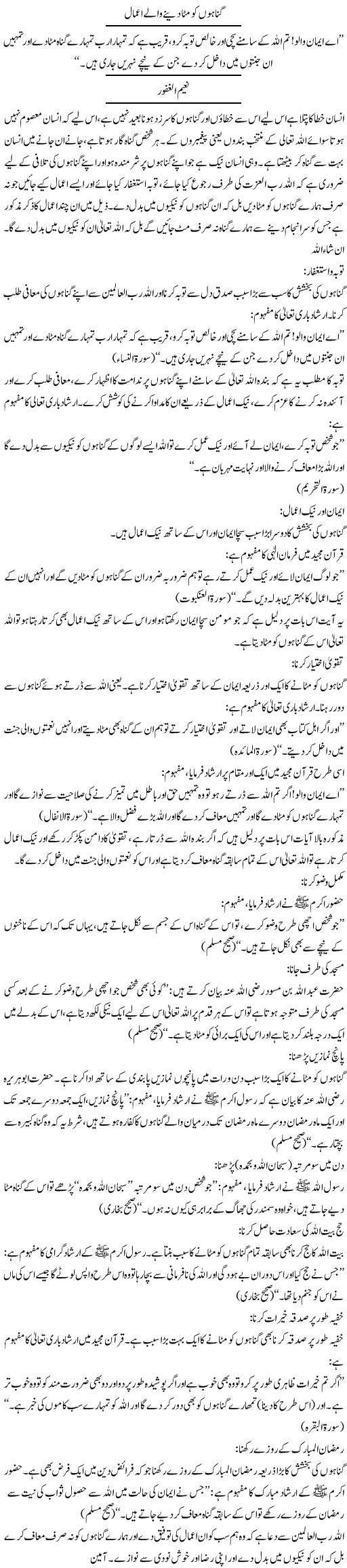
Gunnahoon Ko Mita Denay Wale Aamaal
5 Difficult Sunnahs You Ought To Be Doing
1. Praying Tahajjud or the Night Prayer. Oh yeah, this one is difficult. It’s hard enough for many Muslims to even
get up for Salaatul Fajr (the Dawn Prayer), which is mandatory. It’s certainly no easy thing waking up even earlier for the night prayer. Establishing and maintaining this wonderful act takes great sacrifice and patience. Which is why the rewards are so plentiful.
In fact, this is one of the few Sunnahs that are endorsed by Allah in both the Quran and the hadith. Arise to (pray) the night except for a little. Half of it or subtract a little from it.
Munafiq Kay Aamaal, Misal, Aur Ausaf

Munafiq Kay Aamaal, Misal, Aur Ausaf
Hadith on Duaa
Abu Huraira (radi Allahu anhu) narrates from Rasool Allah(Sallallahu alaihi wasallam), “Do duaa to Allah with his confidence that He will accept it and know this well that Allah doesn’t accept the duaa done with a negligent and careless heart.”(Tirmizi)
Abu Huraira(radi Allahu anhu) narrates from Rasool Allah(Sallallahu alaihi wasallam), “Allah is extremely displeased with the person who doesn’t do duaa to Allah.”(Tirmizi)
Abu Huraira(radi Allahu anhu) narrates from Rasool Allah (Sallallahu alaihi wasallam), “In the court of Allah, there is no greater thing than Duaa.”(Ibn-e-Majah)
Abdullah bin Umar(radi Allahu anhu) narrates from Rasool-Allah(Sallallahu alaihi wasallam),” Among whatever has been descended and whatever has not been descended Duaa is beneficial of all. Oh people of Allah! Assume Duaa a must for yourselves.” (Tirmizi)
Jabir(radi Allahu anhu) narrates from Rasool-Allah(Sallallahu alaihi wasallam), “Whoever does duaa to Allah, Allah fulfills his seeking or in exchange averts misfortune until the duaa is not related to sin or breaking some relation.” (Tirmizi)
Salman Farsi(radi Allahu anhu) narrates from Rasool-Allah(Sallallahu alaihi wasallam), “Duaa turns away destiny, and good deeds lengthen age. (Tirmizi)
Umar (radi Allahu anhu) narrates that, “Whenever Rasool-Allah( Sallallahu alaihi wasallam) raised his hands for duaa, he did not put them down until HE took both hands over his face.” (Tirmizi)
Jabir (radi Allahu anhu) narrates from Rasool-Allah (Sallallahu alaihi wasallam), “Don’t do Bad-duaa [against] yourself, your wealth, or for your children. May it be the moment of acceptance in the court of Allah, and your Bad-duaa be accepted. (Muslim)
Jhoot, Gheebat, Chugli, Aur Ehad Torne Ki Saza
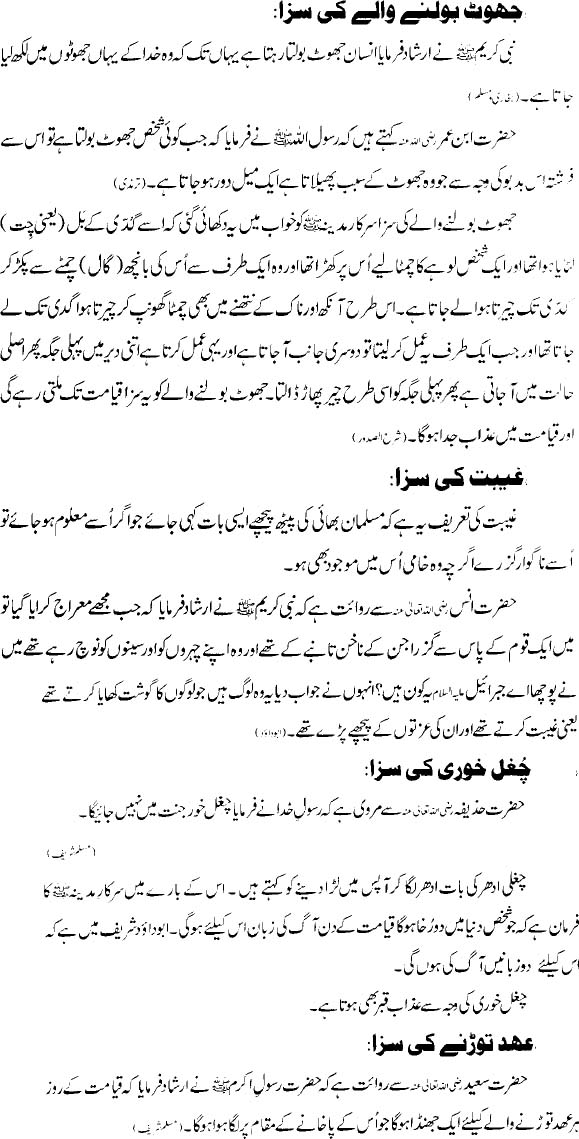
Jhoot, Gheebat, Chugl Khori, Aur Ehad Torne Ki Saza
Sharing Is The Noble Islamic Character
“O you who believe, when you are asked to make room in the meetings, then make room. Allah will make room for you (in Akhirah). And when it is said ‘move up’, then move on. Allah will raise in rank those of you who believe as well as those who are given knowledge. Allah knows whatever you do.” (Al Mujadilah, chap 58 – verse 11).
the religion of community, unity, being together, and helping one another towards righteousness and good deeds. Allah said, which means: “Verily all of mankind is in a state of loss except those who believe, do good deeds, and encourage one another.” (Al-’Asr 103:2-3).
Sharing is the Noble Islamic Character, so you live, sleep, and die with others, like a candle. A candle burns itself and produces light for others. We have to do something not only for our individual selves or families, but for the benefit of other Muslim families, the animals, the birds, and even for non-Muslims.
The Prophet Muhammad (sallallaahu ‘alaihi wa sallam) said: “If the Hour were to occur and you had a seed or a small plant in your hand, (you would plant it) and if you can plant it before that, then plant it (now).”
Subhaanallaah!
Islam is a religion of work and sacrifice. This demonstrates that we are living to help others even if dying. You see the Judgment, the Hour is in front of you, so why not put the seed in the ground? Let someone else benefit if this is the last moment of your life, because you not only live for yourself, but to help others as well.
Allah narrates in the Qur’an the story of Prophet Lut(AS) and how He saved him and his family. But from what?! So the environment is very important. You may know about science and chemistry more than I, and we all know the surroundings of an object will have some impact upon it. Just as a candle’s flame will extinguish from a lack of oxygen, and likewise, a plant unexposed to sunlight will wither. The Prophet (sallallaahu ‘alaihi wa sallam) has explained: “The similitude of good and bad company is like the one who sells perfume and the blacksmith. When you sit with the perfume seller, you smell a good scent, and in contrast, bad company is like one who blows into a furnace.” (Al-Bukhari)
Ghafil Insan
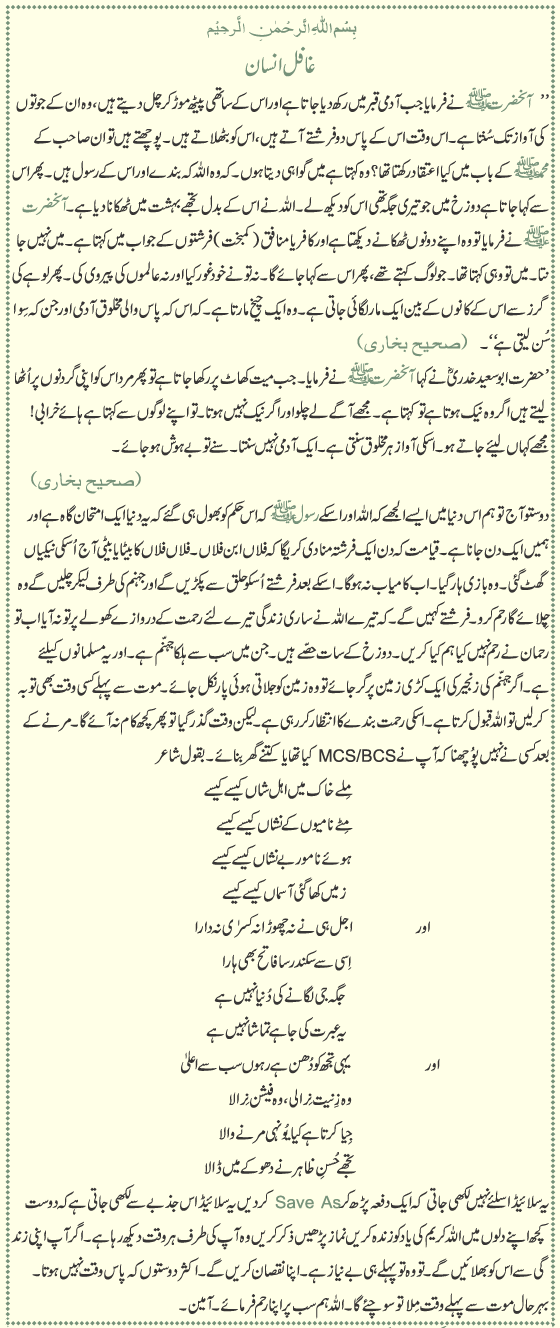
Ghafil Insan
Day of Resurrection
Narrated Abu Huraira: Some people said, “O Allah’s Apostle (peace be upon him)! Shall we see our Lord on the Day of Resurrection?” He said, “Do you crowd and squeeze each other when looking at the sun when clouds do not hide it?” They replied, “No, Allah’s Apostle.” He (peace be upon him) said, “Do you crowd and squeeze each other on looking at the moon when it is full and not hidden by clouds?” They replied, No, O Allah’s Apostle!” He (peace be upon him) said, “So you will see Him (your Lord) on the Day of Resurrection, similarly Allah will gather all the people and say, ‘Whoever used to worship anything should follow that thing. ‘So, he who used to worship the sun will follow it, and he who used to worship the moon will follow it, and he who used to worship false deities will follow them; and then only this nation ( i.e., Muslims) will remain, including their hypocrites. Allah will come to them in a shape other than they know and will say, ‘I am your Lord.’ They will say, ‘We seek refuge with Allah from you. This is our place; we will not follow you till our Lord comes to us, and when our Lord comes to us, we will recognize Him.
Sayyiduna Muhammad (Sollallahu ‘Alaihi Wasallam) Ki Basat Aama
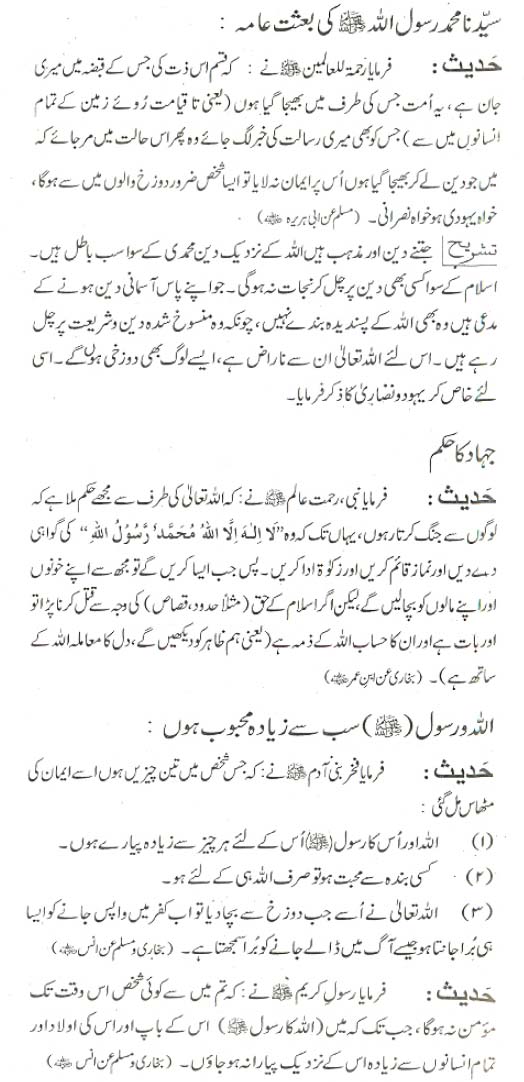
Sayyiduna Muhammad (Sollallahu ‘Alaihi Wasallam) Ki Basat Aama
Safiyyah: A Relative Of Several Prophets
When it was clear that the Prophet (peace be upon him) decided to marry Safiyyah (radi Allahu anha), the news was received with considerable expectation. On their arrival in Madinah, the Prophet (peace be upon him) accommodated her first in the house of his Ansari companion, Harithah ibn Al-Numan. Many women, particularly from the Ansar, went there to see the Prophet’s new wife. This was only to be expected since the Ansar were used to having the Jews living in their city until they had recently been evacuated. Safiyyah’s own people, the Al-Nadir tribe, were evacuated only three years earlier. The Prophet (peace be upon him) even noticed his wife, Ayesha (radi Allahu anha), going there, having covered her face. He (peace be upon him) observed her movement until he saw her going into that house. When she came back home, he (peace be upon him) asked her: ‘How did you find her?’ Her answer expressed her jealous feelings: ‘I only saw a Jewish woman.’ The Prophet (peace be upon him) said: ‘Do not say that. She has become a Muslim, and she is a good Muslim.’