

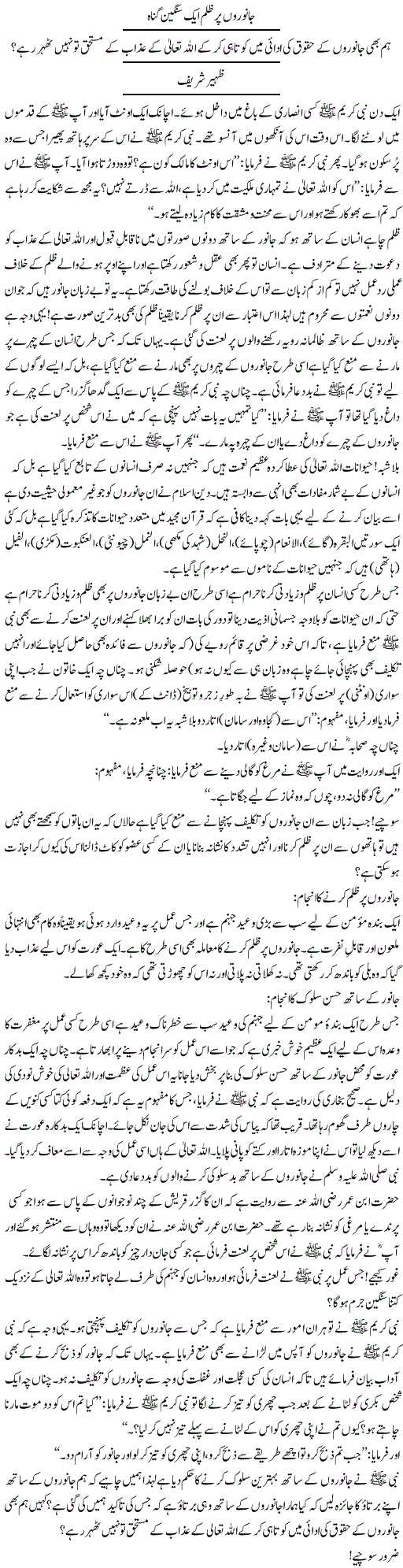
Janwaroon Par Zulm, Aik Sangeen Gunnah
Wonders Of The Holy Quran
*”And indeed We created man (Adam) out of an extract of clay (water and earth).” (TMQ, Surat Al-Mu’minun: The Believers: 12)
This holy ayah appears in the second tenth of Surat Al-Mu’minun, which is a Makkan Surah. This Surah contains 118 ayahs. It is named in praise of the Mu’minun (Believers), demonstrating some of their merits. The main theme of this holy Surah is faith in Allah (SWT) as One and Only God who is the Self-Sufficient Master that all creatures depend on, and the One who is comparable to none; no one shares His Rule, or claims His Power. It also glorifies Allah and eliminates any description that does not befit His Glory.
Signs of creation in Surah Al-Mu’minun:
1. The creation of man from an extract of clay.
2. The extremely accurate description of the successive stages of embryonic development, and the description of the womb as “a safe lodging” (Al-Mu’minun: 13)
3. The creation of the seven skies and the levels in between.
4. The rain and how it is sent down as needed, then stored under the surface of the earth, which proves that the origin of the subterranean reserves of water is rain.
Gunnah Aur Saza
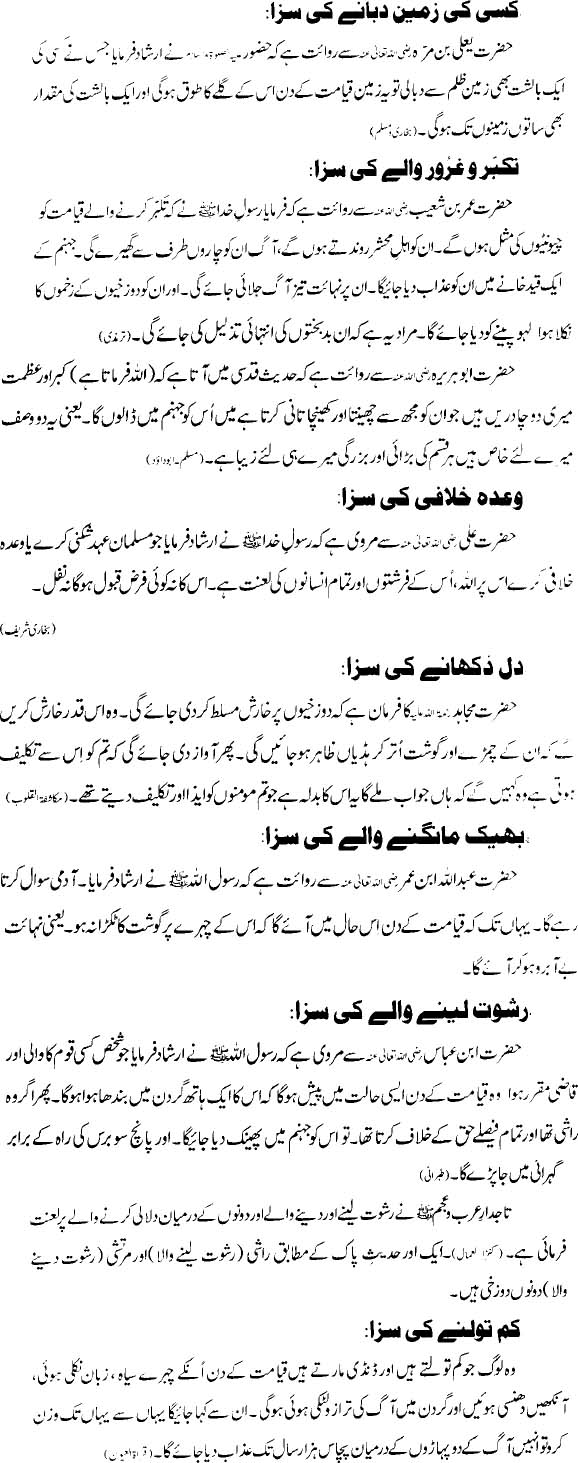
Kisi Ki Zameen Dabane Ki Saza, Takkabur Aur Gharor Ki Saza, Wada Khilafi Aur Dil Dukhane Ki Saza, Bheek Mangne Aur Rishwat Lene Ki Saza, Kam Tolne Ki Saza
Hygiene And Good Smell
The Prophet (peace be upon him) regularly used perfumes, and he liked every pleasant smell, but he preferred distinctive ones when he could find them. Indeed, when he mentioned the two things he liked best in this present life were perfumes and women, emphasizing always the need to treat women kindly, particularly in a social environment in which he grew up, when women were generally ill-treated. One of his wives, Ramlah (radi Allahu anha), used to give him a special perfume she brought with her on her return from Abyssinia. He was very pleased with that because it had a very pleasant and distinctive smell. Lady Ayesha (radi Allahu anha) reports that she used to give the Prophet (peace be upon him) his perfume on special occasions. When he spent several days in the mosque, dedicating himself to worship during Ramadan, he would at times let his wife, Ayesha (radi Allahu anha), comb his hair. She would be in her home, which was adjacent to the mosque, and he would be inside the mosque, but next to his door.
The Prophet (peace be upon him) did not like to eat onions and garlic, because of the smell of the mouth they give. He said to his companions that anyone who ate these should not come to the mosque soon afterward. They thought that he would prohibit them, but he emphasized that as a servant of God, he had no authority to prohibit anything. This authority belongs to God alone.
Two of his wives tried to play a trick on a third one who gave him a type of honey he liked. They wanted to deprive her of the pleasure of giving the Prophet something that pleased him. As he went to see them, each commented that he smelled of a certain type of food, which gave a bad smell. He told them that he only had some honey. They said that the bees must have fed on that food. He decided not to eat that honey again. This was an unnecessary step, because what he ate was perfectly lawful, and he liked it. Besides, the point about its bad smell was not true.
The Prophet (peace be upon him) took care of his personal hygiene, washing and cleaning every part of his body whenever this was needed. He washed his hands before and after meals. He (peace be upon him) would rinse his mouth after eating. He (peace be upon him) taught his companions to rinse their mouths after drinking milk, so that they would remove the traces of cream that milk left. Needless to say, the milk they drank contained all its cream, as they did not have the facilities to skim it. Indeed, they could not leave the milk long enough so that the cream would form a layer on the surface, because in their hot climate, milk would go bad if left for a few hours. Moreover, the Prophet (peace be upon him) encouraged us to take a shower whenever we could. He (peace be upon him) said that it was a duty owed to God by everyone to wash one’s head and body at least once a week. This was in an area where water was scarce. Now that most of us enjoy having plenty of water, more frequent showers are much encouraged.
By Adil Salahi
Surah Falaq Aur Surah Nas Ka Shan-e-Nazool
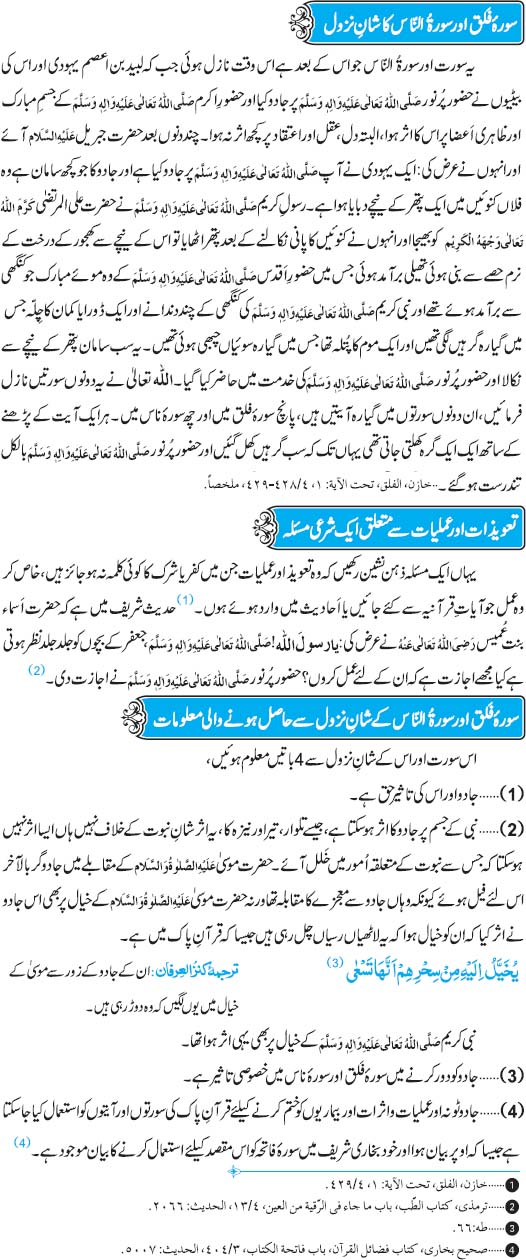
Surah Falaq Aur Surah Nas Ka Shan-e-Nazool. Tawizat Aur Amliyat Kay Mutaliq Shari Masla.
Drawing Allah’s Blessings From Nearness To Allah’s Messenger
Sahih Muslim Book 30 Chapter 19: THE NEARNESS OF ALLAH’S APOSTLE (MAY PEACE BE UPON HIM) TO THE PEOPLE AND THEIR SEEKING BLESSINGS FROM HIM (AND HIS POSSESSIONS)
Keeping water in which Allah’s Messenger has dipped his hand
Anas b. Malik (radi Allahu anhu) reported that when Allah’s Messenger (may peace be upon him) had completed his dawn prayer, the servants of Medina came to him with utensils containing water, and no utensil was brought in which he did not dip his hand; and sometime they came in the cold dawn (and he did not feel reluctant in acceding to their request even in the cold weather) and dipped his hand in them. Sahih Muslim Book 30, Number 5749:
Preserving the Hair of the Holy Prophet Muhammad Sallalaahu Alaihi wassalam
Anas (radi Allahu anhu) reported: I saw when the Messenger of Allah (may peace be upon him) got his hair cut by the barber, his Companions came round him and they eagerly wanted that no hair should fall but in the hand of a person. Sahih Muslim Book 30, Number 5750:
Anas reported that a woman had a partial derangement in her mind, so she said. Allah’s Messenger, I want something from you. He said: Mother of so and so, see on which side of the road you would like (to stand and talk) so that I may do the needful for you. He stood aside with her on the roadside until she got what she needed. Sahih Muslim Book 30, Number 5751:
Umar bin Abi Salamah (radi Allahu anhu) Ka Kufr Ki Halat Mein Quran Pak Yad Kerna

Umar bin Abi Salamah (radi Allahu anhu) Ka Kufr Ki Halat Mein Quran Pak Yad Kerna
What Shall I do When I Have Sinned?
Repentance of the man who committed a hundred murders
Abu Sa’id Sa’d b. Malik b. Sinan al-Khudri says that the Prophet (Peace be upon him) said, “There was a man among a people before you who committed ninety-nine murders. Then he inquired about the most knowledgeable man on earth, and he was led to a monk. He went to him and told him that he had killed ninety-nine people and asked him if he could repent. The monk told him: NO!’ So the man killed him also and completed his hundred. Then he inquired about the most knowledgeable man on earth and was led to a scholar. He went to him and told him that he had killed a hundred people, and asked him if there was repentance for him. The man told him, ‘Yes. And what can come in between you and repentance?’ ‘Then he told him, ‘Go to such and such a town, for in it live people who are devoted to God. Devote yourself there to God in their company and do not come back to your own town for it is an evil place.’
So the man started towards that town. However, while he was halfway through the journey, death overtook him. The angels of ‘mercy’ and ‘punishment’ descended and began to argue over him. The angels of mercy said: ‘This man had repented and was seeking his Lord, (therefore he is our share),’ while the angels of punishment claimed that, ‘he had never done a good thing in life,’ (so he was their share). While they were thus arguing, another angel arrived in the form of a man. They decided to accept him as their arbitrator. He said: ‘Measure the earth between the two towns and let him be assigned to the fate of the one he is nearer to.’ When they measured, they found him nearer to the town he was heading towards. So the angels of mercy took him away.”
Iman Ki Shakhain Aur Alamat
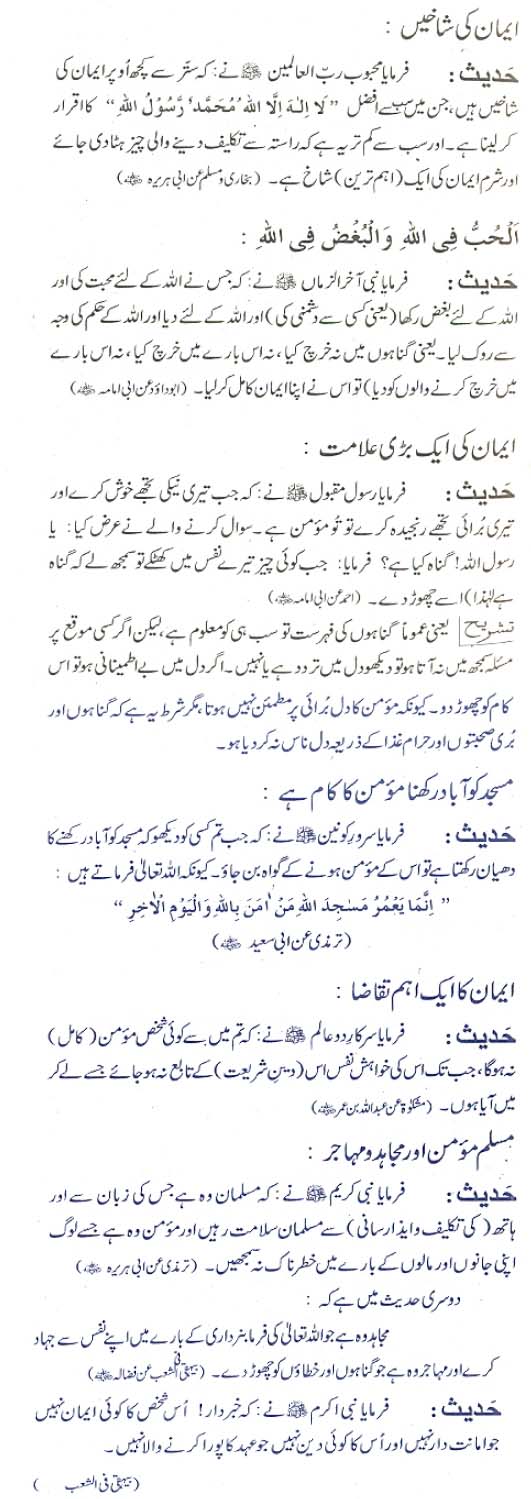
Iman Ki Shakhain
Iman Ki Alamat
Iman Ka Taqaza
Masjid Ko Abad Rakhna Momin Ka Kam ha
Muslim Momin Aur Mujahid wa Muhajir
Why Revive The Sunnah?
1. The Prophet’s way is the best way.
“Truly, in the Messenger of Allah [Sallallahu alaihi wasallam] you have a good example to follow for the one who hopes for the Meeting with Allah and the Last Day and remembers Allah much.”[Al-Ahzab: 21]
2. The Sunnah of the Prophet [Sallallahu alaihi wasallam] is THE way to get Allah’s love. “Say: If you (really) love Allah, then follow me [SAWS], Allah will love you and forgive you your sins. And Allah is Oft-Forgiving, Most Merciful.”[Aal-e-Imran: 31]
3. Following the Sunnah will help us increase in good deeds. “…Helle who follow him, without it detracting in the least from their reward.”[Reported by al-Tirmidhi]
4. The Revp you one another in Al-Birr and At-Taqwa (virtue, righteousness and piety); but do not help one another in sin and transgression. And fear Allah. Verily, Allah is Severe in punishment.”[Al-Ma’idah: 2]
5. The AJR! Large amounts of Ajr (reward) are up for grabs! “Whoever revives an aspect of my Sunnah that is forgotten after my death, he will have a reward equivalent to that of the people of the Ummah, which can only come by following the Sunnah of the Prophet [Sallallahu alaihi wasallam]
The last of this Ummah will not be corrected except by that by which the first of this Ummah was corrected, and that is the Book and the Sunnah. [Imam Darul Hijrah, Malik ibn Anas {r} d. 179]