

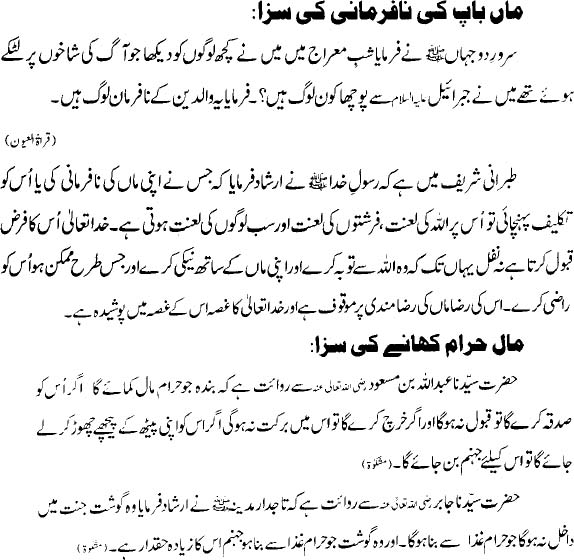
Maa Baap Ki Nafarmani Aur Haram Maal Khane Ki Saza
Sunnahs Of Joking
1. Allah’s Messenger, peace and blessings of Allah be upon him, said to his companion Hanzala, who thought that life should be free from fun and entertainment and that he committed hypocrisy when he played and jested with his wife and children: “But, Hanzala, refresh your heart from time to time.” (Muslim). Here, the Prophet (sallallahu ‘alayhi wa sallam) explained to the man that permissible fun and self-refreshment are desirable for the human soul to regain its activity and liveliness. He, peace and blessings of Allah be upon him, also taught them the rules of conduct as regards joking, when asked about his joking with them, by saying: “Yes, but I speak truthfully.” (Tirmidhi).
2. Once, an old woman came to him and said: O Messenger of Allah, pray to Allah for me to be admitted into Paradise. He said, “No old woman will be admitted into Paradise. On hearing this, she went away crying. He said: Tell her that she won’t be an old woman when she goes into Paradise.
3. Allah’s Messenger’s jokes were not limited to words; they included acts as well. Anas Ibn Malik, may Allah be pleased with him, said, “A bedouin called Zaher used to bring presents from the desert to the Prophet (sallallahu ‘alayhi wa sallam) and the Prophet (sallallahu ‘alayhi wa sallam) also used to supply him with provisions on leaving. He said about him: “Zaher is our ‘desert’ and we are his ‘city’. The Prophet (sallallahu ‘alayhi wa sallam) loved him, though he was ugly-faced. One day, the Prophet (sallallahu ‘alayhi wa sallam) came to him while he was selling some goods. He hugged him from the back unawares. Zaher said, “Release me.” Then he looked behind him and recognized the Prophet (sallallahu ‘alayhi wa sallam), so he pressed his back against the Prophet (sallallahu ‘alayhi wa sallam) ’s chest. The Prophet (sallallahu ‘alayhi wa sallam) called out: “Who purchases this slave?” Zaher said: “O Messenger of Allah, You will find me not sellable”. The Prophet (sallallahu ‘alayhi wa sallam) answered: “But to Allah, you are not unsalable, or he said: To Allah, you are so dear”. (Tirmidhi)
4. A joke should not involve any hurt or insult to any Muslim. Allah’s Messenger said: “No Muslim is allowed to scare another Muslim.” (Abu Dawud) He also said: “Nobody should take (Muslim) brother’s belongings.” (Abu Dawud and Tirmidhi)
5. Joking should not drive a Muslim to lie to make others laugh; this is understood from the Prophet (sallallahu ‘alayhi wa sallam) ’s words: “Woe to him who lies when speaking to make people laugh. Woe to him! Woe to him!”
Iman Ka Aik Aham Taqaza
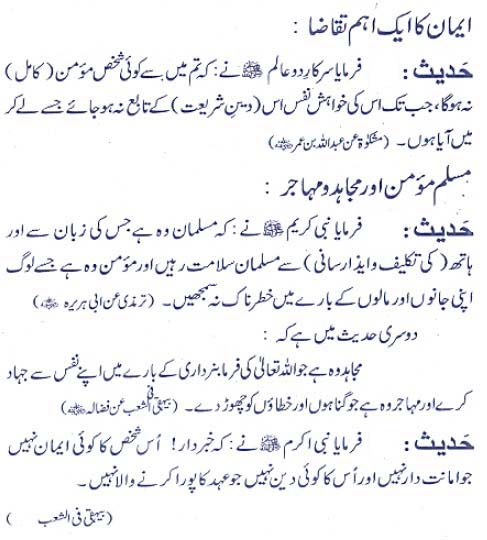
Iman Ka Aik Aham Taqaza
Third Pillar Of Islam
Charity is not just recommended by Islam; it is required of every financially stable Muslim. Giving charity to those who deserve it is part of the Muslim character and one of the five pillars of Islamic practice. Zakat is viewed as ” compulsory charity “; It is an obligation for those who have received their wealth from God to respond to those members of the community in need. Devoid of sentiments of universal love, some people know only to hoard wealth and to add to it by lending it out on interest. Islam’s teachings are the very antithesis of this attitude. Islam encourages the sharing of wealth with others and helps people to stand on their own and become productive members of society.
In Arabic, it is known as zakat, which literally means ” Purification,” because zakat is considered to purify one’s heart of greed. Love of wealth is natural, and it takes firm belief in God for a person to part with some of his wealth. Zakat must be paid on different Categories of Property: Gold – Silver – Money – livestock; Agricultural Produce; And Business commodities, and is payable each year after one year’s possession.
Hasad Ki Qismein, Wady Ki Pasdari
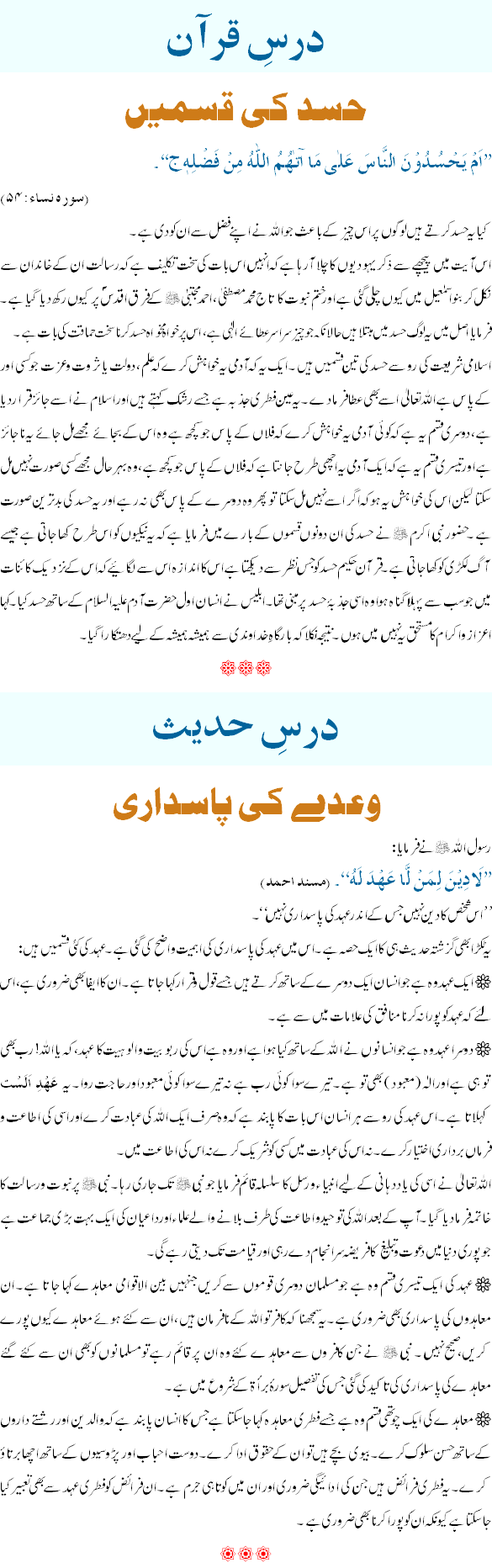
Hasad Ki Qismein, Wady Ki Pasdari
The Marriage Process In Islam
Before Marrying: Selecting a Spouse
The first thing we should look for when marrying is how committed the person is to Islam. Prophet Muhammad (sallallahu alayhi was sallam) said, “A woman is normally sought as a wife for her wealth, beauty, nobility, or religiousness (adherence to Islam), but choose a religious woman and you will prosper.” (Muslim)
And he said, “A woman is married for four things, i.e., her wealth, her family status, her beauty, and her religion. You should marry the religious woman (otherwise) you will be a loser.”(Bukhari) And he said, “The whole world is a provision, and the best object of benefit of the world is the pious woman.” (Muslim)
The same holds when looking for a husband, as the Messenger of Allah (sallallahu alayhi was sallam) said, “When someone with whose religion and character you are satisfied asks to marry your daughter, comply with his request. If you do not do so, there will be corruption and great evil on earth.” (Tirmidhi)
Surah Falaq, Aur Surah Nas Kay Fazail
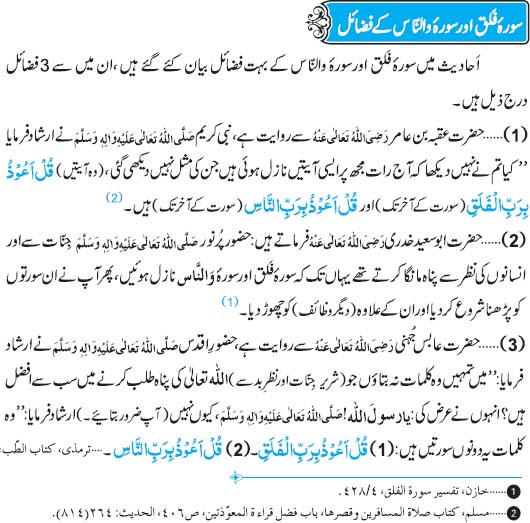
Surah Falaq, Aur Surah Nas Kay Fazail
Placing Your Trust In The Allah
The Great Shaykh Syed Abdul Qadir Jilani, the Sultan of the Awliya, mentions how Allah Subhana taala tests the Momin believer.
The great Shaykh says that Allah turns his blessings away from him when he depends on worldly connections and worldly people for seeking his livelihood
The Shaikh (may Allah be well pleased with him, and grant him contentment) said: Nothing blocks you from direct receiving of Allah’s grace and favor except your reliance upon people and connections, on good turns and handouts. Thus, creatures are your obstacle to gaining a proper livelihood, in keeping with the exemplary practice of the Prophet. As long as you continue to depend on fellow creatures, hoping for their gifts and favors, going from door to door with your requests, you are associating His creation with Allah. He will therefore punish you with deprivation of that proper livelihood, namely, the lawful earnings of this world.
[Sixteenth Discourse from Futuh al-Ghaib]
The Great Shaykh then says that when the believer removes the trust from the worldly people and relies on his earning power, he is still deprived of his allotted share, but this situation is better than the one before.
Then, when you have renounced the habit of depending on people and associating them with your Lord (Almighty and Glorious is He), and have resorted to earning your own livelihood, you get to rely on this earning power and become complacent about it, forgetting the gracious favor of your Lord. You are once again behaving like a polytheist [mushrik], only now the polytheism [shirk] is concealed, of a subtler nature than the previous kind. Allah (Almighty and Glorious is He) will therefore punish you by depriving you of His favor and of direct access to Him.
[Sixteenth Discourse from Futuh al-Ghaib]
The Great Shaykh then conveys that only when the believer sees Allah as the provider and rest all as the means, only then Allah allots the believer the complete share of what is alloted to him
When you turn from this in repentance, ceasing to allow the encroachment of polytheism, and forsaking reliance on your own earning power and abilities, you will see that Allah (Almighty and Glorious is He) is the Provider. It is He who supplies the means, the facilities, and the energy one needs to make a living, and He is the One who enables all good results to be achieved. All sustenance is in His hand. At times He may supply it to you by way of other people, through your appealing to them while in distress or trying straits, or in response to your appeal to Him (Almighty and Glorious is He), sometimes by way of earned remuneration, and at still other times by His spontaneous favor, in such a way that you do not see the intervening cause and means.
[Sixteenth Discourse from Futuh al-Ghaib]
Finally, the Great Shaykh conveys how Allah treats his special favorites, the prophets and saints, and other favorites
O son of Adam, I am Allah. There is none worthy of worship but I alone. I say to a thing, “Be,” and it comes into being. Obey Me, and I will make you such that you say to a thing, “Be,” and it will come into being. Thus, He has dealt with many of His Prophets, His saints, and His special favorites among the children of Adam.
[Sixteenth Discourse from Futuh al-Ghaib]
Aik Sharabi Ka Waqia
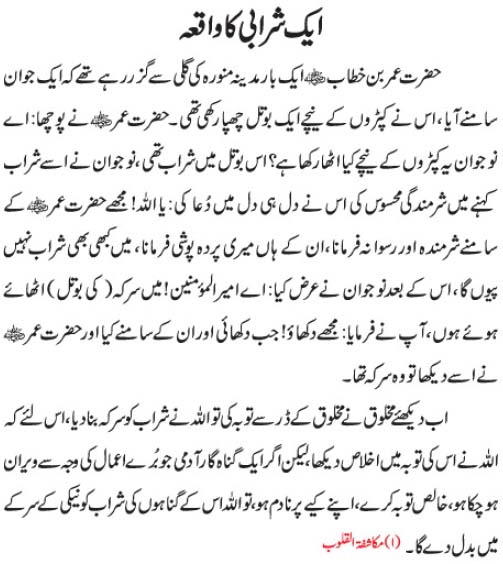
Aik Sharabi Ka Waqia
Prohibition Of Gheebah
Allah has said: “And spy not, neither backbite against one another. Would any of you like to eat the flesh of his dead brother? You would hate it (so hate backbiting). And fear Allah. Verily Allah is the One Who accepts repentance, Most Merciful.” (49:12)
“And follow not that of which you have no knowledge. Verily! The hearing, and the sight, and the heart of each of those ones will be questioned.” (17:36)
“Not a word does he (or she) utter, but there is watcher by him ready (to record it).” (50:18)
Abu Musa narrated it: “Some people asked Allah’s Messenger (peace be upon him), whose Islam is the best?“ (i.e., who is a very good Muslim?)
The Prophet (peace be upon him) replied, “One who avoids harming the Muslims with his tongue and hands.”
“And the person may utter a word which displeases Allah without thinking how serious it is, as a result of which Allah will record His wrath for him, because of His displeasure until the Day when he meets Him.” (Related by Mu’atta Imam Malik and Tirmidhi).