

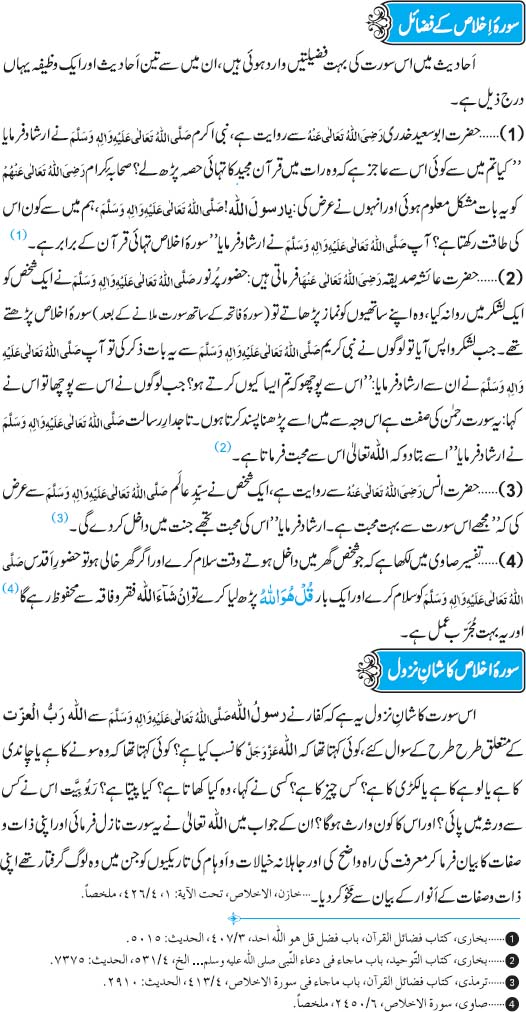
Surah Ikhlas Kay Fazail Aur Shan-e-Nazool
The Greatest Imam (al-Imam al-Aa’zam) Abu Hanifa Nau’man Ibn Thabit Radi Allahu Anhu
Imam al-A’zam Abu Hanifa’s (Alaihir rahma) full name was Nu’man ibn Thabit ibn Zuta ibn Marzuban. He was born in Kufa, Iraq, in 80 A.H. He belonged to the pious period of the Taabi’ins (Successors of the Sahabas).
Early Life
While still in his youth, he met great Sahaba like Sayyiduna Anas bin Maalik, Sayyiduna Sahl bin Saad and Sayyiduna Abul Tufail Amir bin Wathilah (radi Allahu Anhumul Ajma’een). Imam A’zam Abu Hanifa (Alaihir rahma) was first brought up as a trader, but soon started taking a deep interest in Islamic learning.
Education
He attended the lectures of Sayyiduna Hammad Basri (radi Allah anhu) in Fiqh and then began to study the Hadith. He learnt from great scholars in Kufa. In Basrah, he studied under two great Taabi’ie scholars who had learnt Hadith under the Sahaba. In Makkatul Mukarammah and Madinatul Munawwarah, he learnt under Sayyiduna Ata bin Abi Rabah and Sayyiduna Ikramah (radi Allahu Anhuma). In fact, Imam A’zam Abu Hanifa (Alaihir rahma) had numerous teachers. Some historians say that he learnt Hadith from about 4000 scholars. Some of his famous teachers were:
Sayyiduna Imam Baaqir
Sayyiduna Imam Jafer Saadiq
Sayyiduna Ali
Sayyiduna Abu Hurayrah
Sayyiduna Abdullah ibn Mas’ud
Sayyiduna Abdullah ibn Umar
Sayyiduna Aqabah bin Umar
Sayyiduna Safwaan
Sayyiduna Jabir
Sayyiduna Abu Qatadah, etc. (Radi Allahu Anhum Ajma’een).
As A Teacher
When his teacher, Sayyiduna Hammad Basri (Alaihir rahma), passed away, Imam A’zam Abu Hanifa (Alaihir rahma) was 40 years old, and he began teaching. He became very famous and travelled many places. Students from all over the Muslim world came to him to listen to his lectures, interviews and debates. Imam Maalik (Alaihir rahma) also learnt under him. When he was 56 years old, Caliph Mansur came to power after the Umayyad dynasty was overthrown by the Abbasids in 132 A.H. Since Imam Abu Hanifa (Alaihir rahma) opposed the Caliph’s ruthless killing of the Ahl al-Bayt, he was arrested. The Caliph offered the Imam the post of a Qaadi (Judge), but he refused. The Caliph Mansur had him beaten with a stick 30 strokes. His feet bled. Caliph Mansur repented and offered 30,000 pieces of silver to Imam A’zam Abu Hanifa (Alaihir rahma). The great Imam refused once more. He was imprisoned again and thrashed 10 more strokes every day.
Passes Away
Imam A’zam Abu Hanifa (Alaihir rahma) passed away while in Salah. He had been poisoned by the orders of Caliph Mansur. His Janaza Saaah was performed six times, and each time, 50,000 people took part. People continued to come and pray for him for 20 days after he was buried. He was 70 years old. In 459 A.H., a Mazaar (Tomb) was built for him by the Seljuki ruler Alp Arsalan. He lies buried in a Tomb situated near Baghdad in Iraq.
Students
Imam A’zam Abu Hanifa (Alaihir rahma) left behind about 980 students. The most famous among them being:
a. Sayyiduna Qadi Abu Yusuf (Alaihir rahma)
b. Sayyiduna Imam Muhammed (Alaihir rahma)
c. Sayyiduna Imam Zufur (Alaihir rahma)
Personality
Imam A’zam Abu Hanifa (Alaihir rahma) earned his living by trading. Every Friday, he distributed 20 gold coins to the poor for his parents’ souls. For 40 years, Imam A’zam Abu Hanifa (Alaihir rahma) performed the Fajr Salah with the Wudu that he made for the Esha Salah (ie, he did not sleep after the night prayer). He performed Hajj 55 times. Imam A’zam Abu Hanifa (Alaihir rahma) had so much Taqwa (Piety) that for 30 years he fasted every day (except for the 5 forbidden days). He often read the Holy Quran in one rakah or two. He did not accept any presents from anyone. He wore clothes like those of the poor. Imam A’zam Abu Hanifa (Alaihir rahma) once said: “I laughed once in my life and I regret it.” He talked little and thought much. It is said that at the place where his soul was taken, he read the Holy Quran 7000 times.
Greatness Of Imam Abu Hanfia
Yahya ibn Sa`id al-Qattan said: “We have not heard better than Abu Hanifa’s opinion, and we have followed most of his positions.”
Yahya ibn Ma’in, he said of Abu Hanifa, “He is not only thiqa (trustworthy) but thiqa thiqa. Al- Dhahabi even calls Ibn Ma`in a fanatic Hanafi.”
Al-Fadl ibn Dukayn was one of the major authorities of Ahl al-Hadith. He said: “Muslims should make du’a to Allah on behalf of Abu Hanifa in their prayers, because the Sunan and the fiqh were preserved for them through him.”
Waki ibn al-Jarrah, he replied to some of them: “You barred us from Abu Hanifa, are you going to bar us from Zufar?” (Zufar took over the teaching of Hanafi Fiqh in Kufa and Basra after the Imam.)
Abu Mu’awiya al-Darir, he said: “Love of Abu Hanifa is part of the Sunnah”.
Ibn Dawud al-Khuraybi: “Among the people [of learning] there are plenty of enviers and ignorant ones concerning Abu Hanifa.”
Bishr al-Hafi, he said: “None criticises Abu Hanifa except an envier or an ignoramus”.
Ibn al-Mubarak. When al-Awza’i criticised Abu Hanifa, Ibn al-Mubarak copied a compilation of Abu Hanifa’s fiqh under the name al-Nu’man. Al- Awza’i read it without interruption except for Salat al-Fard. Then he said: “This Nu’man is a grand master (hadha nabilun min al-ashyakh). Go to him and take as much as you can from him!” Ibn al-Mubarak said: “This is the Abu Hanifa you had forbidden me to see.” (Tarikh al-Baghdad)
Ibn al-Mubarak considered one’s hatred of Abu Hanifa a mark of Divine wrath.
He also said: “If Allah had not rescued me with Abu Hanifa and Sufyan [al-Thawri], I would have been like the rest of the common people.” Al-Dhahabi relates it as: “I would have been an innovator.”
Ibn A’isha mentioned a fatwa of Abu Hanifa, then said: “Truly, if you had seen him, you would have wanted him [for your teacher]! Truly, his similitude and yours are as in the saying: Curse them much or not, I care little to blame you; But fill – if you can! – the space they left vacant.”
Golden Words Of Wisdom:
* Knowledge without deeds is like a body without a soul. As long as knowledge does not embrace the existence of action, it will not be enough to be agreeable nor sincere.
* Difficulties are the result of sin. The sinful, therefore, does not have the right to lament when difficulties befall him.
* To reduce the connection of the World means that a person takes that which is essential from the World and leaves that which is non-essential.
* That person who seeks knowledge to attain the World finds that knowledge has no place in his heart.
* That person whose knowledge does not prevent him from sinning and transgressions, then who is that person who has suffered or incurred a greater loss than him.
* For the attainment of knowledge, satisfaction is useful and satisfaction is not gained by increasing information but by decreasing it.
Hazrat Ibn Abbas (radi Allahu anhu) Ka Bachpan Mein Hifz-e-Quran
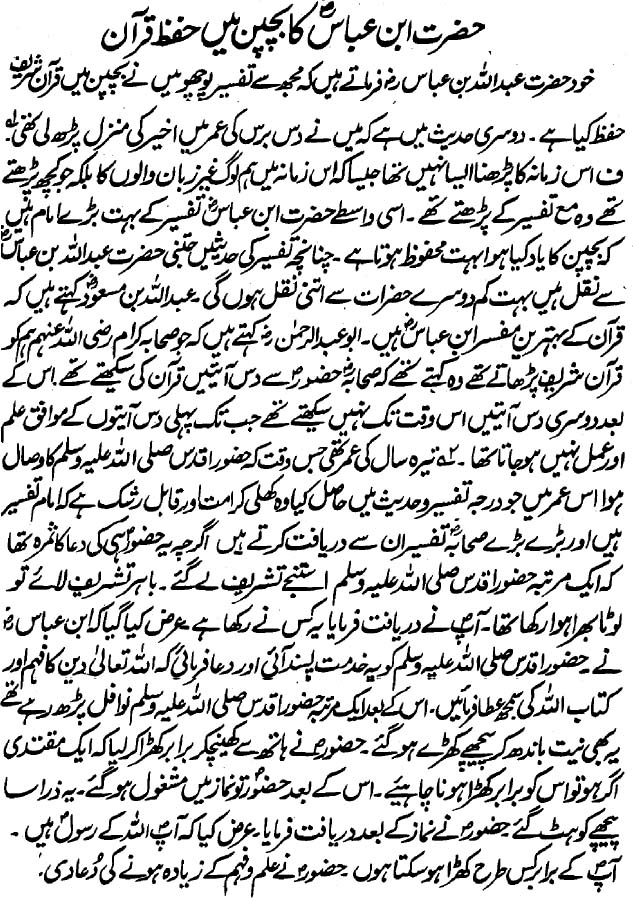
Hazrat Ibn Abbas (radi Allahu anhu) Ka Bachpan Mein Hifz-e-Quran
Jumah Prayer
[Sahih Bukhari: Volume 2, Book 13, Number 1] Narrated Abu Huraira (Radi Allah Anhu): I heard Allah’s Apostle (sal-allahu-alleihi-wasallam) saying, “We (Muslims) are the last (to come) but (will be) the foremost on the Day of Resurrection, though the former nations were given the Holy Scriptures before us. And this was their day (Friday), the celebration of which was made compulsory for them, but they differed about it. So Allah gave us the guidance for it (Friday) and all the other people are behind us in this respect: the Jews’ (holy day is) tomorrow (i.e., Saturday) and the Christians’ (is) the day after tomorrow (i.e., Sunday).”
[Sahih Bukhari: Volume 2, Book 13, Number 5] Narrated Abu Said (Radi Allah Anhu): I testify that Allah’s Apostle (sal-allahu-alleihi-wasallam) said, “The taking of a bath on Friday is compulsory for every male Muslim who has attained the age of puberty and (also) the cleaning of his teeth with Siwak, and the using of perfume if it is available.” Amr (a sub-narrator) said, “I confirm that the taking of a bath is compulsory, but as for the Siwak and the use of perfume, Allah knows better whether it is obligatory or not, but according to the Hadith it is as above.”)
[Sahih Bukhari: Volume 2, Book 13, Number 6] Narrated Abu Huraira (Radi Allah Anhu): Allah’s Apostle (sal-allahu-alleihi-wasallam) said, “Any person who takes a bath on Friday like the bath of Janaba and then goes for the prayer (in the first hour i.e. early), it is as if he had sacrificed a camel (in Allah’s cause); and whoever goes in the second hour it is as if he had sacrificed a cow; and whoever goes in the third hour, then it is as if he had sacrificed a horned ram; and if one goes in the fourth hour, then it is as if he had sacrificed a hen; and whoever goes in the fifth hour then it is as if he had offered an egg. When the Imam comes out (i.e., starts delivering the Khutba), the angels present themselves to listen to the Khutba.”
Shirk Kay Nuqsanat
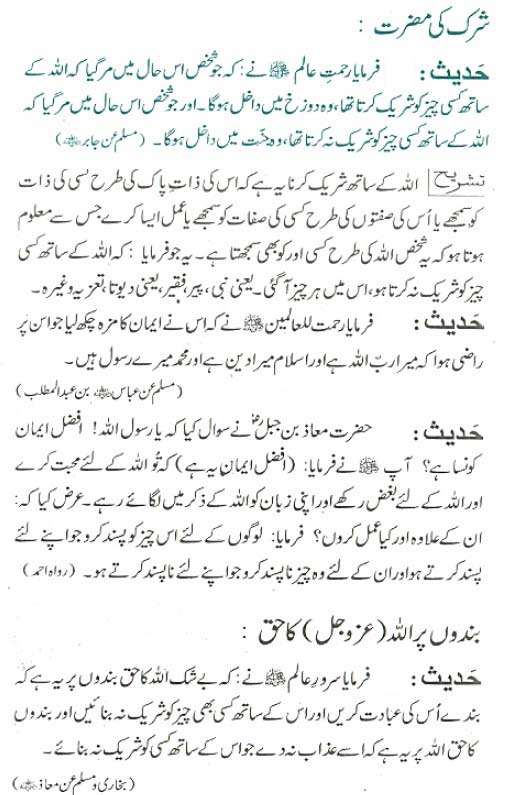
Shirk Kay Nuqsanat
Etiquette Of Differing In Permissible Matters
Islam has laid down lofty standards for how the Muslim, who traverses the methodology of the Prophetic Sunnah, should deal with his brother who has differed with him on an issue of ijtihad. Indeed, how outstanding is the statement of the Prophet (peace be upon him): “Indeed I have been sent to perfect noble manners.” (Al-Adab Al-Mufrad, No.273, authenticated by Al-Albani)
From these etiquettes:
1. To have an open heart in accepting what comes to you by way of clarification of the mistakes that you have made, and to know that this is from the sincere advice which your brother for Allah’s sake is giving to you as a gift. So know that your refusal of the truth and your becoming angry with yourself is actually from pride; may Allah protect us. Indeed, the most eminently truthful (peace be upon him), said: “Pride is to reject the truth and to scorn other people.” (Sahih Muslim, No. 91)
Rizq-e-Halal Ki Ahmiyat Aur Fazeelat

Rizq-e-Halal Ki Ahmiyat Aur Fazeelat
Desiring World’s Life And Hereafter
[11. Surah Hud: Ayah 15-16] “Whoever desires this world’s life and its finery, We will pay them in full their deeds therein, and they shall not be made to. suffer loss in respect of them.”
“These are they for whom there is nothing but fire in the hereafter, and what they wrought in it shall go for nothing, and vain is what they do.”
[2. Surah Al-Baqarah: Ayah 200-202] “There are some people who say, Our Lord! Give us in the world, and they shall have no resting place.”
“And there are some among them who say: Our Lord! Grant us good in this world and good in the hereafter, and save us from the chastisement of the fire.”
“They shall have (their) portion of what they have earned, and Allah is swift in reckoning.”
[17. Surah Bani Israel: Ayah 18-19] “Whoever desires this present life, We hasten to him therein what We please for whomsoever We desire, then We assign to him the hell; he shall enter it despised, driven away.”
“And whoever desires the hereafter and strives for it as he ought to strive and he is a believer; (as for) these, their striving shall surely be accepted.”
[42. Surah Ash-Shurah: Ayah 20] “Whoever desires the gain of the hereafter, We will give him more of that again; and whoever desires the gain of this world, We give him of it, and in the hereafter he has no portion.”
[18. Surah Kahf: Ayah 103-105] “Say: Shall We inform you of the greatest losers in (their) deeds?”
“(These are) they whose labor is lost in this world’s life, and they think that they are well versed in the skill of the work of hands.”
“These are they who disbelieve in the communications of their Lord and His meeting, so their deeds become null, and therefore We will not set up a balance for them on the day of resurrection. “
Istighfar Ki Fazeelat
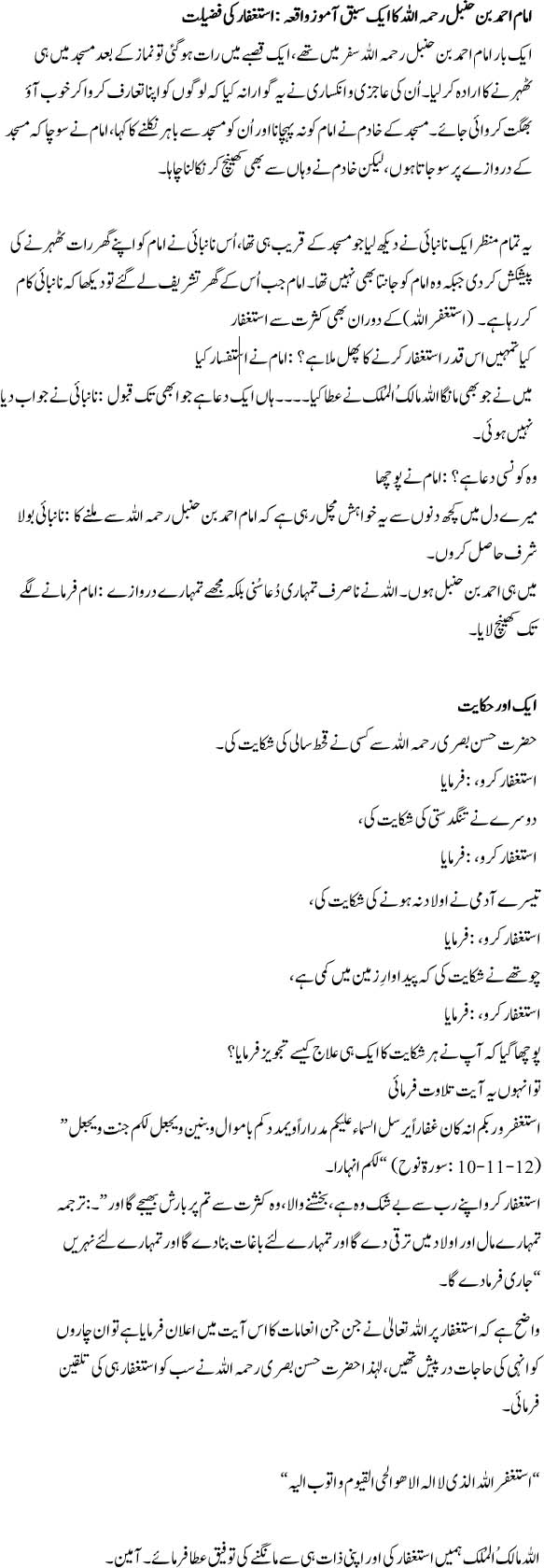
Istighfar Ki Fazeelat: Imam Ahmad Bin Hanbal (rahmatullah alaih) Ka Sabaq Amoz Waqia. Imam Hasan Basri (rahmatullah alaih) Ki Naseehat
Why Don’t You Embrace Islam?
Al-Mighty Allah describes Paradise in the Quran, “Verily, the dwellers of Paradise that Day, will be busy in joyful things. They and their wives will be in pleasant shade, reclining on thrones. They will have therein fruits (of all kinds), and they shall have whatever they desire (They shall be given whatever they ask for). (It will be said to them) “Salamun” (Peace be on you), a Word from the Lord, Most Merciful.” [ Qur’an chapter 36/55-58]
Further, the Quran describes, “No person knows what is kept hidden for them of joy, as a reward for what they used to do.” (Surah As-Sajda 32/17)
Heaven is a beautiful and wonderful place that awaits those who believe in Allah and do righteous good deeds, where every wish is fulfilled. Every kind of beauty and blessing exists in Paradise and will be revealed with a perfection never seen or known before. There would be many types of delights that people enjoy therein. The highest blessing is Allah’s good pleasure. Allah will say: “This is a Day on which the truthful will profit from their truth: theirs are Gardens under which rivers flow (in Paradise) – they shall abide therein forever. Allah is pleased with them and they with Him. That is the great success (Paradise) (Quran Chapter 5/119)