
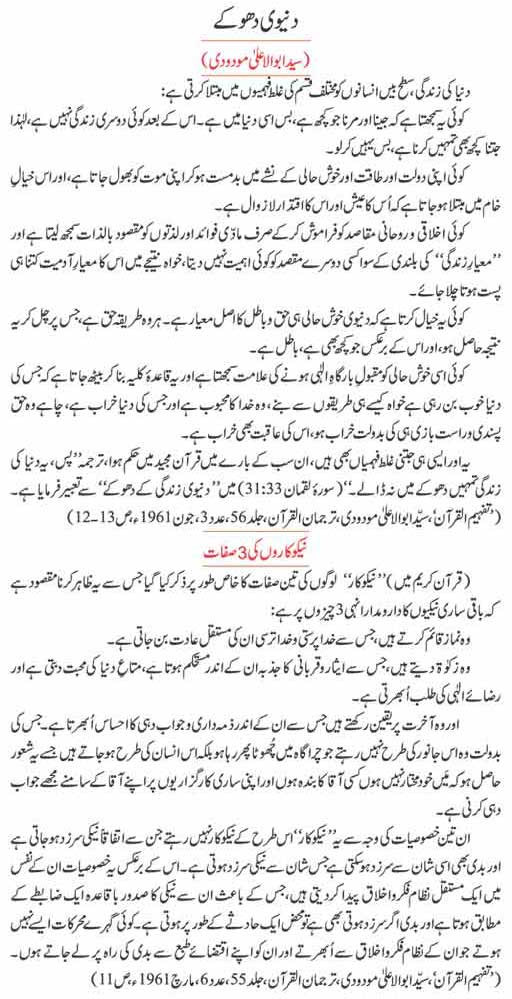
Dunya Kay Dhokay Aur Naiko Kar Logon Ki Sifaat by Syed Abul A’la Maududi
Who Is Muhammad And How Did He Become A prophet And Messenger Of God
Who is Muhammad?
Muhammad [PBUH] was born in Makkah in the year 570, at a time when Christianity was not yet fully established in Europe. Since his father died before his birth, and his mother shortly afterwards, he was raised by his uncle from the respected tribe of Quraysh. As he grew up, he became known for his truthfulness, generosity, and sincerity, so he was sought after for his ability to arbitrate in disputes. The historians describe him as calm and meditative. Muhammad [peace be upon him] was of a deeply religious nature and had long detested the decadence of his society. It became his habit to meditate from time to time in the Cave of Hira near the summit of Jabal al-Nur, the ‘Mountain of Light’ near Makkah.
How did he become a prophet and messenger of God?
At the age of 40, while engaged in a meditative retreat, Muhammad [pbuh] received his first revelation from God through the Angel Gabriel. This revelation continued for twenty-three years and is known as the Qur’an. As soon as he began to recite the words he heard from Gabriel, and to preach the truth which God had revealed to him, he and his small group of followers suffered bitter persecutions, which grew so fierce that in the year 622 God gave them the command to emigrate. This event, the Hijra, ‘migration’, in which they left Makkah for the city of Madinah some 260 miles to the north, marks the beginning of the Muslim calendar.
After several years, the Prophet [peace be upon him] and his followers were able to return to Makkah, where they forgave their enemies and established Islam definitively. Before the Prophet [pbuh] died at the age of 63, the more significant part of Arabia was Muslim, and within a century of his death, Islam had spread to Spain in the west and as far east as China.
What is the Ka’aba?
The Ka’aba is the place of worship that God commanded Abraham and Ishmael to build over four thousand years ago. The building was constructed of stone on what many believe was the original site of a sanctuary established by Adam. God commanded Abraham to summon all mankind to visit this place, and when pilgrims go there today they say ‘At thy service, O Lord’, in response to Abraham’s summons.
How did the spread of Islam affect the world?
Among the reasons for the rapid and peaceful spread of Islam was the simplicity of its doctrine — Islam calls for faith in only One God worthy of worship. It also repeatedly instructs man to use his powers of intelligence and observation. Within a few years, great civilizations and universities were flourishing, for according to the Prophet [pbuh], ‘seeking knowledge is an obligation for every Muslim man and woman’. The synthesis of Eastern and Western ideas and of new thought with old brought about great advances in medicine, mathematics, physics, astronomy, geography, architecture, art, literature, and history. Many crucial systems such as algebra, the Arabic numerals, and also the concept of the zero [vital to the advancement of mathematics], were transmitted to medieval Europe from Islam. Sophisticated instruments which were to make possible the European voyages of discovery were developed, including the astrolabe, the quadrant, and good navigational maps.
Hadith Qudsi: Maseebat Par Sabar
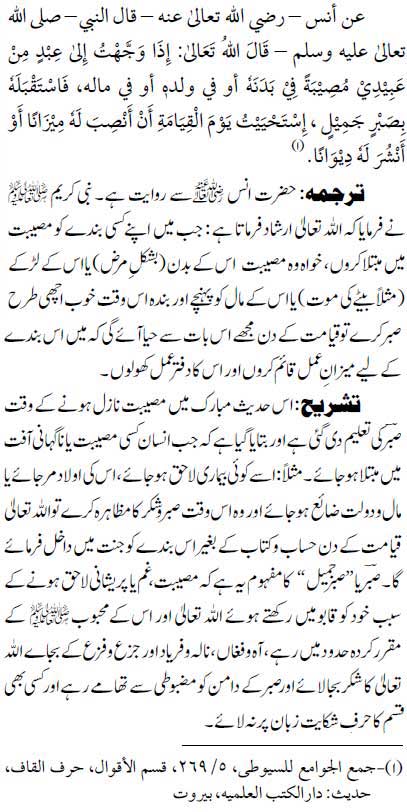
Hadith Qudsi: Maseebat Par Sabar
What Is Islam And Who Are The Muslims
What is Islam?
Islam is not a new religion, but the same truth that God revealed through all His prophets to every people. For a fifth of the world’s population, Islam is both a religion and a complete way of life. Muslims follow a religion of peace, mercy, and forgiveness, and the majority have nothing to do with the extremely grave events which have come to be associated with their faith.
Who are the Muslims?
Over one billion people from a vast range of races, nationalities, and cultures across the globe — from the southern Philippines to Nigeria — are united by their common Islamic faith. About 18% live in the Arab world; the world’s largest Muslim community is in Indonesia; substantial parts of Asia and most of Africa are Muslims, while significant minorities are to be found in the Soviet Union, China, North and South America, and Europe.
What do Muslims believe?
Muslims believe in One, Unique, Incomparable God; in the Angels created by Him; in the prophets through whom His revelations were brought to mankind; in the Day of Judgment and individual accountability for actions; in God’s complete authority over human destiny and in life after death. Muslims believe in a chain of prophets starting with Adam and including Noah, Abraham, Ishmael, Isaac, Jacob, Joseph, Job, Moses, Aaron, David, Solomon, Elias, Jonah, John the Baptist, and Jesus, peace be upon them. But God’s final message to man, a reconfirmation of the eternal message and a summing-up of all that has gone before was revealed to the Prophet Muhammad [peace be upon him] through Gabriel.
How does someone become a Muslim?
Simply by saying, ‘There is no god apart from God, and Muhammad is the Messenger of God.’ By this declaration the believer announces his or her faith in all God’s messengers, and the scriptures they brought.
What does ‘Islam’ mean?
The Arabic word ‘Islam’ simply means ‘submission’, and derives from a word meaning ‘peace’. In a religious context, it means complete submission to the will of God. ‘Mohammedanism’ is thus a misnomer because it suggests that Muslims worship Muhammad [peace be upon him] rather than God. ‘Allah’ is the Arabic name for God, which is used by Arab Muslims and Christians alike.
Do Islam and Christianity have different origins?
No. Together with Judaism, they go back to the prophet and patriarch Abraham, and their three prophets are directly descended from his sons — Muhammad [peace be upon him] from the eldest, Ishmael, and Moses and Jesus [peace be upon him] from Isaac. Abraham established the settlement that today is the city of Makkah, and built the Ka’aba towards which all Muslims turn when they pray.
Rah e Khuda Mein Maal Kharch Karnay Say Bukhal Aur Nabi (PBUH) Kay Ausaf Chupana
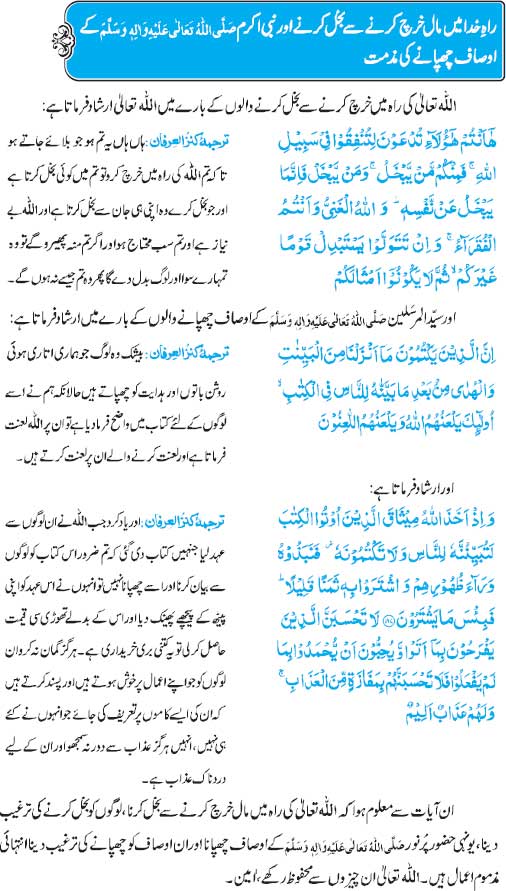
Rah e Khuda Mein Maal Kharch Karnay Say Bukhal Aur Nabi (PBUH) Kay Ausaf Chupanay Ki Muzamat
Develop Khushoo In Salah
- Striving to gain that which gives and strengthens Khushoo.
- Preparing oneself properly for Prayer.
- Moving at a measured pace during Salah
- Remembering death while praying
- Thinking about the Aayath and Adhkaar being recited during Salah and interacting with them.
- Pausing at the end of each Aayah.
- Reciting in a slow, rhythmic tone (Tarteel) and making one’s voice beautiful while reciting.
- Knowing that Allah responds to Salah
- Praying with a barrier (sutrah) in front of one and praying close to it.
- Looking at the place of prostration.
- Varying the Surahs, Ayahs, Adhkaars, and Duas recited in Salah.
- Performing Sujood al Tilawah when reciting an ayah where this is required.
- Seeking refuge with Allah from the Shaytaan.
- Thinking of how the Salaf were when they performed Salah.
- Striving to offer duas at the appropriate times during Salah, especially in Sujood.
- Adhkaar is to be recited after prayer.
- Removing anything that may distract the worshipper.
- Not praying in a garment that has decorations, writings, or pictures that will distract the worshipper.
- Not praying when food is prepared when one wants to eat.
- Not praying when one needs to answer the call of nature.
- Not praying when one feels sleepy.
- Not praying behind someone who is talking or sleeping.
- Not occupying oneself with smoothing the ground in front of one.
- The Prophet (SAW) said: Do not wipe the (ground) when you are praying, but if you have to do then do it only once. (Abu Dawud:946)
- Not disturbing others with one’s recitation.
- Not turning around during prayer.
- Not raising one’s gaze to the heavens.
- Not spitting in front of one when in Salah.
- Trying not to yawn when in Salah.
- Not putting one’s hands on one’s hips when in Salah.
- Not letting one’s clothes hang down (Sadl) during Salah.
- Not rembling like animals in Salah.
Asbab Ikhtiyar Karna Tawakkul Kay Khilaf Nahi

Asbab Ikhtiyar Karna Tawakkul Kay Khilaf Nahi by Mufti Muneeb ur Rehman
Granting Time To The Debtors
[Sahih Bukhari: Book 3 ‘Sales and Trade’, Book 34, Number 290] Narrated Jabir bin ‘Abdullah (Radi Allah Anhu), Allah’s Apostle (sal-allahu-alleihi-wasallam) said: “May Allah’s mercy be on him who is lenient in his buying, selling, and in demanding back his money.”
[Sahih Bukhari: Book 3 ‘Sales and Trade’, Book 34, Number 291] Narrated Hudhaifa (Radi Allah Anhu), The Prophet (sal-allahu-alleihi-wasallam) said: “Before your time the angels received the soul of a man and asked him, ‘Did you do any good deeds (in your life)?’ He replied, ‘I used to order my employees to grant time to the rich person to pay his debts at his convenience.’ So Allah said to the angels; “Excuse him.” Rabi said that (the dead man said), ‘I used to be easy to the rich and grant time to the poor.’ Or, in another narration, ‘grant time to the well-off and forgive the needy,’ or, ‘accept from the well-off and forgive the needy.’
[Sahih Bukhari: Book 3 ‘Sales and Trade’, Book 34, Number 292] Narrated Abu Huraira (Radi Allah Anhu), The Prophet (sal-allahu-alleihi-wasallam) said: “There was a merchant who used to lend the people, and whenever his debtor was in straitened circumstances, he would say to his employees, ‘Forgive him so that Allah may forgive us.’ So, Allah forgave him.”
My Lord! grant me that I should be grateful for Thy favor which Thou hast bestowed on me and on my parents and that I should do good such as Thou art pleased with, and make me enter, by Thy mercy, into Thy servants, the good ones.
Surah Al Hashr Ki Fazeelat

Surah Al Hashr Ki Fazeelat
O You Who Believe! Spend (Benevolently)
[2. Surah Al-Baqarah: Ayah 261] The parable of those who spend their property in the way of Allah is as the parable of a grain growing seven ears (with) a hundred grains in every ear; and Allah multiplies for whom He pleases; and Allah is Ample-giving, Knowing.
[2. Surah Al-Baqarah: Ayah 262] (As for) those who spend their property in the way of Allah, then do not follow up what they have spent with reproach or injury, they shall have their reward from their Lord, and they shall have no fear nor shall they grieve.
[2. Surah Al-Baqarah: Ayah 263] Kind speech and forgiveness are better than charity followed by injury; and Allah is Self-sufficient, Forbearing.
[2. Surah Al-Baqarah: Ayah 264] O you who believe! do not make your charity worthless by reproach and injury, like him who spends his property to be seen of men and does not believe in Allah and the last day; so his parable is as the parable of a smooth rock with earth upon it, then a heavy rain falls upon it, so it leaves it bare; they shall not be able to gain anything of what they have earned; and Allah does not guide the unbelieving people.
[2. Surah Al-Baqarah: Ayah 265] And the parable of those who spend their property to seek the pleasure of Allah and for the certainty ‘of their souls is as the parable of a garden on an elevated ground, upon which heavy rain falls so it brings forth its fruit twofold but if heavy rain does not fall upon it, then light rain (is sufficient); and Allah sees what you do.
[2. Surah Al-Baqarah: Ayah 266] Does one of you like that he should have a garden of palms and vines with streams flowing beneath it; he has in it all kinds of fruits; and old age has overtaken him and he has weak offspring, when, (lo!) a whirlwind with fire in it smites it so it becomes blasted; thus Allah makes the communications clear to you, that you may reflect.
[2. Surah Al-Baqarah: Ayah 267] O you who believe! spend (benevolently) of the good things that you earn and or what We have brought forth for you out of the earth, and do not aim at what is bad that you may spend (in alms) of it, while you would not take it yourselves unless you have its price lowered, and know that Allah is Self-sufficient, Praiseworthy.
[2. Surah Al-Baqarah: Ayah 268] Shaitan threatens you with poverty and enjoins you to be niggardly, and Allah promises you forgiveness from Himself and abundance; and Allah is Ample-giving, Knowing.
[2. Surah Al-Baqarah: Ayah 269] He grants wisdom to whom He pleases, and whoever is granted wisdom, he indeed is given a great good and none but men of understanding mind.
[2. Surah Al-Baqarah: Ayah 270] And whatever alms you give or (whatever) vow you vow, surely Allah knows it, and the unjust shall have no helpers.
[2. Surah Al-Baqarah: Ayah 271] If you give alms openly, it is well, and if you hide it and give it to the poor, it is better for you; and this will do away with some of your evil deeds, and Allah is aware of what you do.
[2. Surah Al-Baqarah: Ayah 272] To make them walk in the right way is not incumbent on you, but Allah guides aright whom He pleases; and whatever good thing you spend, it is to your own good, and you do not spend but to seek Allah’s pleasure, and whatever good stuff you spend shall be paid back to you in full, and you shall not be wronged.
[2. Surah Al-Baqarah: Ayah 273] (Alms are) for the poor who are confined in the way of Allah – they cannot go about in the land; the ignorant man thinks them to be rich on account of (their) abstaining (from begging); you can recognize them by their mark; they do not beg from men importunately; and whatever good thing you spend, surely Allah knows it.
[2. Surah Al-Baqarah: Ayah 274] (As for) those who spend their property by night and by day, secretly and openly, they shall have their reward from their Lord and they shall have no fear, nor shall they grieve.
Our Lord! accept from us; surely Thou art the Hearing, the Knowing.