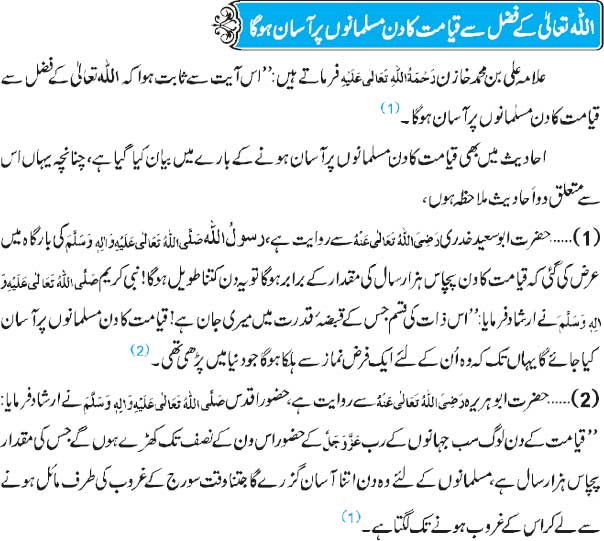
الله کے فضل سے قیامت کا دن مسلمانو پر آسان ہو گا
Allah (Subhaanahu wa Ta’aala) says:
{Therefore remember Me, I will remember you and be grateful to Me, and never be ungrateful to me}, [Soorah al-Baqarah, Aayah 152]
{O you who believe! Remember Allah with much remembrance}, [Soorah al-Ahzaab, Aayah 41]
{And for men and women who engage much in Allah’s remembrance, for them has Allah prepared forgiveness and great reward}, [Soorah al-Ahzaab, Aayah 35]
{And bring your Lord to remembrance in your [very] soul, with humility and remember without loudness in words, in the mornings and evenings; and be not of those who are unheedful}, [Soorah al-A’raaf, Aayah 205]
The Prophet (sal-Allaahu `alayhe wa sallam) said:
((The comparison of the one who remembers Allah and the one who does not remember Allah, is like that of the living and the dead)), [al-Bukhaaree with al-Fat.h 11/208 and Muslim 1/539]
He (sal-Allaahu `alayhe wa sallam) also said:
((Should I not inform you of the best of deeds, and the most sanctifying of deeds before your Lord, which does more to raise your positions [with Him], and are better for you than the disbursement of gold and money or battle with the enemy?))
They [the companions] said: “Indeed! Inform us.”
He (sal-Allaahu `alayhe wa sallam) then said:
((Remembrance of Allah (Subhaanahu wa Ta’aala))), [at-Tirmidhee 5/459 and Ibn Maajah 2/1245, see: Saheeh Ibn Maajah 2/316 and Saheeh at-Tirmidhee 3/139]
The Prophet (sal-Allaahu `alayhe wa sallam) also said:
((Allah (Subhaanahu wa Ta’aala) says: “Indeed I am as My servant presumes Me to be, and I am with him when he remembers Me, so if he remembers Me to himself I remember him to Myself, and if he remembers Me amongst a company I remember him amongst a company greater than it, and if he draws near to Me the span of a hand I draw near to him the span of an arm, and if he draws near to Me the span of an arm I draw near to him the span of two outstretched arms, and if he takes a step towards Me I hastily step towards him”)), [al-Bukhaaree 8/171 and Muslim 4/2061, this specific wording is related by al-Bukhaaree]
On the authority of ‘Abdullaah Ibn Busr (radhi-yallaahu ‘anhu): “A man said to the Prophet (sal-Allaahu `alayhe wa sallam): “O Messenger of Allah, the rites of Islam are much for me, so tell me of something that I might hold fast to”
He (sal-Allaahu `alayhe wa sallam) said:
((Let not your tongue cease from the remembrance of Allah)), [at-Tirmidhee 5/458 and Ibn Maajah 2/1246, see: Saheeh at-Tirmidhee 3/139 and Saheeh Ibn Maajah 2/317]
The Prophet (sal-Allaahu `alayhe wa sallam) also said:
((Whoever recites a letter of Allah’s Book has for it, a merit and ten more like it, not to say that alif, laam, meem are one letter but rather alif is a letter, laam is a letter and meem is a letter)), [at-Tirmidhee 5/175, see: Saheeh at-Tirmidhee 3/9 and Saheeh al-Jaami’ as-Sagheer 5/340]
The Prophet (sal-Allaahu `alayhe wa sallam) also said:
((Whoever takes a seat and fails to remember Allah, has incurred upon himself a loss from Allah, and whoever lies down [relaxes] and fails to remember Allah, has incurred upon himself a loss from Allah)), [Abu Daawood 4/264 and others, see: Saheeh al-Jaami’ 5/342.]
Please note: All supplications are taken from the English translation of Hisnul-Muslim (“Fortification of the Muslim through Remembrance and Supplication from the Qur.aan and Sunnah”), as published by Invitation To Islam.
PROPHET MUHAMMAD (peace be upon him) was both a prophet of Allah and a statesman. His leadership was most comprehensive and dynamic. He was the paragon of virtue and spirituality. He was a noble and compassionate teacher, guide, and reformer. He was a family man.
Indeed, he was also a political leader. As a political leader the Prophet (peace be upon him) unified the Arabian Peninsula, established a great state whose capital was Madina, defeated his enemies, and had most successful military expeditions. However, his real political leadership was in the realm of morality and spirituality in which he conducted himself perfectly in situations of weakness as well as strength. His way of dealing in Makkah and Madina indicates his great political leadership.
He was always willing to help others. Almighty Allah endowed him with a special insight to resolve conflicts and disputes. Even before he became the Prophet of Allah, he was able to resolve a major dispute between the people of Makkah. It is reported that the people of Makkah were repairing the walls of the Ka`ba. When the time came to place the Black Stone in its place in the southeast corner of the Ka`ba, each tribe wanted to have this honor. Muhammad was asked to be the judge and decide the matter fairly. He resolved this dispute with great wisdom in an amicable way. He spread his own cloak on the ground and placed the Black Stone upon it. He then asked representatives of each tribe to lift the cloak together. When the Black Stone reached the required height from the ground he went forward and set it in its place.
He always wanted to make peace among people. At an early age it is reported that when some people of Makkah wanted to establish a committee to suppress violence in their society, he immediately joined them. This committee took a pledge of virtue known as the Hilf Al-Fudul. Later during his prophetic life he recalled this pledge and praised it highly and said, “Even now if I am called upon in the name of this pledge, I shall not refuse.”
Prophet Muhammad (peace be upon him) was a man of ideals but he was also a practical man. He preached the message to all and did not isolate himself from his society. He used any of the good traditions and customs they had and benefited from them. Although his uncle, Abu Talib, did not accept his message of tawheed, he was willing to give him all his support and help in the Islamic work. The Prophet (peace be upon him) appreciated his uncle’s help. After his uncle’s death he went to Taif to seek alliances with some other tribes there. He did not succeed, but it is important to note that he was trying to seek alliances for the cause of Islam.
The migration to Ethiopia is also an example of his political skill in seeking alliances with others. When the persecution increased in Makkah and some of his followers found it difficult to live in that environment, The Prophet (peace be upon him) allowed them to migrate to Ethiopia and seek the help of the Christian king there. In Ethiopia Muslims found peace and they reciprocated the king’s hospitality with prayers and support for him and his party. Muslims’ relations were so good with the monarch that he grew to love Islam and before his death he became a Muslim.
In Madina, the Prophet (peace be upon him) established a state where all people were equal, where matters were decided through consultation, and where all people had to follow the same law. It was a state without any favoritism in favor of any family or group.
Even a non-Muslim was not to be mistreated under his rule. The story of Tu’mah Ibn Abraq is an excellent example of justice and human rights for all people under his authority. Tu’mah, who was a Muslim, stole someone’s armor in Madina and then he blamed a Jew. Allah sent a special revelation to warn people against such injustice (Qur’an 4:110-112). The Jewish citizen of Madina was declared innocent and Tu’mah was found guilty.
Prophet Muhammad (peace be upon him) was a man of great patience and resolution. There are many lessons for us to learn from his life. The most important aspect of his leadership was that he was always honest and truthful.
Even his enemies could not find any flaw in his honesty and truthfulness. The most beautiful example of this we find in the conversation between Heraclius, the Emperor of Byzantium, and Abu Sufyan who was a bitter enemy of the Prophet (peace be upon him) at that time. This conversation took place in the year 628 CE when Heraclius received a letter from the Prophet (peace be upon him). Heraclius was on a pilgrimage to Jerusalem when he received this important letter. After receiving the message, the emperor sent for his chief of police and told him to search around the country for a man from the same tribe as the one who claimed to be a prophet. Abu Sufyan, a leader of the Quraish, happened to be trading in Gaza with some of his companions from Makkah. The emperor’s search party found them there and they were immediately taken to Jerusalem.
Heraclius called them into his court and he had all the senior Roman dignitaries around him. He called for his chief aide who translated Heraclius’ questions and said to them, “Who amongst you is closely related to the man who claims to be a prophet?” Abu Sufyan replied, “I am the nearest relative (amongst the group) to him.”
Heraclius said, “Bring him (Abu Sufyan) close to me and make his companions stay behind him.” Abu Sufyan added, “Heraclius told his translator to tell my companions that he wanted to ask me some questions regarding that man (the Prophet) and that if I told a lie they (my companions) should contradict me.” Abu Sufyan added, “By Allah! Had I not been afraid of my companions labeling me a liar, I would not have spoken the truth about the Prophet.”
The first question Heraclius asked me was, “What is the status of his family among you?” I replied, “He belongs to a good (noble) family amongst us.” Heraclius further asked, “Has anybody else amongst you ever claimed the same (that is, to be a prophet) before him?” I replied, “No.” He said, “Was anybody amongst his ancestors a king?” I replied, “No.” Heraclius asked, “Do the nobles or the poor follow him?” I replied, “It is the poor who follow him.” He said, “Are his followers increasing or decreasing (day by day)?” I replied, “They are increasing.” He then asked, “Does anybody amongst those who embrace his religion become displeased and renounce the religion afterwards?” I replied, “No.” Heraclius said, “Have you ever accused him of telling lies before his claim (to be a prophet)? I replied, “No.” Heraclius said, “Does he break his promises?” I replied, “No. We have a truce with him but we do not know what he will do.” I could not find the opportunity to say anything against him except that. Heraclius asked, “Have you ever had a war with him?” I replied, “Yes.” Then he said, “What were the outcome of these battles?” I replied, “Sometimes he was victorious and sometimes we were.” Heraclius said, “What does he order you to do?” I said, “He tells us to worship Allah and Allah alone and not to worship anything along with Him, and to renounce all that our ancestors had said. He orders us to pray, to be chaste, and to keep good relations with our kith and kin.”
After this conversation it is reported that Heraclius said:
“I asked you about his family and your reply was that he belonged to a very noble family. In fact, all the Messengers come from noble families amongst their respective peoples. I questioned you whether anybody amongst you ever claimed such a thing, your reply was in the negative. If your reply had been in the affirmative, I would have thought that this man was following the previous man’s statement. Then I asked you whether anyone from his ancestors was a king. Your reply was in the negative, and if it had been in the affirmative, I would have thought that this man wanted to take back his ancestral kingdom. I further asked whether he was ever accused of telling lies before he said what he is now saying, and your reply was in the negative. So I wondered how a person who does not tell a lie about others could ever tell a lie about Allah. I then asked you whether the rich people followed him or the poor. You replied that it was the poor who followed him. And in fact all the Messengers are followed by the poor in the beginning. Then I asked you whether his followers were increasing or decreasing. You replied that they were increasing, and in fact this is the way of true faith, till it is complete in all respects. I further asked whether there was anybody, who, after embracing his religion, became displeased and discarded it. Your reply was in the negative, and in fact this is (the sign of) true faith when its light enters the hearts and gets absorbed completely. I asked you whether he had ever betrayed. You replied in the negative and likewise Messengers never betray. Then I asked you what he ordered you to do. You replied that he ordered you to worship Allah and Allah alone and not to worship anything along with Him and forbade you to worship idols and ordered you to pray, to speak the truth, and to be chaste.
“If what you have said is true, he will very soon occupy the place underneath my feet and I knew it (from the Scriptures) that he was going to appear, but I did not know that he would be from among you, and if I could reach him I would go immediately to meet him and if I were with him, I would certainly wash his feet.”
If we can learn to depend on Allah with due reliance, He will certainly give us provisions as He gives to the birds who leave their nests in the mornings and return with full bellies at dusk.
But what do we need in order to achieve this? We must have firm belief that only Allah can help and benefit us. The Prophet (peace be upon him) said, “Whoever wishes to be strong should rely on Allah.”
Allah the Almighty says: “… Victory will be yours; and put your trust in Allah if you are believers indeed.” (Qur’an 5:23)
These words give us strength to face hardships. But at the same time as depending on Allah, we must exert effort and use all the material resources provided by Allah. If we do so we will be obeying His orders. When we sincerely depend on Allah we feel tranquility in our hearts because we know that Allah is on our side. We should try to detach ourselves from always seeking material things and keep in mind that no harm or benefit comes to us without the permission of Allah.
Umar Bin Al-Khattab (May Allah be pleased with him) told us about the birds and how they wake up in the early morning, glorify Allah and go in search of food, (they exert effort) trust in Allah and find sustenance. You may think it strange that birds glorify Allah but the Almighty says in the Qur’an : “The seven heavens and the earth, and all that is therein, glorify Him and there is not a thing but glorifies His praise; and yet you understand not how they declare His glory! Verily, He is the Ever-forbearing, Oft-Forgiving.” (17:44)
Even the prophets worked and so did the Companions of the Prophet (peace be upon him), but they all trusted in Allah in every aspect of life.
When Ibrahim (peace be upon him) was being thrown into the fire, Jibreel (peace be upon him) asked him, ‘Do you need anything?’
But Ibrahim answered, ‘Nothing from you. Allah knows my condition (status).”
Another time, Ibrahim (peace be upon him) took his wife Hajar and his son Isma’il to a place near Makkah.
Allah the Almighty ordered Ibrahim to leave them in the desert, and when Hajar saw him leaving her she wanted to know if it was an order from Allah. Ibrahim answered , ‘Yes’. So she put her trust in Allah and was sure that He would take care of them. Indeed, all help and power are from Allah. Trust in Him! His promise is true.
Prayer or supplication (Dua) is the essence of worship or servanthood to God. What rises to God from the whole creations is prayer. It has kinds and degrees:
1. The first kind is the prayer of all organisms, plant, animal and human, through the natural disposition of their bodies and their functioning in line with their duties in creation. This kind of prayer is always accepted.
2. The second kind is that which is uttered by all organisms, plant, animal, and human, in the tongue of vital needs. God meets these needs just on time, with the exception that plants, and the animals relatively weaker and less intelligent (as compared to others, such as wolves and foxes), are nourished more easily than the others. The more powerful and intelligent and more self-subsisting a creature is, the greater hardship it suffers to get nourishment.
3. The third kind of prayer is that which is done by human beings. This falls into two categories:
i. The first category is the active prayer. It means complying with the laws that God has set for life. For example, a farmer’s ploughing the soil is knocking on the door of Divine providence. A patient’s going to the doctor is appealing to God for cure. This kind of prayer is usually accepted.
ii. The second category is the verbal prayer that we do. This kind of prayer is also answered. But answering is different from accepting. God answers all the prayers done sincerely. However, He answers sometimes by giving whatever is asked for, sometimes by giving what is better, sometimes by postponing giving to the afterlife, and sometimes by not giving at all, since it will not turn out in favor of the one who prays. The way that God answers prayer depends on His wisdom.
When we pack our bags to go visit our friends, we remember to pack our clothes, shoes, and other little things.
Since we could know right from wrong, we have started packing our bags and will finish when our souls leave us.
Have you packed your prayer in your bag of provisions everyday? Have you packed your fasting? Have you packed your reading and memorizing the Qur’an?
Our bags are called life. We have to pack everyday because we don’t know when Allah will call us back, so we have to be ready for the journey.
And on the way up to Allah, you don’t get any U-turns so that you could go back and get the things you forgot to pack. So start packing if you already haven’t, and don’t forget, there’s no such thing as too many bags when we’re packing for our trip to Allah.
There are a number of different collections of Islamic terms and common expressions. Here is a collection that I have found to be most useful to explain common expressions and terminology used by Muslims.
ALAYHIS SALAM-
‘Peace be upon him’, a formula used after the name of a prophet
ALLAHU AKBAR-
The Arabic expression meaning ‘Allah is greater.’ Also called the takbir
ALLAHU ALAM-
An Arabic expression meaning ‘Allah knows best’
AMMA BAAD-
An expression used for separating an introductory from the main topics in a speech; the introductory being usually concerned with Allah’s praises and glorification. Literally it means ‘whatever comes after’
ASTAGFURALLAH-
The Arabic expression meaning ‘I ask forgiveness of Allah’
AUDHU BILLAHI MIN ASH SHAYTAN AR RAJIM-
The Arabic expression meaning ‘I seek protection in Allah from the accursed satan.’
AZZA WA JAL-
A formula used after the mentioning the name of Allah meaning ‘Mighty and Majestic is He’
BARAKALLAH FIK-
An expression which means ‘May the blessings of Allah be upon you.’ When a Muslims wants to thank another person, he uses different statements to express his thanks, appreciation and gratitude. One of them is BarakAllah
BISMILLAH AR RAHMAN AR RAHIM-
‘In the name of Allah, the all Merciful the all Compassionate.’
FI AMANALLAH-
Valedictory phrase meaning ‘In Allah’s protection’
FI SABILILLAH-
The Arabic expression meaning ‘In the way of Allah’, ‘For the cause of Allah’ [also used to mean ‘for the love of Allah’]
AL HAMDU LILAH WA SHUKRU LILLAH-
The Arabic expression meaning which means ‘Praise belongs to Allah and all thanks to Allah’
HASBALA-
The Arabic expression, ‘Hasbunallah wa nimalwakil’ meaning ‘Allah is enough for us and an excellent guardian’
HAWQALA-
The Arabic expression, ‘la hawla wa la quwwata illa billah’ which means ‘There is no power nor strength save (expect) by Allah’
INNA LILLAHI WA INNA ILAYHI RAJIUN-
This is something which a Muslim expresses when he is afflicted by a misfortune, the meaning of which is ‘We are from Allah and to Him are we returning.’ It is taken from an ayat (verse) from the Quran (ch 2 vs 156).
[this is usually said upon hearing of the death of an individual]
INSHALLAH-
The Arabic expression meaning ‘If Allah wills’
[this is usually said when referring to a situation in the future e.g. inshAllah I will go to the grocery shop tomorrow etc]
ISTIGHFAR-
To ask the forgiveness of Allah, especially by saying, Astagfuralah, ‘I seek the forgiveness of Allah’
ISTITHNA-
Exception, saying ‘InshAllah’, ‘If Allah wills’
JALLA JALALUH-
The formula said after the name of Allah meaning ‘Great is His Majesty’
JAZAKALLAHU KHAIRAN-
This is a statement of thanks and appreciation to be said to a person who does a favor. Instead of saying ‘shukran’ (thanks), this phrase is used. It means ‘May Allah reward you with good.
KARAM ALLAHU WAJHAHU-
‘May Allah honor him’, a formula used when Ali ibn Abi Talib (RadiAllahu Ta’ala anhu) is mentioned
LABBAYK-
‘At your service’, the talbiya or call of the pilgrim to his Lord in the hajj.
[the full talbiya is ‘LabbaykAllah huma Labbayk, LabbaykAllah sharee kalala Labbayk, innal hamda, wa naimata lakawulmulk la shareekala’ which means “Here I am O Lord, here I am, Oh Allah, here I am. Here I am. You have no partner. Here I am. Surely all praise, grace and dominion is yours, and you have no partner.”]
LA HAWLA WALA QUWWATA ILLA BILLAH-
The meaning of this expression is ‘There is no power nor strength save in Allah’. This is said by a Muslim when he is struck with calamity, or is taken over by a situation beyond his control.
LI WAJHILLAH-
Literally, ‘For the face of Allah’, meaning in order to obtain the pleasure of Allah, purely for Allah himself.
MA SALAMA-
‘With peace’, a formula for ending letters
MASHALLAH-
A phrase literally meaning ‘What Allah wishes’, and it indicates a good omen
[example of usage, I get an A in a test, my mother would say MashAllah]
MALWANA
‘Our master’, a term of respect
[usually used in the context of referring to the Prophet SAW, also however used in the context of referring to a learned individual e.g. scholar or imam, a concept I am not too keen on supporting and Allah knows best]
RABBANA WA LAKAL_HAMD-
‘Our Lord, Praise if yours’, said after rising from ruku after saying ‘sami Allahuliman hamidah’
[which means ‘Allah listens to the one who praises him’]
RADIYALLAHU ANHA-
The formula ‘May Allah be pleased with her’ used after a female companion
[usually abbreviated as RA or RAA]
RADIYALLAHU ANHU-
This is an expression to be used by Muslims whenever a name of a companion of the Prophet Muhammad is mentioned or used in writing. IT means ‘May Allah be pleased with him’
[usually abbreviated as RA or RAA]
RADIYALLAHU ANHUM-
The formula, ‘May Allah be pleased with them’, used after a group of companions
[usually abbreviated as RA or RAA]
RAHIMAHULLAH-
The formula, ‘May Allah have mercy on him’
ASSALAMU ALAYKUM
‘Peace be upon you’ the greeting of the Muslim
[the reply is ‘wa alaikumus salam’ which means ‘and peace be upon you. The fuller version reads, ‘assalam u alaikum wa rahmatulahi wa baakatuhu’ which means ‘peace be upon you and the blessings and mercy of Alllah’ the reply is ‘wa alaikumus salam wa rahmatulahi wa baakatuhu’]
SALLAHU ALAYHI WA SALLAM-
‘May Allah bless him and grant him peace’, the formula spoken after the mentioning of the Prophet Muhammad
[usually the following two sets of abbreviations are used for this phrase (pbuh) which means ‘peace be upon him’ and is the technical reply for all Prophets or (saws) the correct suffix when referring to the Prophet Muhammad ]
SAMI ALLAHU LIMAN HAMIDAH-
‘Allah heard him who send praise to Him’, said by someone praying when he rises from ruku (unless he is following an imam in prayer)
[if he is following an imam in prayer he says ‘Rabana wala kalhamd’ only]
SAYYIDUNA-
‘Our Master’, a term of respect
[usually used to refer to the Prophet Muhammad SAW , however many people use it to refer to learned man / scholar]
SUBHANALLAH-
‘Glorified is Allah.’ To honor Allah and make Him free from all (unsuitable evil things) that are ascribed to Him, (or ‘Glorified be Allah’)
SUBHANAHU WA TA’ALA-
‘Glorified is He and exalted,’ an expression that Muslims use when the name of Allah is pronounced or written
[this us usually abbreviated as (swt)]
TA’ALA-
‘Exalted is He’, an expression used after the name of Allah is mentioned
[i.e. Allah Ta’ala meaning, Allah, exalted be He]
TAAWWUDH-
Saying, ‘I seek refuge in Allah…’ (audhu billahi minash shaitan nirajeem)
TABARAKALLAH-
The formula ‘Blessed is Allah’
TAHMID-
Saying the expression ‘alhamdulillah’, which means ‘Praise belongs to Allah’
TAKBIR-
Saying ‘Allahu akbar’, which means ‘Allah is Great’
TALBIYA-
Saying ‘Labbayk’, which means ‘At your service’ during the hajj
TAMJID-
Glorifying Allah
TARDIYA-
Saying one of the expressions which begin with ‘radiyallahu….’
TASBIH-
Glorification, saying ‘SubhanAllah’, which means ‘Glory be to Allah’
TASHMIT –
Uttering a prayer for the sneezer which thes the form, ‘yarhamuk Allah’ which means ‘may Allah have mercy on you’
[when a person sneezes he says, Ahamdulillah (Praise be to Allah), a person who hears the sneeze says ‘yarhamuk Allah’ and the sneezer replies ‘Yahdikumul-lah wa Yuslih balakum’ which means ‘May Allah give you guidance and improve your condition.’]
WAJHULLAH –
‘The face of Allah’, meaning for the sake of Allah, irrespective of any reward in this life, purely for Allah’
also however used in the context of referring to a learned individual e.g. scholar or imam
By Aisha Bewley
Bismillaahi wa’Alaa barakatillahi (“[I am eating] In the name of Allah (swt) and with the blessings of Allah (swt)”). These words are spoken before taking a meal to express our gratitude for the food on our table.
Food is life, a gift from Allah (swt) given to humans for sustenance. The Qur’an states “O believers, eat the clean things we have provided you, be grateful to Allah if you sincerely want to obey Him” (7:158).
The resources that Allah (swt) has provided to us are His gifts, and by respecting them, we are in turn being grateful to Allah (swt). No human can produce his own sustenance; we are, in essence, living off of the fruits of the earth, which are gifts from Allah. The food which we garner from the earth is our only means of sustenance. Without that food, we cannot survive. Hence, we owe our everyday existence to Allah, for Allah is our Provider and our Sustainer, ar-Razzaq being one of His many names.
According to the Qur’an and Sunnah, Muslims must follow certain etiquette, before, during and after eating, not only to be satiated with what is given to us, but also to be grateful and appreciative of the gifts of food and life that Allah (swt) has blessed us with. During a meal, Muslims have to abide by certain protocol to show their gratitude towards Allah (swt) and respect for His gifts. Prophet Mohammad (saw) said “mention the Name of Allah and eat with your right hand, and eat of the dish which is nearer to you (Bukhari VII; 65:288). In the Qur’an, Allah (swt) says, “Eat and drink but do not waste by excess, for Allah does not love the wasters” (VII: 31). Islamic law emphasizes the importance of remembering and thanking Allah (swt) while eating and only consuming enough food to survive. “A Muslim eats in one intestine (i.e. he is satisfied with a little food) while a Kafir (unbeliever) eats in seven intestines (eats much)” (Bukhari VII, 65:308).
Gluttony is considered wasteful. When one has greater access and availability of food and resources, one should take only what is necessary to sustain oneself without over-consumption. If there is an excess of food, then one must distribute it to the needy instead of hoarding or throwing it away.
Many of us are guilty of leaving food on our plates and trashing leftovers from the refrigerator. The amount of food wasted by well-off people could easily feed the famished stomachs of young children all around the world. Homelessness and starvation could lessen if charity were practiced locally. Major epidemics, famine and hunger could also be reduced if the right steps were taken to distribute food evenly round the world instead of having the wealthy few cache a majority of the resources. If charity were practiced more frequently, and an understanding that food and resources of this world are a blessing and gift from Allah (swt) were more widespread, then may be food shortage and hunger wouldn’t be so widespread today.
As the centuries have passed, people who can afford to, eat more, while those who can’t are left famished and dying. It is important to understand that Allah (swt) is the Sustainer of life and provides many of us with resources so we can preserve our lives. How we use the gifts of Allah (swt) is important. If we throw away these gifts instead of carefully cherishing them and sharing them with the needy, then we are disrespecting Allah’s gifts and being ungracious.
Because food is the key to life, Allah (swt) has outlined rules for us to respect food and treat it as a valuable and important part of our lives. Remembering Allah (swt) for His gift is integral to understanding the value of food. When Muslims are done with their meals, they must say, “Al-hamdu lill’hilladhi at-amana’ wasaq’n’ waja-alana minal muslimin.” (“All praise is due to Allah (swt) who gave us food and drink and made us Muslims”) (Tirmidhi). It is our duty to show our gratitude for our food by sharing it with others, thus showing our thankfulness to Allah for our gift of life.
By Mahruq Siddiqui
SIDDIQUI is a UC Irvine Alumna with a B.S. in Information and Computer Science.
Many years ago, there lived a very industrious, hardworking people. They were the people of Ad, and they built large and beautiful houses. On every mountain, they had erected a tower and they were very proud of their beautiful buildings.
Among the people of Ad lived a man called Hud (Alaih Assalaam), and Hud (Alaih Assalaam) had been chosen by Allah as His prophet Mohammad (pbuh). Allah has sent me to you, Hud (Alaih Assalaam) said to his people. Allah has taught you all that you are able to do. He has also given you children and many animals. Therefore you should stop worshiping your false gods. Worship only Allah(swt) and obey His commands. Do good and do not commit wrongs and evil. Listen to what I say, for if you do not, I fear that a punishment will come upon you.
But the people of Ad scorned Hud (Alaih Assalaam): We are not going to listen to you, they scoffed. We are not going to let our gods down, just because you tell us to. Who are you, anyway? You are nothing but a liar. If you are not a liar, then prove it: tell Allah to send us the punishment.
Hud (Alaih Assalaam) was very sad and disappointed when he heard this. I am not a liar, I am the Prophet of Allah, he said, “Do you think the houses you have built will last for ever? Remember that it is Allah Who has given you your fortunes. He is my Lord and your Lord and only in Him do I trust. I have already warned you before: If you don’t obey Allah, He will choose some other people to take your place. Allah knows and hears everything. But despite Hud (Alaih Assalaam)’s warnings, the people of Ad went on worshiping their false gods.
Hud was very disappointed. He called his true companions together and with them, he left the people of Ad. In this way, as you shall soon see, Allah protected and preserved those who believed in Him.
Shortly afterwards, a huge black cloud appeared in the sky over the people of Ad. When the unbelievers of Ad saw it, they said: This cloud is surely going to bring us some refreshing rain.
But they were very much mistaken. The cloud brought a terrible wind which killed them all. The wind swept everything away. Nothing was left except a few large stones, which were the remains of the houses and towers. Therefore, it is of no use to build and make many things. If one does not obey Allah, the punishment is sure to come, and all one has built will become ruins.