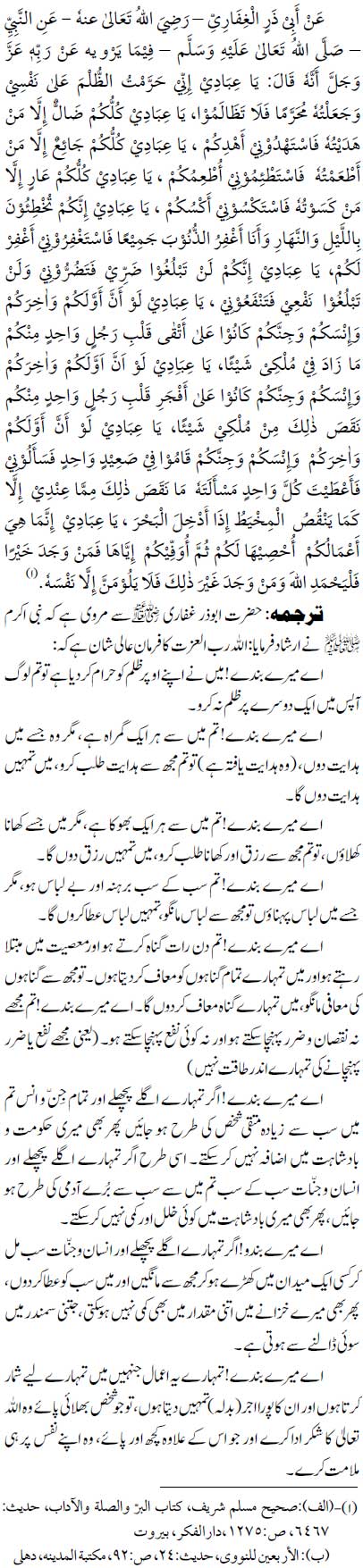
Hadith Qudsi: Allah Rahman, Raheem Aur Ata Karnay Wala
TAG: Allah
What Holy Quran Says About Associating Allah In Worship
And how should I fear those whom you associate in worship with Allah (though they can neither benefit nor harm), while you fear not that you have joined in worship with Allah things for which He has not sent down to you any authority. (So) which of the two parties has more right to be in security? If you but know.” [6:81]
They (Jews and Christians) took their rabbis and their monks to be their lords besides Allah (by obeying them in things which they made lawful or unlawful according to their own desires without being ordered by Allah), and (they also took as their Lord) Messiah, son of Maryam (Mary), while they (Jews and Christians) were commanded [in the Tauraat (Torah) and the Injeel (Gospel)) to worship none but One Ilaah (God – Allah) Laa ilaaha illa Huwa (none has the right to be worshipped but He). Praise and glory be to Him, (far above is He) from having the partners they associate (with Him).” [9:31]
And they worship besides Allah things that hurt them not, nor profit them, and they say: “These are our intercessors with Allah.” Say: “Do you inform Allah of what He knows not in the heavens and on the earth?” Glorified and Exalted be He above all that which they associate as partners with Him! [10:18]
Say (O Muhammad): “I am only a man like you. It has been inspired to me that your Ilah (God) is One Ilah (God i.e. Allah). So whoever hopes for the Meeting with his Lord, let him work righteousness and associate none as a partner in the worship of his Lord.” [18:110]
And (remember) when We showed Ibrahim (Abraham) the site of the (Sacred) House (the Ka’bah at Makkah) (saying): “Associate not anything (in worship) with Me, [La ilaha ill-Allah (none has the right to be worshipped but Allah Islamic Monotheism], and sanctify My House for those who circumambulate it, and those who stand up for prayer, and those who bow (submit themselves with humility and obedience to Allah), and make prostration (in prayer, etc.);” [22:26]
And let them not turn you (O Muhammad ) away from (preaching) the Ayat (revelations and verses) of Allah after they have been sent down to you, and invite (men) to (belief in) your Lord [i.e: in the Oneness (Tauhid) of Allah (1) Oneness of the Lordship of Allah; (2) Oneness of the worship of Allah; (3) Oneness of the Names and Qualities of Allah], and be not of the mushrikun (those who associate partners with Allah, e.g. polytheists, pagans, idolaters, those who disbelieve in the Oneness of Allah and deny the Prophethood of Messenger Muhammad). [28:87]
Allah is He Who created you, then provided food for you, then will cause you to die, then (again) He will give you life (on the Day of Resurrection). Is there any of your (socalled) partners (of Allah) that do anything of that? Glory be to Him! And Exalted be He above all that (evil) they associate (with Him). [30:40]
He is Allah than Whom there is La ilaha illa Huwa (none has the right to be worshipped but He) the King, the Holy, the One Free from all defects, the Giver of security, the Watcher over His creatures, the All-Mighty, the Compeller, the Supreme. Glory be to Allah! (High is He) above all that they associate as partners with Him. [59:23]
Hadith Qudsi: Allah Ka Fazal Aur Ihsan
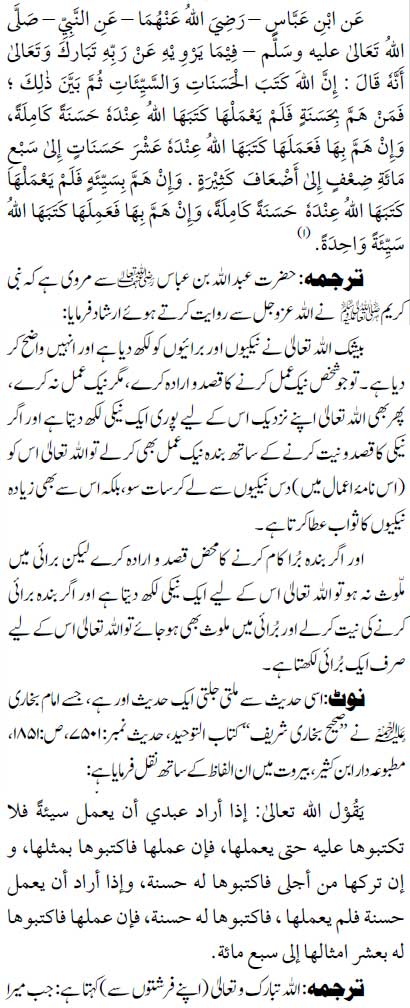
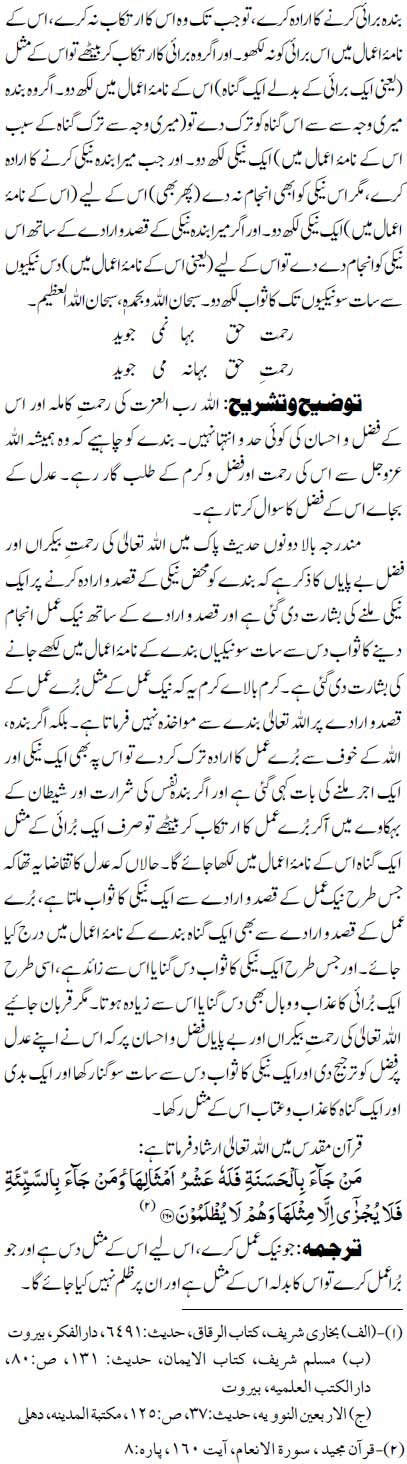
Hadith Qudsi: Allah Ka Fazal Aur Ihsan
Hadith Qudsi: Roza Allah Kay Liye Hai Aur Allah He Ajar Day Ga
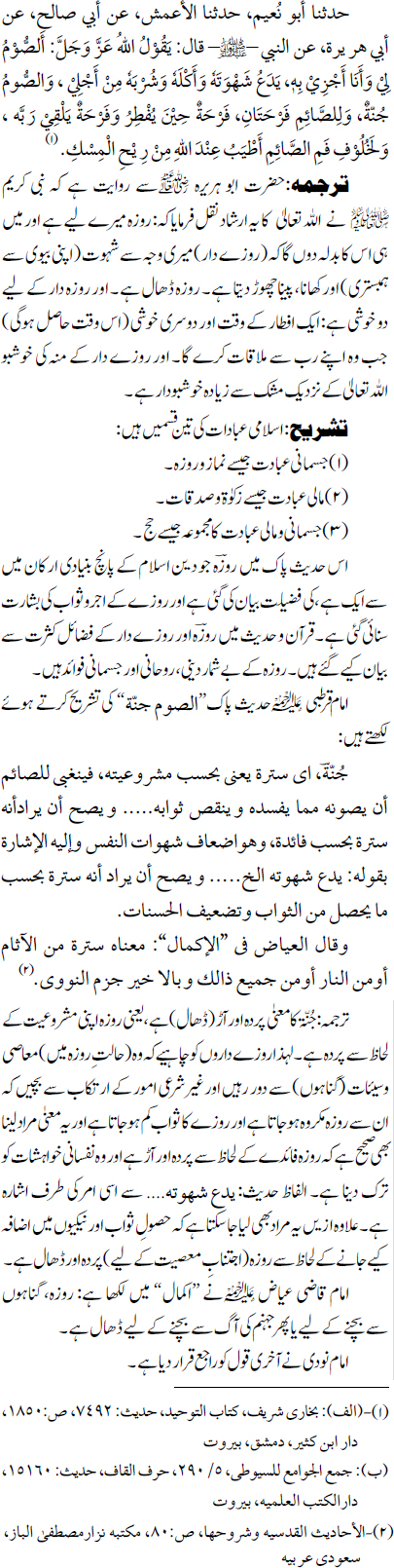
Hadith Qudsi: Roza Allah Kay Liye Hai Aur Allah He Ajar Day Ga
There Is No Obedience To Anybody While Disobeying Allah
A general rule of Islam implies that there is no obedience to any creature when it involves disobedience (or sinning) to Allah, the Exalted. Obedience to others other than Allah is only allowed in matters of one’s likes and dislikes. The Messenger of Allah (sallallahu alaihi wa-sallam) said: “He who complies with the command of a master, a leader or a ruler in disobedience and defiance of Allah is an unbeliever and a Mushrik (he who associates partners with Allah). There shall be no obedience to a creature of Allah when it would involve disobeying or displeasing Allah.” [Saheeh Muslim, Book Imarah, p.1469]
He (sallallahu alaihi wa-sallam) also said: “Obedience is only in what is good.” [Saheeh al-Bukharee (Eng. trans. 9/193/259) and Saheeh Muslim (Eng. trans. 3 / 1022/no.4535)
And: “Hearing and obeying is (binding) upon the Muslim in what he likes or dislikes, so long as he is not ordered to sin. If he is ordered with sin, then there is no hearing and no obeying.” [Agreed upon]
Similarly, obedience to parents is only obligatory in matters that are permitted by Allah, the Exalted, and as Allah says: But if they (both) strive with you to make you join in worship with Me others that of which you have no knowledge, then obey them not, but behave with them in the world kindly, and follow the path of him who turns to Me in repentance and in obedience. Then to Me will be your return, and I shall tell you what you used to do. (31:15)
Imam Ibn Katheer (may Allah have mercy upon him) writes in the Tafseer of the above verse: “means, if they try hard to make you follow them in their (false) religion, then do not accept that from them, but do not let that stop you from behaving towards them with respect.”
Allah also said in Soorah Al-Ankabut, “And We have enjoined on man to be good and dutiful to his parents, but if they strive to make you join with Me (in worship) anything (as a partner) of which you have no knowledge, then obey them not. Unto Me is your return, and I shall tell you what you used to do.” (29: 8)
An excellent example of the above (first) verse is found in the narration of Sa’d Ibn Malik, who said: “This verse (31:15) was revealed concerning me. I was a man who honored his mother, but when I became a Muslim, she said: ‘O Sa’d! What is this new thing I see you doing? Leave this religion of yours, or I will not eat or drink until I die, and people will say: ‘Shame on you, for what you have done to me and they will say that you have killed your mother.’ I said, ‘Do not do that, O mother, for I will not give up this religion of mine for anything.’ She stayed without eating for one day and one night, and she became exhausted; then she stayed for another day and night without eating, and she became utterly exhausted. When I saw that, I said: ‘O mother, by Allah, even if you had one hundred souls and they were to depart one by one, I would not give up this religion of mine for anything, so if you want to, eat, and if you want to, do not eat.’ So she ate.” [Mentioned by Ibn Al-Athir in Usd al-Ghabah 2: 216]
Shaikh al-Islam Ibn Taymiyyah said: “Abu Bakr said in his book, Zad-ul-Musafir, ‘Whosoever made his parents angry and brought tears to them is required to go back and make them laugh.’ This indicates that it is necessary to obey parents with regards to permissible things and whatever they command should be avoided, if all this brings their benefit and does not harm their child, including ending travel plans and staying with them if they wished that.’
Hadith Qudsi: Allah Ki Takzeeb Na Karo
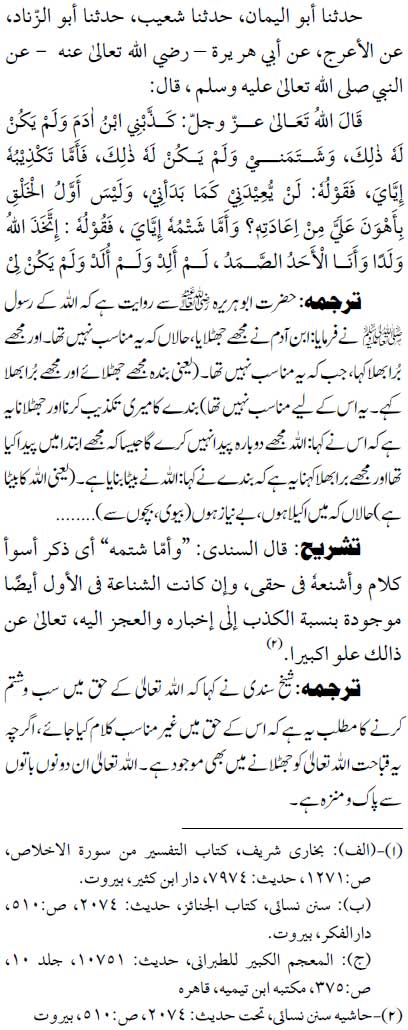
Hadith Qudsi: Allah Ki Takzeeb Na Karo
Allah And Evil
Good and evil are not alien to humankind. Humans are equipped with a sharp vision to separate the former from the latter. More often than not, he strikes the right choice between right and wrong. Even where he fails, he is found to have another good sense. This sense helps him appreciate the correct choice when someone else distinguishes
between good and evil. While he appears to be instinctively inclined to good in order to personify it, he seems to experience strong repulsion to evil – so much so that he wants to eliminate it altogether. His adherence to good makes him feel relieved, contented, and humble. And his submission to evil causes him to feel low, embarrassed, and arrogant. However, perpetual adherence to either virtue or vice determines the course of his life before too
long. Little does he deviate from this course once it is set by his conscious compliance with either of them – he is then destined to reach the destination defined by his own actions.
The Holy Quran says that the Lord has shown him both these ways. In addition to blessing him with eyes, tongue, and lips, he also blessed him with the knowledge of right and wrong (Quran 90:9-10). In more than one place, the Quran reinforces that man knows both ways and it is up to him to choose whatever he may wish; he can either become thankful by taking the correct course of life or be unthankful by treading the path of evil (Quran 76:3). The Lord indeed has inspired him the boundaries to respect and the vices to avoid that lie beyond them (Quran 91:7-8). The assertions of the Quran can hardly be disputed since they depict a phenomenon commonly observed. The
tradition of the majority of humankind seems to be pregnant with narratives of how they have cherished the good virtues and loathed the despicable ways of evil. The annals of history record the awe-inspiring anecdotes of the sacrifices made for upholding the virtue of justice, and eradicating the evil of oppression. From a simple shoemaker to a grand emperor each has made unforgettable contributions to the preservation of virtues and elimination of
evil. It is therefore highly improbable that we can put down the assertions of the Holy Book regarding the human knowledge of right and wrong.
Despite our instinctive impulses to comply with our knowledge of good and bad, the Holy Quran enjoins us to remind each other of the mutual teaching of Truth. It is true that we have the knowledge; we nonetheless have other frailties that obstruct perpetual adherence to good. The Holy Book recognizes that to have this knowledge does not mean that we have acquired a knack and that we are now preconditioned to do good (Quran 103:3). For if we were
conditioned, there would have been no reward for us in the Hereafter. To confuse knowledge with conditioning is to overlook the central problem in most issues facing humankind on the face of this earth. Unless hypnotized by falsehood, man will carry out good works by his own free desire. To galvanize human desire in the favor of good, one needs to be reminded constantly. It is a duty prescribed for us – to help others and be helped in order to lead a life that is virtuous.
Allah Har Aib Say Pak Hai
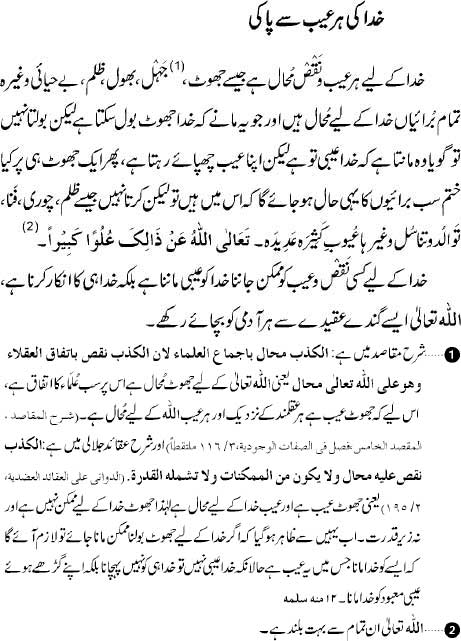
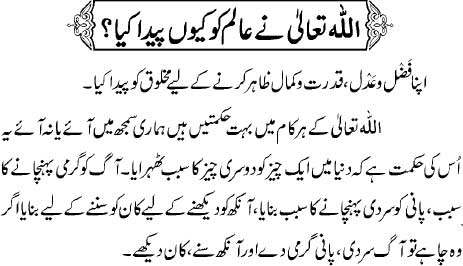
Allah Nay Alam Ko Kyon Peda Kiya
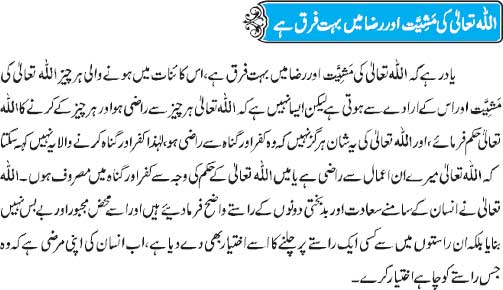
Allah Ki Mashiyyat Aur Raza Mein Farq Ha